


More news on this day
Spain’s national rail operator Renfe has reinstated access for electric scooters on most of its trains from 7 September 2026, introducing a detailed set of safety and eligibility rules that reshapes how passengers combine rail and micromobility travel.
Get the latest news straight to your inbox!
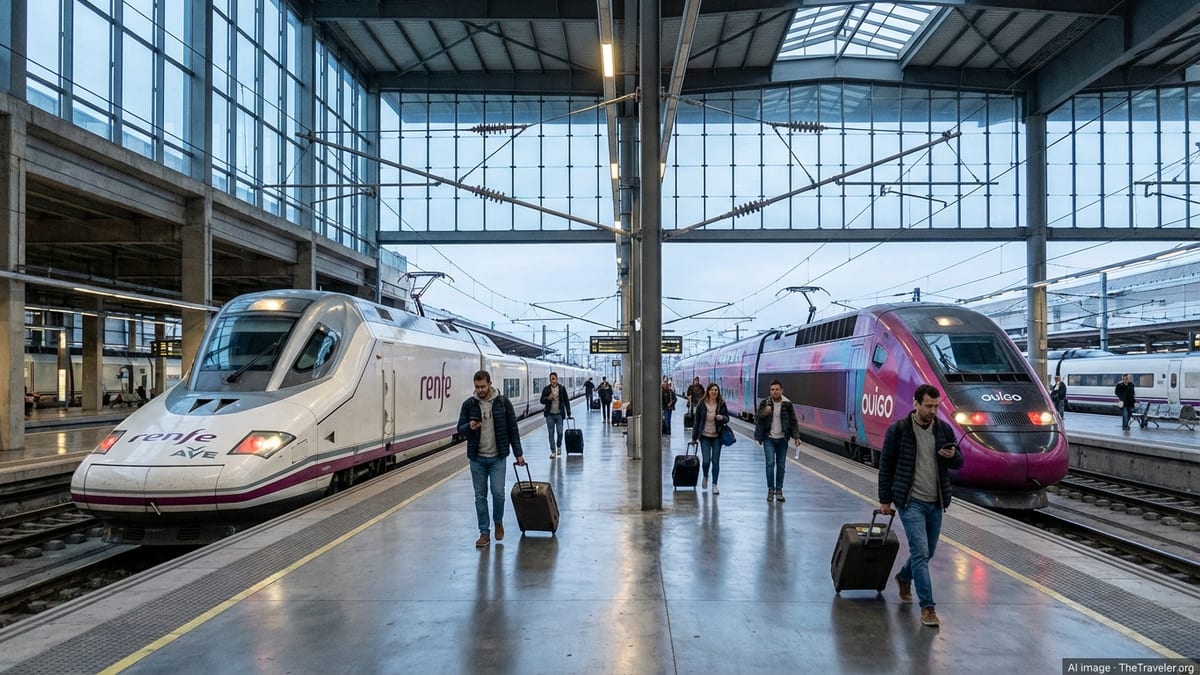
Electric Scooters Return to Renfe Services
Publicly available information shows that Renfe is once again allowing electric scooters on board its Cercanías, Media Distancia and Larga Distancia services from 7 September 2026, ending a network-wide ban introduced in 2023 amid concerns over battery fires. Reports indicate that the readmission does not initially apply to Rodalies services in Catalonia or to Cercanías Euskadi, where the previous restrictions remain in place.
The company frames the change as part of a broader shift toward integrated and sustainable mobility. According to published coverage, Renfe sees the combined use of train and electric scooter as a practical option for daily journeys, particularly in dense urban and metropolitan areas where passengers often need a flexible solution to cover the distance between stations and final destinations.
Local media note that the move aligns Renfe more closely with practice at several European rail operators that already admit e-scooters under specific safety conditions. Observers suggest that this harmonization may help standardize expectations for travelers who frequently move between European rail networks.
Strict Technical, Legal and Insurance Requirements
The restored access comes with tight eligibility criteria for vehicles and users. Renfe’s own published guidance indicates that only homologated scooters that comply with Spain’s Law 5/2025 may board. That law incorporates light personal vehicles into the national compulsory civil liability insurance system, adapting Spanish rules to the European Union’s Directive (EU) 2021/2118 on motor vehicle insurance.
To qualify for carriage, scooters must be registered with Spain’s traffic authority (Dirección General de Tráfico, DGT). Public information specifies that vehicles need to appear in the DGT register, carry a visible identification plate or small license-style tag, and hold a valid circulation certificate confirming that they meet current technical standards. A current compulsory liability insurance policy is also required, linking each scooter to an identifiable owner and policy.
These conditions exclude older or non-compliant devices that lack certification or insurance. Analysts of Spain’s micromobility rules note that the new regime effectively turns electric scooters into regulated light vehicles, reducing the number of unregistered devices circulating in cities and on public transport. In practice, travelers who wish to take a scooter on a Renfe service must ensure both their legal paperwork and technical conformity before boarding.
Onboard Rules Prioritize Battery and Passenger Safety
Renfe’s documentation on the new policy emphasizes how scooters must be handled once inside the train. During travel, vehicles must remain folded and switched off at all times, and they must be placed either in designated luggage racks or in other areas where they do not block aisles, doors, emergency exits or priority spaces for passengers with reduced mobility.
Charging scooter batteries on board is explicitly prohibited. This mirrors approaches adopted by various European urban rail and metro systems, where unattended charging has been linked to fire risk. By requiring scooters to stay powered off and forbidding charging, Renfe seeks to limit the possibility of thermal incidents related to lithium-ion batteries while still permitting micromobility devices on board.
Reports also indicate that operational staff retain discretion to deny access or request that a scooter be removed if it does not meet the stated conditions or if train occupancy makes its presence incompatible with safe travel. This discretionary element is presented as a way to keep safety paramount during peak periods or in crowded cars, without reverting to a blanket ban.
From 2023 Ban to a Regulated Return
The policy shift closes a chapter that began in early 2023, when Renfe and several other public transport operators in Spain halted carriage of electric scooters after a series of high-profile battery fires on buses and metro systems in other regions. At the time, regulators had not yet developed a specific framework for personal mobility vehicles, and operators cited difficulties in distinguishing between compliant and unsafe devices.
Since then, Spain has introduced a more comprehensive regulatory structure for scooters and similar vehicles. According to transport-focused coverage, this includes standardized technical requirements, DGT registration, unique identification plates and the extension of compulsory insurance to light personal vehicles. Renfe links its new policy to that framework, stating in publicly available material that the current context allows for stricter control and traceability of the scooters that travel on its trains.
Observers describe the 2026 decision as a shift from a precautionary prohibition to a managed-risk model, in which regulation and enforcement replace a simple ban. The approach reflects a wider European trend in e-scooter policy, where governments move from experimental pilots and emergency restrictions toward detailed long-term rules on equipment, speed, parking and interaction with other modes of transport.
Impact on Urban Mobility and Travelers
Travel and mobility analysts view Renfe’s move as significant for commuters who rely on scooters for “first and last mile” segments of their journeys. By allowing compliant vehicles back onto most national rail services, the operator effectively reconnects regional and long-distance routes with local micromobility networks in many Spanish cities.
Coverage of the change highlights potential benefits for students and workers living beyond walking distance of stations or in areas with limited bus connections. For these groups, combining train and scooter can reduce travel times and make car-free commuting more realistic, especially in large metropolitan regions such as Madrid, Valencia and Seville.
At the same time, experts caution that the new policy will require consistent enforcement and clear communication to passengers. Renfe has announced information campaigns and internal guidance to ensure that riders understand the new rules, from registration and insurance requirements to onboard behavior. The balance between encouraging sustainable travel and preserving safety standards is likely to be a focus of ongoing monitoring as the rules take effect on busy commuter corridors.
For international travelers, the change positions Spain’s main rail operator closer to European norms on micromobility carriage, making it easier for visitors accustomed to taking scooters on trains in other countries to navigate Spain with similar expectations. How quickly passengers adapt to the stricter conditions, and how often staff exercise their discretion to restrict access on crowded services, will shape the day-to-day experience of the renewed policy.
Renfe press information on e-scooter access
Renfe Q&A on electric scooters on trains