


The first time I stepped to the rim above Bryce Amphitheater, I stopped mid-stride. Below me, thousands of orange and pink rock spires rose out of the earth like a frozen city on some distant world. The air was thin and cool, the silence broken only by a raven’s call and the faint murmur of other visitors. I had seen photos of Bryce Canyon National Park before, but standing there in person, it felt less like a canyon in Utah and more like a landing site on another planet.
Get the latest updates straight to your inbox!
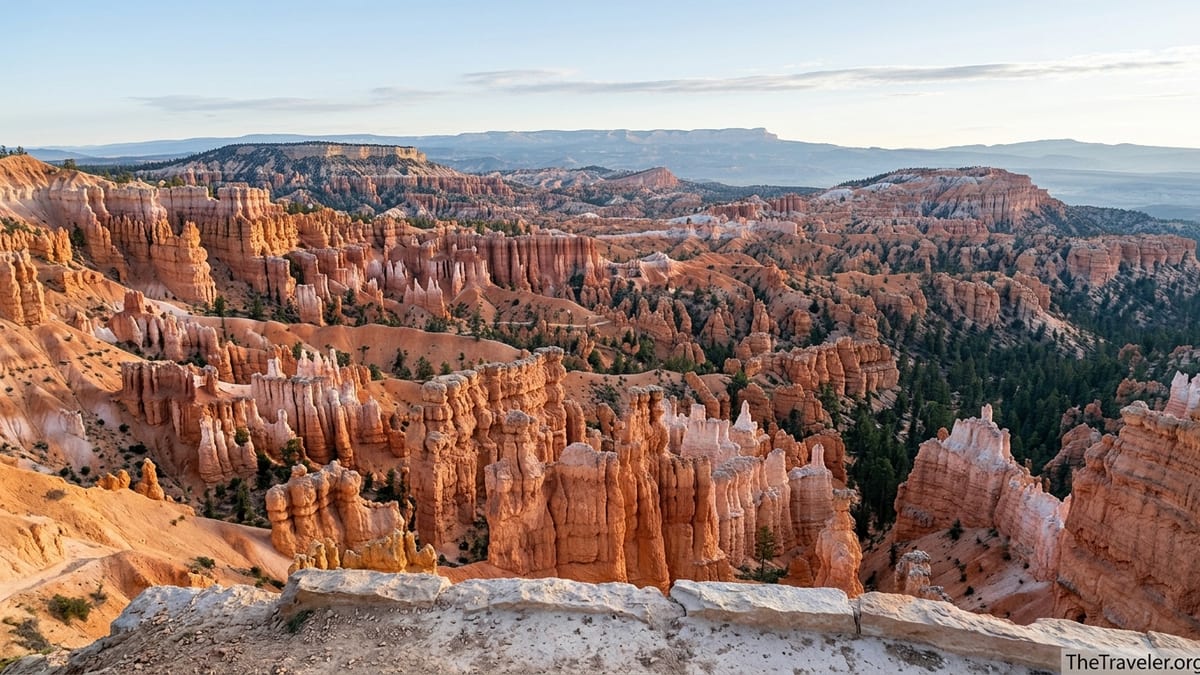
Meeting the Amphitheater for the First Time
Bryce Amphitheater is the star attraction of Bryce Canyon National Park, carved into the eastern edge of the Paunsaugunt Plateau in southern Utah. Most visitors encounter it within minutes of passing the entrance station. The park’s main road runs along the rim, and the first three miles hold the four classic viewpoints: Bryce Point, Inspiration Point, Sunset Point, and Sunrise Point, all overlooking the same sweeping basin from slightly different angles.
From any of these overlooks, the scene is astonishing. The Bryce Amphitheater is packed with hoodoos, the tall, thin rock pinnacles that give Bryce its lunar reputation. In the early light, they glow sherbet shades of orange, coral, and cream, with thin bands of white limestone tracing their layers. Down in the basin, faint dirt trails thread between them, occasionally disappearing behind rock fins and reappearing in places that seem impossible for a footpath.
On a recent late-spring visit, I parked near Sunset Point just after dawn and walked out to the rim. The air at roughly 8,000 feet felt cold enough that I could see my breath, even in May. To my left, the line of the Rim Trail disappeared toward Inspiration Point. To my right, the hoodoo city dropped away in dizzying depth. The sheer density of formations, the almost biological way they clustered and branched, made it hard to believe this was the product of snowmelt and rain patiently dissolving limestone over millions of years.
Unlike the sheer vertical drama of the Grand Canyon or the towering walls of Zion, Bryce hits you with intricate detail. From the rim, you find your eyes wandering through the amphitheater, tracing arches, free-standing columns, and whole amphitheaters within the amphitheater. It is this unfamiliar geometry, sculpted in color, that tricks your senses into believing you have stepped off Earth entirely.
Choosing Your Rim: Sunrise, Sunset, Inspiration, and Bryce Point
Most travelers will meet Bryce Amphitheater from one of the four main overlooks, each offering a slightly different perspective and mood. Thinking of them as different “orbits” around the same alien world can help you decide how to spend your limited time, especially if you are visiting on a day trip from Zion or from nearby towns like Tropic or Panguitch.
Sunrise Point, close to the lodge and general store, is often the first stop for early risers. From here you look diagonally across the amphitheater, with easy access to the Queens Garden Trail if you decide to descend. On busy summer mornings it can feel crowded, but it is also one of the gentlest ways to ease into Bryce, with a paved rim path that is friendly to strollers and many mobility levels.
Sunset Point, a short, mostly flat half-mile walk from Sunrise along the Rim Trail, gives you a front-row view into the heart of the hoodoos, including the famous formation known as Thor’s Hammer. On a clear evening in June or July, you might find families wrapped in fleece, couples sharing thermoses of coffee, and tripods lined up along the fence as the late sun carves sharp shadows between the spires. The parking lot here fills early from late spring into fall, which is why many visitors leave their car outside the park and ride the free seasonal shuttle into the Bryce Amphitheater area.
For that true “other planet” sensation, Bryce Point and Inspiration Point often deliver the strongest punch. Bryce Point, reached by a short spur road and a brief walk from the shuttle stop, gives you a wide, high view across almost the entire basin. At sunrise, the first horizontal rays ignite the tops of the hoodoos so they seem to glow from within while the lower slopes remain in blue shadow. Inspiration Point, a little closer to Sunset and Sunrise, has multiple levels of viewing platforms. From the highest one, you can look straight down into dense clusters of spires, the formations arranged in tight, parallel rows like some giant, eroded organ pipe.
Light, Seasons, and the Mood of Another World
Part of what makes Bryce Amphitheater feel alien is how dramatically it changes with light and season. In summer, especially on clear days, the midday sun can flatten the colors into bright orange and pale tan. The true magic happens in the edges of the day, when the low sun brings back depth, shadow, and subtle pinks and purples in the limestone.
On a July visit, for example, you might wake to a cool 45 degrees Fahrenheit at Bryce Point before watching the temperature climb into the high 70s or low 80s by midday. Many travelers drive in from Springdale near Zion, leaving around 4 a.m. to reach the rim in time for sunrise, then heading back by early afternoon to avoid both heat and crowds. In contrast, a November morning can start below freezing, with thin ice on windshield wipers and occasional patches of snow along the rim, while afternoons may hover in the 40s and 50s.
Winter adds another layer of unreality. The National Park Service keeps the main road to Bryce and Inspiration Points open in typical conditions, though temporary closures can occur after storms. When the hoodoos are dusted in snow, the white caps accentuate every ridge and ledge, and the amphitheater looks like a coral reef dipped in sugar. Even a light snowfall creates sharp contrast between the red rock and the white drifts settling in the creases. Trails into the amphitheater can be icy, and rangers recommend traction devices such as microspikes, but standing at the rim on a still January morning, the silence and the strange texture of the landscape feel more Martian than ever.
Spring and fall are the sweet spots for many visitors. In May, patches of snow still linger in the shadows while mule deer graze in the meadows near the campground. In late September and early October, the cottonwoods and aspen below the rim turn yellow, adding a ribbon of color at the base of the hoodoos. In every season, the changing angle of the sun brings out new facets of the amphitheater. Spending more than one night in or near the park gives you a chance to see it under several different moods rather than in a single midday snapshot.
Walking the Rim: The Easiest Way to Feel the Scale
If you only do one walk above the amphitheater, make it the Rim Trail section between Sunrise Point and Sunset Point. At roughly half a mile each way, paved and mostly flat, it provides some of the best views in the park with minimal effort. Even visitors acclimating to the park’s 8,000 to 9,000 feet of elevation usually find this stretch manageable if they take it slow. Benches placed at intervals let you stop and simply stare at the hoodoos, which is, frankly, the main activity at Bryce.
On a typical summer morning, you might see grandparents leaning on the fence to peer into the basin while kids press smartphone cameras through the railings for a clear shot. Couples with coffee from the Sunrise Point general store stroll the path, pausing every few yards because each viewpoint looks slightly different. As you walk, you see small groups descending the Queens Garden Trail, the line of hikers soon hidden among the rock walls, reminding you just how deep the amphitheater cuts into the plateau.
From Sunset Point, the Rim Trail continues toward Inspiration Point and then on toward Bryce Point, adding more elevation and distance but also more expansive views. If you are comfortable with a moderate hike at altitude, a one-way walk from Bryce Point down to Inspiration or Sunset and then hopping on the shuttle back to your starting point is a rewarding way to experience how the amphitheater’s shape changes as you move along the rim. Expect to spend a few hours if you stop often for photos and simply to let your brain catch up with what your eyes are seeing.
Accessibility along the rim is better here than in many parks carved by erosion. Sections of the trail between Sunrise and Sunset are suitable for wheelchairs and mobility devices, and several designated accessible viewpoints are marked on the park’s official map and seasonal visitor guide. If steep descents into the canyon are not an option for you, know that you can still have a profound, otherworldly experience simply by walking the rim and lingering at these overlooks.
Dropping Into the Hoodoo World
From above, the amphitheater feels vast and abstract. It is only when you step below the rim that Bryce shifts from alien to intimate. The park’s most popular descent routes begin at Sunrise and Sunset Points, threading into the stone maze on well-maintained dirt paths that switchback among the formations.
The Queens Garden Trail, starting at Sunrise Point, is often described as the easiest way down into the amphitheater, although “easy” is relative at this altitude. Over less than a mile, you lose several hundred feet of elevation, passing through natural rock windows and between balanced hoodoos that feel close enough to touch. Many visitors hike down for 20 or 30 minutes, find a quiet spot to sit among the spires, then turn around rather than committing to a longer loop.
From Sunset Point, the Navajo Loop drops steeply via tight switchbacks into the depths of Wall Street, where sheer orange walls rise on either side like skyscrapers along a narrow canyon street. Depending on current trail conditions, park alerts, and seasonal closures, some segments may be temporarily off limits, so it is important to check the latest information at the visitor center or the park’s official channels before setting out. When fully open, hikers often combine Queens Garden and Navajo Loop into a figure-eight style route that returns to the rim at Sunset Point, offering a compact but intense tour of the hoodoo world.
Inside the amphitheater, the sense of being in another world only intensifies. Light filters down between tall fins, creating stripes of shadow and glowing rock. Tree roots twist around boulders, and pockets of cool air linger in shaded corners long into the day. Looking back up, the rim appears as a jagged skyline while the hoodoos tower like stone pillars supporting nothing but empty blue sky.
Practical Ways to Maximize the Experience
That feeling of standing above another planet is easier to reach if you plan around Bryce’s logistics. The park’s elevation means thinner air and stronger sun than many travelers expect. Even in cool temperatures, the ultraviolet intensity is high, so bringing a wide-brimmed hat, sunscreen, and at least a liter of water per person for even short rim walks is wise. During summer, rangers frequently remind visitors that altitude and dry air can combine to cause headaches and fatigue, especially for those who drove in from lower elevations the same day.
From roughly April through mid-October, the free Bryce Canyon shuttle circulates between the main viewpoints in the Bryce Amphitheater area. Many visitors park at the shuttle station just outside the entrance, near the cluster of hotels and restaurants around Ruby’s Inn, then ride in to Sunrise, Sunset, Inspiration, or Bryce Point instead of hunting for parking inside the park. The shuttle typically runs every 10 to 15 minutes during peak hours, which makes it easy to plan one-way walks along the rim or to descend into the amphitheater and come back up at a different trailhead.
Entrance fees follow the standard national park structure and are subject to revisions, so checking current pricing before you go is smart. In recent seasons a private vehicle pass has been in the range many travelers expect for a major U.S. national park, valid for several consecutive days of entry. If you are visiting other parks like Zion, Arches, or Canyonlands on the same trip, the annual interagency pass often pays for itself after three or four park entrances. Purchasing that pass at Bryce’s entrance station can be a practical way to cover several parks on a single Southwest loop.
Lodging shapes the kind of experience you will have with the amphitheater. Staying inside the park at the historic Bryce Canyon Lodge or at the North and Sunset Campgrounds lets you walk to the rim for first light or for a late-night session under some of the darkest skies in the region. Rooms inside the park tend to book months ahead for peak summer and fall weekends. If you base yourself in nearby Bryce Canyon City, you are only a few minutes’ drive or shuttle ride from the viewpoints, while towns like Tropic and Panguitch offer more budget motels and vacation rentals within about a 20 to 40 minute drive.
Photography and Stargazing on the Edge of the Void
For photography, Bryce Amphitheater is both a gift and a challenge. The sheer density of hoodoos can overwhelm compositions, especially under harsh midmorning or afternoon light. Many of the classic images are made at sunrise from Bryce or Inspiration Points, when sidelight skims across the spires and low-lying haze softens the distant plateau. A moderate wide-angle lens in the 24 to 35 millimeter range on a full-frame camera often works well from the rim, wide enough to take in the basin yet tight enough to maintain structure in the hoodoos.
Tripods are welcome at the viewpoints as long as you are considerate of other visitors and do not block railings for long stretches. In busy months, arriving at least half an hour before sunrise or sunset helps you secure a comfortable spot. With modern smartphones now offering excellent dynamic range, you do not need professional gear to do justice to Bryce. What you do need is patience: watching how the color shifts over 20 or 30 minutes can reveal compositions you might miss in a quick snapshot.
At night, Bryce’s high elevation and relative isolation give it exceptionally dark skies. On clear moonless nights, the Milky Way arches over the amphitheater like a faint cloud. The park frequently hosts astronomy programs and night sky events in the warmer months, where rangers point out constellations and set up telescopes near the rim. Standing there after midnight, with only the silhouettes of hoodoos visible against the star field, the sense of standing on a different planet returns in force.
If you stay for night photography, be prepared for much colder conditions than daytime forecasts suggest. Temperatures can drop rapidly after sunset, even in June. A headlamp with a red-light mode helps you move around viewpoints without ruining other photographers’ night vision. Always respect safety barriers, as rim edges can be uneven or undercut, and avoid walking on unlit paths close to drops.
The Takeaway
Some landscapes need time to work on you. Bryce Amphitheater is not one of them. Within minutes of stepping to the rim at Sunrise, Sunset, Inspiration, or Bryce Point, the scene below feels too strange, too elaborate, to belong on familiar Earth. Yet the longer you stay, the more you notice the small details that ground it in reality: the crunch of gravel underfoot on the Rim Trail, the smell of pine, the chatter of jays working the picnic areas, the clusters of hikers emerging, dusty and smiling, from the Queens Garden or Navajo Loop.
Standing above Bryce Amphitheater can feel like visiting another planet, but the logistics are comfortably terrestrial: a paved road, a free shuttle in season, and viewpoints never far from a parking area or trailhead. Whether you are taking an easy stroll between Sunrise and Sunset Points, dropping into the hoodoo maze for a half-day hike, or wrapping yourself in a jacket to watch the stars from the rim, this corner of Utah invites you to step outside your ordinary frame of reference.
In the end, that is the real gift of Bryce. It reminds you that alien worlds do not always require a rocket or a starship. Sometimes they are waiting on the high plateau, a few hours’ drive from familiar highways, where wind, water, and time have carved a canyon that feels like nowhere else on Earth.
FAQ
Q1. What is the best time of day to see Bryce Amphitheater?
The amphitheater is especially dramatic at sunrise and sunset, when low-angle light creates deep shadows and rich color on the hoodoos.
Q2. How many days should I spend at Bryce Canyon National Park?
Many travelers visit in a single long day, but one or two nights in or near the park allow you to experience multiple sunrises, sunsets, and perhaps a star-filled night.
Q3. Do I need a car, or can I rely on the Bryce Canyon shuttle?
You can do an excellent visit using the free seasonal shuttle, which connects Sunrise, Sunset, Inspiration, and Bryce Points. A car is helpful for exploring beyond the amphitheater or in winter when the shuttle does not operate.
Q4. Are the rim viewpoints accessible for visitors with limited mobility?
Several viewpoints, including areas between Sunrise and Sunset Points, offer paved, relatively level paths and designated accessible parking. Check the latest park accessibility information before you go.
Q5. What should I wear for a visit to the amphitheater in summer?
Layered clothing, a sun hat, sunglasses, and sturdy walking shoes are important. Mornings can be cool at 8,000 feet, while midday brings intense sun and dry heat.
Q6. Is it safe to hike into the amphitheater if I am not used to high elevation?
Many visitors who are new to altitude hike the Queens Garden or Navajo trails successfully, but it is important to go slowly, drink water, and be prepared for the uphill climb back to the rim.
Q7. Can I see the highlights of Bryce Amphitheater on a day trip from Zion?
Yes. Many travelers drive from Springdale to Bryce very early, spend the day between the main viewpoints and one short hike, then return in the evening. It makes for a full but rewarding day.
Q8. Are there food and restrooms near the main viewpoints?
Restrooms are available at key stops in the Bryce Amphitheater area, and a general store near Sunrise Point offers snacks, drinks, and basic supplies during the main season.
Q9. Is Bryce Amphitheater worth visiting if some trails are closed?
Absolutely. Even if popular routes such as parts of the Navajo Loop are temporarily closed, the rim views from Bryce, Inspiration, Sunset, and Sunrise Points still deliver the park’s signature experience.
Q10. Do I need special equipment to visit in winter?
In winter, warm layers, waterproof footwear, and traction devices such as microspikes are strongly recommended. Road and trail conditions can change quickly after storms, so always check current park advisories.