


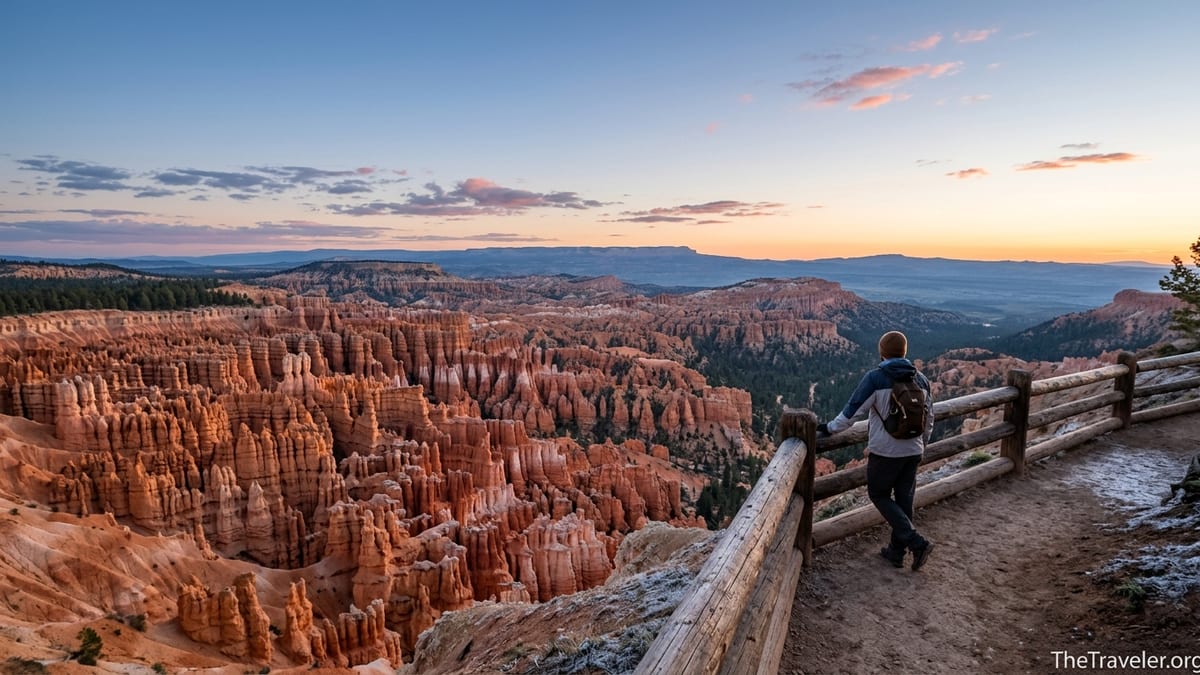
Standing on the rim of Bryce Amphitheater at first light, as the hoodoos shift from deep purple to blazing orange, is one of the most memorable sunrise experiences in the United States. Combine that show with a few carefully chosen trails beneath the rim and you have the essence of Bryce Canyon National Park. This guide focuses on how to explore the Bryce Amphitheater area specifically for the best sunrise views and hiking, with practical, up to date details so you can make the most of even a single day in the park.
Get the latest updates straight to your inbox!
Understanding Bryce Amphitheater and When to Go
Bryce Amphitheater is the heart of Bryce Canyon National Park. Despite the park’s name, this is not a true canyon carved by a river but a series of huge natural bowls eroded out of the Paunsaugunt Plateau. The amphitheater contains the park’s densest forest of hoodoos, the tall, thin spires of orange and pink rock that make Bryce so distinctive. Sunrise Point, Sunset Point, Inspiration Point and Bryce Point all ring this natural amphitheater and give you different angles on the same sweeping landscape.
The park sits at high elevation, roughly 8,000 to over 9,000 feet above sea level around the amphitheater, which has two big implications for sunrise hikers. First, even in late spring and early fall, mornings are often near or below freezing, so a pre-dawn start requires real insulation, not just a light sweatshirt. Second, the thin air can make even short climbs feel strenuous, particularly if you are arriving from sea level the day before. Building in time to acclimate and starting with shorter hikes on day one can make your sunrise outing far more enjoyable.
If your priority is sunrise photography, late fall and early spring can be attractive because the sun rises later and crowds are thinner. In July, you might be setting an alarm for around 5:00 a.m. to be on the rim in time; in October it can be closer to 7:00 a.m. Exact times change yearly, so check a sunrise table for Bryce Canyon City the week before you go and plan to arrive at your chosen viewpoint at least 30 minutes before listed sunrise.
Summer is the park’s busiest season, but sunrise is still the quietest part of the day. Even in July and August, you can usually find space along the rim railings if you arrive 20 to 30 minutes before sunrise, especially at Inspiration Point or along the Rim Trail between Sunrise and Sunset Points. Afternoon thunderstorms are common from roughly July through early September, another reason to prioritize morning hikes below the rim.
Current Logistics: Entrance, Shuttles and Parking
Bryce Canyon National Park charges a standard entrance fee per vehicle that is valid for seven days, and the park has shifted toward cashless payment, so plan to use a card at the entrance station or buy a pass online before arrival. As of 2026, many visitors purchase the America the Beautiful annual pass if they plan to visit several national parks in a year, since Bryce, Zion and the Grand Canyon are commonly combined in one trip. Non U.S. residents should be aware that Bryce is now among the parks that add a separate nonresident fee unless you hold the appropriate annual pass, which can significantly change the cost for international travelers.
From roughly early April to mid October the Bryce Amphitheater shuttle runs a loop that serves the four main viewpoints: Bryce Point, Inspiration Point, Sunset Point and Sunrise Point, along with stops at the visitor center and nearby lodgings outside the entrance. Buses typically arrive around every 15 minutes in the main season, and you can board at any stop by showing proof of park admission. Many visitors park once at the shuttle station north of the gate or at a hotel like Ruby’s Inn, then ride the shuttle to avoid hunting for parking near the rim during busy hours.
Parking near Sunrise and Sunset Points is limited and, during shuttle season, there are restrictions on oversized vehicles in the Bryce Amphitheater lots. If you are driving a large RV or towing a trailer, it is usually simpler to leave your rig at the shuttle station or campground and ride in. Sunrise photographers with a standard passenger car can often find a spot before dawn even on peak summer days, but by mid morning those same lots can be full and rangers may direct you to park elsewhere and ride the shuttle.
The visitor center, a short drive inside the entrance, opens earlier in summer than in winter and is where you can get the latest on trail conditions. Wall Street, the tight slot-like section of the Navajo Loop, often closes in winter and early spring due to ice and rockfall risk. Rangers can confirm whether the full Navajo Loop is open or whether you will need to use the Two Bridges side instead, and they often post board notices near the trailheads as conditions change.
Choosing the Best Sunrise Viewpoint in Bryce Amphitheater
All four amphitheater rim viewpoints are stunning at sunrise, but each offers a different mood and composition. Sunrise Point, as its name suggests, faces more directly toward the rising sun. When you stand here before dawn, you look east over a maze of hoodoos framed by Boat Mesa and the distant Aquarius Plateau. As the sun clears the horizon, light rakes across the formations and the shadows between the spires glow deep blue, a combination that many photographers love. It is also the trailhead for the Queens Garden Trail, so it works well if you plan to head straight into a hike once the light is higher.
Sunset Point, a short stroll or half mile paved walk from Sunrise Point along the Rim Trail, is equally attractive at daybreak. Instead of facing straight east, you look more southeast, which often means softer sidelight and a classic view of famous formations such as Thor’s Hammer. This can be ideal if full sun flare is not your goal and you prefer balanced light on the hoodoos. Sunset Point is also the starting point for the Navajo Loop, which makes it the natural choice if you are eyeing a post sunrise descent through Wall Street or the Two Bridges side of the loop.
Inspiration Point, slightly farther south, is a superb choice if you want a grand, layered view of the entire amphitheater rather than a closeup of individual hoodoos. From the upper viewpoint you look down on an almost abstract forest of spires, particularly impressive when the low sun skims across their tops. The access path climbs a bit and can be icy in colder months, so microspikes are wise here in late fall, winter and early spring. Because it requires a bit more effort than Sunrise or Sunset Point, Inspiration Point is usually less crowded at dawn.
Bryce Point sits at the southern end of the amphitheater rim loop and provides a more oblique, elevated view northward. It is famous for its “spectacular sunrise” reputation because you see the first rays slide across nearly the entire amphitheater at once. If you want a single, unforgettable first-morning impression and are content with a drive or shuttle ride rather than immediate trail access, Bryce Point is an excellent choice. Many visitors visit Bryce Point for their first sunrise, then focus on Sunrise or Sunset Point for later mornings when they plan to hike directly below the rim.
Classic Amphitheater Hikes After Sunrise
Once the sun is up and the cold eases, the best way to experience Bryce Amphitheater is to walk among the hoodoos. The park’s signature loop is the Queens / Navajo Combination Loop, a roughly 2.9 mile circuit that descends from the rim and returns via a different route, with about 625 feet of elevation change. It can be started at either Sunrise Point or Sunset Point and usually takes 2 to 3 hours for first time visitors who stop often for photos. Many experienced hikers still rank this as their favorite Bryce Canyon walk because it combines tight switchbacks, open valleys and distinctive formations in a compact package.
A common route is to start at Sunrise Point, descend the Queens Garden Trail, then connect to the Navajo Loop and climb out at Sunset Point. This direction spreads the elevation gain out over a longer distance, which many people find easier in the high altitude environment. The Queens Garden section weaves through arches and short tunnels and passes formations like the Queen Victoria hoodoo, which gives the trail its name. Near the bottom you join the Navajo corridor, then climb toward the rim via the Two Bridges side or, when open, the dramatic Wall Street slot with its stacked switchbacks between tall walls of orange limestone.
Another strategy, recommended by some local guides and hikers, is the Figure 8 combination, which adds the Peekaboo Loop to the Queens / Navajo circuit for a longer outing of roughly 6 to 7 miles and around 1,600 feet of total climbing. This route lets you explore a broader section of the amphitheater, including interior views that most day visitors never see. It is best tackled on cool days outside the peak of summer or by early risers who are comfortable with sustained uphill walking on the return.
For visitors who want a shorter, less demanding walk after sunrise, the Queens Garden out and back is a good compromise. Starting at Sunrise Point, you can descend partway into the amphitheater, experience walking under arches and between hoodoos, then turn around whenever the climb back feels appropriate for your group. Even a one hour partial descent and return offers a very different perspective from the rim views and works well for families with younger children or older relatives who may not be up for a full loop.
Rim Walks, One Way Routes and Using the Shuttle
You do not have to descend below the rim to enjoy Bryce Amphitheater after sunrise. The Rim Trail between Sunrise and Sunset Points is a paved, mostly level half mile stretch that many people regard as one of the best easy walks in the park. It is wheelchair and stroller friendly in good weather and keeps you close to the edge, with constant views into the hoodoo-filled basin. Continuing farther along the rim to Inspiration Point adds a bit more distance and some uphill but rewards you with a more elevated angle on the same amphitheater.
The shuttle system makes one way hikes easier to plan. For example, you might ride the shuttle to Bryce Point just before sunrise, watch the sun break over the plateau, then follow the Rim Trail down to Inspiration Point and onward to Sunset or Sunrise Point. This rolling, mostly downhill walk offers continuous amphitheater views without the steep, tight switchbacks you encounter on trails like Navajo. Once you finish at either Sunrise or Sunset Point, you can hop on the shuttle back to your car or lodging instead of retracing your steps along the rim.
Similarly, the Queens / Navajo Combination Loop works well as a semi point to point hike by using the shuttle. If you park or stay near the shuttle station, you can ride to Sunrise Point at first light, complete the loop that ends at Sunset Point, then either stroll the half mile rim walk back to your starting point or catch the next shuttle. This flexibility is especially useful on crowded summer days when parking at individual viewpoints fills quickly after mid morning.
Before relying heavily on the shuttle, check the current season’s operating dates and last departure times. Toward the shoulders of the season in April and October, the last buses in the evening may be significantly earlier than in midsummer. While this is rarely an issue for sunrise oriented trips, it matters if you decide to linger for sunset photography or a late dinner and are counting on the shuttle to return to a hotel outside the park.
Practical Gear, Safety and Photography Tips
Conditions in Bryce Amphitheater can swing rapidly, and sunrise hikers in particular need to be prepared. Even in June, temperatures before dawn on the rim often feel wintery, and wind along the exposed edge can make it colder. A typical layered setup might include a synthetic base layer, a light fleece, an insulated jacket and a windproof shell, along with a warm hat and gloves. Once the sun is higher and you begin hiking below the rim, you can strip layers and stash them in a daypack.
Footwear with good traction is essential. The steep grades on Queens Garden and Navajo may be well graded, but loose gravel on hardpacked dirt can be slick, particularly on the descent. In late fall, winter and early spring, many regular visitors carry microspikes that can be slipped over hiking shoes for icy sections near Sunrise, Sunset and Inspiration Points. Trekking poles are helpful for knees on both the descent and the climb back to the rim, and they are commonly seen on the Figure 8 and Peekaboo combinations.
Hydration is critical at Bryce’s elevation. Even relatively short hikes like the Queens / Navajo combination can feel demanding in dry, sunny weather. A reasonable baseline is to carry at least one liter of water per person for short morning hikes and more for anything extending into midday or early afternoon, plus snacks with some salt. There are water fill stations near the visitor center and in the main amphitheater area in the high season, but do not assume taps will be available at every trailhead, especially during shoulder seasons or early in the morning.
For photography, a wide angle lens in the 16 to 24 millimeter range on a full frame camera captures the breadth of the amphitheater from the rim, while a short telephoto around 70 to 100 millimeters helps isolate individual hoodoos and compress layers of spires as the sun rises. Many travelers are content with modern smartphones, which handle the high contrast of sunrise better than older models, especially if you tap to expose for the bright sky and adjust later. A small travel tripod can be useful for low light pre dawn shots, but if you are prioritizing mobility on steep trails immediately afterward, handheld shooting with image stabilization is usually a better compromise.
Sample One Day Sunrise and Hiking Itinerary
If you have a single full day devoted to Bryce Amphitheater, plan backward from your chosen sunrise spot. Suppose you visit in early September when sunrise is roughly 6:50 a.m. A realistic timetable from lodgings near Bryce Canyon City might have you leaving your hotel around 5:45 a.m., driving five to ten minutes to the park entrance, then continuing to Sunrise Point and parking by 6:15 a.m. This leaves a comfortable buffer for finding a spot along the railing and watching the sky shift colors well before the sun breaks the horizon.
From 6:15 to 7:15 a.m., you can enjoy sunrise at Sunrise Point and stroll the paved rim section toward Sunset Point as the light strengthens, stopping at several overlooks to photograph the changing shadows and colors. After a brief snack break on a bench near Sunset Point, you could begin the Queens / Navajo Combination Loop by descending Queens Garden at around 7:45 a.m., when temperatures are still cool but the trails are bright enough for safe footing. Allowing three hours for the loop with plenty of photo stops and water breaks would put you back at Sunset Point around 10:30 or 11:00 a.m.
Late morning, you might walk the half mile paved Rim Trail back to Sunrise Point if you left your car there, or simply take the next shuttle to Inspiration Point for an elevated midday look at the amphitheater. Lunch could be a picnic at one of the designated areas near the visitor center or a simple meal back at your lodging. In midsummer, this is a good time for a rest indoors to avoid the hottest part of the day.
In the late afternoon, if you still have energy, you could ride the shuttle or drive to Bryce Point for an early evening view and, if you are not too tired, walk a portion of the Rim Trail back toward Inspiration Point as the low sun lights the hoodoos from a different angle. Depending on your plans for the next day, you might either stay for sunset or head out early to rest before another pre dawn start at a different viewpoint.
The Takeaway
Exploring Bryce Amphitheater at sunrise combines the drama of shifting light with the quiet of early morning and the intimacy of walking among the hoodoos before the main crowds arrive. With four rim viewpoints that all offer distinct takes on the same natural amphitheater and a network of classic trails like Queens Garden and the Navajo Loop, you can tailor the experience to your fitness, interests and time constraints.
Success in Bryce comes down to a few simple choices: understand the high elevation and dress for cold dawns, choose your primary sunrise viewpoint and build your morning around it, use the shuttle and rim trails to your advantage, and prioritize at least one hike that drops below the rim. With realistic expectations and a bit of planning, even a short visit can include a glowing sunrise from the rim, a walk through sculpted orange corridors and the satisfaction of looking back at the amphitheater in full daylight, knowing you experienced it at its most magical hour.
FAQ
Q1. Which Bryce Amphitheater viewpoint is best for a first sunrise?
For a first visit, Bryce Point is a strong choice if you want a sweeping, high angle view of almost the entire amphitheater lit at once. If you plan to hike immediately afterward, Sunrise Point or Sunset Point are more convenient starting spots because they sit right at the trailheads for Queens Garden and Navajo.
Q2. How early should I arrive for sunrise at Bryce Amphitheater?
Plan to arrive at least 30 minutes before the listed sunrise time, and 45 minutes early in peak summer. That gives you a cushion for parking, walking to the overlook and watching the pre dawn color show, which is often as beautiful as the moment the sun clears the horizon.
Q3. Is Queens / Navajo Combination Loop suitable for beginners?
It is considered moderate rather than easy. The loop is under 3 miles long but involves around 600 feet of elevation gain at high altitude. Most reasonably fit first time hikers do fine if they pace themselves, carry water and take breaks on the climb back to the rim.
Q4. What if Wall Street on the Navajo Loop is closed?
When the Wall Street section closes for ice or rockfall risk, you can still hike the Queens / Navajo Combination by using the Two Bridges side of the Navajo Loop instead. The overall distance and difficulty are similar, and trail junction signs make the alternate route clear.
Q5. Do I need a car, or can I rely on the Bryce shuttle?
You can explore the entire Bryce Amphitheater area using the seasonal shuttle, boarding at stops near local hotels and at the shuttle station just outside the gate. A car offers more flexibility for sunrise at relatively remote viewpoints in the wider park, but for Sunrise, Sunset, Inspiration and Bryce Points the shuttle is usually sufficient.
Q6. Are sunrise temperatures really that cold in summer?
Yes, they often are. Even in June and July, pre dawn temperatures at 8,000 feet can feel close to freezing, especially with wind. Many summer visitors underestimate the chill and end up shivering at the rim, so pack layers, gloves and a warm hat even if daytime highs are forecast in the 70s or 80s.
Q7. Can families with kids enjoy hikes below the rim?
Families regularly hike part of Queens Garden or the full Queens / Navajo loop with school age children. The key is to start early, turn around if anyone is tired, and build in plenty of snack and photo stops. Strollers are not practical below the rim, so younger kids need to walk or ride in a child carrier.
Q8. What is the easiest way to see the amphitheater without strenuous hiking?
The paved Rim Trail between Sunrise and Sunset Points is the best low effort option. It is short, mostly level and offers continuous views into the amphitheater. You can combine it with quick visits by shuttle or car to Inspiration Point and Bryce Point for a nearly complete set of rim perspectives.
Q9. How do I avoid crowds at Bryce Amphitheater?
The simplest strategies are to visit outside the peak summer months, focus on sunrise and early morning hours, and walk a bit farther than the nearest overlook platforms. For example, starting the Queens / Navajo loop soon after sunrise often means you are below the rim on relatively quiet trails while the biggest crowds arrive later in the morning.
Q10. Is it safe to hike alone at sunrise in Bryce Amphitheater?
Many people hike solo on the main amphitheater trails at sunrise, and the routes around Sunrise, Sunset and Queens / Navajo are usually well populated soon after dawn. As always, tell someone your plan, carry adequate water, layers and a map or downloaded trail app, and be conservative about weather or trail conditions, especially in winter when ice can make descents more hazardous.