


More news on this day
A sudden Federal Aviation Administration ground stop rippled across the United States Northeast on Monday, halting takeoffs at several major airports and leaving thousands of travelers facing cascading delays that stretched well into the night.
Get the latest news straight to your inbox!
Telecom fiber cut behind widespread FAA outage
Publicly available information indicates the disruption began late Monday morning, September 21, when a construction crew in New Jersey accidentally severed a Verizon fiber-optic cable feeding a key Federal Aviation Administration facility that manages air traffic for the region. The damaged line interrupted data and communications used to sequence flights and monitor aircraft in crowded East Coast airspace.
According to multiple news outlets, the outage affected an FAA terminal radar approach control center linked to operations at Newark Liberty International Airport and other major hubs. That facility, located near Philadelphia, handles complex arrivals and departures for some of the country’s busiest routes, and any loss of capability quickly constrains how many aircraft can safely move through the system.
As the technical problems unfolded, the FAA issued ground stop orders that temporarily halted most departures at a cluster of key Northeast airports, including Newark Liberty, New York’s John F. Kennedy and LaGuardia, Philadelphia International, and New Jersey’s Teterboro. Aviation tracking services showed flight operations sharply reduced for several hours as controllers worked around the communications gap.
By late afternoon, telecom providers reported that the severed lines had been repaired and that core systems were coming back online. Even after the formal ground stops were lifted, however, airlines faced a significant backlog of aircraft and crews out of position, ensuring continued disruption well into the evening.
Major hubs see hours-long delays and cancellations
Flight status data compiled by major tracking platforms on Monday showed hundreds of cancellations and delays concentrated at Northeast airports. Newark Liberty, already one of the most delay-prone hubs in the country, was particularly affected, with more than 600 flights into and out of the airport reported canceled over the course of the day as the outage coincided with peak afternoon operations.
New York’s two other primary commercial airports, JFK and LaGuardia, also experienced several hours during which departures were largely frozen under the ground stop. Published coverage indicates that flights already in the air were allowed to continue to their destinations where space permitted, but new departures were held at gates or on tarmacs until controllers could reliably manage additional traffic.
To the south, Philadelphia International Airport reported some of the longest knock-on delays. Local reports described average departure holds exceeding three hours at the height of the disruption. Smaller business and general aviation fields in the region, such as Teterboro in northern New Jersey, also saw operations curtailed as the FAA prioritized restoring service at the largest commercial hubs first.
Even airports not directly included in the initial ground stop, including Boston Logan and Washington’s Reagan National, experienced secondary delays as aircraft scheduled to arrive from the affected hubs failed to depart on time. Schedules across the broader domestic network remained out of sync into the late-night and early-morning hours as airlines attempted to reposition planes and crews.
Travelers face missed connections and overnight disruptions
The timing and geography of the outage created particular complications for passengers connecting through the Northeast. Many long-haul and international arrivals into New York, Newark, and Philadelphia land in waves around midday and early afternoon, just as the ground stops were in effect. With onward domestic departures frozen or heavily delayed, travelers struggled to secure rebookings and overnight lodging.
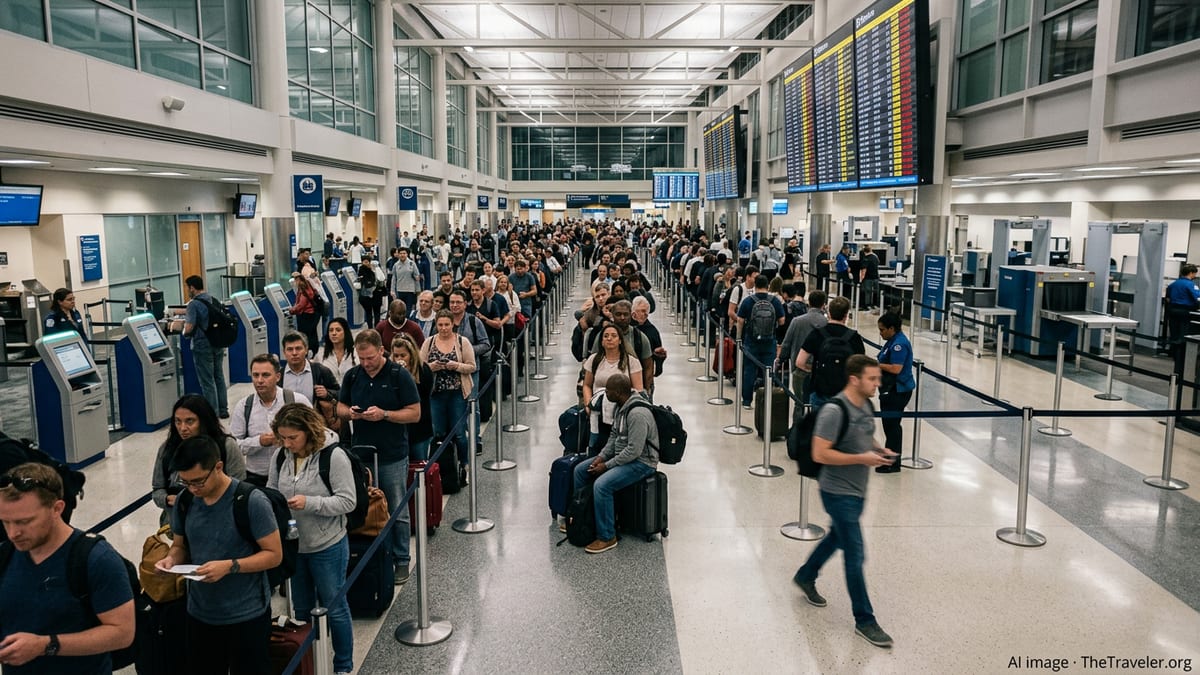
Reports from airport terminals described long lines at customer service desks as travelers sought new itineraries and meal vouchers. With aircraft movements restricted, some passengers waited hours on board parked planes for clearance to depart or return to gates, only to see their flights eventually canceled when crews reached duty-time limits.
International traffic added another layer of complexity. The outage coincided with heavy transatlantic and long-haul traffic ahead of high-profile events in New York City, including meetings linked to the United Nations General Assembly. Disruptions at JFK and Newark forced some inbound flights to adjust arrival times or reroute, compounding the pressure on airport staffing, ground transportation, and nearby hotels.
Airlines urged affected customers to use mobile apps and websites to rebook rather than waiting in line, highlighting limited seat availability on later services as crews and aircraft remained scattered. For many travelers, particularly those on multi-leg itineraries, the practical impact extended well beyond the Northeast, affecting trips across the United States and to overseas destinations.
Why the outage hit the Northeast so hard
The incident underlined how dependent modern air travel is on a handful of high-capacity control centers and data links. The FAA facility at the heart of Monday’s outage manages approach and departure traffic in an already congested corridor that includes New York City, Philadelphia, and surrounding airfields. When its capacity is reduced, the system rapidly reaches the limits of what can be handled safely.
Federal aviation documents published in recent months have highlighted chronic strain in this airspace, citing a mix of air traffic controller staffing shortfalls, complex overlapping flight paths, and persistent congestion. To keep operations manageable, regulators have already imposed schedule limits and temporary waivers on slot usage at airports such as JFK, LaGuardia, and Newark through at least 2027, acknowledging that the region operates near its maximum sustainable volume even on normal days.
Against that backdrop, the loss of a key fiber-optic link quickly translated into stricter spacing between aircraft and reduced acceptance rates for arrivals and departures. While backup systems and contingency plans allowed some traffic to continue, the slowdown was severe enough that issuing ground stops became the only practical way to avoid overloading controllers and safeguarding aircraft already in the air.
Aviation analysts note that similar technical incidents rarely cause such widespread disruption in less congested parts of the country, where there is more flexibility to reroute and absorb delays. The events in the Northeast demonstrate how relatively routine construction activity, if it affects critical infrastructure, can still trigger large-scale ripple effects in regions operating on thin margins.
What travelers should expect in the next 24 hours
By early Tuesday, September 22, operations at the major Northeast airports were moving again, but timetables had not fully recovered. Airlines warned that residual delays and scattered cancellations were likely to continue through at least the morning rush as aircraft and crews returned to normal rotations.
Travelers scheduled to fly through Newark, JFK, LaGuardia, Philadelphia, or nearby airports over the next day have been advised in public statements and travel alerts to monitor their flight status closely and to arrive early at the airport, even if conditions appear normal on departure boards. Same-day connections through the region remain vulnerable to further disruption if thunderstorms, staffing constraints, or minor technical issues intersect with the already strained schedules.
Published guidance from airline and airport operators emphasizes the importance of digital tools in managing irregular operations. Passengers are being encouraged to enable notifications in carrier apps, confirm that their contact details are current, and consider proactive rebooking if they have tight layovers or essential appointments at their destinations.
While the severed fiber line has been repaired, transportation analysts suggest that Monday’s ground stop will feed into broader discussions about redundancy in critical communications infrastructure around major hubs. For travelers, the event is a reminder that in a densely trafficked region like the U.S. Northeast, even a localized technical failure can have outsized consequences for air journeys across the country and beyond.