


I went to Bryce Canyon’s Mossy Cave Trail expecting a quick leg stretch between longer hikes, the kind of easy detour you squeeze in on a road trip along Utah’s Scenic Highway 12. What I found instead was a scene that felt oddly out of place in the high desert: a flowing creek, a man made waterfall, and a shallow cave dripping with moss and icicles depending on the season, all framed by Bryce’s trademark hoodoos. For a trail that measures only about 0.8 miles round trip, Mossy Cave delivers far more than its mileage suggests.
Get the latest updates straight to your inbox!
First Impressions of an “Easy” Bryce Canyon Hike
The Mossy Cave Trail sits at the northern edge of Bryce Canyon National Park, just off Highway 12, about 4 miles east of the junction with Highway 63. Unlike most visitors who roll through the park entrance station, you pull into a small parking lot right off the highway and, somewhat confusingly, you are already inside a fee area of the park. There is no booth here, but you are expected to have a valid park pass displayed in your car. It feels informal at first glance, but it is every bit as protected as the more famous viewpoints inside the main amphitheater.
On paper, the hike sounds almost too easy. The National Park Service lists Mossy Cave as an easy, 0.8 mile round trip trail with about 150 feet of elevation gain, usually taking 30 to 60 minutes for most visitors. The path is well maintained, the surface is firm native sediment, and the width is generous by park standards. Most brochures categorize it as a short front country stroll, and when you first see families piling out of minivans in flip flops, it is tempting to mentally file it under “must be forgettable.”
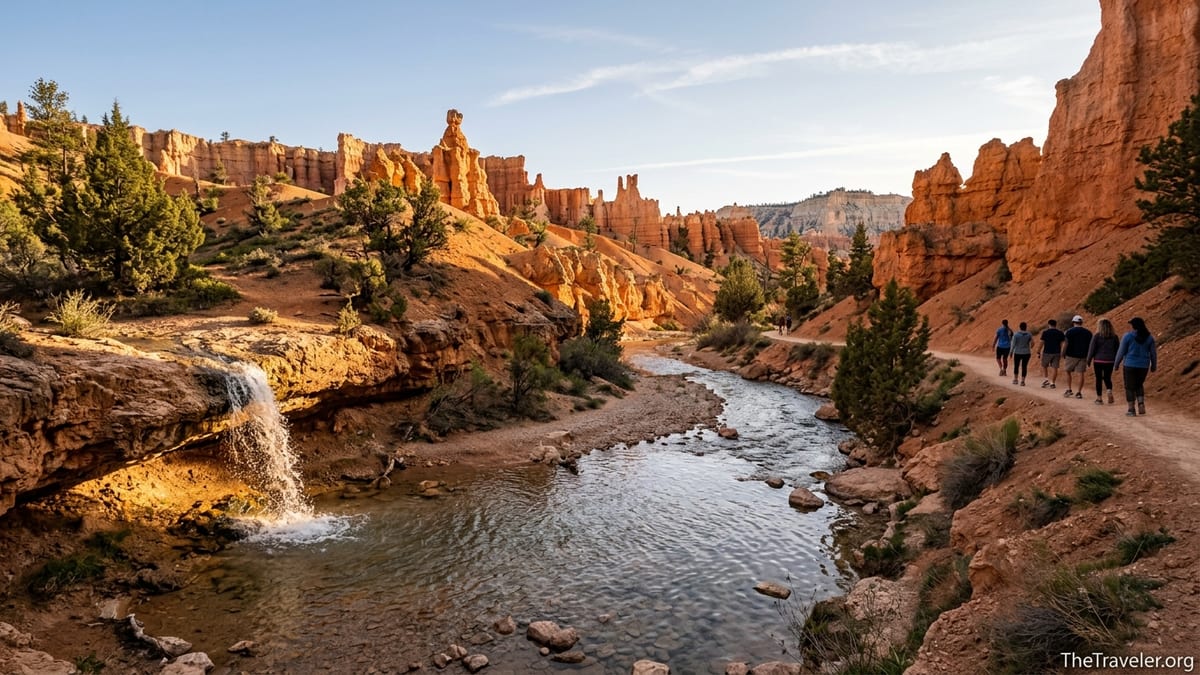
Yet from the very first steps, Mossy Cave feels different from the classic Bryce experience. Instead of walking along the rim of a vast amphitheater, you start in a narrow desert wash with a small stream running through it. Hoodoos rise on the horizon, but the immediate focus is the sound of water, a detail that is almost startling in this high, dry landscape. I realized within a few minutes that this would not be the typical hoodoo viewpoint stop I had imagined.
If you are planning from nearby base towns like Bryce Canyon City or Tropic, budget at least an hour, not counting driving time. In peak summer, the 15 standard spaces and 2 oversized spots in the Mossy Cave lot fill quickly between about 10 am and 6 pm, and parking along Highway 12 is not allowed. An early morning arrival around 8 am or an early evening visit can mean a calmer experience and space to simply listen to the water.
Following a Desert Creek That Should Not Be There
From the trailhead, the path climbs gently beside a lively stream, often called Tropic Ditch or Tropic Ditch Creek. This water is the first surprise. Most Bryce visitors spend the day walking above dry amphitheaters and dusty switchbacks, so hearing a real creek, clear and cool, within the park boundary feels like stumbling into another ecosystem. In midsummer, you will probably see children wading near the bridge crossings, shoes in hand, laughing as the cold water numbs their toes.
What makes this even more unexpected is that Tropic Ditch is not a natural mountain stream at all. It is part of an irrigation canal completed in the late 19th century to bring water from the East Fork of the Sevier River to farms near the town of Tropic. Local settlers hand dug miles of canal through unforgiving terrain, a project that today would be considered a major civil engineering feat, simply so their community could survive. That canal threads through this red rock canyon, and here, along Mossy Cave Trail, it takes the form of a perennial creek.
Walking alongside this water, you feel the way human determination has reshaped a corner of the park. Without the canal, this would be another dry wash. With it, cottonwoods and willows line the banks, and the soundscape changes from wind and ravens to the constant rush of flow through rock. It is one of the rare moments in a national park where a human built feature feels as integral to the experience as the geology itself.
In practical terms, the stream also influences how people use the trail. The park service allows visitors to enter the water, but rangers ask that you step in and out only at bridge crossings to avoid trampling fragile banks and creating new social paths. On a hot July afternoon, you will see families following this guidance, clustering around the bridges, where adults dip hats or neck gaiters into the water while kids build miniature dams from pebbles. The creek becomes both a cooling station and an impromptu classroom about the value of water in the desert.
The Unexpected Waterfall: Tropic Ditch Falls
About a quarter mile from the trailhead, the path splits near a wooden sign. A short spur heads to the right, climbing a few dusty switchbacks to a natural overlook. From above, you can look down onto a compact waterfall, Tropic Ditch Falls, where the canal plunges over a ledge in a curtain of white water into a shallow pool. It is picturesque in a way I had not associated with Bryce Canyon, more reminiscent of a small cascade you might find in a mountain state park than inside a high desert national park.
Up close, the falls are even more striking. The water shoots over a sculpted rock lip, flanked by orange cliffs and scattered juniper. The spray cools the air by a few degrees, enough that even in late afternoon sun, you can stand here comfortably for far longer than you might at the exposed rim viewpoints. In early summer, when snowmelt is still feeding the canal upstream, the volume of water can be surprisingly robust for such an arid region, turning the falls into a focal point for photographers and families alike.
It is important to remember that this waterfall is entirely man made in origin. The drop exists because the canal builders followed the contour of the land, and in this spot, the terrain required water to flow over a natural ledge. Over roughly a century of continuous flow, the water has deepened and shaped the channel, carving a small gorge and sculpting the pool below. The result looks, to the casual visitor, like a naturally occurring desert waterfall, but it is a vivid example of how human projects can, over time, blend almost seamlessly into a wild landscape.
Photographically, Tropic Ditch Falls rewards a bit of patience. In mid morning, when the sun crests the rim, you often get a soft, angled light that highlights the texture in the orange cliffs without blowing out the white water. Visitors with a basic mirrorless camera and a small travel tripod can experiment with slower shutter speeds to blur the water slightly, while smartphone photographers will find that simply tapping to expose on the waterfall and slightly lowering brightness can keep the sky from washing out. Either way, early or late in the day is preferable to midday’s harsh overhead light.
Mossy Cave: A Shallow Grotto With Two Personalities
From the junction near the waterfall, the main trail continues gently uphill, crossing the stream on a wooden bridge before reaching a second fork. A short path leads left to the base of Mossy Cave, a shallow alcove tucked into the sandstone. It is not a deep cavern and has none of the underground chambers you may associate with famous limestone caves. Instead, it is a shaded grotto where groundwater seeps through the rock, creating a cool, damp microclimate that supports a layer of moss and seasonal icicles.
In summer, the cave walls drip with moisture. Moss clings to the shaded rock, glowing almost neon green against the orange backdrop, and small rivulets of water trace faint paths down the surface. On a hot afternoon, stepping into this pocket of shade feels like entering natural air conditioning. The temperature inside can feel several degrees cooler than the exposed trail, and the faint scent of wet stone is a rare sensory treat in such a dry environment.
In winter, the cave transforms again. Seeping water freezes into thick icicles and shimmering curtains of ice that hang from the alcove ceiling and line the back wall. Photographs taken in January often show the cave filled with towering ice pillars, some as tall as an adult, glowing blue-white in the low sun. Access can be more challenging in snow and ice, and traction devices are a smart addition to your packing list if you plan a cold season visit, but the payoff is seeing Bryce’s red rock paired with a frozen grotto that looks almost Arctic in texture.
What surprised me most about Mossy Cave was its intimate scale. After standing at Bryce Point or Inspiration Point earlier in the day, looking out over miles of hoodoos and distant ridgelines, walking into this small, shady recess felt personal and human sized. You share the space with a handful of other visitors, hear drops of water landing on sand, and notice details like tiny ferns clinging to moist cracks. It is not grand in the way the Bryce amphitheater is grand, but it underscores how varied this seemingly uniform plateau can be.
Practical Planning: Seasons, Crowds and Safety
Because Mossy Cave sits at one of the lower elevations in Bryce Canyon National Park, the trail is typically accessible year round, weather permitting. Spring brings cooler temperatures, some snowmelt running through Tropic Ditch, and smaller crowds. Summer is the busiest season, with midday hours particularly congested as day trippers from Zion or the wider Highway 12 corridor add the hike to packed itineraries. Autumn offers crisp air and often thinner crowds, while winter delivers the dramatic ice formations that make the cave feel most magical.
If you are visiting in July or August, think of Mossy Cave as a morning or evening activity. Arriving before about 9 am gives you a better chance at a parking space in the 15 spot lot and a quieter experience near the waterfall and cave. Late evening, shortly before sunset, can be equally rewarding, with soft light on the hoodoos above and temperatures dropping just enough that the uphill section feels less strenuous. Midday visits may involve circling for parking or returning later, as roadside parking is prohibited both for safety and to protect vegetation along Highway 12.
Gear wise, this is not a technical outing, but it is still a real hike. The trail includes a typical grade around 5 percent, with short sections that reach steeper grades, so sturdy walking shoes or light hiking shoes are a better choice than flip flops, especially if you plan to explore both the waterfall overlook and the cave spur. Bring water even though the distance is short; the sun at roughly 8,000 feet of elevation can be deceptively intense. In winter, lightweight traction devices that slip over boots and a pair of trekking poles can dramatically increase comfort on packed snow and icy patches near the cave.
Most importantly, be mindful of how you move around the water. The park service specifically requests that visitors enter and exit the stream at designated bridge crossings only. This simple habit helps concentrate foot traffic in durable spots and prevents the canyon from becoming a maze of informal paths that erode quickly. It also reduces the chance of twisted ankles on unstable banks, something local rangers see every busy season as visitors underestimate the risks of off trail scrambling on loose slopes.
Seeing Bryce Canyon Differently in Under an Hour
One reason Mossy Cave caught me off guard is that Bryce Canyon is usually sold through a very specific visual story: massive amphitheaters, rows of hoodoos, and sweeping sunrise views from the main rim. When you arrive at Mossy Cave after a day of viewpoints like Sunset Point and Bryce Point, the scale suddenly shifts. You are not looking out across miles of landscape but following a narrow canyon, watching water cutting through soft sediment and listening to swallows darting under the cliffs.
This change of perspective can be especially valuable if you are traveling with children or anyone who has already reached their limit on scenic overlooks. Kids who grew restless staring into the amphitheater often come alive when they can touch cold water, toss pebbles, and feel a sense of progress walking toward a defined destination like a waterfall or a cave. For multi generational groups, Mossy Cave offers a manageable experience where those with limited mobility can still enjoy the first section along the creek while more energetic family members explore the short, steeper spurs.
For photographers, the trail presents a chance to capture Bryce’s colors in a more intimate context. Instead of wide panoramas, you find yourself drawn to details: sunlight filtering through cottonwood leaves and reflecting in the creek, orange walls mirrored in a still pool above the falls, or tiny icicles in the cave catching the last light of day. A standard travel zoom lens in the 24 to 70 millimeter range or the default lens on a smartphone is usually enough here, since the subjects are close and the canyon naturally frames your shots.
Time wise, Mossy Cave is also a useful addition to a day where your schedule is already filled. Because the hike typically takes under an hour for most visitors, plus maybe another 20 to 30 minutes if you linger for photos or play by the water, it easily slots in before a late lunch in Tropic or after a sunrise session along the main rim. It can also be a smart stop when you are driving east on Highway 12 toward destinations like Escalante or Capitol Reef, giving you one last taste of Bryce’s hoodoos paired with the surprise of water in the desert.
The Takeaway
Going into Mossy Cave, I expected a simple, pleasant walk, nothing more. The trail turned out to be one of the most memorable parts of my time at Bryce Canyon National Park precisely because it defied those expectations. In less than a mile, it compresses a surprising variety of experiences: a historic irrigation canal that looks and sounds like a natural creek, a compact waterfall set against glowing hoodoos, and a shaded grotto that can feel like a mossy refuge in summer or an ice palace in winter.
For travelers planning a first trip to Bryce, it is worth building Mossy Cave into your itinerary, not as a throwaway stop, but as a deliberate change of pace. Visit early or late to avoid crowds, wear shoes that can handle a bit of uneven terrain, and give yourself permission to slow down beside the water instead of racing from overlook to overlook. You may step out of your car assuming this will be a quick box to check. You are likely to leave with wet feet, a camera full of unexpected images, and a deeper appreciation for how much variety can be tucked into a short desert trail.
FAQ
Q1. How long is the Mossy Cave Trail and how difficult is it?
The Mossy Cave Trail is about 0.8 miles round trip with roughly 150 feet of elevation gain. It is officially rated as an easy hike, though there are short, steeper sections that can feel moderate for those not used to walking uphill at altitude.
Q2. Do I have to pay the Bryce Canyon National Park entrance fee to hike Mossy Cave?
Yes. Although the trailhead sits outside the main park entrance station along Highway 12, Mossy Cave is still within the national park fee area. You should have a valid park pass or proof of admission displayed in your vehicle.
Q3. Is there parking at the Mossy Cave trailhead?
Yes, there is a small parking lot directly off Highway 12 with around 15 regular spaces and a couple of oversized spots. Parking is free, but the lot often fills between late morning and late afternoon in peak season, and parking along the highway is not allowed.
Q4. Can children and less experienced hikers manage this trail?
Most families find Mossy Cave very manageable. The distance is short, the path is well maintained, and there are interesting features like the creek, waterfall and cave to keep children engaged. Young kids and less experienced hikers may need brief breaks on the uphill sections, but many complete the trail comfortably.
Q5. When is the best time of day and year to hike Mossy Cave?
Mornings and evenings are ideal to avoid crowds and enjoy softer light. Spring and autumn bring cooler temperatures and often smaller crowds. Summer offers strong water flow and greenery, while winter can transform the cave with icicles and snow, provided you are prepared for icy footing.
Q6. Can I go into the water along the trail?
Visitors are allowed to wade in the stream, but the park service asks that you enter and exit the water only at bridge crossings. This helps protect the banks from erosion and keeps the canyon from developing a web of unofficial paths.
Q7. What should I wear and bring for this hike?
Sturdy walking shoes or light hiking shoes, sun protection, and water are recommended, even though it is a short trail. In winter, traction devices and warm layers are helpful. If you plan to wade, consider quick drying shoes or sandals that strap securely to your feet.
Q8. Is Mossy Cave accessible in winter?
The trail is generally open year round, but conditions vary with snow and ice. In winter, packed snow and icy patches are common, particularly near the cave, so traction devices and caution are important. Check recent conditions with the park before heading out in colder months.
Q9. How does Mossy Cave compare to the main Bryce Canyon viewpoints?
Mossy Cave offers a more intimate experience than the huge amphitheater overlooks. Instead of standing on a rim, you walk along a creek in a small canyon, visit a man made waterfall, and step into a shaded grotto. It complements, rather than replaces, the big rim views.
Q10. Can I combine Mossy Cave with other activities in one day?
Yes. Because the hike usually takes under an hour, Mossy Cave fits easily into a day that includes classic stops like Sunrise Point, Sunset Point, or the Navajo Loop. Many travelers pair it with a morning of rim viewpoints or use it as a refreshing stop when driving along Highway 12 toward other southern Utah destinations.