


Mossy Cave Trail is one of Bryce Canyon National Park’s easiest hikes, but it packs in an impressive amount of scenery: a flowing stream, a small but photogenic waterfall, orange hoodoos rising above the canyon, and a shady grotto that turns mossy in summer and icy in winter. Because it starts from a roadside trailhead off Scenic Byway 12 rather than the main park road, many travelers are unsure how to find it, when to go, and what to expect. This guide walks you through everything you need to know to hike Mossy Cave Trail and make the most of this compact but memorable corner of Bryce.
Get the latest updates straight to your inbox!
Where Mossy Cave Trail Is and Why It Is Unique
Mossy Cave Trail sits at the northern end of Bryce Canyon National Park, just off Utah Scenic Byway 12, about 4 miles east of the junction with Highway 63 and the main Bryce Canyon entrance road. Instead of starting on the rim like the park’s famous amphitheater hikes, this trail follows a shallow canyon known as Water Canyon, with orange cliffs and hoodoos looming above. The route feels more like a streamside desert walk than a traditional rim hike, which makes it a useful contrast to Bryce’s better known viewpoints.
What makes Mossy Cave especially unusual in the high desert is reliable flowing water. As you leave the parking lot and set out along the well graded dirt path, you quickly meet a small stream that runs most of the year. This is not a natural creek fed by snowmelt; it is the Tropic Ditch, an irrigation canal that 19th century settlers dug by hand to bring water roughly 15 miles from the East Fork of the Sevier River to new farms near Tropic. Today that same water cuts through soft rock, feeds a roughly 20 to 30 foot waterfall and reshapes the canyon floor below Bryce’s hoodoos.
The Mossy Cave itself is a shallow alcove in the cliff at the end of one fork of the trail. In summer its ceiling drips and supports bright green moss, a surprising sight in dusty southern Utah. In winter, the dripping water freezes into an array of icicles and ice mounds that can linger into late spring. Along the way to this grotto you can detour to view the waterfall framed by orange rock walls and scattered ponderosa pines, all within a round trip distance of under a mile.
Trail Stats: Distance, Difficulty and Timing
According to the National Park Service, Mossy Cave Trail is about 0.8 miles, or 1.3 kilometers, round trip with approximately 150 feet of total elevation gain. It is classed as an easy front country hike that most reasonably fit visitors can complete in 30 to 60 minutes. The path starts with a gentle uphill from the parking lot, then splits, with one fork leading to the waterfall viewpoints and the other climbing slightly higher to the grotto itself. Because the trail begins with a climb and ends with a descent back to your car, the uphill portion comes first when you are fresh.
The surface is packed native soil and gravel, generally wide enough for two people to walk side by side. You will find a few short steeper pitches near the end as you approach the cave, but these sections are brief. Families with young children, older travelers and people acclimating to Bryce’s elevation often choose Mossy Cave as a low effort introduction. The trail sits at a somewhat lower elevation than Bryce’s main amphitheater, which can help if you are feeling the altitude on longer routes like Queens Garden or the Navajo Loop.
In terms of timing, plan on at least an hour if you want to photograph the falls, let kids play by the water in warmer months and walk both branches of the fork. Many visitors combine this stop with a half day of scenic driving and short walks from the main amphitheater viewpoints, leaving Mossy Cave for early morning or late afternoon when parking is easier. In peak summer, the National Park Service notes that the small lot can be extremely busy between about 10 a.m. and 6 p.m., so an 8 a.m. visit can save you from circling the lot or turning back.
Finding the Trailhead, Parking and Fees
Reaching the Mossy Cave trailhead is straightforward with a car. From the Bryce Canyon National Park entrance station, drive back to the junction with Highway 12. Turn east, toward the town of Tropic, and continue for roughly 4 miles. Shortly after crossing a small bridge over the stream, look for a signed parking area on the right side of the highway. The lot is paved and includes standard parking spaces along with a few pull through areas that can fit small RVs or travel trailers. Because the highway shoulder is narrow and traffic moves quickly, the park explicitly forbids roadside parking here; vehicles left on the shoulder risk a ticket and create a safety hazard for pedestrians.
There is no park shuttle service to Mossy Cave, and the trail is not directly connected by walking paths to the Bryce Amphitheater. That means you need your own vehicle or a private tour operator that includes the stop. Several Bryce area hotels in Bryce Canyon City and Tropic offer seasonal local shuttles or guided tours that may stop at Mossy Cave as part of a loop of viewpoints, especially for visitors without cars. If you arrive in your own car during the busiest summer weekends, consider timing your visit early or late in the day to avoid a full lot and the need to wait for a spot.
Mossy Cave lies within Bryce Canyon National Park’s boundary and is managed as a fee area. Even though you do not pass through the main entrance station to reach the trailhead, you are still required to have a valid park entrance pass displayed in your vehicle or proof of your pass with you. As of 2026, a standard private vehicle pass for Bryce is typically valid for seven consecutive days and is priced in line with other Utah national parks, and the America the Beautiful annual pass is widely accepted here. Because fees can change, check current prices shortly before your trip and purchase your pass at the main entrance, from an automated kiosk if available, or online before you drive to the Mossy Cave parking lot.
What You Will See: Waterfall, Stream and Hoodoos
Within a few minutes of leaving the trailhead you will be walking alongside the Tropic Ditch, the man made stream that gives this hike much of its character. In late spring and early summer, as snowmelt and irrigation flows increase, you will usually hear the sound of moving water long before you reach the first footbridge. Children often enjoy watching small sticks or leaves float downstream under the bridges, and many visitors stop on the second bridge to photograph the canyon walls rising above the creek.
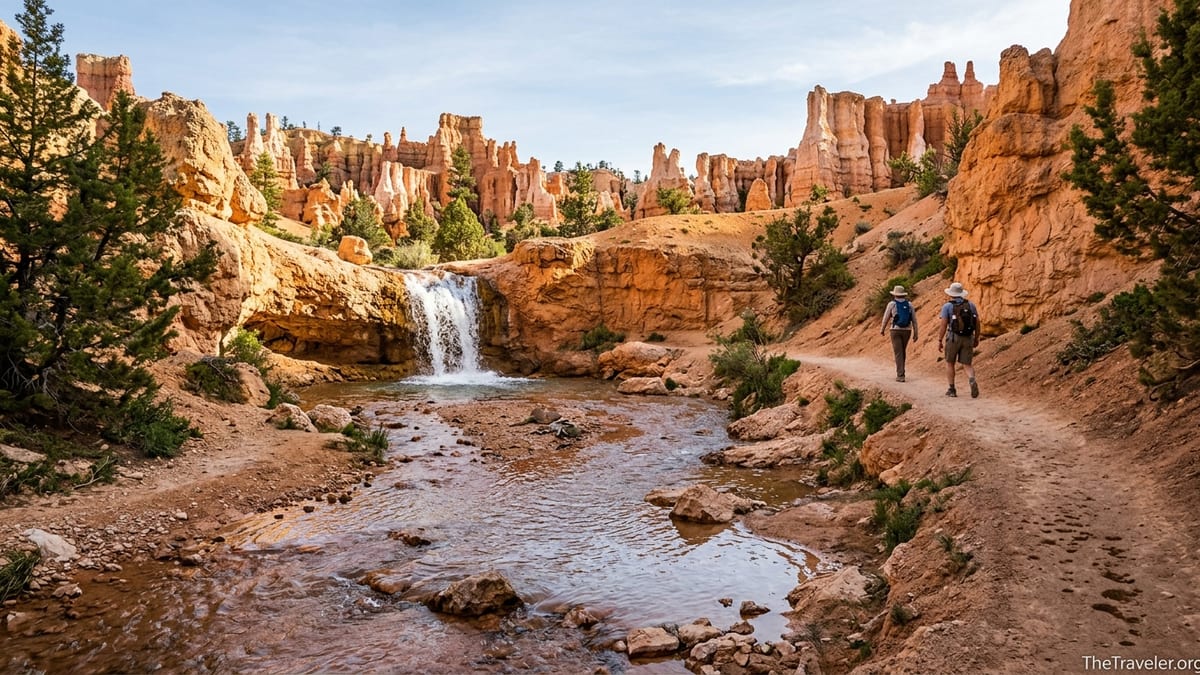
The waterfall, sometimes called Tropic Ditch Falls, sits a short distance upstream from the main trail. When you reach a signed junction, a short spur to the right leads to a viewpoint where you can see the water tumbling over an orange rock ledge into a pool below. The drop is modest by western waterfall standards, roughly two to three stories high, but the contrast of white water against red rock and the backdrop of distant hoodoos makes it an especially photogenic scene. In midsummer, you may see visitors wading in the shallow water downstream of the falls to cool off; if you choose to do this, enter and exit near the bridge crossings where the park encourages access, to avoid trampling fragile plants and creating new social paths.
Above the canyon, rows of hoodoos and eroded fins mark the edge of the Paunsaugunt Plateau. On a clear afternoon the orange and cream layers glow in the sun, and you can pick out windows, arches and isolated spires that look similar to the formations seen from Sunrise or Sunset Point. Mossy Cave offers a chance to view these features from the bottom of a small canyon rather than from the top of the amphitheater, which gives a different sense of scale. Look up and you may spot swallows, ravens or occasional raptors riding the thermals above the cliffs.
The Mossy Cave grotto itself lies at the end of the left fork from the main junction. The alcove is shallow, more of an overhang than a deep cave, but water seeping through the rock keeps the ceiling damp. In warmer months a curtain of moss and ferns clings to the walls around the opening, creating a surprising oasis effect. In winter, that same drip freezes into icicles that can be several feet long, along with layered ice at the base of the alcove. The park asks visitors not to climb on or break the ice formations, both for safety and to protect the fragile microhabitat.
Seasonal Conditions: When to Go and What to Expect
Mossy Cave Trail is open year round, but your experience will vary significantly by season. In late spring and early summer, usually from May into early July, flows in the Tropic Ditch and the waterfall tend to be their most impressive, depending on snowpack and irrigation needs. Temperatures are generally cooler than at lower elevation Utah parks such as Zion, but the midday sun can still be strong. Expect daytime highs in the 60s to 80s Fahrenheit and plan your hike for morning or late afternoon for softer light and less heat.
Summer, particularly June through August, is the busiest period. On holiday weekends, cars can fill the small lot by midmorning, and rangers often recommend arriving before 9 a.m. or after 5 p.m. for a smoother experience. Afternoon thunderstorms are common in July and August across the Colorado Plateau, bringing brief but intense downpours and lightning. If dark clouds build, avoid lingering on exposed slopes and be prepared to cut your visit short until conditions improve.
Autumn brings cooler days, fewer crowds and golden foliage along the stream, especially among cottonwoods and willows that line Water Canyon. By late October or November, overnight freezes become more frequent, and shaded sections of the trail can be icy in the mornings. Microspikes or similar traction devices are helpful if a recent storm has left compacted snow or ice on the approach to the cave. In winter, generally December through March, the trail can be snow covered and may have limited access during or after major storms, but this is also when the cave lives up to its name with impressive icicle displays.
If you come specifically for the ice, aim for midwinter or very early spring when daytime temperatures are cold enough that the formations do not melt rapidly. Dress for wind, since the small canyon can funnel breezes, and prepare for temperatures well below freezing at night. Because Mossy Cave is at relatively low elevation for Bryce, snow here can melt sooner than on the rim, so conditions often change quickly from one week to the next.
Safety, Etiquette and Photography Tips
Even though Mossy Cave Trail is short and popular, it still requires basic trail awareness. Wear sturdy footwear with good tread rather than flip flops or smooth soled sandals, especially if you plan to walk near the water or visit in cooler months when ice is possible. Carry at least a small water bottle per person; Bryce’s high elevation and dry air can dehydrate you faster than you expect, even on a brief hike. Sun protection is important year round. A brimmed hat, sunglasses and broad spectrum sunscreen will make the largely unshaded approach more comfortable.
For safety and to protect the landscape, stay on the designated trail and signed access points to the stream. The soft, crumbly slopes above the canyon are prone to erosion, and shortcut paths quickly damage plants that take many years to establish in the desert. Do not climb on hoodoo bases or scramble up loose banks for a better photo. Pets are not allowed on Mossy Cave Trail, in line with wider Bryce Canyon rules, with the exception of trained service animals as defined by federal regulations.
From a photography perspective, the waterfall and hoodoos photograph best in softer light. Early morning often brings even illumination on the canyon walls, while late afternoon can backlight the waterfall but create dramatic contrast on the orange cliffs. Many photographers bring a compact mirrorless or DSLR camera with a standard zoom in the 24 to 70 millimeter range, which allows both wide angle shots of the canyon and tighter compositions of the falls. A smartphone can also capture excellent images here; consider using the ultra wide setting to emphasize the curve of the stream and the height of the hoodoos above.
Be mindful of water spray and fine dust when changing lenses or cleaning your camera. If you wade in the stream, avoid splashing near other visitors’ equipment. In winter, icy footing near the edge of the pool below the falls can be slick, so take extra care if you are positioning yourself for a low angle shot. Respect other visitors by stepping aside from the main viewpoint periodically so everyone has a chance to enjoy the scene.
Planning Your Visit in the Context of Bryce Canyon
Mossy Cave works well as a complement to Bryce Canyon’s classic rim and amphitheater hikes rather than a replacement. Many travelers allocate one full day to the park, spending the morning on a loop like Queens Garden and Navajo, then driving the scenic road in the afternoon. In that case, you might stop at Mossy Cave either first thing in the morning on your way from nearby towns like Panguitch or Tropic, or in the early evening on your way back to lodging outside the park. Because the hike is short, it is also a good option for a stretch break if you are driving Scenic Byway 12 between Bryce and Capitol Reef or the town of Escalante.
For families, Mossy Cave is often one of the most kid friendly stops in Bryce. The presence of water, small bridges and a defined goal at the cave or waterfall keeps children engaged without a long uphill slog. Parents frequently pair the hike with a visit to the Bryce Canyon Visitor Center, where kids can pick up Junior Ranger booklets, or with a stop for ice cream or pizza in Bryce Canyon City afterward. If you are staying in Tropic, the trailhead is only a short drive uphill, making it easy to visit at sunset when the cliffs above the canyon catch the last light.
If your schedule allows more than one day inside Bryce, consider visiting Mossy Cave on a different day from your longer hikes so you are not rushed. For example, you might hike Fairyland Loop or Peekaboo Loop one day, then dedicate a second morning to Mossy Cave and a leisurely drive out to Rainbow Point at the end of the park road. This pacing gives you time to linger by the stream, take photographs and appreciate the contrast between the park’s lush canyon bottom and its high, wind swept rim.
The Takeaway
Mossy Cave Trail proves that in Bryce Canyon National Park, you do not need a strenuous, all day trek to experience dramatic geology and surprising pockets of water. In less than a mile of hiking you can see hoodoos from below, watch an irrigation canal plunge over a stone ledge as a waterfall, and step into a cool grotto where moss and ice cling to the walls. Its location off Scenic Byway 12 makes it easy to add to a Bryce itinerary, especially if you are driving between nearby towns or exploring southern Utah’s broader network of parks and monuments.
With realistic expectations, a bit of timing to avoid the busiest hours and respect for the delicate canyon environment, Mossy Cave can be one of your most memorable stops in Bryce. Use this short hike as a chance to slow down, listen to running water in the desert and look closely at how people and landscapes have shaped each other here, from hand dug canals to the constantly eroding hoodoos above.
FAQ
Q1. How long does it take to hike Mossy Cave Trail?
Most visitors complete the 0.8 mile round trip Mossy Cave Trail in about 30 to 60 minutes, allowing time to see both the waterfall and the grotto.
Q2. Is Mossy Cave Trail suitable for young children and older adults?
Yes, the trail is considered easy, with about 150 feet of elevation gain and a wide, well defined path, so it is manageable for many families and older travelers.
Q3. Do I need to pay a park entrance fee to hike Mossy Cave?
Yes. Mossy Cave lies inside Bryce Canyon National Park’s fee area, so you must have a valid park pass, even though you access it directly from Highway 12.
Q4. Can I swim or wade in the water at Mossy Cave?
Wading is allowed in designated areas, and many people cool their feet in the shallow stream, but you should enter and exit near bridge crossings and avoid climbing on the banks or near the falls.
Q5. When is the best time of year to see the waterfall flowing?
The waterfall typically looks its strongest in late spring and early summer, when snowmelt and irrigation flows increase water in the Tropic Ditch, though some flow often continues through summer.
Q6. Is Mossy Cave accessible in winter?
Yes, the trail is open year round, but snow and ice can cover parts of the path in winter, so traction devices and warm layers are recommended, especially near the grotto.
Q7. Are pets allowed on Mossy Cave Trail?
No. Pets are not allowed on Mossy Cave Trail, in keeping with most Bryce Canyon trails, except for trained service animals that meet federal definitions.
Q8. Is there public transportation or a shuttle to the Mossy Cave trailhead?
No, there is no park shuttle to Mossy Cave. You need a private vehicle or a guided tour that specifically includes the trailhead on Scenic Byway 12.
Q9. What should I wear and bring for the hike?
Wear sturdy walking shoes or light hiking boots with good traction, bring drinking water, sun protection such as a hat and sunscreen, and a light jacket in cooler seasons.
Q10. Can I still enjoy Mossy Cave if I am short on time in Bryce Canyon?
Yes. Because it is less than a mile round trip and close to the highway, Mossy Cave is an excellent option when you only have an hour or less to spare in the park.