


More news on this day
Rail passengers in and out of London faced severe disruption after a fire shut a key central station, triggering mass cancellations, overcrowded concourses and hours of delays across Britain’s already strained rail network.
Get the latest news straight to your inbox!
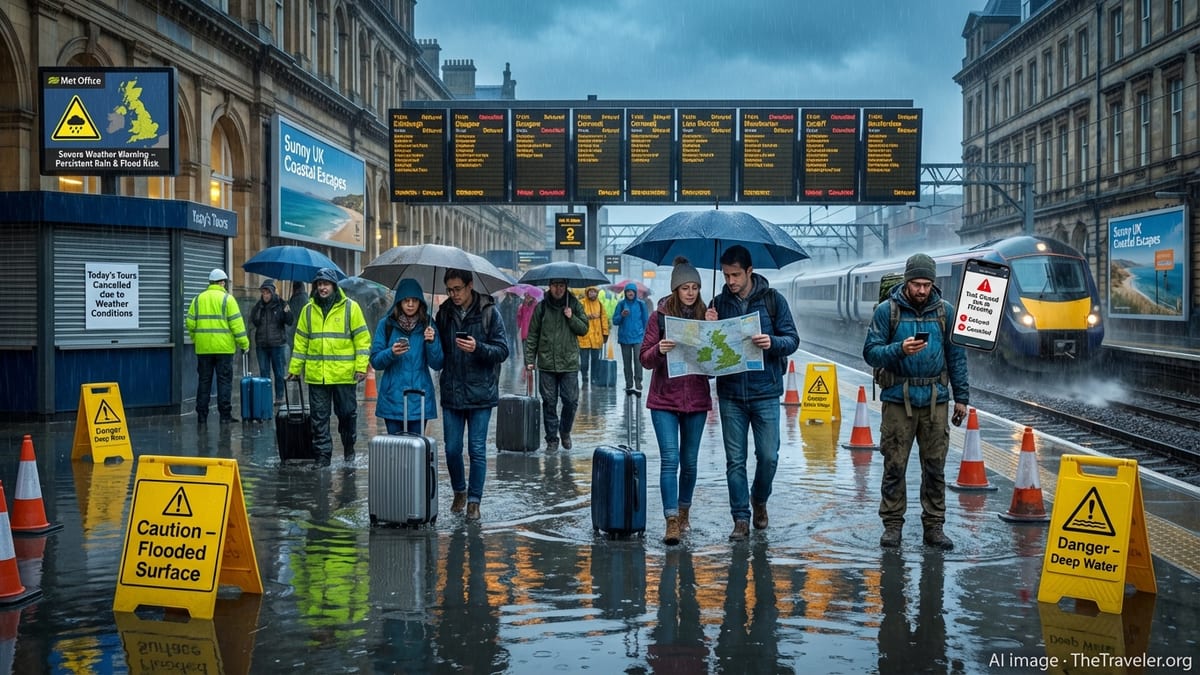
Services halted as fire closes major London terminus
According to early reports, a significant fire incident inside a central London rail station led to an immediate suspension of services, with trains held outside the capital and platforms evacuated as smoke spread through parts of the concourse. Photos and footage circulating on social media show dense smoke near tracks and firefighters working around entrances that are normally packed with commuters and visitors.
Publicly available information from rail operators indicates that services into and out of the station were either cancelled outright or diverted to alternative London terminals, creating sudden bottlenecks at already busy hubs. Passengers on approaching trains described being held outside the city for extended periods while rail control centres attempted to reorganise routes and identify safe paths into London.
The disruption hit at a time when summer holiday travel is building, meaning long-distance intercity services, airport links and commuter routes all felt the impact at once. The combination of peak-season demand and a sudden loss of capacity at a key node in the London network led to what some passenger groups characterised as a system close to breaking point.
Operational updates from train companies suggest that engineers and safety teams were required to inspect overhead lines, signalling equipment and station infrastructure before any limited service could restart, prolonging the shutdown and delaying the resumption of normal timetables.
Passengers face queues, diversions and overcrowded concourses
The immediate effect for travellers was visible in lengthy queues stretching across station forecourts and surrounding streets. With the main concourse closed for safety checks, passengers were redirected to side entrances at neighbouring stations or told to remain outdoors while crowd-control barriers were installed.
National rail journey planners showed a cascade of knock-on delays across routes serving the south and east of England, with some trains terminating short of London and others diverted to alternative terminals hours away from their original destinations. Travellers heading to coastal destinations or connecting to airport services reported missing onward trains and flights, as lengthy diversions added significant time to journeys.
Social media posts from those caught in the disruption described packed carriages on diverted services and difficulty boarding at intermediate stops as trains approached capacity. At several London stations, departure boards cycled through repeated updates showing cancellations, altered stopping patterns and extended journey times, adding to confusion for those unfamiliar with the network.
Compensation rules and ticket flexibility became a pressing issue for many passengers. Published guidance from operators indicates that tickets are generally valid via reasonable alternative routes during major disruption, but in practice many travellers reported uncertainty over which services they could board, particularly when staff at smaller stations were dealing with limited real-time information.
Knock-on impact across already fragile UK rail operations
The incident comes during a period of heightened pressure on the United Kingdom’s rail system, with ongoing industrial disputes, planned engineering works and other localised faults all contributing to a sense of fragility in the network. Recent weeks have already seen advance warnings of timetable changes and partial closures at key London terminals for upgrade projects and maintenance.
In this context, the sudden loss of capacity at a central London hub amplified existing stresses. According to publicly available performance data, even small timetable changes can reverberate across large parts of the national network, and an unplanned station closure of this scale has far greater consequences. Services far beyond the capital reported delays as sets and crews were left out of position, with evening peak trains in regional cities also affected.
Travel information platforms showed that operators attempted to spread services between alternative London termini to keep some flows running. However, shifting long-distance trains to unfamiliar stations can create its own complications, from platform length constraints to limited connection options with local transport, reducing the usefulness of the emergency plan for passengers making complex journeys.
Rail analysts note that while fire incidents of this magnitude remain relatively rare, the response highlights the importance of resilient infrastructure and contingency planning. The concentration of so many services into a handful of London terminals means that any single point of failure, whether from fire, signalling faults or structural issues, can quickly spill over into a national problem.
Information gaps and calls for clearer passenger guidance
As disruption unfolded, the availability and clarity of passenger information emerged as a major concern. Travellers reported discrepancies between official journey planners, station departure boards and operator announcements, with some services described as running on one platform while being listed as cancelled on another system.
Consumer groups have long argued that such information gaps worsen the impact of sudden disruptions by forcing passengers to make decisions with limited or conflicting details. In this case, reports from affected travellers suggest that some people abandoned rail travel altogether in favour of long-distance coach services or car hire, in part because they were unsure whether delayed trains would eventually run.
Publicly available guidance from transport watchdogs recommends that operators provide clear, consistent updates across all channels during major incidents, including social media feeds, station announcements and on-board messaging. However, implementing this in real time remains challenging when control centres are rapidly redesigning timetables and diversion routes while safety assessments are still underway.
In the aftermath, campaigners are expected to renew calls for simplified delay-compensation processes and automatic refunds where services are cancelled, arguing that passengers caught in large-scale incidents should not be required to navigate complex forms and evidence requirements after already stressful journeys.
What travellers should know for the coming days
With inspections and repairs continuing at the affected London station, operators are warning that disruption could continue into the next several days, even if a limited service is restored relatively quickly. Publicly available timetables indicate that some early-morning and late-evening trains are particularly vulnerable to rolling alterations, as operators reposition stock and staff.
Passengers planning trips into or through London are being advised by journey planners and operator updates to check services repeatedly on the day of travel, rather than relying solely on tickets booked weeks in advance. Those with flexible plans are encouraged in public guidance to avoid the busiest peak times, when limited capacity is likely to be stretched and minor delays can rapidly escalate into crowding issues.
Travel information platforms also stress the importance of building in additional connection time when transferring between mainline rail, underground services and airports. With the national network still recovering from the station closure, even routes not directly passing through the affected terminus may experience last-minute platform changes or short-notice cancellations.
While full details of the fire and its long-term impact on station infrastructure are still emerging, the episode underlines the vulnerability of dense urban rail hubs to disruptive incidents. For passengers, the key message from publicly available advice is to plan ahead, allow extra time and remain prepared for plans to change at short notice while the system works to recover.