


More news on this day
Initial investigative findings are beginning to clarify how a rush-hour collision between two passenger trains near Bedford, on a main route into London St Pancras, turned fatal and left scores of travelers injured.
Get the latest news straight to your inbox!
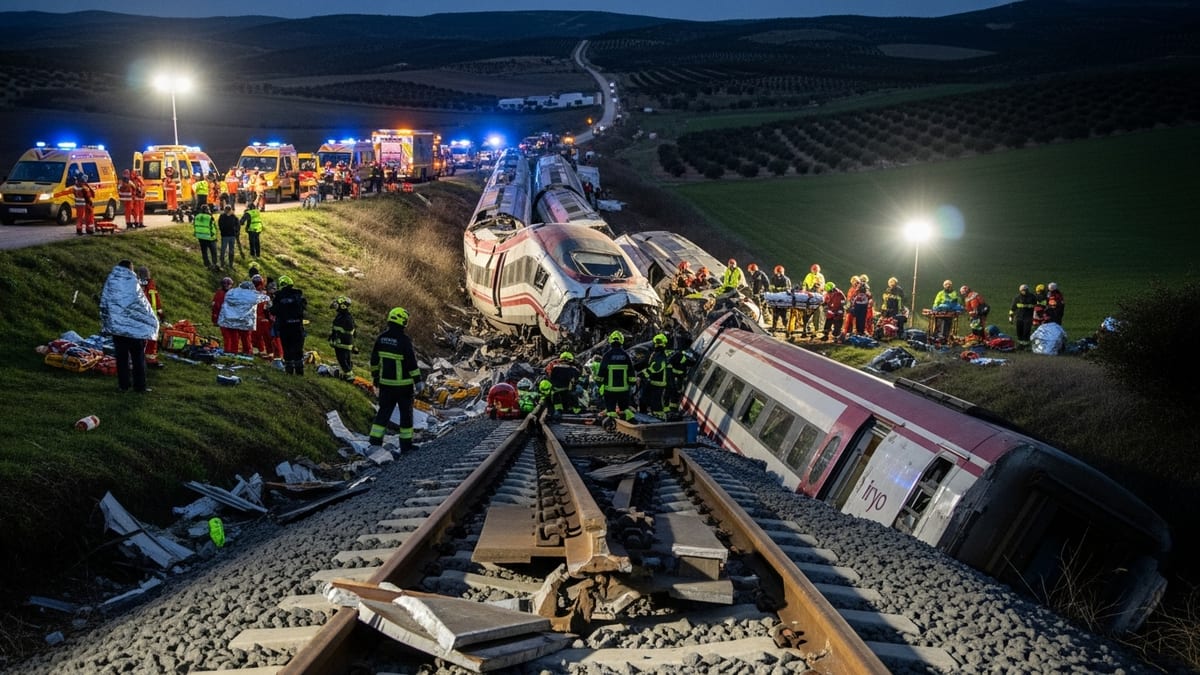
Emerging picture of the collision near London
The collision occurred on the evening of 19 June on the Midland Main Line just south of Bedford, a critical artery for services into London St Pancras. Two southbound East Midlands Railway services were involved, one from Nottingham and one from Corby, both carrying commuters and long-distance passengers toward the capital.
Reports describe how the rear train struck the back of the leading service near Elstow, a few miles north of Luton. The impact killed the driver of the following train and injured more than 100 people, with several passengers reported to be in critical condition in the days after the crash. The incident prompted a major emergency response and significant disruption to one of the busiest rail corridors into London.
Publicly available information indicates that services between Bedford and London remained severely curtailed for several days as damaged rolling stock was recovered and engineers examined track, signalling and overhead line equipment. The line closure created a knock-on effect across the wider network, with rerouted and replacement services affecting journeys well beyond the immediate crash site.
For rail travelers, the incident was a stark reminder that even on networks with strong safety records, a single failure in the chain of systems, procedures or human responses can have dramatic consequences, particularly on densely used approaches to major cities such as London.
First clues from the safety investigation
Attention has focused on early findings from the Rail Accident Investigation Branch, which published an interim account of events based on data recorders, signal logs and physical evidence at the scene. That initial overview suggests that the following train passed a red signal shortly before colliding with the stationary service ahead.
According to published coverage of the preliminary report, the Nottingham to London train ahead had come to an unexpected halt after a technical issue with on-board equipment linked to the line’s warning and protection systems. The Corby to London service behind it then continued south and, despite a late brake application, failed to stop in time. Investigators have highlighted a nine second gap between the final braking command and the impact.
The early analysis has raised questions about exactly how the signalling and train protection systems were functioning in the minutes before the crash. Investigators are examining whether all warnings were correctly displayed and acknowledged, and whether any technical faults, trackside conditions or human factors might have influenced the driver’s perception and response to the signals.
Specialists are also reviewing data from the trains’ equivalent of flight recorders, which capture speed, braking and control inputs. These devices are expected to help determine how visibility, line speed and gradient, along with the timing of the emergency braking, combined to turn a routine approach toward London into one of the United Kingdom’s most serious rail incidents in recent years.
What is known about the trains and the line
The two services involved were modern intercity-style trains operated by East Midlands Railway, running on electrified tracks that form part of a key interurban route feeding into London St Pancras. The corridor carries a mixture of long-distance, commuter and airport-bound traffic, with frequent services and complex junctions as trains converge on the final stretch toward the capital.
In the days after the collision, railway infrastructure managers described the incident in public statements as a tragic but isolated event on a network that has generally recorded a strong safety performance. The Midland Main Line around Bedford is equipped with established colour-light signalling, standard United Kingdom automatic warning systems and, in sections, more advanced train protection technologies. Investigators are now scrutinising how those layers interacted at the precise location and time of the crash.
The leading train’s unplanned stop has become a central focus. Early reports attribute that halt to a fault in equipment associated with its warning system, which led to the service coming to a standstill just south of Bedford. Establishing whether the signalling system responded as designed to a train unexpectedly stopped on the line, and whether the protection afforded by danger signals and on-board systems was sufficient, will be critical to the final conclusions.
For travelers and operators alike, the collision has intensified interest in how different protection systems, from traditional signal aspects to modern automatic speed control, overlap to guard against both technical failures and human errors on intensively used approach routes into London.
Impact on passengers and regional travel
The human impact of the crash has been widely reported, with passengers describing sudden deceleration, thrown luggage and the challenging aftermath inside crowded carriages. Many people made their way along the tracks to safety, while others required stretcher evacuations from the more seriously damaged vehicles.
Hospitals across the Bedfordshire and north London area reported receiving dozens of casualties in the hours after the collision, leading some emergency departments to urge the public to attend only for the most serious cases. As patients began to be discharged over the following days, rail travelers planning journeys into and out of London were urged to check for last-minute changes and substitute services.
Timetables on the affected section between Bedford and Luton were sharply reduced as engineers worked to stabilise the scene, remove damaged rolling stock and repair any affected infrastructure. Operators redirected some long-distance services via alternative routes where capacity allowed, but many passengers experienced extended journey times and additional transfers.
For the broader travel industry, including accommodation and attractions in London and the East Midlands, the disruption served as a reminder of how integral resilient rail links are to regional tourism. Tour operators and business travelers who rely on predictable journey times into the capital are watching closely for updates on when full services will resume and what interim measures will be in place.
Broader questions for rail safety on routes into London
Beyond the immediate findings, the Bedford collision is already feeding into a wider conversation about rail safety on busy routes approaching London and other major cities. Commentators have pointed to a small number of serious incidents elsewhere on the network in recent years, including collisions where trains did not slow sufficiently before reaching stationary or slower-moving services.
These events have renewed focus on train protection technologies that intervene automatically when a driver passes a red signal or approaches a hazard too quickly. While such systems are in place across much of the network, their configuration and coverage can vary. The question of whether more advanced, continuous speed supervision should be rolled out more widely on intensively used routes into London is likely to feature prominently in policy debates once the Bedford investigation concludes.
For travelers, any future upgrades may bring short-term disruption through possessions and engineering works, but campaigners and rail specialists argue that they could provide another layer of protection on top of already robust standards. The combination of modern rolling stock, renewed infrastructure and enhanced digital signalling is being promoted as a pathway to reducing the likelihood of high-consequence collisions.
Until the Rail Accident Investigation Branch publishes its final report, many details will remain provisional. However, the first clues now emerging from the inquiry already underline how a chain of technical events and split-second decisions in the environs of London can reshape both individual journeys and wider confidence in one of Europe’s most heavily used intercity rail corridors.