


More news on this day
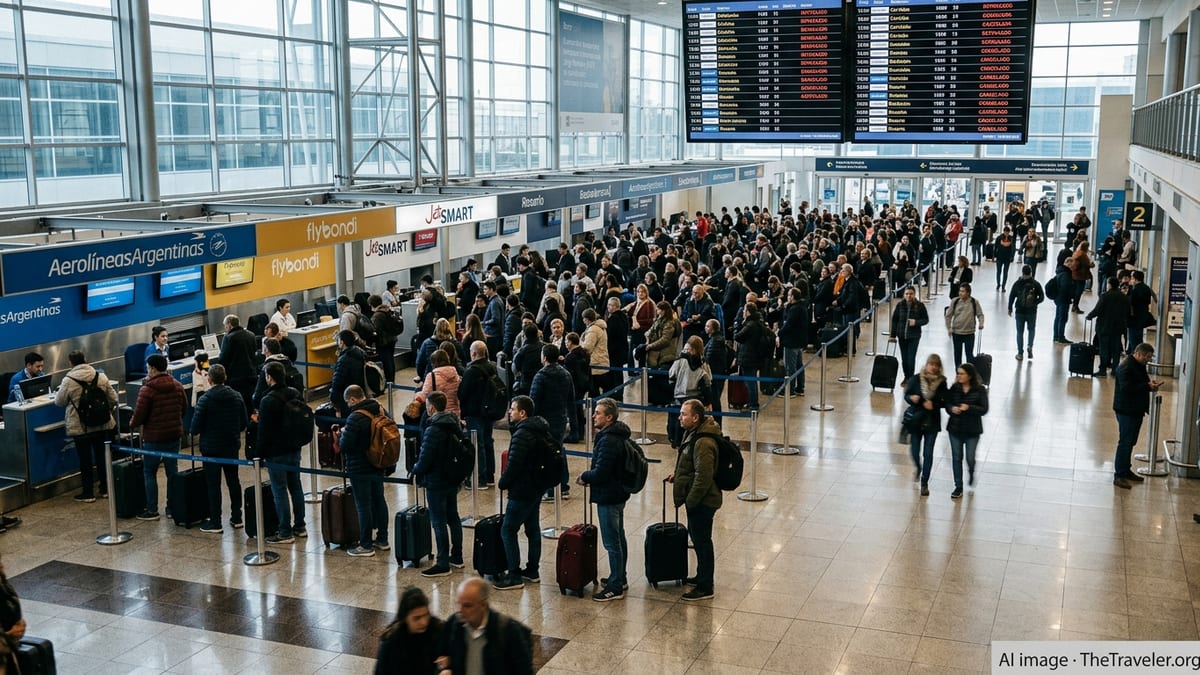
Air travel in Argentina faced fresh disruption this week as more than a dozen flights operated by Flybondi, Paranair, JetSMART, Aerolíneas Argentinas and other carriers were canceled or heavily delayed at airports in Buenos Aires and Salta, stranding passengers and complicating travel across one of South America’s busiest domestic markets.
Get the latest news straight to your inbox!
Operational strains trigger new wave of cancellations
Publicly available flight tracking data and regional media coverage point to a particularly difficult spell for low cost operator Flybondi, which has already been under scrutiny for its operational reliability. Monitoring platforms drawing on Aeropuertos Argentina 2000 data show multiple daily cancellations and delays for the airline in recent weeks on key domestic routes, including services linking Buenos Aires with Salta and other provincial capitals.
Coverage from local outlets indicates that Flybondi has been operating with a sharply reduced fleet during June 2026, at times with as few as one or two aircraft available for commercial service. Industry analyses cited in that reporting state that between June 2025 and the end of May 2026 the carrier canceled more than 2,500 flights, affecting hundreds of thousands of passengers across Argentina, a pattern that has continued into the current winter season.
The latest round of cancellations in Buenos Aires and Salta adds to that record. On affected days, daily summaries for Argentina’s main airports list more than a dozen Flybondi flights canceled or significantly delayed, alongside scattered disruptions on other airlines. While weather and routine congestion may explain some of the issues, the concentration of problems on a single carrier has fueled ongoing criticism from travelers and consumer advocates.
Reports also note that the Argentine government has previously applied sanctions and administrative proceedings in response to earlier waves of mass cancellations by Flybondi. Those measures, announced in early 2026, were intended to push the airline to present a more robust contingency and maintenance plan, but recent disruption indicates that the operational reset remains incomplete.
Buenos Aires and Salta emerge as disruption hotspots
The impact of the latest irregularities has been felt most intensely at Buenos Aires’ main domestic hub, Aeroparque Jorge Newbery, and at Martín Miguel de Güemes International Airport in Salta. Both airports serve as critical gateways for leisure and business travelers, and both sit on trunk routes used by Flybondi, JetSMART and Aerolíneas Argentinas.
On days with acute disruption, airport status boards and tracking services show clusters of Flybondi departures from Aeroparque marked as canceled or rescheduled, particularly on routes to Salta, San Juan and several Patagonian destinations. Smaller numbers of delayed or canceled services appear next to flights operated by JetSMART and Aerolíneas Argentinas, suggesting broader congestion as ground handling and slot allocations are adjusted in response to last minute schedule changes.
Salta has been particularly exposed to the current turbulence. Regional news platforms report that Flybondi has already reduced its presence in the province, with only a small number of weekly flights still scheduled. When those services are canceled or delayed, travelers often find that the remaining options on Aerolíneas Argentinas or JetSMART are either sold out or priced significantly higher, creating a bottleneck for connections between northwest Argentina and the capital.
Paranair, which links Salta and Buenos Aires with destinations in neighboring Paraguay, has also featured in the latest disruption reports, with isolated cancellations and delays adding to the overall uncertainty for passengers trying to coordinate cross-border itineraries. Although the Paraguayan carrier is not showing the same volume of irregular operations as Flybondi, any schedule shift on its limited regional network can have an outsized impact.
Contrasting performance among competing airlines
Despite the current turbulence, publicly available statistics suggest that not all carriers in Argentina are facing the same level of operational stress. Industry data compiled for the twelve months to the end of May 2026 indicate that Aerolíneas Argentinas and JetSMART maintained on time performance close to 90 percent and cancellation rates below 1 percent, highlighting a gap with Flybondi’s record over the same period.
Independent dashboards built on Aeropuertos Argentina 2000 feeds rank airlines by punctuality and cancellation ratios and consistently place Flybondi at the bottom of the league tables for recent months. By contrast, JetSMART, which is backed by private equity firm Indigo Partners, typically appears near the top of those rankings, even while operating a leaner fleet and focusing on ultra low cost fares.
Travelers posting on consumer forums and social media in 2026 frequently describe last minute cancellations, schedule changes and limited customer service response from Flybondi. By comparison, experiences shared about JetSMART and Aerolíneas Argentinas point to fewer outright cancellations, though passengers still report delays, occasional aircraft substitutions and, in the case of the state owned flag carrier, higher ticket prices.
Paranair, which operates a smaller regional network, has attracted less systematic analysis, but scattered reports of delayed or canceled flights in recent days suggest that it has not been entirely immune to the broader pressures on Argentina’s aviation system. Nevertheless, the heaviest concentration of criticism and negative performance indicators continues to focus on the domestic low cost segment.
Knock on effects for tourism and domestic mobility
The disruption at Buenos Aires and Salta arrives at a sensitive moment for Argentina’s tourism sector. June sits at the threshold of the southern winter high season, when international visitors head to ski destinations and domestic travelers flock to Andean provinces and Patagonia. Flight cancellations and extended delays during this period can ripple through hotel bookings, excursion schedules and regional transport connections.
Tourism operators in Salta and other provinces have already expressed concern in recent weeks over the reliability of some domestic air services. Regional news coverage notes that repeated cancellations force travelers to rebook on more expensive flights, switch to long distance buses or abandon trips altogether, undermining revenue projections for smaller destinations that depend heavily on air connectivity.
Business travelers and residents are facing similar challenges. Reports of passengers stranded overnight or forced to reroute through alternate airports highlight the limited redundancy in Argentina’s domestic network, particularly on routes where only one or two airlines compete. When a carrier with a significant market share on those routes experiences sustained operational issues, the options for same day recovery become sharply constrained.
In the medium term, analysts quoted in local coverage suggest that persistent reliability problems could shift demand toward airlines perceived as more stable, even at higher prices. That trend may benefit Aerolíneas Argentinas and, to a lesser extent, JetSMART, while further pressuring low cost competitors already dealing with financial and regulatory headwinds.
What affected travelers can do now
For passengers caught in the latest wave of disruptions, the immediate priority is to secure alternative transport and seek redress for additional costs. Consumer protection information published by the Argentine government and aviation regulators highlights several avenues for complaints and reimbursement, including formal claims with airlines and online procedures for reporting potential infractions.
Travel advisers generally recommend that passengers whose flights are canceled or subjected to significant delays document all communications with the airline, retain receipts for meals and accommodation, and check whether their tickets or travel insurance include specific coverage for irregular operations. Many travelers in recent incidents have turned to public channels such as social media to chronicle their experiences and put pressure on carriers to respond.
Given the pattern of cancellations affecting certain operators, some industry observers are encouraging passengers with upcoming domestic journeys in Argentina to verify their flight status frequently in the days leading up to departure and to consider building in extra time or flexible reservations where possible. This is especially relevant for itineraries that involve connections in Buenos Aires or rely on limited frequency services to and from Salta.
As the winter travel period unfolds, the performance of Flybondi, Paranair, JetSMART, Aerolíneas Argentinas and other carriers on these key routes will remain under close scrutiny from travelers, regulators and tourism businesses seeking greater stability in Argentina’s vital air transport network.