


More news on this day
Hundreds of travelers have been left in limbo after at least 166 flights were cancelled and 103 delayed across Bahrain International, Hamad International, Dubai International, and King Khalid International Airport, disrupting air travel links in Bahrain, Qatar, the United Arab Emirates, and Saudi Arabia as carriers struggle to stabilize schedules.
Get the latest news straight to your inbox!
Fresh Wave of Disruptions Across Four Major Gulf Gateways
Operational tallies drawn from flight-tracking platforms and regional aviation coverage indicate that a new wave of disruption has swept through key Gulf hubs, with 166 flight cancellations and 103 delays recorded across Bahrain International Airport, Hamad International in Doha, Dubai International, and Riyadh’s King Khalid International Airport within a compressed operating window. While the figures are modest compared with the mass shutdowns seen during the height of recent regional tensions, the concentration of problems at these four interconnected hubs has had an outsized impact on passengers attempting to transit between Asia, Europe, and Africa.
Publicly available information shows that the disruption follows months of intermittent turbulence for Middle East aviation, including large-scale airspace closures and partial shutdowns at Dubai and Doha earlier this year. In that context, even a single day of triple-digit cancellations and delays can reverberate quickly through airline networks that depend heavily on tightly timed connections.
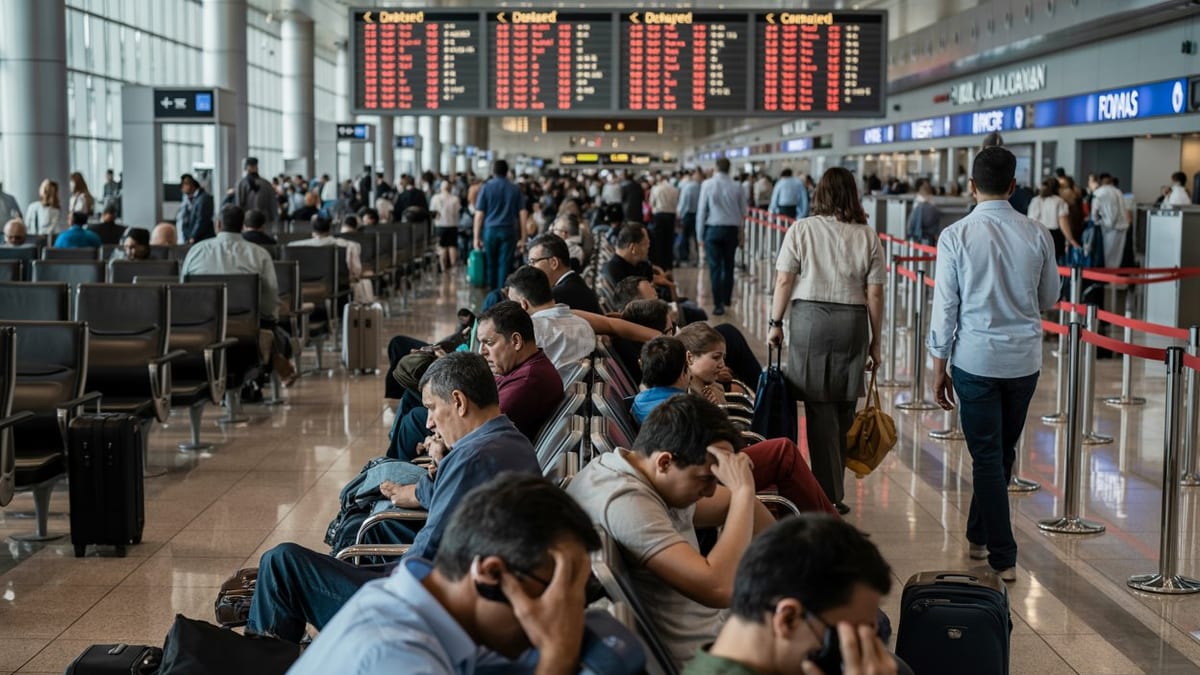
Regional travel media describe crowded departure halls, long queues at service desks, and departure boards filled with red and amber status indicators as passengers attempt to rebook, reroute, or secure overnight accommodation. Many travelers caught in the latest operational crunch had already been re-accommodated from earlier waves of cancellations, compounding frustration and logistical challenges.
Aviation analysts note that the Gulf’s hub-and-spoke model magnifies the effect of any disruption. When flights feeding into Bahrain, Doha, Dubai, and Riyadh are cancelled or significantly delayed, onward services often depart with empty seats or leave late, creating rolling knock-on effects that can stretch well beyond the region.
Regional Tensions, Airspace Constraints, and Operational Knock-On Effects
The latest cancellations and delays come against the backdrop of an already stressed operating environment across the Middle East. In recent months, published coverage from international and regional outlets has documented widespread airspace restrictions and temporary airport closures linked to conflict-related security concerns, forcing airlines to cancel thousands of flights and reroute many more around sensitive corridors.
Dubai International, one of the world’s busiest international hubs, has already experienced periods with sharply reduced schedules after conflict-related incidents and temporary suspensions of operations. Qatar’s Hamad International and Bahrain International have likewise faced curtailed movements during prior airspace shutdowns, creating backlogs that take days to unwind even after flights resume at reduced capacity.
In this context, the new wave of 166 cancellations and 103 delays is being interpreted by industry observers as part of a broader pattern rather than an isolated systems failure. Airlines are juggling altered routings, extended block times, and crew duty limitations triggered by longer detours, all of which raise the likelihood that individual rotations will be cancelled or pushed back when schedules tighten.
Weather and routine technical issues can also play a role, but analysts highlight that, with regional networks still recalibrating after major disruptions earlier in the year, even relatively minor operational challenges can tip the system into a day of widespread delays. The four affected airports sit at the heart of that recalibration, connecting tens of thousands of transit passengers each day.
Passenger Impact: Missed Connections, Visa Pressures, and Overnight Stays
For travelers on the ground, the statistics translate into missed connections, unexpected overnight stays, and, for some, urgent visa concerns. Reports from regional travel publications and social media show passengers lining terminal floors with luggage trolleys, watching departure boards cycle through updates as they wait for rebooking options.
At Bahrain International and Hamad International in particular, cancellations on short-haul feeder routes have disrupted carefully planned itineraries for travelers heading onward to Europe, North America, or East Asia. Many of these journeys are structured around narrow connection windows, meaning that even a delay of one to two hours can result in a missed long-haul departure and a delay of 24 hours or more.
In Dubai and Riyadh, long-haul travelers arriving from Asia and Africa have reported being held in transit zones for extended periods while airlines work to secure new routings. Some accounts from recent months describe passengers facing difficulties with expiring visas and work permits when outbound flights to Gulf destinations are cancelled at short notice, particularly for migrant workers whose travel is tied to specific entry deadlines.
Travel industry advisers note that, in situations like the current disruption, passengers are often entitled to care provisions such as meals, hotel accommodation, and ground transfers when cancellations result in unexpected overnight stays, although the exact entitlements vary depending on origin, destination, and applicable regulatory regimes. However, securing those benefits can require lengthy waits at customer service counters or on call centers already stretched by high call volumes.
Airlines and Airports Work to Clear Backlogs and Restore Predictability
According to operational updates and published aviation analytics, airlines using Bahrain, Doha, Dubai, and Riyadh are gradually working to clear the latest backlog by deploying spare capacity, upgauging aircraft on selected routes, and consolidating lightly booked services. Recovery efforts are complicated by crew duty-time limits and the need to rotate aircraft back to their scheduled routes after ad hoc changes during earlier disruption days.
Airport operators in the region have been encouraging travelers to verify their flight status before heading to the terminal and to arrive early if their service is still showing as operating. Past disruption episodes at Hamad International and Dubai International have shown that, while some flights may depart broadly on time as recovery begins, others can experience last-minute gate changes or additional short-notice delays as air traffic control manages congested airspace and runway slots.
Industry observers expect the impact of the 166 cancellations and 103 delays to linger beyond the single reporting period, particularly for passengers booked on multi-sector itineraries involving codeshare partners or separate tickets. Even after operations normalize at the four main hubs, some travelers may find themselves rebooked on unfamiliar routings through secondary airports as airlines attempt to reposition aircraft and crews.
Travel data specialists caution that as long as regional airspace remains constrained and schedules continue to rely on tight connection windows, similar pockets of disruption are likely to recur. For travelers planning itineraries through Bahrain, Qatar, the United Arab Emirates, or Saudi Arabia in the coming weeks, that means building in additional flexibility and monitoring flight-status updates more closely than usual.
What Travelers Can Do If Their Gulf Transit Plans Are Disrupted
Consumer advocates and travel-risk consultants suggest that passengers affected by cancellations or severe delays at Gulf hubs take a structured approach to protecting both their time and their finances. The first priority is to secure confirmed rebooking, either on the original carrier or, where permitted, on an alternative airline serving the same route or nearby destination. In cases where onward connections are at risk, asking to be rerouted via an alternative hub can sometimes save significant time compared with waiting for the next direct departure.
Travelers are also encouraged to keep detailed records of any additional costs incurred, such as hotel stays, meals, local transportation, and replacement tickets on other airlines. Depending on the applicable legal framework and the cause of the disruption, some of these expenses may be recoverable through airline policies, travel insurance, or, in certain markets, passenger-protection regulations.
Specialists point out that communication with employers, tour operators, or cruise lines is critical when disruptions at Gulf hubs cause travelers to miss onward segments or scheduled departures in other regions. Documentation from airlines describing the cancellation or delay can help in securing waivers, refunds, or itinerary changes from third-party providers.
As regional carriers and airports continue to rebuild resilience in the wake of repeated shocks to Middle East air travel, passengers transiting Bahrain, Doha, Dubai, and Riyadh are being advised to leave extra time between connections, keep digital copies of all travel documents, and remain prepared for last-minute changes. The latest cluster of 166 cancellations and 103 delays is a reminder that, for now, even a brief operational hiccup in the Gulf can ripple across global travel plans.