


More news on this day
Flight operations at Newark Liberty International Airport and Philadelphia International Airport are gradually returning to normal after a widespread air-traffic equipment outage on September 21 brought large parts of the Northeast corridor’s skies to a standstill.
Get the latest news straight to your inbox!
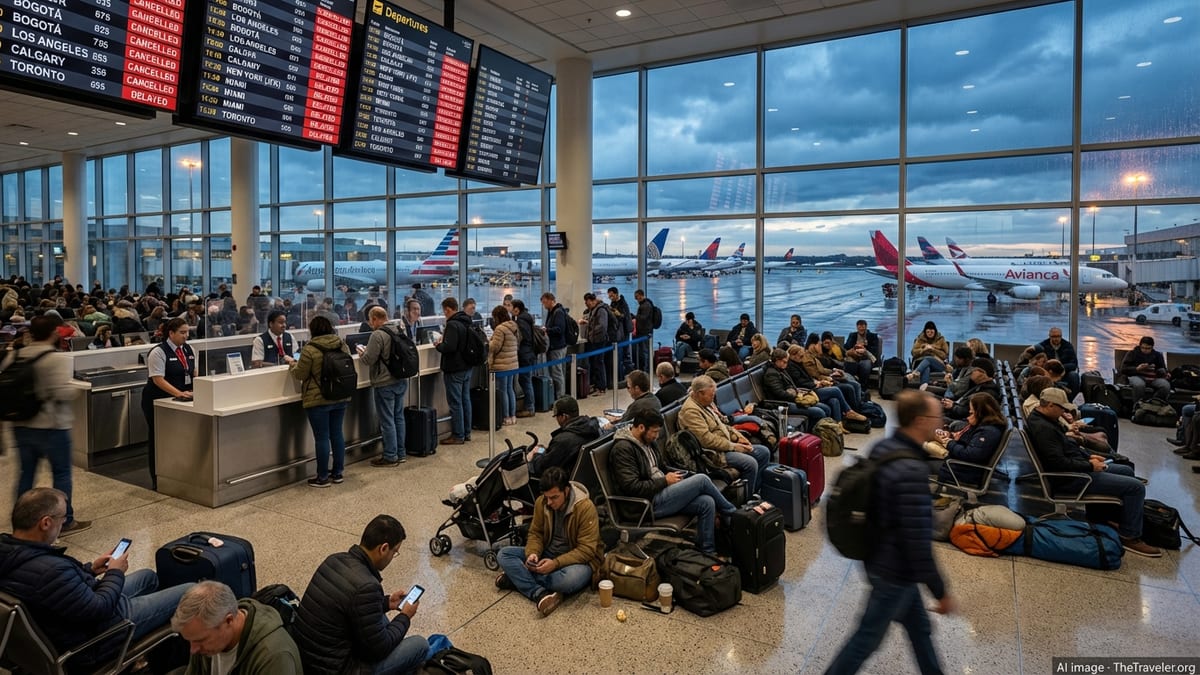
Flights resume as delays slowly unwind
By the morning of September 23, publicly available tracking data showed traffic flowing more regularly at both Newark Liberty (EWR) and Philadelphia International (PHL), with significantly fewer cancellations than during the height of Monday’s disruption. Residual delays remained, but the severe gridlock that stranded thousands of travelers across the region had eased.
Reports from flight-tracking services indicated that commercial arrivals into Newark had halted from about 9:40 a.m. to just after 5:20 p.m. local time on September 21, while Philadelphia saw extensive arrival and departure delays throughout the afternoon and evening. Subsequent schedules showed airlines reinstating most flights on Tuesday and Wednesday, though some rotations remained out of place as carriers worked through aircraft and crew imbalances.
According to published coverage from national outlets, operations at New York’s LaGuardia and John F. Kennedy airports also recovered overnight into Tuesday after experiencing related ground stops. With those airports now largely back on schedule, Newark and Philadelphia no longer appeared to be the main choke points in the Northeast air network.
Travel industry reporting noted that average delays at Newark and Philadelphia on Monday reached well over an hour, with some Newark flights pushed back nearly three hours. By midweek, remaining disruptions were generally measured in tens of minutes rather than hours, signaling a shift from crisis management to clean-up.
Cut fiber line and circuit failure at Philadelphia facility
Publicly available information indicates that the problems began when a circuit failed at the Federal Aviation Administration’s Philadelphia Terminal Radar Approach Control facility, which manages approach and departure traffic for both Philadelphia and Newark. When controllers attempted to switch to a backup system, a key fiber line in New Jersey was discovered to be damaged.
Transportation coverage citing federal statements reported that an Amtrak construction crew working on the Delco Lead rail project between New Brunswick and North Brunswick accidentally severed a Verizon fiber-optic cable around mid-morning on September 21. The cut disabled the backup communication path just as the Philadelphia facility was dealing with its own equipment failure, resulting in a cascading outage affecting radar and radio connectivity.
The combined issues forced the FAA to impose ground stops at Newark, Philadelphia, and several other major Northeast airports while technicians worked to reroute traffic and restore connections. Data cited by European and U.S. news outlets showed that Newark and Philadelphia experienced some of the heaviest disruptions, with dozens of arrivals and departures canceled or significantly delayed.
Federal documents published in recent years have already highlighted vulnerabilities at the Philadelphia facility, including antiquated wiring, aging systems, and complex interdependencies with New York-area operations. The latest incident underscored how a single infrastructure failure outside the air-traffic system itself can quickly spill over into aviation.
Ongoing knock-on effects for airlines and passengers
Even as the immediate equipment problems were resolved late Monday and into Tuesday, airlines at Newark and Philadelphia continued to grapple with knock-on operational challenges. Aircraft and crews that never reached their intended destinations created gaps in Tuesday’s schedules, forcing carriers to consolidate flights or substitute smaller aircraft in some cases.
Reports from airline-focused outlets noted that Newark, a major hub for United Airlines, saw particularly heavy cancellations on Monday as the carrier cut dozens of domestic departures when the ground stop extended through the afternoon. At Philadelphia, American Airlines and its regional partners worked through a backlog of delayed flights as gates and departure slots became available again.
Travelers caught in the disruption reported, through social media posts and local coverage, a mix of rebookings, overnight hotel stays, and diversions to secondary airports as carriers attempted to reposition aircraft. With the outage categorized as an infrastructure issue rather than an airline-caused problem, standard U.S. regulations did not require compensation beyond rebooking and basic assistance such as meal vouchers in limited cases.
By midweek, schedules at both airports more closely resembled normal late-September operations, though some passengers with missed connections continued to arrive at their destinations a day or more behind plan. Travel news coverage suggested that the episode may encourage some travelers to build longer layovers into future itineraries through the Northeast during peak events, such as the United Nations General Assembly week that coincided with Monday’s disruption.
Infrastructure and oversight under renewed scrutiny
The outage has drawn attention to the condition of critical communications infrastructure that underpins air travel in the busy Northeast corridor. Congressional hearing records and Federal Register notices over the past two years have documented concerns about outdated copper wiring, antiquated equipment, and staffing pressures at facilities responsible for Newark and Philadelphia airspace.
Federal filings in 2025, for example, described recurring technology issues at the Philadelphia facility and their impact on Newark operations, prompting efforts to reduce scheduled flights at peak times in order to ease congestion. The same documents acknowledged that Philadelphia assumed radar approach responsibilities for Newark in 2024, creating a tighter operational link between the two airports.
The latest incident, coming after earlier outages tied to the same facility, is expected to fuel ongoing debates over funding levels for air-traffic modernization projects. Public remarks from transportation leaders in recent days have emphasized the need to harden backup systems and diversify routing for critical fiber connections used by radar and communication networks.
Analysts quoted in aviation trade coverage have pointed out that while full shutdowns of major approach control facilities are rare, partial equipment failures and localized outages occur more frequently than many travelers realize. The cut fiber line in New Jersey highlighted how construction activity far from any runway can still bring a major hub’s operations to a halt if redundant links are not adequately protected.
What travelers using Newark and Philadelphia should expect
For travelers booked through Newark or Philadelphia in the coming days, airline schedules suggest a broadly stable picture, but with pockets of residual disruption. Carriers have continued to adjust departure times and aircraft assignments as they reposition fleets, so same-day schedule checks remain important.
Publicly available delay data shows that average hold times at both airports have already fallen from Monday’s peaks, yet mid-afternoon bank periods at Newark in particular continue to see some congestion as airlines compress multiple rescheduled flights into limited runway and gate capacity. Travelers connecting through the airport may wish to allow extra time between flights to account for potential minor delays.
At Philadelphia, the latest published information from airport and airline channels points to primarily weather-related and routine operational delays rather than systems issues. However, crews and aircraft displaced by Monday’s outage may still affect certain routes, particularly regional services along the East Coast.
For now, there is no indication in public reporting of continuing technical problems at the Philadelphia air-traffic facility, and federal status pages show normal operations across the Northeast. The episode serves as a reminder to travelers that even short-lived equipment outages can have effects lasting several days, especially at complex hub airports like Newark and Philadelphia.