


More news on this day
Air travelers using São Paulo’s main airports are facing renewed disruption as a mix of weather, infrastructure works and network pressures trigger delays and cancellations for leading Brazilian carriers Gol, Azul and Latam.
Get the latest news straight to your inbox!
São Paulo Airports Under Pressure
Brazil’s largest air hub, the São Paulo region, has seen a series of operational challenges in recent weeks, affecting flight schedules at Guarulhos, Congonhas and Viracopos. Publicly available data and media coverage indicate that passengers flying with Gol, Azul and Latam have encountered growing numbers of delayed and canceled services on key domestic and regional routes.
Guarulhos, the country’s busiest international gateway, has been particularly exposed. Earlier infrastructure works that required the airport to operate with a single runway prompted schedule adjustments and selective cancellations by major airlines, including Latam and Azul, as they reorganized their networks to cope with reduced capacity. Reports indicate that Gol also faced knock-on effects as peak periods became more congested.
At Congonhas, the city airport serving primarily domestic routes, operational complexity remains high because of dense schedules and slot restrictions. Azul, Gol and Latam all depend on this airport for high-frequency shuttles to other Brazilian capitals, which makes any disruption in São Paulo reverberate quickly across their broader networks.
Viracopos, near Campinas, functions as a major base for Azul and is a key alternative for flights that cannot operate through Congonhas or Guarulhos during periods of strong storms or capacity limitations. When weather systems move across the state of São Paulo, reductions in arrival and departure rates at all three airports can combine with airline timetable changes to create significant delays and cancellations for travelers.
Communication System Failure and Weather Disruptions
Recent disruption in the São Paulo airspace was intensified by a communication system failure that temporarily interrupted operations at airports in the region. Coverage from Brazilian media and aeronautical information services shows that air traffic controllers and pilots experienced a loss or degradation of standard communication channels, leading to a short suspension of movements as safety procedures were applied.
Public statements from the Brazilian Air Force and service providers attribute the interruption to a technical problem affecting telecommunications infrastructure that supports the air traffic management system. During the outage, departures and arrivals at Guarulhos, Congonhas and Viracopos were partially halted or slowed, creating queues of aircraft waiting to take off or land once normal operations resumed.
On the same day, commercial updates from Azul, Gol and Latam indicated that they were compelled to delay flights and reroute some services to other airports in Brazil. According to published coverage, the suspension period lasted for a little more than an hour, but residual impacts persisted for several hours as aircraft and crews were repositioned and connections rescheduled.
The communication failure added to an already fragile operating environment shaped by seasonal weather patterns. In recent months, heavy rain, low visibility and strong winds around São Paulo have occasionally reduced runway capacity and forced airlines to cancel or combine flights. These interruptions have coincided with busy travel days, amplifying disruption for passengers across domestic and international routes.
Network and Cost Pressures for Gol, Azul and Latam
Beyond one-off technical incidents, Gol, Azul and Latam are managing broader cost and capacity pressures that influence how they respond to operational constraints in São Paulo. Public financial disclosures and business reports show that rising fuel prices and currency volatility have pushed carriers to adjust their networks, sometimes trimming frequencies or consolidating flights on certain routes.
Latam has publicly discussed the need to optimize its schedule in Brazil to protect profitability amid higher jet fuel costs. Industry analysis indicates that this has included targeted reductions in less profitable domestic services, some of which touch Guarulhos and Congonhas, where airport fees and slot constraints are significant. While these changes are planned months in advance, they can appear to travelers as a pattern of cancellations or rebookings at specific times of day.
Azul, which relies heavily on Viracopos and operates a broad regional network, recently indicated that it had cut a portion of its overall capacity in response to higher operating expenses. According to economic coverage, the airline has sought to prioritize routes with strong demand and higher yields, which may mean fewer backup options when irregular operations occur at São Paulo’s main airports.
Gol, another major user of Guarulhos and Congonhas, has focused on maintaining its core domestic network while adjusting capacity during periods of elevated costs. Visible schedule changes, including the consolidation of late-night or low-load flights, can limit the ability to reprotect passengers rapidly when weather or airspace constraints disrupt operations, leading to cascading delays and scattered cancellations.
Passenger Impact and Rights During Disruptions
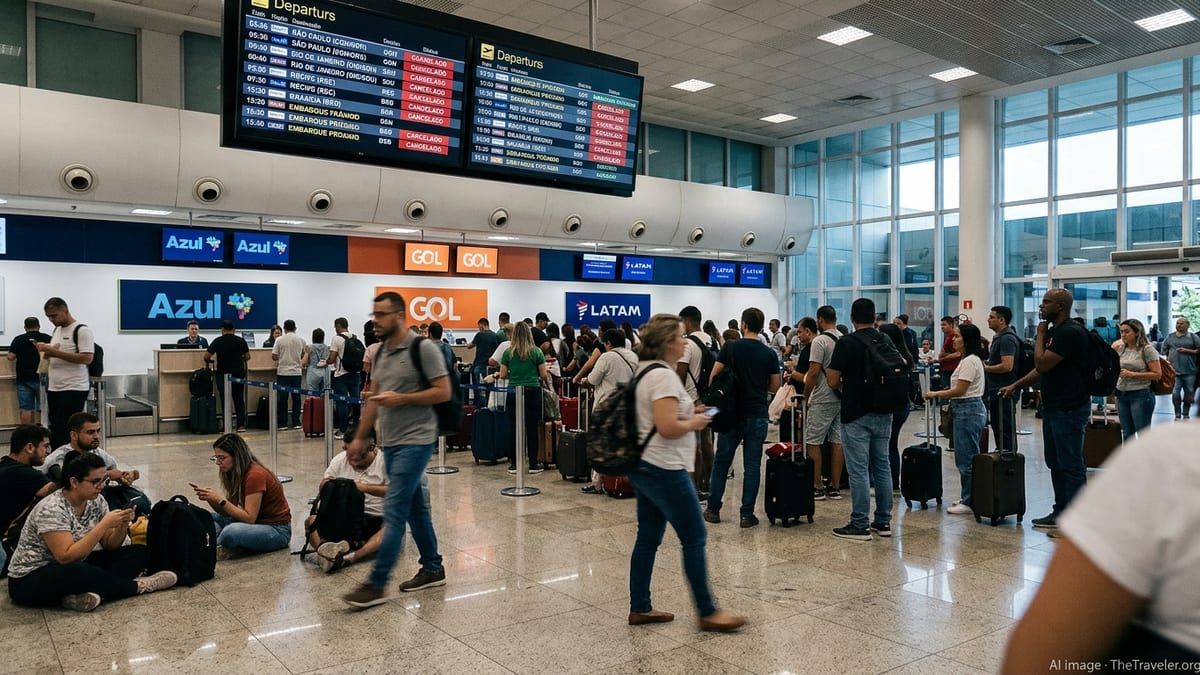
As delays and cancellations accumulate, passengers passing through São Paulo often confront longer lines at check-in counters, boarding gates and customer service desks for Gol, Azul and Latam. Reports from consumer rights organizations and travel advocacy groups describe travelers waiting several hours for rebooking assistance on days when multiple airlines are simultaneously affected by weather or technical failures.
In Brazil, passenger protections are defined by national civil aviation regulations that set out assistance obligations when flights are delayed or canceled. Public guidance from regulators explains that, depending on the length and cause of the disruption, airlines may be required to provide communication, food, lodging and alternative transportation options. Travelers departing or connecting in São Paulo are increasingly encouraged by advocacy campaigns to document disruptions and seek compensation where applicable.
Data compiled by flight compensation specialists suggest that the cluster of delays and cancellations at Guarulhos and other major airports in mid May left thousands of passengers eligible to claim reimbursement or alternative travel arrangements from airlines, including Latam, Gol and Azul. Although not all disruptions fall under compensation rules, particularly in cases tied to severe weather or air traffic control limitations, passenger awareness of these frameworks has grown.
Consumer groups also note that proactive communication from airlines can mitigate frustration. When Gol, Azul and Latam provide early notification through apps, email or airport displays about expected delays in São Paulo, travelers are better able to adjust itineraries, reroute through different cities or modify ground transport plans. On days when disruptions escalate quickly, however, information can lag behind operational realities on the ground.
Outlook for São Paulo’s Air Travel Reliability
Looking ahead, São Paulo’s role as Brazil’s central aviation hub means that even modest operational disturbances can have national repercussions for airlines and passengers. Infrastructure upgrades at Guarulhos and Congonhas, together with investments in air traffic management technology, are expected to improve resilience, but in the near term they may continue to require partial runway closures or schedule adjustments.
Gol, Azul and Latam have signaled, through their public planning and fleet announcements, that they intend to preserve strong connectivity into São Paulo as they adjust capacity in response to market conditions. Network planners are likely to keep refining departure waves, connection times and aircraft rotations in an effort to absorb shocks from weather events and system outages with fewer knock-on delays.
For travelers, the recent pattern of delays and cancellations underlines the importance of monitoring flight status closely on the day of travel, particularly during peak holiday periods and seasons of intense rain in southeastern Brazil. Travel industry analysis often recommends allowing longer connection times at Guarulhos, Congonhas or Viracopos when itineraries depend on tight same-day transfers among Gol, Azul and Latam services.
While the underlying causes of disruption vary from technical failures to structural cost pressures, São Paulo’s airports are expected to remain busy and occasionally strained. Ongoing coordination among airport operators, air navigation services and airlines will be central to reducing the impact of future irregular operations on passengers across Brazil’s busiest air corridors.