


More news on this day
Airport operations across the busy Northeast corridor are resuming on Tuesday after a Federal Aviation Administration equipment outage in the Philadelphia area triggered thousands of flight delays and cancellations at major hubs from Newark and New York to Philadelphia and Boston.
Get the latest news straight to your inbox!
Telecom failure behind widespread air traffic disruption
Publicly available information indicates that the disruption began on Monday morning, September 21, when a telecommunications circuit at a Federal Aviation Administration air traffic facility near Philadelphia failed, severing a key data link used to manage traffic flows along the Northeast corridor. A backup fiber line intended to provide redundancy was also found to be out of service after being cut during construction work at a separate site in New Jersey.
Coverage from multiple outlets describes the outage as affecting the Philadelphia regional air traffic control center responsible for handling high-altitude and approach traffic into some of the nation’s busiest airports, including Newark Liberty International, John F. Kennedy International, LaGuardia, and Philadelphia International. The loss of communications and radar data triggered conservative safety protocols, leading to immediate pauses in some arrivals and tightly metered departures while contingency routes were put in place.
Airline operations data compiled by flight-tracking services shows how quickly the outage rippled across the system. By Monday night, reports indicated roughly 8,400 flights had been delayed nationwide and more than 1,100 canceled, with the largest share tied to airports in the New York, New Jersey, and Philadelphia region. Newark Liberty alone saw more than 600 cancellations into and out of the airport on Monday, alongside hundreds of additional delays.
The failure echoes earlier episodes linked to the same FAA facility, including a series of disruptions at Newark in spring 2025. Aviation analysts note that the latest incident highlights the vulnerability of legacy telecom infrastructure that still underpins critical air traffic systems, even as the agency rolls out new digital tools to better manage congested airspace.
Ground stops at key hubs from Newark to Boston
As the outage unfolded, the FAA implemented ground stops and ground-delay programs at several major Northeast airports, effectively halting or sharply reducing arrivals until controllers could safely manage traffic using alternative routes and capacities. Newark Liberty was among the hardest hit, with commercial arrivals paused for much of the day. Flight-tracking data cited in published reports shows no commercial landings at Newark from about 9:40 a.m. to just after 5:20 p.m. local time on Monday.
Operations at New York’s LaGuardia and JFK airports were also significantly constrained, with departure queues stretching into the evening and average delays climbing near or past an hour at peak times. Reagan National Airport outside Washington, D.C., experienced a ground stop attributed in federal advisories to volume and downstream congestion as the ripple effects of the outage spread along the East Coast route network.
Farther north, Boston Logan International reported a surge in delays and cancellations Monday afternoon as airlines adjusted schedules to cope with aircraft and crew imbalances created earlier in the day around New York and Philadelphia. Local coverage from the New England region described thousands of travelers facing rolling departure-time changes as carriers attempted to re-sequence flights once restrictions began to ease.
Even airports well outside the initial impact zone felt the strain. Data reported from San Francisco International indicated more than 400 delayed flights on Monday, reflecting how disruptions in the nation’s most densely traveled corridor can quickly cascade across transcontinental routes and connecting banks at major hubs.
Gradual recovery on Tuesday, but schedules remain fragile
By early Tuesday, September 22, technicians had restored the damaged telecom lines and the FAA began lifting ground stops, allowing airports in the New York, New Jersey, and Philadelphia area to resume more typical operations. Regional news coverage from the morning described traffic flows improving at Newark, JFK, LaGuardia, and Philadelphia, with airlines working through a backlog of repositioning flights.
Flight tracking services showed Newark still coping with dozens of cancellations and roughly similar numbers of delays early Tuesday, but far below the scale seen the previous day. At Philadelphia International, totals reported late Monday included about 400 delays and 200 cancellations, with Tuesday’s schedule focused on normalizing bank structures and reconnecting disrupted itineraries.
Industry-focused reporting noted that United Airlines, which operates a major hub at Newark, had stopped canceling additional domestic flights there by Monday evening, signaling a shift toward recovery operations. However, airlines across the region continued to warn of residual disruptions as aircraft and crews returned to their intended positions, particularly for early-morning departures and tight connections.
Travel data specialists expect irregular operations linked to the outage to persist through at least the end of Tuesday as carriers rebuild their schedules. Passengers booked through affected hubs are being advised in public guidance to monitor their flight status frequently and to allow extra time for security and boarding, especially at Newark, LaGuardia, JFK, Philadelphia, and Boston Logan.
Impact on travelers and what passengers can expect
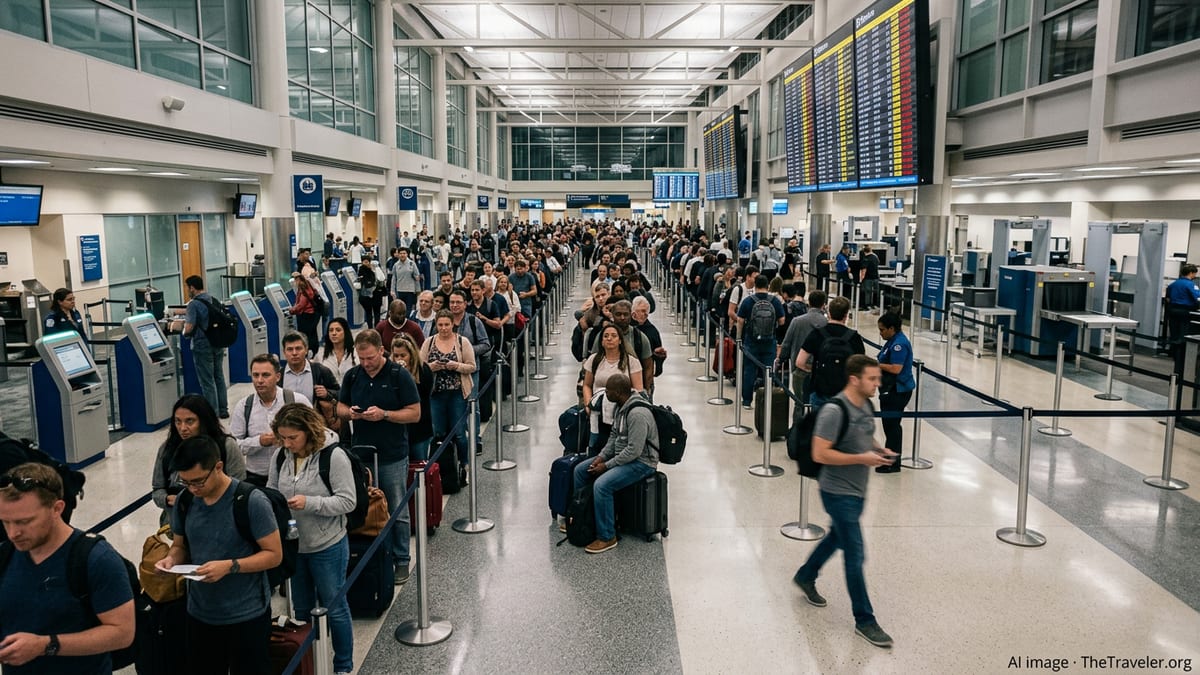
For travelers, the outage created a classic Northeast corridor bottleneck, with limited options to reroute around the disruption. Reports from major carriers show heavy knock-on effects for connecting itineraries, particularly those relying on short-haul feeders into Newark, LaGuardia, and Philadelphia. Crowded customer service lines and long waits for rebooking were common Monday afternoon and evening as airlines triaged passengers based on available seats.
Publicly available airline advisories indicate that several major U.S. carriers issued systemwide travel waivers tied to the outage, allowing customers scheduled to fly to, from, or through the affected airports on September 21 and, in some cases, September 22 to change their itineraries without standard change fees or fare differences, subject to certain date and routing constraints. The most flexible options appeared to focus on customers willing to shift their travel to later in the week or reroute through alternative hubs such as Chicago, Atlanta, or Dallas.
For passengers still planning to travel through the region, aviation analysts suggest building in additional buffers. Even as operations stabilize, aircraft may not be aligned with their original rotations, which can lead to last-minute gate changes, swaps to different aircraft types, or residual delays. Travelers with time-sensitive connections, cruises, or rail links out of the Northeast are being encouraged in consumer-facing coverage to reconfirm all segments and consider same-day earlier departures where possible.
Rail and intercity bus options along the Northeast Corridor remained available throughout the outage, but schedules were already busy due to the United Nations General Assembly in New York, which typically brings a spike in demand for both air and ground transport. Some travel advisors are recommending that passengers with short regional trips between cities such as Washington, Philadelphia, New York, and Boston weigh rail as a backup option for the next few days in case air schedules experience further strain.
Broader questions about FAA infrastructure reliability
The outage has renewed scrutiny of the condition and redundancy of the country’s air traffic control infrastructure, particularly in high-density regions like the Northeast. News coverage and industry commentary connect Monday’s event to a string of prior technical glitches in recent years, ranging from localized radar failures to the nationwide ground stop that followed a Federal Notice to Air Missions system problem in early 2023.
Policy documents and public briefings on the FAA’s ongoing modernization efforts emphasize the gradual replacement of older, circuit-based communications with more resilient digital networks and satellite-enabled navigation. However, Monday’s disruption shows that critical nodes still rely on physical fiber connections that can be severed by construction accidents, underscoring the need for more robust protections and alternative routing paths.
Recent federal notices related to congestion management at New York-area airports already anticipated elevated delay risk in the region through at least 2027, even without unexpected outages, due to a combination of staffing, construction, and airspace complexity. The latest incident adds a new layer to that challenge, illustrating how quickly a single point of failure can overload an already constrained system.
Aviation experts quoted in public reports suggest that regulators, telecom providers, and infrastructure operators will face renewed pressure to harden critical links, improve real-time monitoring of backup systems, and clarify responsibilities when third-party construction activity damages aviation-related communications. For travelers, the episode serves as another reminder that even on clear-weather days, disruptions tied to infrastructure can be as impactful as major storms on the nation’s busiest routes.