


Swiping a familiar card in an unfamiliar country can feel reassuring, right up until your statement arrives loaded with fees and puzzling exchange rates. For travelers from the United States, the United Kingdom and the euro area, the true cost of paying abroad is shaped not only by the headline “foreign transaction fee” but also by currency conversion systems, ATM surcharges and merchant tricks like dynamic currency conversion. This guide explains how those charges work, using concrete examples to help you choose the right card and avoid expensive surprises.
Get the latest updates straight to your inbox!
What foreign transaction fees really are (and what they are not)
When you use a credit or debit card abroad, several different organizations can touch the transaction, and each can add its own cost. Understanding who charges what is the foundation for controlling your travel spending.
The most visible cost is the foreign transaction fee charged by your card issuer. Many mainstream US cards still charge around 3 percent on purchases made in a non‑US currency or processed outside the United States. By contrast, several popular US travel cards, including versions of the Chase Sapphire, Capital One Venture and many airline co‑branded cards, advertise zero foreign transaction fees on purchases. In the UK, cards from major banks such as Barclays, Lloyds or HSBC may add around 2.75 to 3 percent on non‑sterling transactions, while specialist travel cards like Halifax Clarity or certain Virgin Money and Barclaycard products often charge 0 percent on purchases abroad. Within the euro area, cards used in another eurozone country generally do not incur foreign transaction fees because there is no currency conversion, but charges can apply when paying in non‑euro currencies such as US dollars, pounds or Thai baht.
Separate from issuer fees sits the currency conversion done by the card network, usually Visa or Mastercard. When you pay in a foreign currency but let the transaction go through in that local currency, your purchase is converted at the network’s wholesale exchange rate for that day, plus whatever foreign transaction fee your bank may add. Visa, Mastercard and American Express each publish their indicative daily rates, which tend to be close to the mid‑market rates you would see on financial news sites, but they are not identical.
Two other players can also alter the price you pay. Merchants and ATM operators can offer to convert the transaction themselves through a service called dynamic currency conversion, where you see the bill in your home currency at a rate they choose. In addition, ATM operators may levy fixed surcharges for cash withdrawals, and card issuers can treat cash obtained with a credit card as a cash advance, attracting higher interest and separate cash advance fees. The key point is that issuer foreign transaction fees, network exchange rates, merchant currency conversion and ATM charges are all distinct. They can stack on top of one another if you are not careful.
How card networks convert foreign currency into your home currency
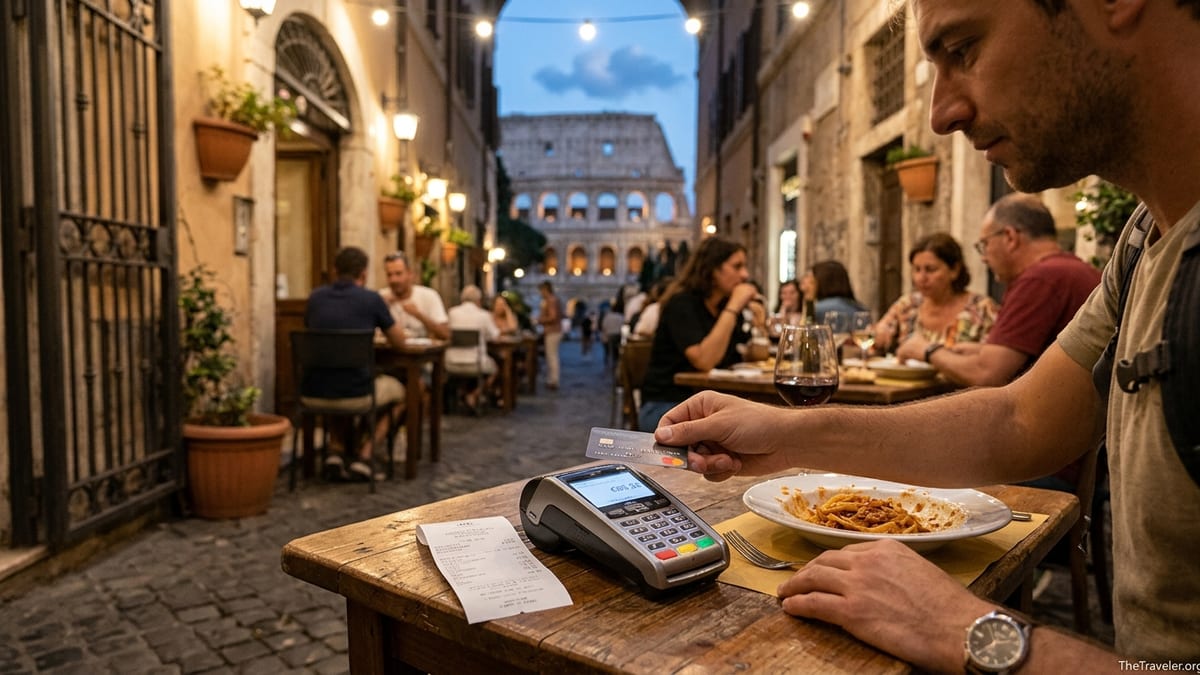
When you pay in a foreign currency and decline any merchant conversion, your transaction usually follows a sequence that is largely invisible to you. Suppose a US traveler uses a Visa card to pay €100 at a restaurant in Rome. The transaction is first authorized in euros, then sent through the Visa network. Visa converts the amount into US dollars at its prevailing euro to dollar rate, which is based on wholesale foreign exchange markets and may be calculated on the processing date, not always the exact moment of purchase.
Your issuing bank then takes that converted dollar amount and posts it to your account, potentially adding its own foreign transaction fee. If the bank charges 3 percent, it applies that fee on top of the converted US dollar amount, not on the original euros. If the bank charges 0 percent, you pay only the network converted amount. UK and European cardholders see similar flows. A British traveler using a Mastercard in Tokyo to spend in Japanese yen will have that yen amount converted to pounds by Mastercard’s daily rate, and a euro‑area traveler will see non‑euro currencies converted into euros.
The rate you ultimately get can differ from the rate you saw when you checked on a currency app at the time of purchase. Networks publish their daily rates, but the transaction might settle a day or two later. If the euro weakens against the dollar between Saturday’s dinner in Florence and Monday’s settlement, the dollar amount posted could be slightly lower than you expected. The reverse is also true. This timing difference is normal and can work in your favor or against you, independent of any explicit fee.
Real‑world card terms highlight how these pieces combine. As of late 2026, many US travel‑oriented credit cards aimed at frequent flyers promote 0 percent foreign transaction fees but higher annual fees, while more basic cash‑back cards from the same banks often keep foreign transaction fees around 3 percent. Several UK debit cards attached to app‑based banks and fintechs offer spending abroad with no additional fee up to specified monthly limits, then introduce a small markup on the network rate above those thresholds. In continental Europe, some premium travel cards waive foreign transaction fees outside the eurozone entirely, though they may still pass through independent ATM operator charges that they do not control.
Worked examples: spending in Italy, Japan and Thailand
To see how the various fees play out, consider three practical scenarios. Exchange rate levels change every day, so the numbers below use rounded, dated assumptions purely for illustration. Imagine that on a given date the wholesale rates used by card networks are approximately 1 euro to 1.10 US dollars, 1 Japanese yen to 0.0053 British pounds and 1 Thai baht to 0.027 euros.
First, take a US traveler who spends €1,000 in Italy using a card that charges a 3 percent foreign transaction fee. If the network applies an exchange rate of 1 euro to 1.10 dollars when the transaction settles, the base converted amount is 1,000 multiplied by 1.10, or 1,100 dollars. The bank then adds 3 percent of 1,100 dollars as a foreign transaction fee, equal to 33 dollars. The total cost in dollars on the statement becomes 1,133 dollars. If the same traveler had used a 0 percent foreign transaction fee travel card, the identical Visa or Mastercard rate would still convert €1,000 to 1,100 dollars, but no extra percentage fee would appear, saving 33 dollars on that single transaction.
Next, imagine a British traveler spends ¥100,000 in Japan using a credit card that charges a 2.99 percent non‑sterling transaction fee. Using the illustrative network rate of 1 yen to 0.0053 pounds, ¥100,000 converts to 530 pounds. The foreign transaction fee is then roughly 2.99 percent of 530 pounds, about 15.85 pounds. The traveler’s statement would show a total of roughly 545.85 pounds. A specialist UK travel card that charges 0 percent on foreign purchases would show only the 530 pounds. Over a two‑week trip where the traveler spends ¥300,000 in total, the difference between a 3 percent card and a 0 percent card would add up to nearly 48 pounds.
For a euro‑area traveler withdrawing cash in Thailand, the calculation brings in additional fees. Suppose a traveler with a euro credit card withdraws 10,000 Thai baht from a Bangkok ATM. Using the assumed rate of 1 baht to 0.027 euros, the network converts 10,000 baht to 270 euros. If the card issuer adds a 1 percent foreign transaction fee on cash plus a separate 3 percent cash advance fee, those percentages apply on the euro amount. The foreign transaction fee would be 2.70 euros and the cash advance fee 8.10 euros, for a subtotal of 280.80 euros even before any interest. If the ATM operator also charges a flat 220 baht fee, which is common in Thailand, this adds another 220 multiplied by 0.027, or about 5.94 euros. The total cost to access 10,000 baht in cash is then roughly 286.74 euros. Compared with a debit card from a bank that does not charge extra for foreign ATM use and refunds or minimizes operator surcharges on partner networks, the difference over several withdrawals can become large.
Dynamic currency conversion and why “pay in your home currency” is a trap
Dynamic currency conversion, or DCC, is when a merchant or ATM offers to charge your card in your home currency instead of the local one. At first glance this seems helpful, letting you see the bill in familiar dollars, pounds or euros. In practice it nearly always costs more because the merchant or its processing partner sets the exchange rate and embeds a markup.
An example shows how expensive DCC can be. Imagine the British traveler again in Tokyo, facing a restaurant bill of ¥20,000. The card terminal offers a choice: pay in yen or have the amount converted and charged in pounds. If paid in yen, and using our earlier wholesale rate of 1 yen to 0.0053 pounds, the base amount would be about 106 pounds. If the card carries a 3 percent non‑sterling transaction fee, the statement total becomes about 109.18 pounds. Now suppose the terminal’s dynamic currency conversion offers to charge 115 pounds immediately, describing this as a guaranteed rate. That 115 pounds is roughly 8.5 percent higher than the 106 pounds wholesale equivalent, a hidden markup much steeper than the bank fee.
Now consider how DCC interacts with a foreign transaction fee. Take a US traveler buying €200 of train tickets in Italy. If they pay in euros, and the wholesale rate is 1 euro to 1.10 dollars, the base charge is 220 dollars. With a 3 percent foreign transaction fee, the total becomes 226.60 dollars. If a merchant’s terminal proposes to bill 240 dollars directly via DCC, claiming to “lock in” the rate, that implies a markup of about 9 percent over the 220 dollar base. If the card issuer still applies a 3 percent foreign transaction fee on top, which some do because the transaction is processed abroad even in dollars, the total rises further to approximately 247.20 dollars. That is effectively a 12 percent premium over the underlying exchange rate, created by the interaction of a 5 to 9 percent DCC markup and a 3 percent bank fee.
The safest rule is simple: when asked at a card terminal or ATM whether you want to pay in your home currency or the local currency, choose the local currency almost every time. Doing so keeps the transaction on the Visa or Mastercard network’s wholesale rate and avoids merchant markups. There are rare cases where DCC might slightly favor you if the underlying exchange rate moves sharply, but those are difficult to predict, and the built‑in markup typically outweighs any advantage.
Foreign ATM withdrawals, cash advances and why credit cards can be costly for cash
Withdrawing cash abroad introduces several layers of cost that differ from card purchases. Many banks charge separate fees for foreign ATM use, often a combination of a fixed amount per withdrawal and a percentage of the transaction. In the United States, some major banks have published fees in the range of 3 to 5 dollars per withdrawal plus around 3 percent of the converted amount when using out‑of‑network ATMs overseas. In the UK, certain high‑street banks allow fee‑free cash withdrawals in the European Economic Area but charge markups or fixed fees elsewhere. In Thailand, Mexico and parts of the United States, ATM operators themselves commonly add surcharges that are disclosed on screen and must be accepted to proceed.
Debit cards and credit cards also behave differently at ATMs. A debit card withdrawal typically draws funds directly from your current account. Although foreign transaction and ATM fees may apply, there is usually no ongoing interest if your account remains in credit. By contrast, using a credit card for cash is often treated as a cash advance. Many issuers impose a separate cash advance fee, for example 3 to 5 percent of the amount or a fixed minimum, whichever is higher. Interest on cash advances frequently starts from the day of withdrawal without a grace period and may accrue at a higher annual rate than for purchases.
Consider a euro‑area traveler using a credit card that charges a 3 percent cash advance fee and 20 percent annual interest with no grace period. If they withdraw the equivalent of 300 euros in local currency, the immediate fee is 9 euros. If they repay the balance only after one full statement cycle of roughly 30 days, the interest on 300 euros at a 20 percent annual rate adds about 5 euros, turning the cost of that cash into nearly 14 euros before any ATM operator surcharge. Over multiple trips or repeated withdrawals, this pattern quickly becomes much more expensive than planning ahead with a suitable debit card or bringing a modest amount of local currency obtained at a reasonable rate at home.
Some banks and card networks offer partial relief through global ATM alliances or fee rebates, especially on premium travel accounts. For example, certain high‑end US checking accounts market reimbursement of foreign ATM operator fees up to a monthly limit, while some European banks partner with foreign institutions so that their customers can use specific ATM brands abroad without extra bank surcharges. Checking whether your bank has such arrangements before departure can make a meaningful difference.
Refunds, currency movements and why credits may not match debits
Currency volatility can also affect refunds on purchases made abroad. When you return goods or a service provider issues a credit in a foreign currency, the card network converts that refund using the exchange rate in effect on the day the refund is processed, not the original purchase rate. If the foreign currency has strengthened against your home currency in the meantime, the refund in your home currency may be smaller than the original charge, even when the foreign currency amount is identical.
Imagine a US traveler buys a jacket in Paris for €200. On the purchase date, the Visa rate might convert this to 220 dollars, and their card adds no foreign transaction fee. Two weeks later, the traveler returns the jacket and receives a refund of €200. If, in the meantime, the euro has risen so that the applicable rate is now 1 euro to 1.12 dollars, the refund will post as 224 dollars. In this case the traveler slightly benefits. Reverse the movement, however, and the result changes. If the euro weakens so that the applicable rate is 1 euro to 1.05 dollars, the refund would be 210 dollars, 10 dollars less than the original charge.
Foreign transaction fees complicate the picture further. Some issuers refund the original foreign transaction fee when a purchase is fully reversed, while others refund only part or none of it, depending on internal policies. A British traveler charged a 3 percent non‑sterling fee on a hotel deposit in US dollars might receive a refund of the underlying amount but not necessarily the entire fee if the booking is canceled. Travelers should read their card’s terms regarding how disputes and refunds are handled for foreign transactions and be prepared for minor discrepancies when currencies move.
For long trips with many foreign transactions, these differences usually balance out, but large single purchases such as expensive tours or electronics in another currency can produce noticeable gaps between charges and refunds. Keeping digital or paper copies of receipts in the original currency makes it easier to check that you have at least been reimbursed correctly in that currency, even if the home‑currency equivalent has shifted.
Do travel card annual fees pay off? Three traveler profiles
Many premium travel cards in the US, UK and Europe charge annual fees but waive foreign transaction fees and sometimes add perks such as airport lounge access or travel insurance. To decide whether such a card is worthwhile, it helps to calculate a break‑even point for overseas spending compared with a no‑fee card that charges a foreign transaction fee.
Assume a US card with no annual fee but a 3 percent foreign transaction fee, and a competing travel card from the same bank with a 95 dollar annual fee and 0 percent foreign transaction fee. Ignoring other benefits, the annual‑fee card becomes cheaper purely on foreign transaction fees when 3 percent of your overseas card spending would exceed 95 dollars. That means foreign card purchases of more than about 3,167 dollars per year. Below that level, the no‑fee card with a 3 percent surcharge may cost less overall. Similar calculations apply in the UK when comparing, for example, a basic card with a 2.99 percent foreign usage fee and a specialist travel card with a modest annual charge but no fee on foreign purchases.
Now place that into three concrete traveler profiles. An occasional weekend traveler who spends, say, 500 dollars equivalent abroad in a year would pay about 15 dollars in foreign transaction fees on a 3 percent card, far less than the 95 dollar annual fee for a premium travel card. For this traveler, a no‑fee card used sparingly abroad, or a low‑fee debit card with a small markup, is often the more rational choice.
A two‑week international vacationer might spend around 3,000 dollars abroad in a year on hotels, dining and activities. At a 3 percent foreign transaction fee, this traveler pays about 90 dollars in fees, very close to the 95 dollar annual fee threshold. In this case, a premium travel card starts to make sense, especially if the traveler also values included benefits like travel insurance or earns rewards that effectively offset the remaining cost. For someone who repeats such trips each year, a 0 percent foreign transaction fee card with a moderate annual fee can be financially justified.
A frequent business traveler who spends, for example, 10,000 dollars equivalent abroad annually on flights, hotels and client entertainment would hand over about 300 dollars in foreign transaction fees on a 3 percent card. For this traveler, paying a 95 dollar or even higher annual fee for a 0 percent foreign transaction fee card is financially sensible before counting extra rewards. Many corporate travelers already hold premium US cards from major issuers or UK and European business cards that are designed with this pattern in mind.
Comparing cards, fintech multi‑currency accounts and fraud protection
Beyond fees, travelers should consider how different payment tools balance security and transparency. Credit cards typically offer strong fraud protection, with clear dispute processes and temporary credits while investigations proceed. They also insulate your current account from direct fraud impact. Debit cards, in contrast, pull funds directly from your bank balance, so delayed fraud resolution can leave you temporarily out of pocket, though consumer protection rules usually provide a route to eventual reimbursement.
Fintech multi‑currency accounts, offered by several app‑based providers in Europe, the UK and increasingly in the US, allow you to hold balances in multiple currencies and spend directly from those wallets at relatively tight spreads to wholesale rates. For instance, a UK‑based traveler might hold euros and dollars in advance of a trip, locking in exchange rates when they feel favorable. These services can offer transparent rate calculators and low foreign spending fees, particularly within set monthly allowances.
Yet fintech accounts have limitations. Free or low‑cost tiers may cap fee‑free ATM withdrawals or overseas spending, after which markups or withdrawal fees apply. Cards may also lack the same level of consumer protection as a credit card for chargebacks on disputed purchases or failed services. Certain hotel chains and car rental companies prefer or require traditional credit cards for deposits, making a fintech debit card less practical in those contexts.
When comparing methods, also think about where you travel. A traveler moving mostly within the euro area might value a debit card that offers cheap cash withdrawals and a credit card for hotels, with no concern for intra‑euro foreign transaction fees. Someone bouncing between currencies in Asia or North America may lean toward a strong travel credit card with 0 percent foreign transaction fees for purchases, supplemented by a fintech or bank debit card that minimizes ATM costs.
Practical selection criteria, common ATM mistakes and key checks before departure
Bringing the pieces together, a few concrete criteria help you choose the right card mix. First, verify the foreign transaction fee percentage on your existing cards for both purchases and cash advances. Some banks quote separate percentages for point‑of‑sale transactions and ATM withdrawals. Second, look up not only your bank’s fees but also whether your network publishes indicative currency conversion tools so you can understand the approximate rates you will receive. Third, check your card’s policy on dynamic currency conversion fees and whether foreign transaction fees still apply when a transaction is processed in your home currency abroad.
At ATMs, common mistakes include accepting dynamic currency conversion to your home currency, ignoring on‑screen operator surcharges, and making many small withdrawals rather than fewer larger ones, which multiplies fixed per‑withdrawal fees. Travelers also sometimes use a credit card for cash out of habit, not realizing that interest on cash advances begins immediately. When possible, a fee‑light debit card from a reputable bank or fintech, used for occasional larger withdrawals, keeps total charges lower.
Before departure, contact your bank through official channels to confirm whether your cards require travel notifications to avoid fraud blocks, what phone numbers to call from abroad if your card is lost, and whether emergency replacement cards or cash services are offered. Ask explicitly about foreign ATM fee structures, non‑sterling or non‑euro fees, and whether any partner banks abroad allow lower‑cost withdrawals. If you hold a travel card with an annual fee, revisit your expected overseas spending to confirm that the savings from 0 percent foreign transaction fees outweigh the yearly cost.
In the end, the best setup for most travelers is a combination of one primary credit card with 0 percent foreign transaction fees for purchases and strong fraud protection, plus one debit card that keeps foreign ATM charges low. Avoid dynamic currency conversion by always choosing to pay in the local currency, watch for ATM operator surcharges, and limit cash advances on credit cards. With those habits and a clear understanding of how foreign fees and exchange rates interact, you can turn your cards into allies instead of sources of unpleasant surprises when you return home.