


More news on this day
Air travel forecasts for late November indicate that Sydney Kingsford Smith Airport will rank among the world’s busiest hubs, as overlapping school breaks in Australia and major holiday travel in North America and Europe drive an intense global surge in passenger numbers.
Get the latest news straight to your inbox!
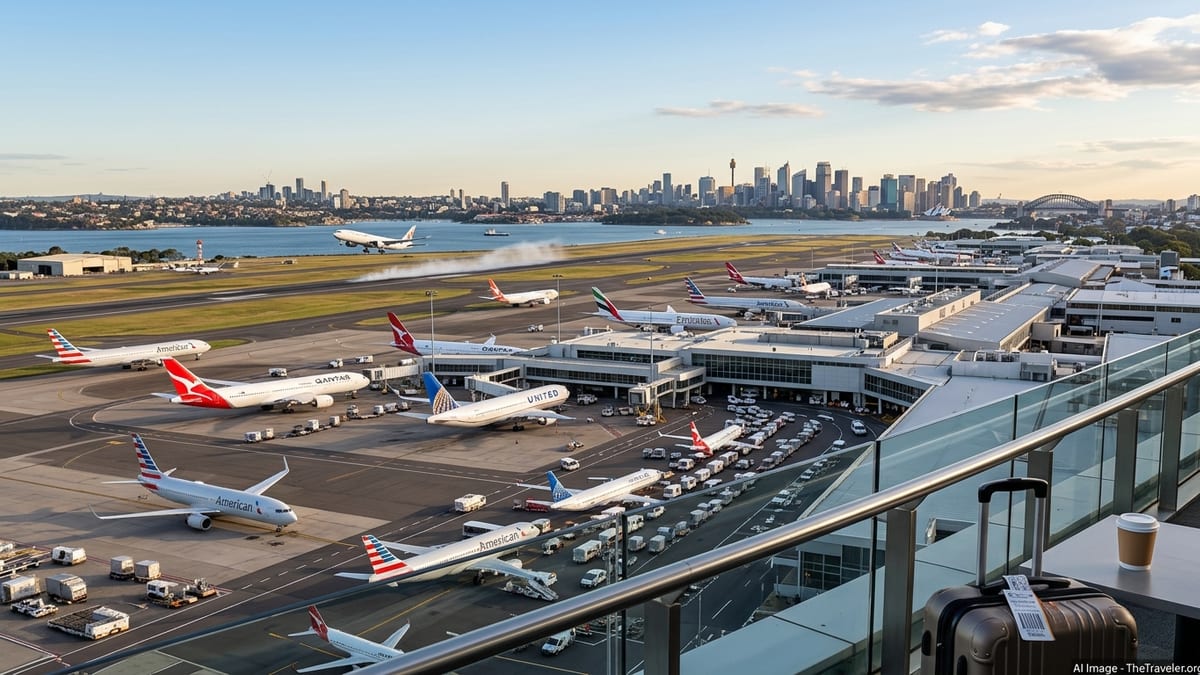
Global holiday calendar converges on late November peak
Late November 2026 is shaping up as a convergence point for several major travel periods, creating heavy pressure on airport capacity worldwide. In the United States, trade group projections for the Thanksgiving travel window between 20 and 30 November anticipate nearly 29 million airline passengers, with the Sunday and Monday after the holiday expected to be the busiest days of the period. This spike coincides with early movements for the southern hemisphere summer, when Australians begin to travel in larger numbers ahead of the December school holidays.
Industry analysis from airline and schedule data providers highlights that global seat capacity for November is running ahead of last year, reflecting both a continued recovery in long-haul demand and additional frequencies on key international routes. North American hubs such as Atlanta and Dallas Fort Worth are forecast to handle more than 2 million departing seats each over the combined late-November and early-December window, underscoring how concentrated the demand is in that narrow time frame.
This demand does not remain contained within one region. Long-haul connections between North America, Europe, the Middle East and the Asia-Pacific funnel passengers through a relatively small group of global hubs. With Sydney Kingsford Smith serving as Australia’s primary international gateway, any upswing in transpacific and Europe-bound traffic tends to be mirrored almost immediately in its terminal passenger counts.
As a result, analysts expect that the final days of November will see parallel peaks across several continents, with Sydney joining the ranks of the busiest airports even as the formal Australian summer holiday period has yet to begin.
Sydney Kingsford Smith’s traffic rebound pushes it up global rankings
Recent passenger statistics show why Sydney Kingsford Smith is now firmly in the conversation about the world’s busiest airports. Government aviation data indicates that Sydney handled more than 2.1 million domestic passengers in March 2026 alone, maintaining its position as Australia’s largest aviation hub. Annual figures compiled from national infrastructure and tourism reports suggest that, when domestic and international traffic are combined, Sydney’s total passenger volumes have rebounded strongly and continue to trend higher.
Global comparisons highlight the scale of that growth. Compilations of worldwide airport traffic show Sydney Kingsford Smith entering the list of the world’s busiest airports by total passengers, with traffic above 29 million and one of the fastest percentage increases among major gateways over the past reporting year. That growth has been driven primarily by the resurgence of international travel, with more than 50 overseas destinations now served nonstop from Sydney.
At the same time, Australian aviation network summaries for November in recent years point to sustained growth in long-haul markets, particularly links to the Middle East, Southeast Asia and New Zealand. These are precisely the routes that see additional capacity in the lead-up to the northern winter and year-end holidays, reinforcing Sydney’s role as a critical interchange for both outbound Australians and inbound visitors.
With this backdrop, aviation planners anticipate that end-of-November schedules through Sydney will feature high load factors across both domestic and international services, placing the airport in the top tier of global hubs by daily passenger throughput.
Western Sydney and other Australian airports share the load
The anticipated late-November surge will not fall entirely on Sydney Kingsford Smith. Long-term planning documents for the Sydney Basin show that, from late 2026, demand will increasingly be shared between the existing Kingsford Smith facility and the new Western Sydney International Airport at Badgerys Creek. Forecasts in environmental and airspace planning reports assume that traffic will be distributed across the two airports as Western Sydney gradually ramps up its operations.
Elsewhere in Australia, other capital city airports continue to expand their own networks, feeding additional traffic into Sydney. Data from domestic aviation activity publications lists Sydney as the country’s leading airport for regular passenger transport movements, but also shows rising passenger numbers through Melbourne, Brisbane, Perth and Adelaide. These airports operate some of the nation’s busiest domestic routes into Sydney, contributing to congestion on key days when connecting passengers join international flights.
Regional tourism gateways, including popular leisure airports in Queensland and South Australia, report year-on-year growth on Sydney routes as well. This means that late-November pressure at Kingsford Smith is driven not only by long-haul visitors, but also by Australians beginning domestic holidays or positioning for onward international services via Sydney.
Collectively, this network effect positions Sydney and a cluster of similar high-traffic airports to experience their busiest days of the year within a relatively tight window at the end of November.
North American and European hubs amplify global congestion
Sydney’s late-November traffic peak is closely tied to activity at major hubs in North America and Europe. Forecasts published ahead of the 2026 Thanksgiving period indicate that United States airports will experience record passenger levels, with particular strain on large connecting hubs. Analyses from travel data firms single out airports such as Hartsfield-Jackson Atlanta, Dallas Fort Worth, Denver and Chicago O’Hare as handling the greatest volumes, measured by scheduled seats and departures.
European air traffic managers are preparing for their own seasonal peaks between early November and late December, with rolling network plans highlighting dense traffic flows across Western Europe’s primary hubs. While European demand is traditionally strongest closer to Christmas and New Year, transatlantic and Middle East connections linked to the U.S. Thanksgiving period add pressure in the final week of November.
These patterns matter for Sydney because they influence airline scheduling and fleet deployment on long-haul routes. When North American and European hubs are stretched, airlines are inclined to maximise aircraft utilisation and seat capacity on trunk routes, including services to Australia. This results in fuller flights and tighter turnaround times at Sydney, aligning its busiest days with those of distant hubs.
In practical terms, the end of November becomes a synchronized stress test for aviation infrastructure on multiple continents, with Sydney Kingsford Smith and other globally connected airports all contending with heightened demand at roughly the same time.
What travellers can expect at the end of November
For passengers, the concentration of demand in the last ten to twelve days of November will be most visible in longer queues, fuller flights and limited flexibility to change travel plans at short notice. Historical records from previous holiday seasons show that security checkpoints, check-in counters and border control areas tend to operate near capacity on the Sunday and Monday following Thanksgiving in the United States, even for flights that never touch American soil.
Publicly available guidance from airlines and travel advisory services consistently recommends arriving earlier than usual for flights during this period, particularly at major hubs such as Sydney, where both departure and arrival halls are expected to be busy across most of the day. Passengers connecting from domestic services into international flights may need to allow additional buffer time, as any disruption on heavily used trunk routes can quickly cascade.
Analysts also point to the likelihood of weather-related disruptions in the northern hemisphere adding complexity to global operations at the end of November. Snow and storms in North America and Europe can ripple through airline networks, causing schedule changes that affect aircraft and crew rotations on long-haul routes, including those serving Australia’s east coast.
Despite these challenges, industry data suggests that airlines and airports have increased capacity and refined operational plans for the 2026 season compared with earlier recovery years. For Sydney Kingsford Smith and its counterparts around the world, the final days of November are set to be a high-intensity period that underscores their status as some of the busiest airports on the planet.