


More news on this day
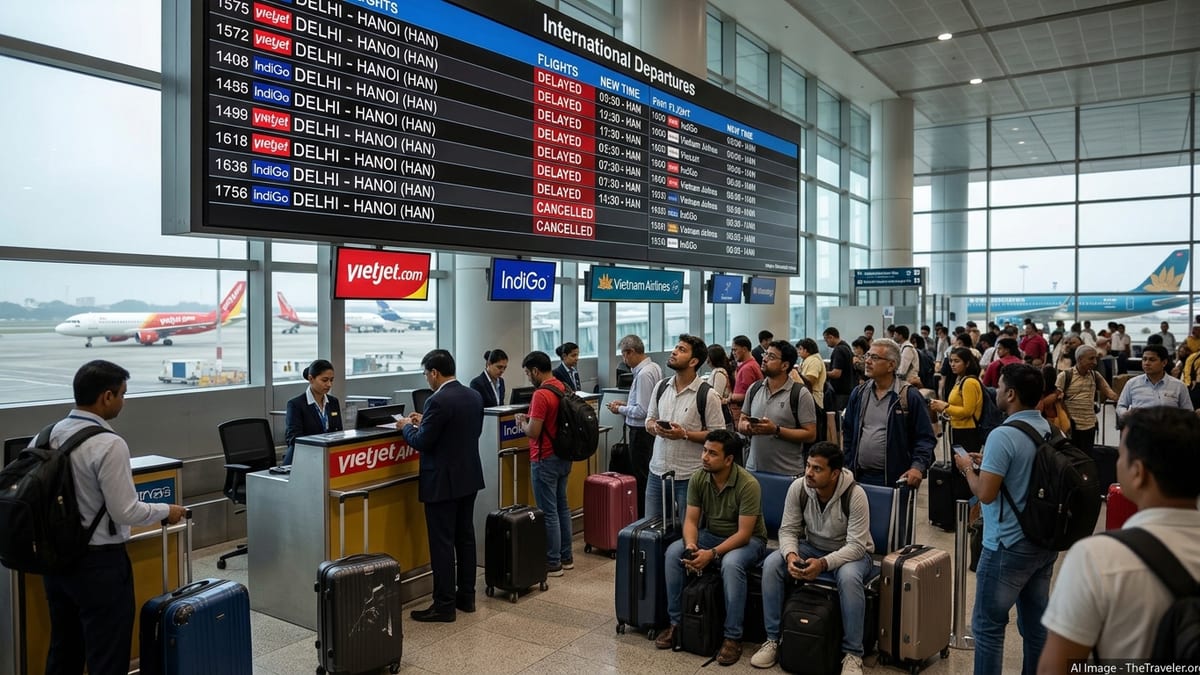
Major airports across Asia are experiencing a fresh wave of disruption, with publicly available tracking data indicating at least 221 flight cancellations and more than 4,800 delays concentrated around hubs such as Hanoi and New Delhi.
Get the latest news straight to your inbox!
Tracking Data Shows Widespread Operational Strain
Real-time disruption trackers that aggregate airline and airport feeds show an elevated level of irregular operations across Asia, with hundreds of flights removed from schedules and thousands operating behind time. The latest snapshots for Sunday, November 15, suggest around 221 cancellations and approximately 4,863 delays across monitored Asian airports, pointing to a system under continued strain rather than isolated incidents on a single route or carrier.
Regional hubs in Vietnam and India are among the most affected. New Delhi’s Indira Gandhi International Airport, one of Asia’s busiest gateways, is reporting a higher than typical ratio of disrupted departures and arrivals, according to aviation analytics platforms that compare live operations against historical baselines. Hanoi’s Noi Bai International Airport is likewise handling a dense sequence of delayed flights that ripple through morning and evening banks of traffic.
Global knock-on effects are contributing to the pressure. Disruptions linked to a recent nationwide ground stop in the United States have compressed long haul schedules into and out of Asia, pushing aircraft and crew rotations off-cycle. Transpacific services bound for Asian destinations have been operating with residual delays, narrowing the recovery window for airlines that rely on tightly timed connections through major Asian hubs.
Hanoi’s Noi Bai Airport Manages Stacks of Late Arrivals
Hanoi’s Noi Bai International Airport is contending with a busy arrival board marked by late inbound flights from around the region and beyond. Live arrival data for November 15 shows a series of services landing behind schedule or with revised estimated times, including regional flights from Shenzhen, Jakarta and Manila as well as multiple services from major Southeast Asian capitals.
Traffic from New Delhi stands out among the delayed operations. A Vietnam Airlines service from Delhi to Hanoi is scheduled to arrive in the early morning, with tracking platforms indicating revised arrival times as the flight progresses. Separate monitoring tools show VietJet services on the same route operating with significant delay, with at least one recent Delhi to Hanoi sector arriving more than two hours later than timetabled.
The pattern is not limited to a single carrier. Aggregated boards for Noi Bai list delayed and rescheduled arrivals across a variety of airlines, including low cost and full service operators. Short haul regional services are particularly exposed, as late inbound aircraft compress turnaround times and leave minimal margin for recovery before the next departure wave. This creates a cascading effect in which a relatively small initial delay can translate into wider slippage across an entire day’s schedule.
Local weather has also played a role in recent weeks. Travellers sharing recent experiences through public forums have described extended holding patterns and diversions around Hanoi during periods of poor visibility or heavy rain, underscoring how seasonal conditions in northern Vietnam can quickly translate into congestion and late arrivals at Noi Bai.
New Delhi Confronts Persistent Delays on Key International Routes
New Delhi’s Indira Gandhi International Airport, a critical connecting point between South Asia and the rest of the world, is facing its own cluster of delays. Flight status tools tracking departures from Delhi indicate that several services to Hanoi have been running late, including overnight departures by VietJet and daytime services by IndiGo and other carriers serving Vietnam.
One VietJet Delhi to Hanoi flight monitored on November 15 departed from Delhi more than two hours behind schedule before making up some time en route. On the same corridor, an IndiGo service recorded a modest departure delay but remained listed as operating close to its revised arrival time into Hanoi, reflecting airlines’ efforts to compress turnaround and flight times where operationally feasible.
These individual examples are set against a broader backdrop of delays at the Delhi hub. Data compiled by specialist trackers shows that while the overall percentage of delayed flights at Delhi remains in single digits, even a small uptick can translate into dozens of affected services in a single day due to the airport’s high traffic volume. Historical metrics for some carriers on the Delhi to Hanoi route show on time performance below 90 percent over recent weeks, reinforcing the perception of a corridor under pressure.
Past episodes have highlighted the vulnerability of Delhi’s operation to disruptions, whether from technical issues affecting air traffic systems or from rapid weather changes that constrain runway capacity. Current conditions appear less acute than previous crises, but the accumulation of moderate delays is still enough to affect connections, missed meetings and onward travel plans for thousands of passengers.
Regional Factors: Weather, Security Events and Tight Schedules
The present surge in cancellations and delays across Asian airports is rooted in a combination of structural and short term factors. Seasonal weather patterns remain a major driver. Parts of South and Southeast Asia are transitioning out of heavy rain and storm seasons, with residual thunderstorms, low cloud and crosswinds continuing to disrupt runway operations on certain days. When weather forces reductions in take off and landing rates, hub airports quickly accumulate queues of departures and arrivals, spilling delays into subsequent time periods.
Security related and political events can add further complexity. Recent advisories around upcoming high level regional summits, for example in Southeast Asia, warn that temporary airspace restrictions and altered airport procedures may lead to schedule adjustments or temporary ground holds. Even when such measures are localized, their impact on aircraft and crew positioning can cascade into wider regional timekeeping as airlines juggle rotations.
At the same time, airlines continue to operate densely packed schedules designed to maximize aircraft use. Industry analyses of past disruption episodes in Asia, including crew scheduling crises and infrastructure outages, show that high utilization leaves limited buffer when external shocks occur. With aircraft expected to complete multiple legs per day across different countries, any significant delay on an early sector may eventually translate into a cancellation if it cannot be absorbed without breaching crew duty limits.
Standardized delay coding systems used by carriers across the world reinforce the picture of multi factor causes. Codes associated with airport capacity constraints, weather conditions, connecting passenger flows and crew availability are all appearing in operational logs reported through industry channels, illustrating how various pressures intersect in today’s disruptions.
What Passengers Can Expect in the Coming Days
While the current figures for cancellations and delays are elevated, they remain within a range that aviation analysts describe as challenging but manageable. Airlines in Asia have refined irregular operations playbooks over successive disruption events, introducing more flexible rebooking policies, clearer digital communication tools and expanded cooperation with partner carriers to reroute stranded passengers where possible.
Travellers passing through hubs such as Hanoi and New Delhi in the near term, however, should be prepared for lingering uncertainty. Publicly accessible arrival and departure boards suggest that rolling delays are likely to continue as airlines work through backlogs and reposition aircraft and crews. Even flights that remain scheduled to operate on time may face last minute adjustments if weather or upstream disruptions intensify.
Consumer protection frameworks in key Asian markets, including India, set out entitlements for passengers affected by cancellations and long delays, typically addressing rebooking options, refunds and limited assistance at the airport. The precise remedies vary by jurisdiction, airline policy and the cause of disruption, so travellers are encouraged by regulators and industry advisories to review the rules that apply to their ticket and to monitor airline notifications closely.
For now, the spike of 221 cancellations and 4,863 delays serves as a snapshot of an aviation system still susceptible to compounding shocks. As airlines, airports and air traffic managers across Asia adjust schedules, upgrade systems and factor seasonal risks into capacity planning, the coming weeks will show whether the current disruption wave eases or evolves into a more sustained stress test for the region’s air travel network.