


More news on this day
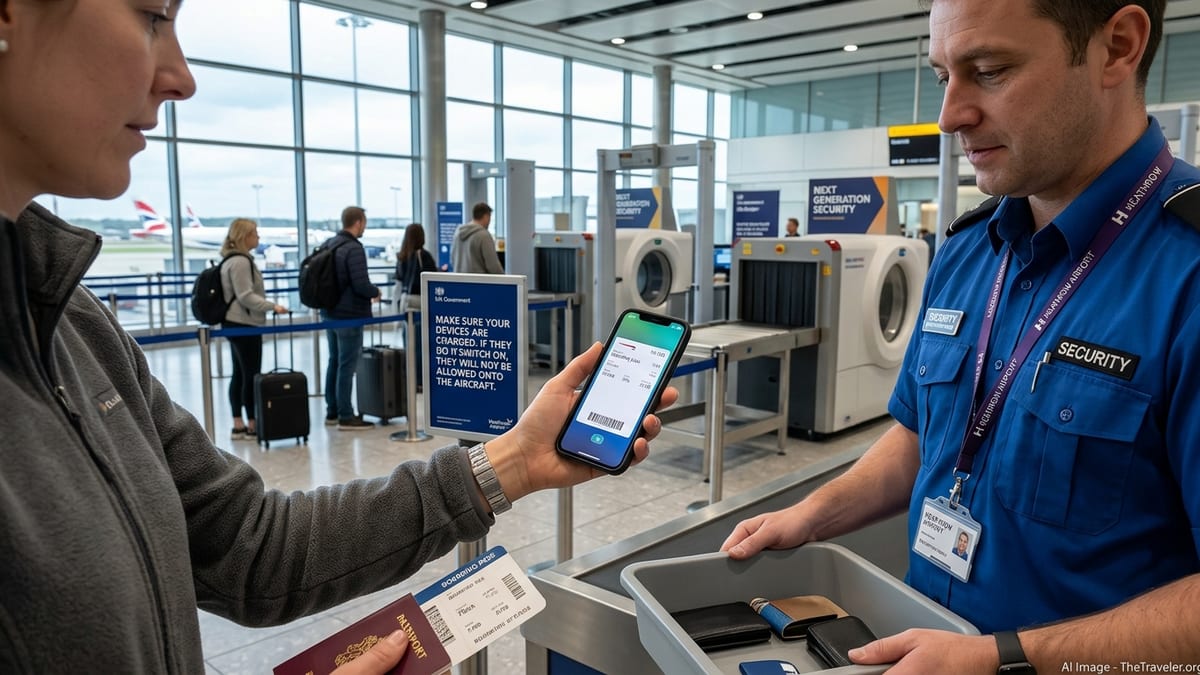
The UK government is reminding air passengers that mobile phones, laptops and other electronic devices in hand luggage must be charged sufficiently to be switched on at security, warning that items which cannot be powered up when requested may be refused carriage on flights departing the country. The clarification, highlighted in updated guidance for travellers using UK airports in 2026, affects anyone carrying personal electronics through security and matters because non‑compliant devices can be held back even if their owners are still allowed to fly.
Get the latest news straight to your inbox!
What the current UK rule actually says
The central requirement is set out in the UK government’s hand luggage guidance on electronic devices and electrical items. Travellers are told to make sure that phones, tablets, laptops and similar devices are charged before travel and are warned that if a device does not switch on when requested at security, it will not be allowed onto the aircraft. This applies to flights departing from UK airports and, on some routes, to flights arriving into the UK as well, reflecting aviation security directions issued by the Department for Transport.
Individual airports echo that message. London City Airport, summarising Department for Transport directives, advises that on some routes into and out of the UK passengers may be asked to show that electronic devices in hand luggage are powered up and notes that, if they cannot be turned on, they may not be accepted in the cabin. Heathrow’s security and baggage guidance similarly cautions that if a device cannot be switched on during screening, passengers may not be able to take it on board, reinforcing that the risk is removal of the item rather than automatic denial of boarding.
Airlines build the same expectation into their own passenger information. British Airways, for example, tells customers that any device carried in hand baggage must be fully charged because airport security staff may ask for it to be turned on. While checks are not universal on every journey, the consistent message from government, airports and carriers is that passengers should assume they could be asked to power up devices at any UK security checkpoint.
How the rule is applied at UK airports
UK security screening is based on a layered system, combining local airport procedures with national requirements. The power‑on rule for electronics sits alongside rules on liquids and baggage screening and can be enforced at any UK airport, even where next generation scanners are in use. Airports such as Heathrow and Gatwick explain that, although advanced scanners may reduce the need to remove laptops and tablets from bags in some lanes or terminals, security staff can still request that a device be produced and switched on if they need additional confirmation about what it is.
Examples from airport guidance illustrate how this works in practice. London City Airport points out that the power‑on requirement is particularly relevant on certain routes that are subject to enhanced security measures, reflecting Department for Transport risk assessments. At other airports, the emphasis is more general: passengers are told that electronic devices should be charged and that, where a device cannot be turned on, security has discretion to deny it passage beyond the checkpoint. This discretion is central to UK aviation security law, which permits airports to impose more stringent checks than the published minimum where they consider it necessary.
There is no publicly available list of flights or destinations where power‑on checks are guaranteed, and the Department for Transport does not publish detailed screening protocols for security reasons. As a result, travellers should not rely on past experience of rarely being asked to start devices. The formal position remains that any passenger may be selected, and that selection can occur at the main search area or, in some cases, at the boarding gate on specific routes.
Why UK authorities are stressing charged devices in 2026
The renewed attention to uncharged electronics comes as the UK continues its multi‑year programme to install next generation security checkpoints, including new computed tomography scanners, across major airports. Government legislation and supporting documents on aviation security note that the roll‑out of new screening technology has prompted a wider review of how cabin baggage and electronic items are screened, with the aim of maintaining or enhancing security while simplifying the process for passengers where possible.
At the same time, security agencies remain wary of the potential misuse of consumer electronics. Official impact assessments and regulatory explanations describe how screening rules are designed to counter evolving threats, including the possibility that portable electronic devices could be modified to conceal prohibited items. Requiring that devices be capable of powering on when inspected is a relatively low‑burden way to provide additional assurance that a phone or laptop is what it appears to be, and it complements more sophisticated imaging systems now being introduced.
Industry bodies have responded by updating their travel advice. The UK travel association ABTA, for example, has issued guidance on new security scanners that reminds holidaymakers to check airport‑specific rules and underlines that, regardless of changes to liquid rules at some airports, requirements concerning electronic devices still apply. Together, these developments help explain why the government and airports are again foregrounding a rule that has technically existed for several years but is now being emphasised to prevent last‑minute problems at the checkpoint.
What this means in practice for travellers
For passengers, the immediate consequence is that there is a real risk of losing access to phones, laptops or tablets on a trip if they run out of power before security. Official guidance explains that if a device cannot be switched on when requested, security staff may retain it, ask the passenger to place it in hold baggage if time and airline rules allow, or refuse to let the item travel. The passenger will normally still be able to take the flight, but will do so without the device unless alternative arrangements such as leaving it with a companion or collecting it later are possible under the airport’s procedures.
This can be particularly disruptive on international journeys where a smartphone often holds boarding passes, hotel confirmations, rail tickets and digital payment methods. Travellers on tight connections are also at higher risk because they have less time to seek charging facilities if a device battery is low on arrival at the airport. The risk is not limited to obvious electronics such as laptops and phones; e‑readers, handheld games consoles and some medical devices can all attract additional scrutiny and may need to be demonstrated as functional.
Passengers should also remember that rules at their destination may be stricter or differently enforced. A UK airport with advanced scanners may not require laptops to be removed from bags on departure, but a return journey from an airport without that equipment might still involve conventional x‑ray screening, separate trays for electronics and a higher likelihood that devices will be individually inspected and powered on. Travellers making multi‑segment trips through several countries therefore need to keep devices charged for the entire itinerary, not only for the first UK departure.
How to reduce the risk of problems with uncharged devices
Authorities and airlines do not prescribe a specific battery percentage, but their published advice points to several practical steps that significantly cut the chance of devices being held back. The Department for Transport and multiple airports tell passengers to fully charge devices before leaving for the airport and to avoid heavy use of phones or tablets while queueing for check in and security. British Airways and other carriers caution that passengers should not rely on being able to recharge before the checkpoint, since power outlets may be limited or unavailable in landside areas.
Carrying an external power bank in hand luggage is permitted under general UK dangerous goods rules provided it contains lithium batteries within airline‑approved limits. However, some airlines, such as Loganair, state that power banks must not be used to charge devices on board the aircraft itself. Travellers may therefore find power banks most useful in the terminal before boarding and on arrival, rather than during the flight. As always, passengers should check their airline’s specific policy on portable batteries and charging to avoid conflicts at the gate.
Looking ahead, the power‑on requirement is expected to remain part of the UK’s aviation security regime even as next generation scanners change other aspects of the screening experience. Government legislation and airport statements indicate that further updates to security rules are likely as the new equipment becomes standard across the network, but they give no indication that the basic expectation of being able to turn on electronic devices will be removed. For now, the most reliable preparation for travellers is simple: charge every device that will go in hand luggage, carry only what is needed and be ready, if asked, to prove that each item works.