


More news on this day
Fresh federal airfare data and independent pricing analyses suggest that travelers who route winter trips through Orlando Sanford International and similar secondary airports can pay dramatically less than passengers using nearby major hubs, underscoring how airport choice is reshaping the cost of flying in the peak holiday and early 2026 season.
Get the latest news straight to your inbox!
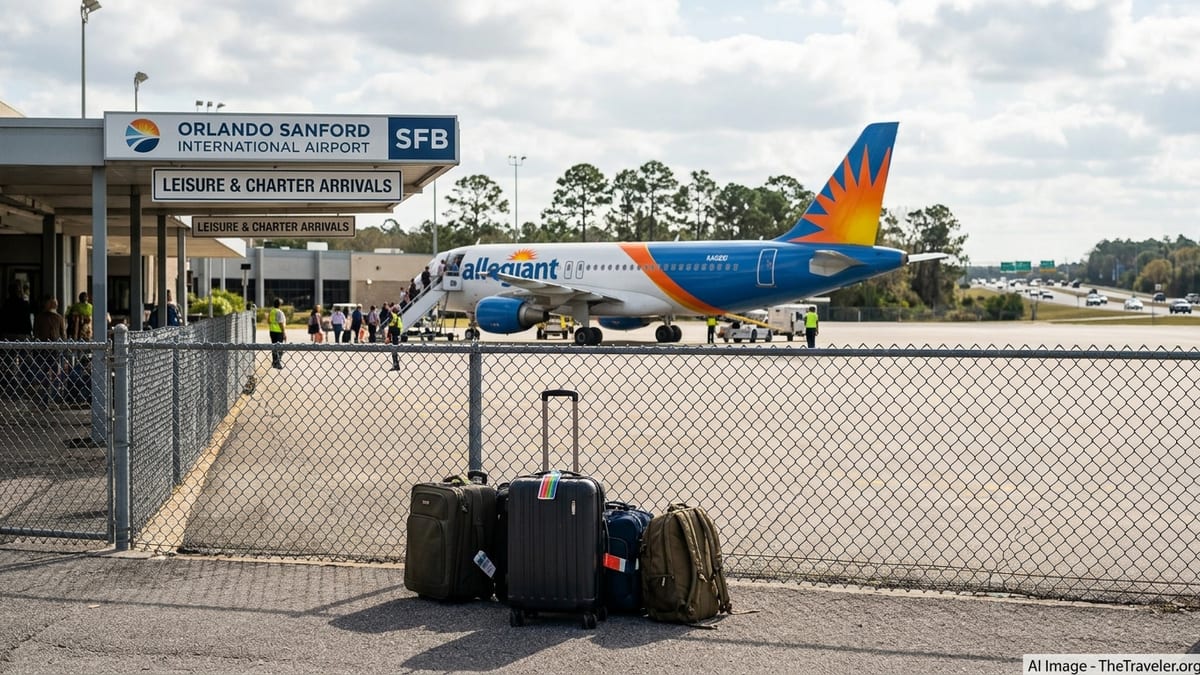
Sanford’s Bargain Fares Stand Out in Federal Data
Recent figures from the U.S. Department of Transportation’s Domestic Airfare Consumer Report show Orlando Sanford International Airport ranking among the lowest priced commercial airports in the country. In the most recent quarter of 2025 analyzed, Sanford’s average domestic fare was reported at just under 100 dollars each way, with a fare “discount” of close to 60 percent compared with the national average ticket price out of U.S. airports.
That positions Sanford in a small group of aggressively priced leisure airports such as St. Petersburg–Clearwater and Punta Gorda in Florida, where low cost carriers concentrate on nonstop links to smaller and mid sized cities across the Midwest and Northeast. The federal data indicate that virtually all of Sanford’s passenger traffic falls into what regulators classify as low fare markets, reflecting the dominance of ultra low cost carrier Allegiant Air on the airport’s route map.
By contrast, nearby large hubs that also serve Central Florida tourists, including Orlando International and Tampa, report average fares that are more than double Sanford’s levels in some recent comparisons compiled from federal statistics and airport finance reports. That spread gives a numerical backbone to the perception among many budget travelers that Sanford functions as a discount gateway to the Orlando theme park region, especially during winter peak demand.
The trade off is that Sanford’s network is narrower and more seasonally focused than its larger neighbor. While Orlando International hosts a broad mix of legacy, low cost and international airlines with hundreds of daily departures, Sanford’s schedule centers on Allegiant’s less frequent flights to specific origin cities, which can limit flexibility even as it keeps base fares low.
Winter Fares Climb Nationally, but Not Evenly
Sanford’s low averages stand out against a national backdrop of rising ticket prices heading into winter. Analyses of federal statistics published this autumn indicate that the typical domestic fare climbed through the first half of 2026, reaching the highest levels in roughly a decade as airlines responded to higher jet fuel costs and capacity constraints.
Industry research from travel booking platforms such as Hopper and forecasts cited in consumer finance coverage point to elevated prices for Thanksgiving, Christmas and New Year travel compared with both 2024 and 2025. Some reports describe “good deal” fares in early 2025 as running more than 10 percent higher than a year earlier, with leisure travelers facing fewer deep discounts close to departure.
Yet those averages mask sharp differences by airport and carrier type. Data highlighted in regional airport briefings show that smaller, leisure focused airports dominated by low cost airlines still post average fares well below national norms, even as major hub airports from Detroit to Portland record domestic round trip prices routinely above 400 dollars. The result is a patchwork in which a traveler’s origin and destination airports matter almost as much as their booking timing.
For winter vacationers heading to Central Florida, that means the gap between Sanford and Orlando International can be especially pronounced during holiday peaks. Sampling of December 2026 itineraries by independent fare trackers shows sub 100 dollar one way offers on select Allegiant routes into Sanford, while many comparable dates into Orlando International price significantly higher, especially in the days immediately before Christmas.
Secondary Airports Across the U.S. Mirror Sanford’s Profile
Sanford is not an isolated case. Recent airport traffic and route summaries from mid sized U.S. cities such as Evansville, Sioux Falls, Bangor and others list Orlando Sanford among their busiest leisure destinations, almost always served by Allegiant as the sole carrier on the route. In many of these markets, Sanford competes directly with Orlando International, which may be served by a different low cost airline such as Breeze Airways.
Published passenger statistics for several of these regional airports show tens of thousands of travelers each year choosing Sanford over larger Florida hubs. Analysts note that the appeal is simple: packages of low base fares, nonstop flights, and smaller terminals that are easier to navigate in winter weather. Community studies filed with federal regulators have also pointed out that itineraries routed through low fare airports like Sanford can shave well over 100 dollars off the average ticket for residents of certain catchment areas.
The pattern is echoed elsewhere in the United States. Government fare tables highlight a group of leisure orientated airports, including Myrtle Beach, certain Gulf Coast fields and other secondary Florida gateways, that consistently post fare discounts of 20 percent or more versus the national mean. In each case, the presence of one or two ultra low cost carriers appears to be the key driver of lower winter fares.
However, these savings often come with conditions. Ultra low cost business models rely on ancillary fees for bags, seat selection and priority boarding, and on operating limited frequencies. For travelers weighing Sanford or similar airports, the apparent fare advantage in federal statistics may shrink once those extras and the cost of ground transportation are added.
Ground Access and Hidden Costs Shape the Real Price
While Sanford’s advertised fares are strikingly low, the total cost of a winter trip can be more complex. Sanford lies north of Orlando’s major attractions, and public transportation links remain limited compared with Orlando International. Travelers frequently depend on rental cars or ride hail services, and anecdotal pricing shared in travel forums suggests that a one way ride between Sanford and the main resort corridor can cost several dozen dollars, especially at busy times.
Orlando International, by contrast, sits closer to the tourist district and is better integrated into regional road and transit networks. For families or groups landing late at night in winter, the extra travel time and expense from Sanford may eat into or even outweigh some of the initial savings from a cheaper ticket, particularly when baggage and seat fees are factored in.
Similar dynamics are reported at other secondary airports nationwide. Community and airline submissions to regulators have highlighted that travelers sometimes drive long distances past a nearby hub to reach a low fare field, in hopes of saving on airfare. Analysts caution that when fuel prices, parking, tolls and extra travel time are considered, the overall financial advantage may narrow.
Still, for many cost conscious travelers within a reasonable drive, the combination of low fares and less congested terminals keeps secondary airports like Sanford attractive, especially during winter, when weather disruptions and long security lines can complicate operations at larger hubs.
How Travelers Can Use Airport Choice to Cut Winter Costs
With national airfare benchmarks trending higher into the 2026 winter, travel experts advising in consumer reports point to airport flexibility as one of the most effective levers for savings. Historical pricing data gathered by fare prediction tools and booking sites generally show that shifting departure or arrival airports, when possible, can cut ticket prices by double digit percentages, particularly in leisure markets.
For travelers considering Central Florida this winter, comparing itineraries into both Orlando International and Orlando Sanford, as well as Tampa or other regional fields, can reveal sizable differences for the same travel dates. Federal statistics underscore that low fare airports may offer especially competitive prices in the shoulder weeks after New Year, once the peak holiday surge has passed.
Research also suggests that booking domestic winter trips roughly one to two months ahead of departure tends to capture many of the best deals, with January and early February often standing out as lower priced windows after the first week of the year. When combined with the structural fare advantage at airports like Sanford, that timing can further compress costs.
Ultimately the new data on Sanford and comparable secondary airports highlight that winter airfare is no longer a simple function of destination alone. As jet fuel costs and capacity decisions continue to push national averages higher, the choice of airport, airline type and travel week increasingly determine whether a winter escape feels affordable or out of reach.