


More news on this day
A cascading wave of flight disruptions swept across the United States over the weekend after a nationwide aviation systems failure, leading to 1,651 cancellations and 4,241 delays, with Chicago’s busy O’Hare and Midway airports among the hardest hit.
Get the latest news straight to your inbox!
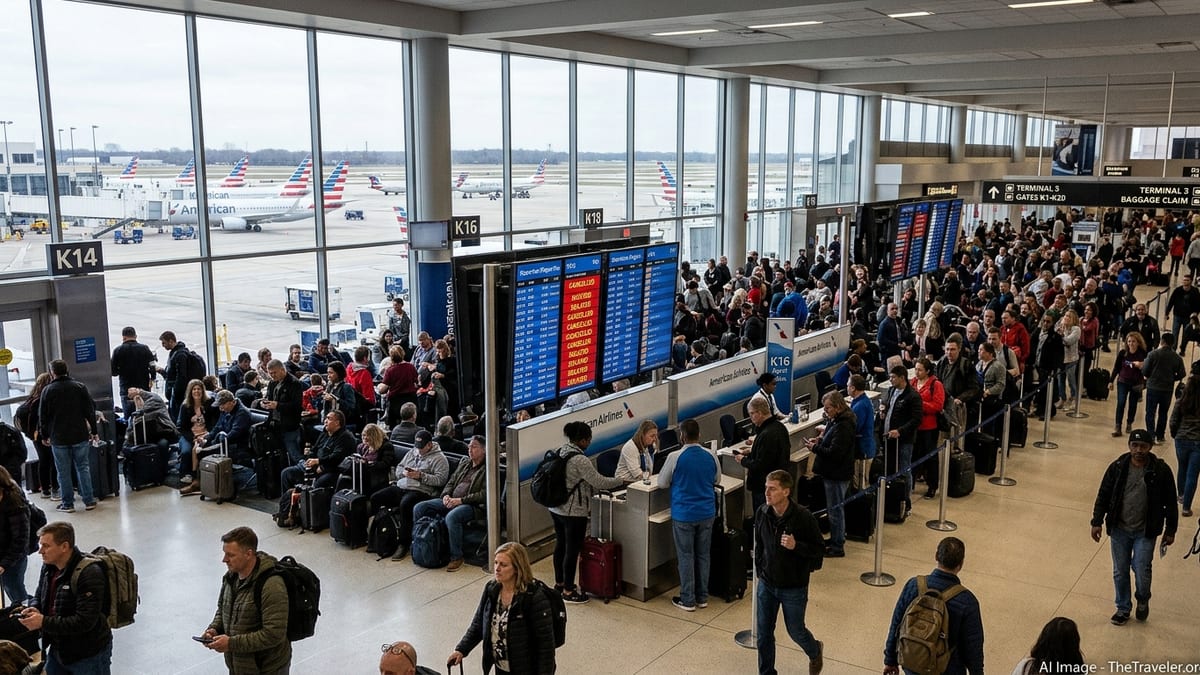
Nationwide Ground Stop Triggers Widespread Disruption
Publicly available flight-tracking data shows that the disruptions began on Friday, when a rare nationwide ground stop halted departures at airports across the United States. Aviation analytics firms reported that the immediate fallout stretched into Saturday and Sunday, as airlines struggled to reposition aircraft and crews after the system outage.
Industry data compiled over the weekend indicated that, at one point, U.S. airports collectively recorded around 1,651 cancellations and more than 4,200 delays in a single reporting window, underscoring the scale of the breakdown. Those figures compare with a typical day when only a fraction of scheduled flights are normally scrubbed.
According to aggregated reports, the disruption was linked to a telecommunications failure that affected critical systems used to manage air traffic and route information. While federal agencies and aviation experts continue to examine the chain of events, early indications in published coverage suggest that the issue was tied to recent infrastructure work on key communication lines.
Flight-tracking platforms and airline status boards reflected the turmoil in real time, with maps showing dense clusters of delayed and canceled flights concentrated around the country’s largest hubs. Travelers experienced rolling delays as the system came back online, often facing long waits even after the nationwide ground stop was lifted.
Chicago’s O’Hare and Midway Emerge as Major Trouble Spots
Chicago’s dual-airport system, already one of the busiest in the world, quickly became a focal point for the disruption. Data published by the Chicago Department of Aviation and local media reports show that on Friday evening, O’Hare International Airport recorded more than 300 cancellations and well over 800 delays within hours of the nationwide order being issued.
Midway International Airport, the city’s secondary but still heavily used facility, also faced mounting complications. Initial tallies on Friday cited dozens of cancellations and close to 200 delays at Midway, according to local news coverage drawing on airport and FlightAware figures. Those numbers continued to climb into Saturday as the ripple effects of grounded aircraft and displaced crews worked through the system.
By Saturday, cumulative data cited in regional outlets pointed to hundreds more cancellations at O’Hare and additional cancellations at Midway, placing Chicago among the hardest hit metro areas in the country. Even as weather remained largely manageable, the residual operational challenges kept departure boards in flux.
On Sunday, Chicago broadcasters reported that more than 100 flights at the two airports were still canceled as carriers labored to stabilize schedules. Official delay boards for O’Hare and Midway showed improvement compared with peak disruption, but travelers were still advised through public messaging to verify departure times and be prepared for last-minute changes.
Airlines Race to Restore Schedules and Reposition Crews
Across the United States, airlines spent the weekend working to rebuild their networks after the sudden halt to operations. Public statements and media briefings from airline representatives emphasized that crews and aircraft were frequently out of position, resulting in a rolling series of delays that continued long after the underlying systems problem had been addressed.
Industry analysts quoted in national coverage explained that a ground stop on this scale effectively scrambles the tightly choreographed movements that keep major carriers running. Aircraft that were supposed to operate multiple legs in a day remained parked for hours, and flight crews often exceeded their legal duty limits before they could complete their planned schedules.
As a result, cancellations accumulated not only where the outage initially hit hardest but also at secondary airports that depend on arriving planes and personnel from major hubs. Reports from several carriers indicated that spare aircraft were in short supply, forcing schedule thinning and consolidation of some services.
By late Saturday and into Sunday, publicly available information from aviation agencies suggested that flight volumes were gradually returning to normal ranges. However, transportation officials and airline executives, speaking in televised appearances and written statements, cautioned that scattered disruptions could persist through the end of the weekend as remaining passengers were rebooked.
Travelers Face Long Lines, Missed Connections and Uncertain Plans
For passengers, the statistics translated into hours spent in terminals and on tarmacs. National and local outlets documented scenes of crowded check-in counters and customer service desks, particularly at major transfer hubs such as Chicago, Atlanta, New York and Dallas, where travelers scrambled to secure alternate itineraries.
Reports highlighted instances of flights sitting at gates or on taxiways for extended periods while dispatchers and air traffic managers worked through evolving restrictions. Some passengers opted to abandon air travel altogether, turning to rental cars or intercity buses when it became clear that their connections would not be restored in time.
Consumer advocates appearing in weekend broadcasts urged travelers to keep documentation of expenses related to hotel stays and meals, noting that reimbursement policies vary significantly from one airline to another. At the same time, online travel forums and social media posts captured widespread frustration over limited rebooking options on already full flights.
Despite the difficulties, aviation analysts pointed out in published commentary that safety protocols and system safeguards remained the priority throughout the episode. The decision to halt flights nationwide, while disruptive, was described as a measure taken to prevent more serious consequences while technicians addressed the underlying problem.
System Vulnerabilities Renew Debate Over Aviation Infrastructure
The wave of cancellations and delays has prompted renewed debate over the resilience of the U.S. aviation system. Editorials and policy discussions over the weekend questioned how a single telecommunications outage could cascade into such far-reaching disruption across one of the world’s most developed air networks.
Transportation officials speaking in televised interviews emphasized ongoing efforts to modernize air traffic control infrastructure, pointing to multi-billion-dollar funding packages meant to upgrade hardware and software. Nevertheless, the latest incident added to a series of recent technology-related breakdowns that have periodically snarled travel in the United States.
Aviation experts cited in national reporting argued that redundancies, backup communication channels and more robust testing of upgrades will be critical to restoring traveler confidence. They also highlighted the increasing interconnectedness of airlines’ internal systems with federal infrastructure, making coordinated planning essential.
For now, the immediate focus for airlines and airports remains on clearing the backlog and restoring normal operations. Yet the figure of 1,651 cancellations and 4,241 delays, and the scenes from Chicago and other hubs over the weekend, are likely to fuel calls for a deeper review of how the nation’s air traffic systems are built, maintained and overseen.