


More news on this day
France has fully joined Germany, Spain, Italy, Greece, the Netherlands, Portugal, Austria and other Schengen members in applying the European Union’s new Entry/Exit System, creating a shared digital border for non EU nationals on short stays and ending the era of routine passport stamping at external frontiers.
Get the latest news straight to your inbox!
A New Phase in Schengen Border Controls
The Entry/Exit System, or EES, is now operational across 29 European countries, including all Schengen states as well as recent joiners such as Croatia, Bulgaria and Romania. The system digitally records the entry, exit and refusals of entry for non EU nationals travelling for short stays of up to 90 days in any 180 day period. It replaces the long standing practice of manually stamping passports at land, sea and air borders.
Publicly available information from European institutions indicates that the EES entered into operation in October 2025, followed by a progressive rollout at external border crossing points, and became fully operational in April 2026. With France now applying the system alongside major destinations such as Germany, Spain, Italy, Greece, the Netherlands, Portugal and Austria, a largely uniform digital border regime has taken shape around the Schengen Area.
The new infrastructure is intended to strengthen the management of the external border while facilitating legitimate travel. Each crossing is registered in a central database, along with the traveller’s passport data and, in most cases, biometric identifiers. This creates a digital trail that replaces reliance on ink stamps and manual counting of days spent in the Schengen zone.
The move places France firmly within a wider European shift toward data driven border management. Travellers arriving in Paris, Marseille, Lyon or at major land and sea crossings now encounter procedures that mirror those in Madrid, Berlin, Rome or Athens, with the same underlying information system verifying each entry and exit.
How the Digital Border Works for Short Stay Visitors
The EES applies to non EU nationals who are travelling for a short stay in the Schengen Area, whether they are visa exempt visitors, such as many travellers from the United States, Canada or the United Kingdom, or holders of a short stay Schengen visa. Citizens of EU and Schengen associated states and holders of long stay residence permits are not registered in the system for their movements within the area.
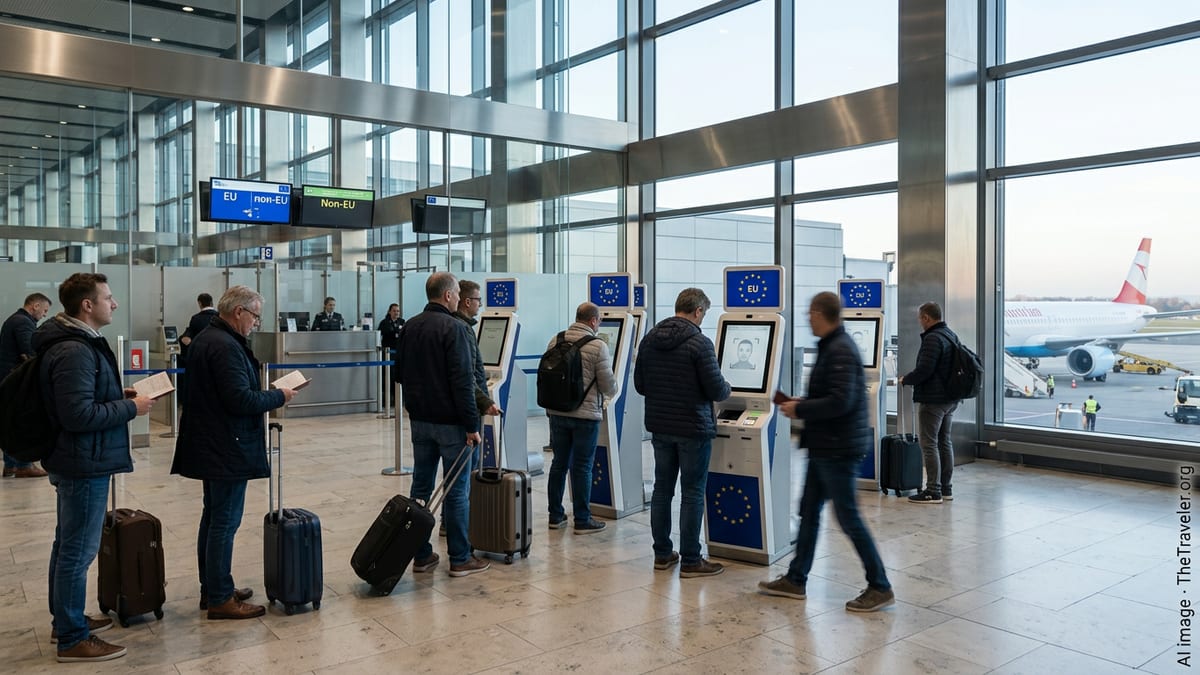
On a first encounter with the digital border, travellers are asked to provide personal data contained in their passport along with biometric information, typically a facial image and fingerprints. These details are captured at staffed counters, self service kiosks or automated border gates, depending on the airport or crossing point. The registration is expected to remain valid for multiple years, reducing the need to repeat the full enrolment process on every trip.
Once registered, the system automatically calculates how many days a traveller has spent in the Schengen Area within the rolling 180 day window. This addresses a longstanding challenge for both travellers and border services, who previously relied on stamps and manual checks to determine whether the 90 day limit had been exceeded. The digital record is designed to flag potential overstays more reliably than paper based methods.
For visitors, this means that time spent in France now counts seamlessly with days in Germany, Spain, Italy, Greece, the Netherlands, Portugal, Austria and all other participating states. The concept of a common Schengen clock is not new, but the EES transforms it into an instantly visible data point for border officers, reducing ambiguity at crossings.
Impact on Airports, Queues and the Travel Experience
The introduction of biometric registration and new kiosks has reshaped the flow of passengers at major European airports. Reports from aviation industry groups and travel outlets describe longer queues at some terminals, particularly during the initial months when many travellers encountered the system for the first time and needed to complete full enrolment.
French hubs such as Paris Charles de Gaulle and Orly are now managing the same adjustment pressures seen earlier in Spain, Italy, Germany, Greece, the Netherlands and Portugal. First time EES users need additional time at the border to capture fingerprints and facial images, which can slow processing during peak holiday periods. Once registration is complete, subsequent crossings are generally quicker, but demand management at busy airports remains a central concern.
European institutions and national authorities have promoted the use of self service kiosks and automated gates to limit congestion. In many locations, travellers are encouraged to carry out data capture and questionnaire steps at kiosks before approaching a staffed desk or e gate. Some airports are also making use of designated EES lanes, signage campaigns and additional staff to guide passengers through the unfamiliar procedures.
For non EU visitors heading to France, the key change is the need to factor biometric registration time into arrival plans, especially when connecting to onward flights or trains. While the long term goal is smoother, more predictable border crossings, the transition phase has brought visible disruption in some of Europe’s busiest terminals.
Data, Security and the End of Passport Stamps
According to official summaries, the EES stores each traveller’s identity data, biometric records and a history of entries and exits for a limited retention period, longer in cases where an overstay is recorded. The database is managed at EU level and connected to national border systems, creating a shared pool of information that can also interact with other large scale European security and migration platforms.
Supporters of the system argue that the new architecture will make it easier to detect identity fraud, document abuse and repeated attempts to circumvent the 90 day rule. Early case studies published by European bodies point to instances where biometric checks at the border have revealed multiple identities or irregular stay histories that were more difficult to uncover under the stamp based regime.
The move away from passport stamps has symbolic as well as practical consequences for travellers. While many visitors have regarded stamps as a tangible record of their journeys, the Schengen Area is now shifting toward a model in which these movements are captured entirely in digital form. In the event of a system outage, guidance indicates that manual stamping can still be used as a contingency measure, but this is no longer the primary tool for monitoring stays.
Privacy advocates have raised questions about data protection, access by law enforcement bodies and the long term implications of mass biometric collection. EU level materials emphasize safeguards such as limited retention, strict access conditions and independent oversight. Travellers entering France or any other participating state are advised to familiarise themselves with these rules and with national information campaigns explaining rights and obligations under the new system.
Looking Ahead: ETIAS and a Fully Digital Travel Chain
The full activation of the EES sets the stage for the next major change in European travel, the European Travel Information and Authorisation System, known as ETIAS. According to public timelines, ETIAS is due to follow after the EES and will apply primarily to visa exempt third country nationals, requiring an online travel authorization to be obtained before departure.
When both systems are in place, a non EU visitor planning a short stay in France, Germany, Spain, Italy, Greece, the Netherlands, Portugal or Austria will typically need to secure ETIAS approval in advance and then undergo EES registration on arrival at the external border. The combination is intended to bring the Schengen Area closer to the digital pre screening and biometric border models already in use in other parts of the world.
France’s full participation in the EES therefore represents more than a technical update. It signals a broader shift in how Europe manages and experiences travel, with data driven controls at the core of a new border reality for millions of visitors each year. As the summer peak approaches, airlines, airports and rail operators are adjusting operations and communications in response, while travellers adapt to a landscape where the most important stamp on their journey is now invisible.