


More news on this day
France has become the latest flashpoint in Europe’s troubled rollout of the new Entry/Exit System, as reports of long queues, missed flights and suspended checks add to mounting concern over summer travel across the Schengen area.
Get the latest news straight to your inbox!
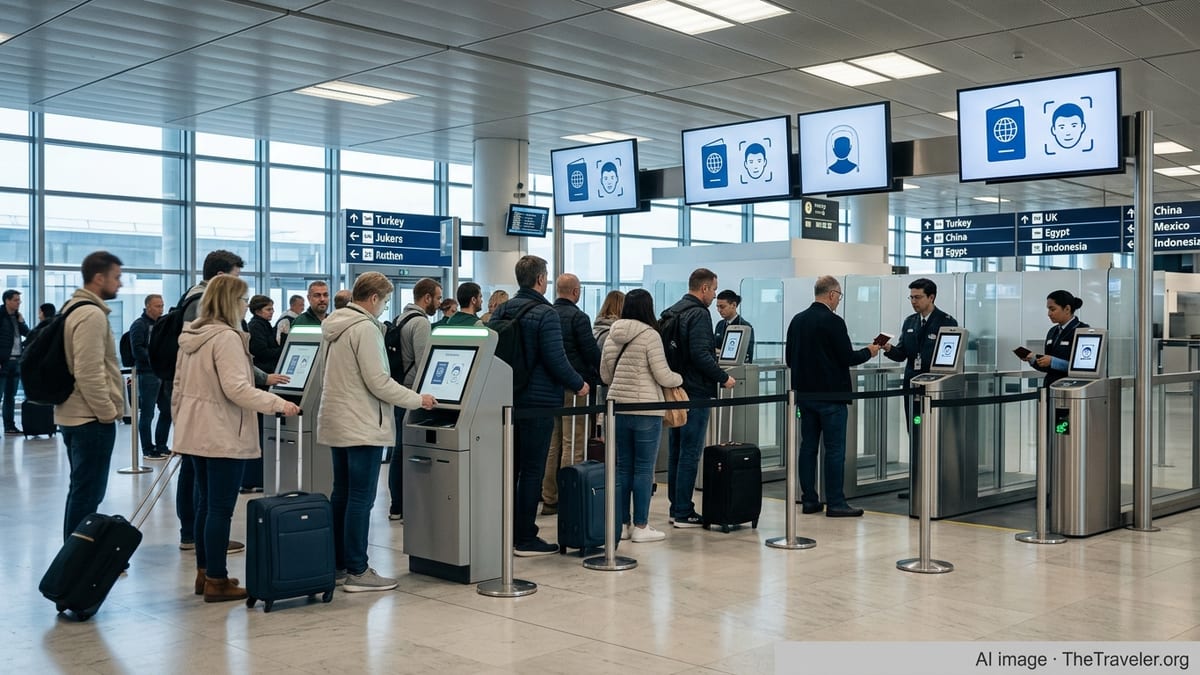
Biometric border shake-up collides with peak travel season
The European Union’s Entry/Exit System, a biometric database for non-EU travelers replacing manual passport stamps, moved into full operation across Schengen external borders on 10 April 2026. Publicly available information from EU institutions describes the project as a cornerstone of a wider digital border upgrade intended to tighten security and automate checks for an estimated 1.3 billion crossings each year.
In practice, the first weeks of full-scale use have been marked by bottlenecks from Paris to Athens. Travel industry circulars and airport advisories describe queues of two to three hours at many external-border hubs, even outside the core summer rush. Airlines and airports argue that adding fingerprinting and facial scans to traditional passport inspections has increased average processing times per traveler while many border checkpoints are still relying on a mix of manual workarounds and partially deployed kiosks.
Passenger-facing guidance from carriers now routinely urges non-EU visitors to arrive significantly earlier than before their flight. Some airlines are advising passengers to allow an extra hour at departure airports that handle large volumes of transatlantic and long haul traffic into France, Spain, Italy, Greece and Portugal, warning that the first EES registration can take several minutes per person when lines are busy.
European airport and airline associations have repeatedly raised concerns that the combination of full EES implementation and record summer demand could produce a level of disruption comparable to the post-pandemic chaos seen in 2022. In a recent joint communication, they called for more staffing, technical fixes and the option to temporarily relax some EES obligations during critical peaks.
France joins list of high-pressure Schengen gateways
French airports have quickly emerged among the most affected gateways as the new system beds in. Travel advisories and tour operator updates describe lengthy queues at major hubs handling long haul arrivals, with some passengers reportedly waiting up to two hours at border control while biometric kiosks are taken offline or reset.
Coverage focused on France indicates that technical glitches with automated registration equipment, combined with insufficient staffing at manual booths, have turned what was designed as a streamlined process into a chokepoint. Some terminals have resorted to opening overflow lanes and reverting to manual checks when the system slows down, adding unpredictability for both passengers and airlines operating tight connection windows.
French delays are part of a wider pattern emerging across the bloc. Recent reports from Spain, Italy and Greece describe similar scenes of crowded arrival halls as first-time EES registrants queue for fingerprint scans and photo capture. Airports in tourist-heavy coastal regions appear to be particularly stretched, with staff juggling a mix of inexperienced leisure travelers and regular business visitors adapting to the new steps.
Belgium has also reported severe congestion at Brussels Airport, where passenger groups and local media have highlighted “totally unacceptable” queues at border control. The hub’s management has issued repeated public warnings that, without rapid adjustments, summer arrivals and departures could tip into what some describe as near-chaotic conditions.
Portugal’s Lisbon move highlights growing pressure for flexibility
Among Schengen countries grappling with EES, Portugal has taken one of the most eye-catching steps. Earlier this month, local travel outlets reported that Lisbon Airport suspended EES checks for a three-month period after facing extreme wait times during the early stages of full rollout. Accounts cited queues that in some cases stretched to several hours for non-EU passport holders.
The temporary halt at Lisbon has been interpreted by many observers as a test case for how much flexibility national authorities might exercise as the system collides with summer demand. While EES remains legally in force at the EU level, industry bodies have been pushing for clear rules that would allow airports to scale back or temporarily suspend biometric registration when lines become unmanageable.
Reports from aviation trade groups suggest that Lisbon is not alone in experimenting with targeted pauses or reduced use of automated kiosks. Smaller regional airports in Greece and Spain are understood to be alternating between full biometric processing and simplified checks at times of peak congestion, in some cases prioritizing passengers with imminent connections.
Travel organizations warn, however, that inconsistent practices across Schengen can create confusion for passengers who are unsure what to expect at each airport. There are concerns that last-minute operational changes, such as switching off kiosks or redirecting travelers to manual booths, risk shifting delays from the border to airline check-in counters and security lines.
Warnings of longer processing times and missed flights
Since late March, a series of public statements from airport and airline associations has painted a stark picture of what could happen if current patterns persist into July and August. These organizations point to data from the first weeks of full EES use showing average border processing times for non-EU passengers increasing by an estimated 25 to 30 percent compared with pre-EES levels at some major hubs.
Industry analysis circulating among carriers suggests that queues of two hours are already common at busy times in large Schengen gateways handling transatlantic and long haul flights. In certain cases, published reports describe waits approaching three hours or more, with passengers missing connections and airlines having to rebook travelers onto later services.
The concerns are particularly acute for airports that function as transfer hubs. If incoming passengers are delayed at border control, airlines risk cascading disruptions across their networks. Schedules that were built around pre-EES processing times may leave little margin for error once biometric registration and system slowdowns are factored in.
Travel advisors now urge passengers transiting through Schengen on separate tickets to leave wider buffers between flights, especially when connecting in France, Spain, Italy, Portugal, Belgium or Greece. Several consumer-focused travel guides recommend avoiding tight layovers at external Schengen borders altogether until there is clearer evidence that EES queues have stabilized.
What travelers should expect across Schengen this summer
Current guidance from airports and airlines points to a single consistent message for summer 2026: non-EU visitors should plan for longer and less predictable processing times at Schengen border control. Travelers arriving in France and other high-volume gateways are being told to expect extra steps, including fingerprinting and facial image capture, during their first EES registration.
Many carriers now advise passengers to arrive at departure airports at least three hours before long haul flights into Schengen, and in some cases even earlier during peak holiday periods. Airports in Greece and Spain are similarly asking travelers to build in additional time, particularly at smaller island or regional terminals where staffing and infrastructure are more limited.
Travel experts caution that conditions may vary widely from one airport to another. Some large hubs have invested heavily in extra kiosks, redesigned queuing areas and additional personnel, which may mitigate delays. Others, especially where terminals are already constrained, could see bottlenecks intensify if passenger numbers rise faster than capacity improvements.
For now, publicly available information indicates that the Entry/Exit System is firmly in place across Schengen, even as individual airports experiment with workarounds to keep queues moving. With France now prominently affected alongside Greece, Spain, Italy, Portugal, Belgium and others, the coming months are expected to test how quickly Europe’s new digital border architecture can be refined to match the realities of peak-season travel.