


More news on this day
SNCF Voyageurs is intensifying its competitive push across France and Europe, rolling out aggressive low-cost expansion, new international services and high-profile promotions as liberalization reshapes the continent’s rail markets.
Get the latest news straight to your inbox!
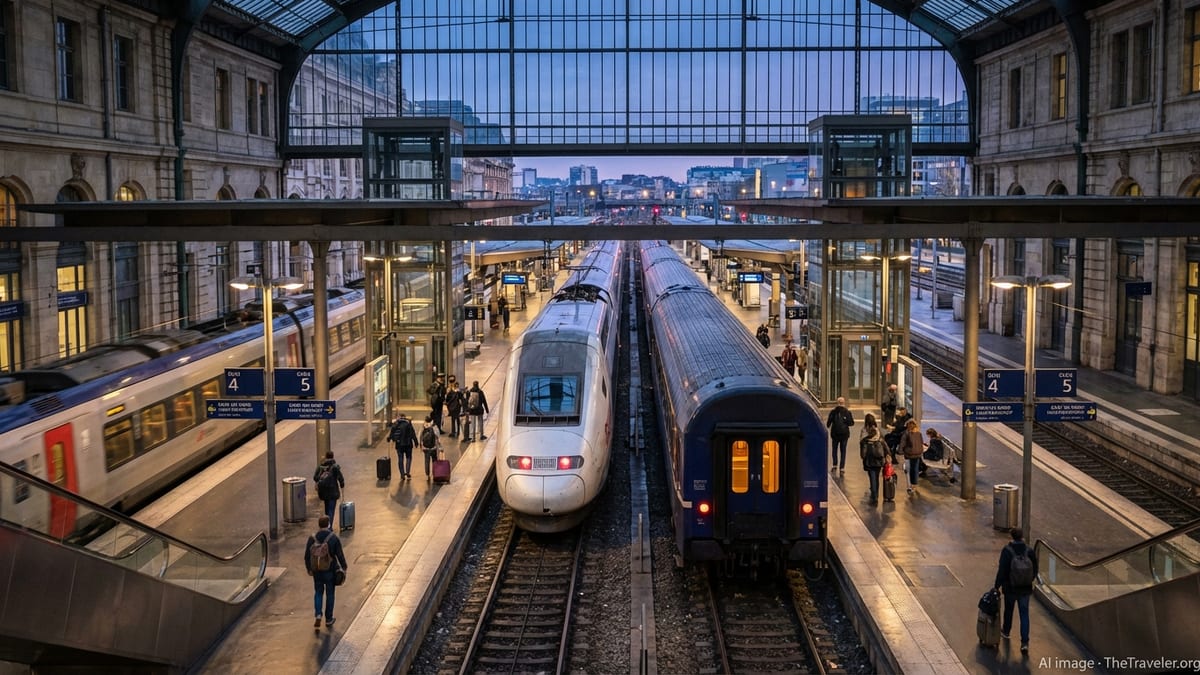
Liberalization fuels a more assertive SNCF Voyageurs
France’s domestic rail market has been gradually opening to competition, with rival operators such as Italy’s Trenitalia and Spain’s Renfe entering key high-speed corridors in recent years. Publicly available information shows that SNCF Voyageurs, the passenger arm of France’s state-owned rail group, is responding with a more assertive commercial stance at home and abroad.
On French high-speed routes, particularly the profitable Paris–Lyon–Marseille axis, new entrants have introduced alternative services and pricing structures. Reports indicate that SNCF Voyageurs is defending its position not only through fare campaigns but also by multiplying service options under its TGV Inoui and Ouigo brands, emphasizing both premium comfort and budget-friendly offers.
Regulatory documents and competition authority reports describe a landscape in which historic monopolies have been replaced by open-access operations, track-access charges and tendered public-service contracts. Within this framework, SNCF Voyageurs appears determined to retain a dominant role, using scale, brand recognition and network depth to counter fresh competition on flagship routes.
The group’s public strategy materials underline that high-speed services are now framed in terms of market share rather than guaranteed monopoly. In practice, this means SNCF Voyageurs is increasingly adopting tactics that mirror those of private rivals, from highly targeted discounts to differentiated onboard experiences aimed at specific customer segments.
Ouigo spearheads the low-cost offensive
At the heart of SNCF Voyageurs’ attack is Ouigo, its low-cost high-speed brand. Company information shows that Ouigo, launched in 2013, is expected to account for a steadily rising share of the operator’s high-speed traffic by the end of the decade, with the goal of significantly increasing overall passenger volumes.
In France, Ouigo Grande Vitesse and Ouigo Train Classique services now link a wide range of cities at simplified, tiered fares designed to compete directly with both cars and low-cost airlines. The model relies on dense seating layouts, fewer onboard services included in the basic ticket and additional fees for options such as extra luggage or specific seat selection, allowing SNCF Voyageurs to advertise headline-grabbing entry prices.
Public documents indicate that SNCF Voyageurs has also introduced new digital tools around Ouigo, such as interactive price maps launched in 2024 that allow travelers to visualize destinations by budget. These tools support an aggressive marketing approach focused on affordability and spontaneity, positioning the brand as a gateway to last-minute city breaks and budget-conscious family trips.
While critics frequently highlight trade-offs in comfort and flexibility associated with low-cost rail, strong load factors reported for Ouigo suggest robust demand. For SNCF Voyageurs, success in this segment is a central plank of its response to liberalization, enabling the company to fill trains, expand its network and pre-empt prospective competitors on some routes.
European expansion targets rivals in Spain and beyond
SNCF Voyageurs is not limiting its push to the French domestic network. In recent years, it has increasingly projected its influence across European high-speed corridors, often positioning itself directly against historic incumbents in neighboring countries.
In Spain, the operator’s Ouigo España subsidiary runs low-cost high-speed services on core routes such as Madrid to Barcelona, challenging the long-standing dominance of Renfe. According to published coverage, Ouigo’s launch helped trigger a broader price war on Spanish high-speed lines, making rail travel more accessible while intensifying pressure on margins for all operators.
Beyond Spain, SNCF Voyageurs continues to partner or compete with national railways through joint ventures and international brands. TGV Inoui services extend to Italy and Switzerland under cross-border arrangements, while cooperation with Germany’s Deutsche Bahn links French cities with major German hubs. These services are being promoted more prominently to leisure travelers, particularly for winter and summer holiday periods.
Seasonal announcements and sales calendars suggest a coordinated strategy: open bookings earlier, advertise international city pairs heavily and accompany them with time-limited promotional fares. By doing so, SNCF Voyageurs aims to capture a greater share of Europe’s growing cross-border travel market, positioning French-operated high-speed trains as a mainstream alternative to short-haul flights.
Price campaigns and capacity boosts to win passengers
Marketing pushes such as themed sales and seasonal promotions are another sign of SNCF Voyageurs moving onto the offensive. The company has recently highlighted major discount operations on both domestic and international routes, inviting travelers to book ahead for autumn and winter at reduced prices.
Publicly available press material shows that these campaigns often bundle France’s internal high-speed services with cross-border links to Spain, Italy, Germany and Switzerland. The approach underscores a message of seamless European mobility, with SNCF Voyageurs presenting itself as a one-stop rail provider from French regional cities to neighboring capitals.
At the same time, the operator is investing in additional capacity. Planning documents and corporate reports describe ambitions to increase the number of high-speed seats in circulation over the coming years, partly through new rolling stock and partly through optimized fleet deployment under the Ouigo and TGV Inoui brands. More capacity allows SNCF Voyageurs to sustain promotional pricing while seeking to maintain acceptable load factors.
For travelers, the impact is visible in a richer menu of options: ultra-low promotional fares when booking early, flexible business-oriented tickets on premium services, and a growing array of international itineraries. The competitive landscape means, however, that prices can fluctuate significantly depending on route, date and operator, encouraging passengers to compare offerings from SNCF Voyageurs and its rivals more actively than in the past.
Balancing service quality, safety and competition
As SNCF Voyageurs pushes harder on commercial levers, it is also confronting operational and social challenges that come with higher traffic and a more complex market. The company has publicly drawn attention to incidents affecting staff safety, highlighting thousands of recorded cases of verbal or physical aggression against frontline employees in 2023 and launching awareness campaigns to address the issue.
Maintaining service quality across an expanding, more segmented portfolio is another concern. While competition has prompted improvements in punctuality and onboard comfort on some routes, traveler associations and consumer reports continue to flag issues including overcrowding, perceived price volatility and dissatisfaction with after-sales processes, particularly on low-cost services.
For SNCF Voyageurs, the challenge is to sustain its offensive strategy without eroding public trust in the national rail system. Efforts to modernize rolling stock, streamline ticketing, and enhance digital information are presented as ways to improve the passenger experience even as the company strives to maximize occupancy and defend market share.
With more competitors eyeing key corridors and European regulators encouraging open access, France’s main rail operator appears committed to a long-term battle for passengers. Its current posture, centered on an assertive mix of low-cost innovation, international expansion and high-profile promotions, suggests that the next phase of Europe’s rail liberalization will be defined as much by SNCF Voyageurs’ attack as by the ambitions of its rivals.