


More news on this day
Travelers at Miami International Airport are facing hours-long delays, crowded terminals, and a reduced flight schedule after an Amazon-branded cargo jet overran a runway on Sunday, killing five people and injuring several others, according to published coverage and federal aviation data.
Get the latest news straight to your inbox!
Deadly cargo overrun forces sudden ground stop at MIA
Publicly available reports indicate that a Boeing 767-300F operating as an Amazon Air cargo flight for contractor 21 Air overran a runway at Miami International Airport (MIA) on the afternoon of Sunday, September 6, 2026. The widebody freighter burst into flames after leaving the paved surface, crossing a perimeter road and coming to rest near an airport parking area.
Coverage from multiple outlets states that at least five people were killed and five others injured in the crash, including some occupants of vehicles struck beyond the runway environment. Images from the scene show a burned fuselage, scorched vehicles and extensive emergency response activity around the southern side of the airfield.
Federal aviation summaries describe a disabled aircraft event that prompted a full ground stop at MIA as firefighters worked to extinguish the fire and secure the scene. The ground stop halted most arrivals and departures for several hours on Sunday, creating an initial wave of delays that continued to cascade into Monday.
While investigators from national and local agencies are beginning to examine what led to the overrun, early information suggests that the crash occurred after the aircraft landed and was attempting to decelerate on the runway. The accident has immediately constrained Miami’s ability to handle traffic during a busy late-summer travel period.
Delays, cancellations and packed terminals for passengers
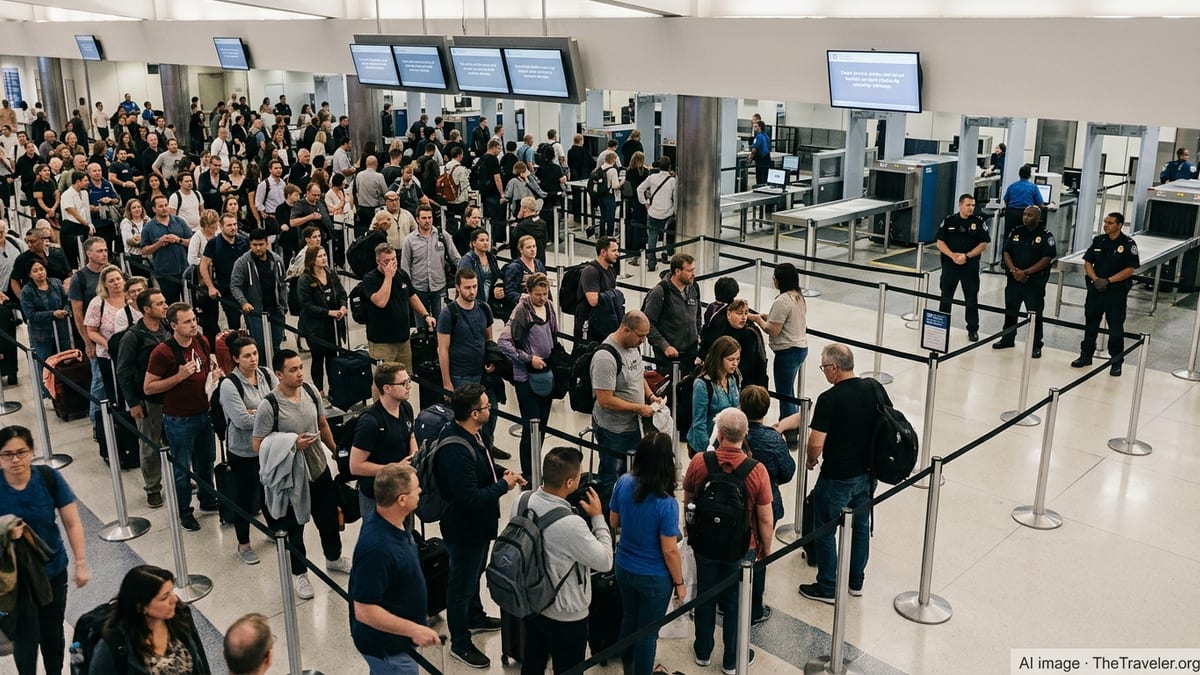
Travelers passing through Miami on Sunday evening and Monday morning encountered long lines at ticket counters, crowded gate areas and uncertain departure times as airlines adjusted to the reduced runway capacity. Local broadcast coverage from inside the terminal showed passengers clustered around departure boards and seated on the floor near power outlets while monitoring delay updates.
According to data cited in regional news reports, the airport faced a spike in cancellations and late operations in the hours after the crash. One local outlet reported that by early Monday, at least 15 domestic flights had been delayed and nearly 40 canceled, as carriers worked through the backlog created by the ground stop and subsequent congestion.
Real-time information from the Federal Aviation Administration’s traffic management system late Sunday indicated average arrival delays into Miami in excess of six hours, categorized as being driven by a disabled aircraft and runway and taxiway constraints. That level of disruption left some passengers diverted to alternate hubs and others stuck on the ground at origin airports awaiting wider system recovery.
Inside the terminal, the impact extended beyond departure boards. Travelers described crowded security lanes and longer waits for customer service as airline staff attempted to rebook missed connections and find available seats on later flights. For many, the disruption turned routine weekend trips into overnight or multi-day journeys.
Runway closures and constrained operations ripple through the network
Miami International Airport typically relies on a complex, four-runway layout to manage heavy passenger and cargo traffic into South Florida. After the crash, airport information shared with local media indicated that only two of the four runways were operating, with the accident site still active for emergency and investigative work.
The reduced airfield capacity has forced air traffic managers to meter arrivals and departures, lengthening the time between flights and limiting how many aircraft can land or take off per hour. FAA advisories referenced runway and taxi restrictions associated with the disabled aircraft, contributing to extended average delays for inbound flights through Sunday night.
Because Miami serves as a major connecting point for Latin America and the Caribbean, disruptions there can quickly spread across the broader air travel network. Flight-tracking and aviation community discussions on Sunday pointed to international services being diverted to other U.S. hubs and to regional airports, adding strain to operations well beyond South Florida.
Industry analysis in trade publications also highlighted the significance of a runway overrun involving a large freighter at a primary gateway airport. With investigators and recovery crews needing uninterrupted access to the site, normal runway usage patterns are expected to remain altered until the wreckage is removed and infrastructure is inspected and repaired.
What travelers through Miami should expect this week
Travelers scheduled to pass through Miami International Airport in the coming days are being advised by airlines and public information channels to monitor their flight status frequently and allow extra time at the airport. With a portion of the airfield still out of service as of Monday morning, delays and schedule changes are expected to persist even as the initial backlog is slowly reduced.
Airline websites and mobile apps are currently serving as the primary tools for rebooking and notifications, and some carriers are offering limited change-fee flexibility for passengers whose itineraries are directly affected by the disruption. Given that Miami remains operational but constrained, many adjustments are taking the form of significant departure delays rather than outright cancellations.
Passengers connecting from Latin America and the Caribbean may experience particular uncertainty as airlines reroute aircraft and adjust bank structures to compensate for the reduced runway availability. Travel experts note that travelers with tight connections through Miami this week face a higher risk of missed onward flights and may wish to explore alternative routings where options exist.
For those already in the terminals, airport announcements and flight information displays are continuing to reflect rolling updates as new air traffic control programs are implemented. The situation remains fluid, and travel conditions are likely to vary by time of day and destination as the system gradually absorbs the impact of Sunday’s accident.
Ongoing investigation and safety focus after the crash
The crash has prompted a formal safety investigation by federal and local agencies, with teams expected to review flight data recorders, cockpit voice recordings, weather conditions, runway friction characteristics and the aircraft’s braking and thrust-reverser systems. Investigators will also study airport infrastructure and emergency response timelines as part of a broader review of how the overrun unfolded and why it proved so deadly on the ground.
Publicly available statements from Amazon and its cargo partner 21 Air express condolences to the families of those killed and injured and indicate cooperation with the ongoing investigation. Aviation analysts note that while runway overruns are a known risk in global air transport, accidents with multiple ground fatalities are comparatively rare, especially at major airports with modern safety infrastructure.
In the near term, the priority for Miami International Airport remains managing safe operations with a partially constrained runway system while accommodating thousands of affected passengers. As investigators proceed and recovery work continues at the crash site, the incident is expected to renew industry attention on runway safety, overrun prevention technologies and emergency planning at busy hub airports worldwide.
Travelers heading to or from South Florida this week will be navigating that evolving backdrop, as the region’s primary international gateway balances operational resilience with a detailed examination of one of its most serious accidents in decades.
AP News coverage of the Miami Amazon cargo plane crash
Local10 report on delays and cancellations at MIA
CBS Miami report on the crash and ground stop at MIA
FAA current delay information for Miami International Airport