


Frankfurt Airport is one of Europe’s busiest hubs and a major gateway for long haul flights between North America, Asia, the Middle East, and Europe. With multiple terminals, several concourses, and a new Terminal 3 now in operation, it can be confusing to know exactly where you need to go. This guide walks you through Frankfurt’s terminals in practical, real world terms so you can quickly figure out which terminal is right for your flight and how to move between them with minimal stress.
Get the latest updates straight to your inbox!
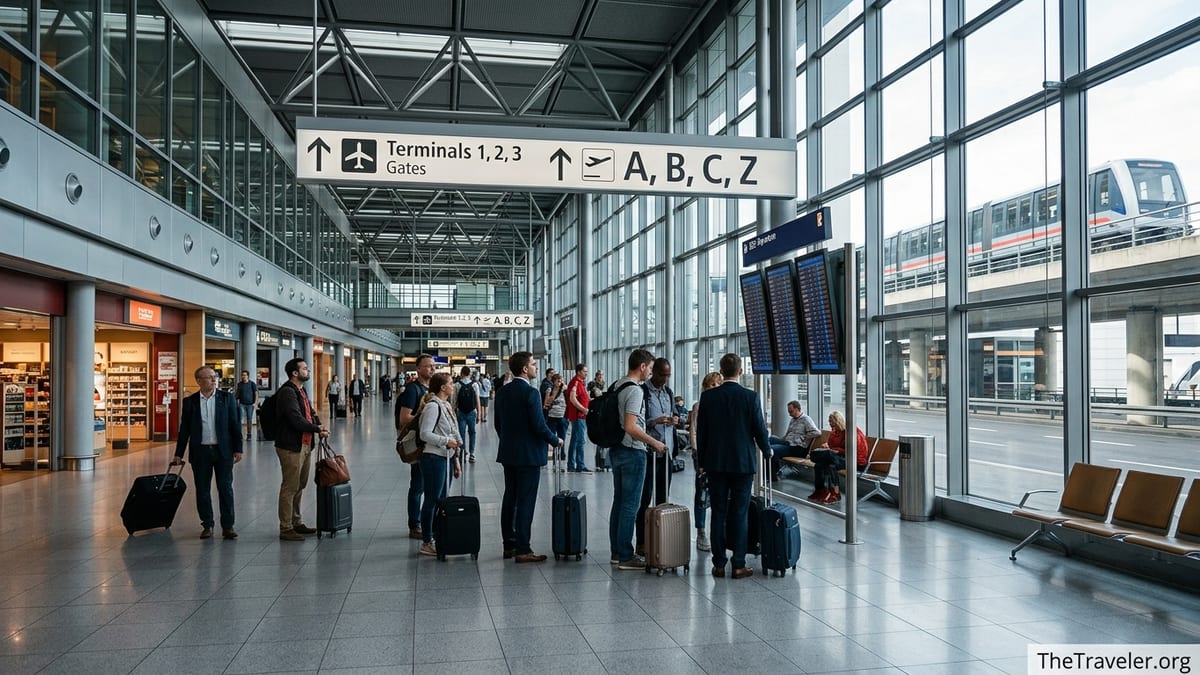
Frankfurt Airport at a Glance
Frankfurt Airport sits just southwest of central Frankfurt and serves more than 60 million passengers in a typical year. Rather than separating terminals into “domestic” and “international,” Frankfurt groups airlines and alliances. That means the terminal you use depends mainly on which airline you fly, whether it is part of the Lufthansa and Star Alliance family, or a competitor like Emirates, Qatar Airways, Delta, or British Airways.
The airport currently has three main passenger terminals. Terminal 1 is the largest and oldest, used primarily by Lufthansa, its subsidiaries such as Swiss and Austrian, and most Star Alliance partners. Terminal 2 traditionally hosted many oneworld and SkyTeam carriers along with independent airlines. In April 2026, Frankfurt opened its new Terminal 3 on the south side of the airfield, and long haul carriers are gradually moving there, especially for non Schengen flights.
All terminals are connected by a free people mover called the SkyLine train and shuttle buses. The regional and long distance train stations are attached to Terminal 1, so if you are arriving by ICE train from cities like Cologne or Munich, or from Frankfurt city center on the S Bahn, you will enter the airport at Terminal 1 and may then need to transfer to another terminal for your flight.
Because airline allocations can change, the most reliable way to confirm your terminal is to check the “Airlines A to Z” section on the official Frankfurt Airport site or your airline’s booking confirmation the day before travel. Still, there are clear patterns that can help you predict where you will likely check in and depart.
Terminal 1: Lufthansa, Star Alliance, and Most European Connections
Terminal 1 is the workhorse of Frankfurt Airport. It handles the majority of flights, especially for passengers connecting within Europe or between Europe and North America or Asia on Lufthansa and other Star Alliance carriers. If you are flying Lufthansa from New York to Frankfurt, then onward to Rome or Munich, you will almost certainly remain within Terminal 1 for both flights.
The building is divided into concourses A, B, C, and Z. In simple terms, A and much of B handle Schengen flights within most of Europe, while Z and parts of B handle non Schengen departures such as flights to the United States, Canada, the United Kingdom, and many intercontinental destinations. For example, a Lufthansa flight from Frankfurt to Chicago or a United Airlines service to Newark usually departs from the Z Gates in Terminal 1, after U.S bound security and exit checks.
Terminal 1 also connects directly to both of Frankfurt’s railway stations. The regional station beneath the terminal gives access to S Bahn lines S8 and S9 toward downtown Frankfurt and to nearby cities like Mainz and Wiesbaden. The separate long distance station, located in a dramatic glass and steel hall across the road, is served by ICE and other intercity trains from major German and neighboring European cities. If you are arriving by ICE from Berlin with a 90 minute connection to a Lufthansa flight, you will arrive at the long distance station and walk into Terminal 1 via a covered pedestrian bridge.
For many travelers, the convenience of Terminal 1 is that you never need to leave the building between check in, security, passport control, and boarding. Lounges such as the Lufthansa Senator and Business Lounges are located near both Schengen and non Schengen gates. If you are flying in business class from Frankfurt to Singapore on Singapore Airlines, for example, you will likely check in at Terminal 1, clear security and passport control there, then follow signs to either a Star Alliance partner lounge or a pay in lounge in the same terminal.
Terminal 2: Mixed Carriers in Transition
Terminal 2 has historically served a broad mix of airlines outside the Lufthansa and Star Alliance group. Major oneworld members like British Airways and American Airlines, SkyTeam carriers such as Air France, KLM, and Delta, and many long haul operators including Emirates, Etihad, Qatar Airways, and Saudia have traditionally operated from here. Budget carriers including Ryanair and leisure airlines such as SunExpress and TUI fly have also commonly used Terminal 2.
The building is divided into concourses D and E, with check in halls and security screening areas on the main departure level. Before the opening of Terminal 3, a traveler flying from Frankfurt to London on British Airways would check in at Terminal 2, Hall D, go through security, then board from a D gate in the Schengen area. Similarly, a passenger flying Emirates to Dubai would use the non Schengen gates in the same terminal, usually with a short bus ride or walk to the aircraft if a remote stand is used.
With Terminal 3 now open, Frankfurt Airport is progressively moving many long haul and non Schengen operations away from Terminal 2. Recent guidance and industry reports indicate that several major global carriers are shifting to the new terminal, especially for flights to Asia and the Middle East. This means that while Terminal 2 still handles flights, its airline mix is more in flux than Terminal 1. A traveler who used Terminal 2 for a Delta flight to Atlanta in 2024 might now find that the same route departs from Terminal 3 instead.
As a result, Terminal 2 is a place where checking your boarding pass and airport flight information screens is particularly important. Travelers connecting from a Lufthansa or Swiss flight in Terminal 1 to an independent carrier like Ryanair may need to transfer to Terminal 2 using the SkyLine or a shuttle bus, with enough buffer time to reclear security and possibly passport control. For a typical 90 minute connection with a terminal change, it is wiser to budget at least 30 minutes purely for walking, signage, and the transfer itself.
Terminal 3: Frankfurt’s New Long Haul Gateway
Terminal 3, located on the southern side of the airfield, is Frankfurt Airport’s newest passenger complex and began passenger operations in April 2026. It has been designed primarily with long haul traffic in mind, with spacious departure lounges, more natural light, and a layout optimized for large aircraft and high passenger volumes.
Many of the airlines that previously used Terminal 2 for non Schengen flights are starting to move their operations to Terminal 3. For example, it is increasingly likely that flights on carriers such as Emirates, Qatar Airways, or Korean Air will arrive and depart from Terminal 3 rather than Terminal 2. If you last flew through Frankfurt on Emirates in 2023 and used Terminal 2, do not assume your 2027 flight will use the same terminal. The shift to Terminal 3 is a central part of Frankfurt’s capacity expansion plan.
Getting to Terminal 3 from the rest of the airport involves either a dedicated extension of the SkyLine people mover or shuttle buses that run from Terminal 1 and Terminal 2. Travelers arriving at the long distance train station, for instance, will walk into Terminal 1, follow signs to “Terminal 3” and then transfer via the SkyLine system on a journey that typically takes around 10 to 15 minutes platform to platform, not including any waiting or walking time on either end.
Inside Terminal 3, travelers can expect a modern, mall like environment familiar from other new European terminals. There are high street style shops, duty free stores, and a wide range of food options from quick service coffee chains to sit down restaurants. While individual brands and locations may change, the general model mirrors newer airports in cities like Istanbul or Doha, with a particular focus on non Schengen transfer passengers connecting between regions such as Asia and North America with a short European stopover.
Moving Between Terminals: SkyLine, Buses, and Walking Times
One of the most common concerns for travelers at Frankfurt is how long it takes to move between terminals, especially on tight connections. The airport’s free SkyLine train is the main solution. This elevated people mover connects Terminal 1 with the northern terminal complex and, through recent extensions, the new Terminal 3 on the southern side. Trains typically run every two to three minutes during main operating hours and the actual ride between terminals is only a few minutes.
For example, if you arrive on a Lufthansa flight from Paris at a Schengen A gate in Terminal 1 and need to catch a British Airways flight to London from Terminal 2, you would follow the yellow or blue transfer signs toward the SkyLine station. From there, the short ride to Terminal 2 is usually under five minutes, but you still need to factor in time to walk to the station, ride up or down escalators, and then clear security and possibly passport control in the new terminal. In practical terms, most experienced travelers advise allowing at least 45 to 60 minutes for a terminal to terminal connection, even if the minimum connection time on your ticket is slightly less.
Buses supplement the SkyLine, particularly for transfers involving remote stands or during maintenance on the rail system. Shuttle buses operate between terminal forecourts and can also be used to reach Terminal 3 or certain parking areas. For instance, a traveler arriving by car and parking in a long term lot near Terminal 3 may use a dedicated shuttle to reach check in. Bus rides between terminals generally take around 10 minutes, but can be longer during peak ground traffic.
Walking long distances between terminals is not usually necessary, but you should be prepared for extended indoor walks within the same terminal, especially in Terminal 1, whose concourses can feel like separate mini terminals. Walking from a Z gate on one end to an A gate on the opposite side can easily take 15 to 20 minutes, particularly if you need to pass through security or passport control along the way. Travelers with reduced mobility should consider pre booking assistance through their airline, which will arrange wheelchairs or electric carts as needed.
Schengen vs Non Schengen: How It Affects Your Terminal Experience
Frankfurt operates within the Schengen Area, a group of European countries that share a common external border and generally do not perform routine passport checks for travel between them. This distinction matters because it affects where you will clear passport control, which concourse you will use, and how your transfer is routed inside the terminals.
Flights within Schengen, such as Frankfurt to Paris, Vienna, or Barcelona, usually depart from the Schengen sections of Terminal 1 or Terminal 2. In Terminal 1, this is most often the A gates and parts of the B concourse. Passengers on these flights normally go through security only and then board without further passport checks, although random spot checks are always possible. Non Schengen flights, like Frankfurt to New York, Dubai, or Tokyo, depart from non Schengen areas such as the Z gates in Terminal 1 or specified zones in Terminal 2 and Terminal 3, where passengers must pass through exit passport control before entering the gate area.
For connecting passengers, the key question is whether your connection crosses the Schengen border. A traveler arriving from Toronto on Air Canada and connecting to a Lufthansa flight to Madrid will arrive in the non Schengen area of Terminal 1, pass through passport control to enter Schengen, and then continue onward to the Schengen A gates for the Madrid flight. In contrast, a passenger arriving from Chicago and connecting to another non Schengen destination such as Istanbul may stay within the non Schengen area and only need to clear security again, depending on the country of origin and specific security arrangements.
This is especially relevant when planning connection times. Clearing passport control can add 10 to 30 minutes or more at busy times, such as early morning arrivals from North America or late afternoon banks of European departures. Automated eGates are available for many EU and some non EU passports, but travelers with children, non biometric documents, or other restrictions may need to use staffed counters. Booking a connection of at least 90 minutes is a practical target when a Schengen border crossing is involved, particularly if a terminal change is also required.
For U.S. travelers, it is important to remember that you generally clear immigration and customs only at your final Schengen destination, not at Frankfurt, if you are connecting onward to another Schengen city on a single ticket. For example, if you fly Newark to Frankfurt to Vienna on one Lufthansa itinerary, you will normally pass through passport control in Frankfurt, collect your bags only in Vienna, and clear customs there. However, if Frankfurt is your final stop, you will clear passport control and customs in Terminal 1 before exiting to the arrivals hall.
Examples of Common Airline and Terminal Pairings
While airline allocations can change over time, there are certain patterns that repeat often enough to provide useful guidance. Travelers flying Lufthansa from U.S. cities such as New York, Chicago, or Los Angeles to Frankfurt almost always arrive and depart from Terminal 1. Their connecting flights to most European destinations on Lufthansa, Austrian, Swiss, or Brussels Airlines also depart from Terminal 1, usually in the A or B concourses. This makes Terminal 1 a straightforward choice for many Star Alliance based itineraries.
Star Alliance partners such as United Airlines, Air Canada, ANA, Singapore Airlines, and Turkish Airlines also primarily operate from Terminal 1. For example, a United flight from Washington Dulles to Frankfurt will typically use the same non Schengen Z or B gates as Lufthansa’s own long haul services. A passenger connecting from United’s Washington flight to a Turkish Airlines flight to Istanbul or an ANA flight to Tokyo may remain within Terminal 1, moving between non Schengen gate areas with a combination of walking, security, and passport control as necessary.
On the other hand, passengers flying with oneworld or SkyTeam carriers are more likely to use Terminal 2 or Terminal 3. Historically, British Airways, American Airlines, Iberia, Finnair, and similar carriers have used Terminal 2. So have Air France, KLM, and Delta. As Terminal 3 ramps up, many of the long haul departures for these airlines are shifting there, especially routes to hubs like Doha, Dubai, or Seoul. For instance, a traveler flying Qatar Airways from Frankfurt to Doha may now be directed to Terminal 3 for check in and departure, while their inbound feeder flight on a European partner could still arrive at Terminal 2 or Terminal 1.
Independent and leisure carriers add more variety. Emirates and Etihad may operate from Terminal 3, while low cost carriers such as Ryanair often use Terminal 2. Charter or seasonal services to Mediterranean holiday destinations on airlines like SunExpress or TUI fly typically operate from Terminal 2 as well. A family flying from Frankfurt to Antalya on a holiday package may check in at Terminal 2 with a tour operator desk, while another family on a self booked Lufthansa trip to the same destination uses Terminal 1, illustrating how the same city pair can involve different terminals depending on airline choice.
The Takeaway
Choosing the right terminal at Frankfurt Airport ultimately comes down to your airline and route rather than any simple domestic or international rule. Terminal 1 remains the stronghold of Lufthansa and Star Alliance and is the most common base for travelers connecting within Europe or between Europe and intercontinental destinations on these carriers. Terminal 2 is still important for a range of oneworld, SkyTeam, and independent airlines but is in a period of transition as long haul traffic migrates to the modern Terminal 3.
For practical planning, always double check your departure terminal on your airline confirmation or the Frankfurt Airport website the day before you fly. Build in extra time for connections that involve both a Schengen border crossing and a terminal change, and remember that the SkyLine train and shuttle buses are free and relatively quick, even if walking distances can be long. If you think in terms of which airline and alliance you are using and whether your journey is Schengen or non Schengen at each step, Frankfurt’s complex layout becomes much easier to navigate.
The new Terminal 3 adds capacity and modern facilities but also makes it more important to read your boarding pass carefully. A traveler who once used Terminal 2 for a flight to Dubai or Doha may now need to go to Terminal 3 for the same route. With a bit of advance checking and an understanding of how the terminals are organized, you can move through Frankfurt confidently, whether you are catching an early morning Lufthansa shuttle to Munich or boarding a midnight long haul flight to Asia on a partner airline.
FAQ
Q1. How do I know which terminal my flight uses at Frankfurt? Check your airline booking confirmation, your boarding pass, and the Frankfurt Airport flight information on the day of travel, as airline terminal assignments can change over time.
Q2. Which terminal does Lufthansa use at Frankfurt? Lufthansa primarily operates from Terminal 1, using the A, B, C, and Z concourses for both Schengen and non Schengen flights, including most connections with partner airlines in Star Alliance.
Q3. Are Terminals 1, 2, and 3 connected airside at Frankfurt? Terminals are linked by the free SkyLine train and shuttle buses. Some transfer routes stay airside, but others require exiting, then clearing security and possibly passport control again.
Q4. How long should I allow to transfer between terminals? The SkyLine ride itself takes only a few minutes, but you should usually allow at least 45 to 60 minutes for a terminal to terminal transfer, including walking, security, and passport control.
Q5. What is the difference between Schengen and non Schengen areas at Frankfurt? Schengen flights serve destinations within most of continental Europe and usually depart from separate concourses from non Schengen flights. Non Schengen flights require exit passport control before boarding.
Q6. Which terminal does Emirates or Qatar Airways use at Frankfurt? Long haul carriers such as Emirates and Qatar Airways have historically used Terminal 2 but are being moved increasingly to the new Terminal 3, so you should confirm on your booking before travel.
Q7. Can I walk from the long distance train station to any terminal? The long distance train station is directly attached to Terminal 1. From there, you can walk to Terminal 1 check in and then use the SkyLine or shuttle buses to reach Terminals 2 or 3.
Q8. Do I need to collect my baggage when transferring through Frankfurt? If all flights are on one ticket and your bags are checked through to your final destination, you usually do not collect baggage during transit. You retrieve it only at your final destination.
Q9. Is there a separate terminal at Frankfurt for domestic German flights? No, domestic German flights are mixed into the general Schengen areas of Terminals 1 and 2. For example, flights to Berlin or Munich often depart from the A or B gates in Terminal 1.
Q10. Does Frankfurt Airport have a special first class terminal? Yes, Frankfurt has a separate First Class Terminal operated by Lufthansa for some first class passengers, but most travelers will use the standard terminals and their regular first or business class check in areas.