


More news on this day
Frankfurt Airport has emerged as one of the biggest pressure points in Europe’s troubled rollout of the new EU Entry/Exit System, with reports of queues stretching up to five hours, missed connections and knock-on delays across major hubs including Paris Charles de Gaulle, Rome Fiumicino and Ciampino.
Get the latest news straight to your inbox!
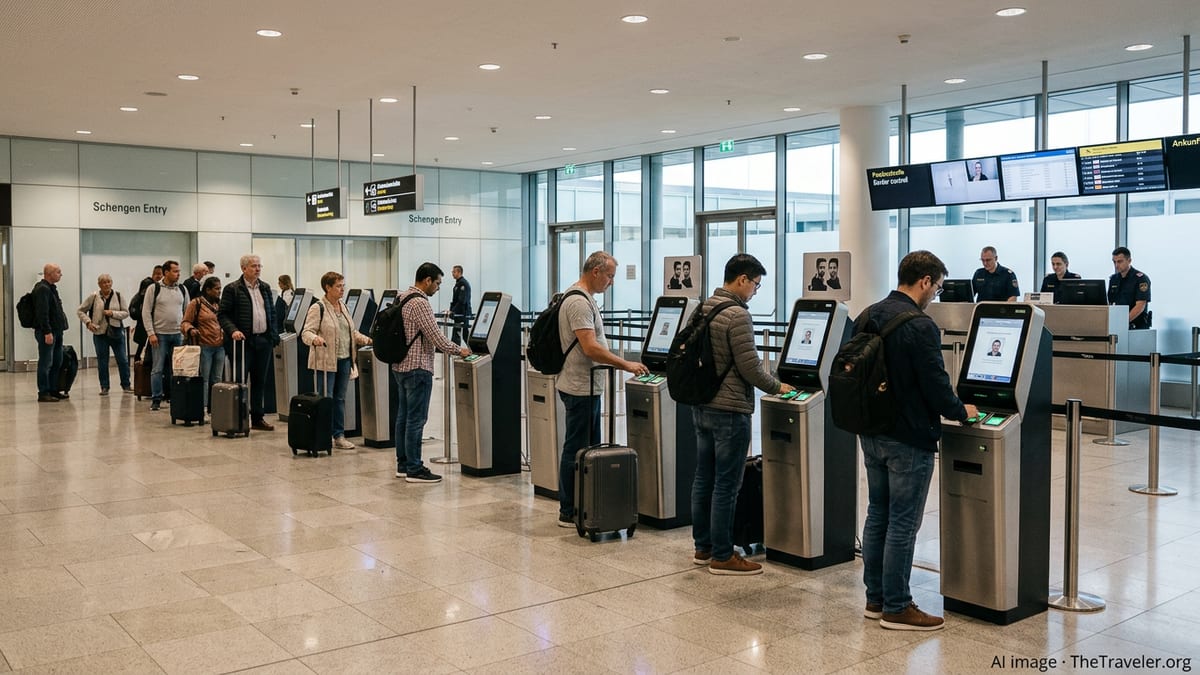
Digital Borders Bite as Summer Peak Arrives
The European Union’s biometric Entry/Exit System, which became fully operational across Schengen borders in April 2026, is reshaping the travel experience for millions of non-EU passengers. The system replaces manual passport stamping with fingerprint and facial-image capture, creating a centralised record of each crossing. While intended to tighten security and automate checks, its first full summer in operation is exposing serious operational strains at high-volume airports.
According to publicly available information from airport associations and travel-industry advisories, border queues have regularly reached two to four hours at peak times since full enforcement began. In some documented cases, travellers have reported waiting longer, particularly at transfer-heavy hubs where connecting passengers must clear immigration between flights.
Travel-rights organisations and airport groups indicate that 15 or more EU countries have seen significant delays at passport control since April. The combination of biometric capture, technical glitches and staff shortages is being cited as a key driver, with particular challenges when large wide-body arrivals coincide or when several flights with high shares of non-EU travellers land at once.
Industry bodies have formally called for more flexibility, including extended transition periods and the temporary easing of some checks during peak hours, arguing that the current set-up is incompatible with summer traffic volumes without additional staffing and infrastructure.
Frankfurt Connects the Crisis to Paris and Rome
Frankfurt Airport, one of Europe’s busiest intercontinental hubs, has become a focal point of the Entry/Exit System stress. Recent passenger accounts shared publicly describe non-EU travellers facing queues of four hours or more at border control, with many missing onward connections despite scheduled layovers of two to three hours. Online travel forums and consumer-rights sites have carried multiple testimonies from transiting passengers who were rebooked or stranded overnight after being unable to clear immigration in time.
Reports indicate that Frankfurt’s layout and heavy reliance on connecting traffic amplify the impact. Non-Schengen transfer passengers often must pass through centralised control points that can quickly become saturated when long-haul arrivals from North America, the Middle East and Asia converge. Even when airlines delay departures to wait for connecting travellers stuck in the queues, there are accounts of flights leaving with dozens of booked passengers still held at passport control.
The disruption does not stop at Germany’s borders. Operational data and traveller reports suggest that Frankfurt’s difficulties are cascading to other hubs, including Paris Charles de Gaulle. When connections via Frankfurt fail, passengers are frequently re-routed through alternative gateways such as Paris or Rome, adding extra demand to border-control lines that are already under pressure from their own originating traffic.
Rome’s Fiumicino and Ciampino airports have publicly warned of what they describe as a risk of summer chaos if biometric checks continue unchanged at the height of the season. Italian media coverage cites airport-management statements suggesting that the process, as currently designed, is proving incompatible with peak flows, and that suspending or partially relaxing Entry/Exit System checks during the busiest weeks may be the only way to avoid gridlock.
Airlines Sound the Alarm Over Five-Hour Queues
Major European carriers have increasingly shifted from quiet concern to open alarm about the border situation. Industry coverage shows that groups representing airlines, as well as individual carriers such as British Airways, Ryanair and EasyJet, have joined calls for urgent adjustments to the Entry/Exit System rollout.
Budget and network airlines alike are reporting missed connections, delayed departures and aircraft leaving without large numbers of booked passengers who remain trapped in passport-control queues. In one widely cited incident, an EasyJet service departed a Milan airport with more than a hundred passengers still waiting at border control following Entry/Exit System checks. Similar accounts have emerged from German hubs, where low-cost and full-service carriers report that non-EU passengers are particularly vulnerable to delays.
Ryanair’s customer guidance on the new system highlights that biometric registration can lengthen processing times and warns passengers to build in extra time at Schengen-border airports. Publicly available travel advisories from other airlines now routinely recommend arriving at least three hours before departure for flights from EU airports with Entry/Exit System checks, with some suggesting even longer buffers at complex hubs or for those with tight connections.
For British Airways, which funnels substantial UK-origin traffic through hubs such as Frankfurt, Paris and Rome via partner airlines and codeshares, the chaos presents both operational and reputational risks. Travellers sharing their experiences on public forums frequently describe sprinting through terminals after hours in queues, or being rebooked via different airports such as Amsterdam or Vienna to avoid the worst-affected locations.
Rome’s Biometric Checks Under Scrutiny
In Italy, the manager of Rome’s airports has become one of the most outspoken voices on the Entry/Exit System’s practical limits. Italian business media report warnings that, if current processes remain unchanged, Fiumicino and Ciampino could face intolerable congestion during July and August, when traffic peaks with holidaymakers from the United Kingdom, North America and Asia.
Rome’s leadership has publicly floated the prospect of temporarily suspending biometric checks at the height of summer in order to keep passenger flows moving. Press coverage indicates that on at least some recent days, staff at Fiumicino briefly reverted to traditional manual passport booths to clear backlogs, underscoring the difficulty of running both the new digital system and legacy procedures side by side.
At the same time, European-level messaging from institutions and technology providers continues to emphasise the long-term benefits of the Entry/Exit System. The official narrative stresses enhanced security, more accurate monitoring of overstays and, eventually, faster automated processing once initial enrolments are complete. However, reports from Rome and other hubs suggest that repeated registrations and technical issues are forcing some passengers to go through the full biometric capture process more than once, eroding those promised efficiency gains.
For travellers connecting between Frankfurt, Paris Charles de Gaulle and Rome, the effect is cumulative. A missed inbound connection at Frankfurt can lead to rebooking via Fiumicino or Charles de Gaulle, only for passengers to encounter fresh queues there as they enter or re-enter the Schengen area under the same digital regime.
Pressure Mounts for Emergency Fixes Before Peak Holiday Traffic
European airport and airline associations are now urging policymakers to introduce urgent, short-term fixes before the core holiday period. Joint position papers and press releases from these groups argue that without temporary derogations or more flexible operating rules, the Entry/Exit System will continue to generate long queues, missed flights and growing passenger frustration throughout the summer.
Proposals circulating in industry circles include pausing biometric enrolment for selected nationalities at the busiest times, allowing more use of traditional passport stamping where queues exceed certain thresholds, and funding additional staffing for border-police units at key hubs such as Frankfurt, Paris Charles de Gaulle, Fiumicino and Ciampino. Some stakeholders are also calling for clearer public communications so that travellers understand the need to arrive earlier and plan longer connection times.
Meanwhile, consumer-rights organisations remind passengers that European air-passenger protection rules continue to apply where delays or missed connections fall under airline responsibility. However, the blurred line between border-control bottlenecks and airline scheduling decisions is already generating disputes, as carriers point to state-controlled processes while passengers seek compensation for disrupted journeys.
With schools across Europe breaking for summer and transatlantic demand running high, Frankfurt’s struggles are being closely watched as a bellwether for the wider system. If the combination of Entry/Exit System complexity, staffing constraints and surging passenger numbers is not eased, observers expect more travellers to route around the most affected hubs, reshaping Europe’s aviation map for at least this summer season.