


More news on this day
Turkmenistan Airlines is quietly building a new niche between Europe and Southeast Asia, using rare Boeing 777-200LR jets and ex-Cathay Pacific 777-300ER cabins to connect London and Bangkok via Ashgabat at prices that often undercut larger Gulf and European rivals.
Get the latest news straight to your inbox!
Network Niche: London to Bangkok via Ashgabat
The London to Bangkok market is traditionally dominated by Gulf carriers, major European hubs and nonstop services, but publicly available booking data shows Turkmenistan Airlines increasingly appearing as one of the cheapest one-stop business class options on the route. The carrier links London, currently served from Gatwick and Stansted on different schedules, to Bangkok Suvarnabhumi with a change of aircraft at Ashgabat International Airport.
Reports from frequent flyer forums and recent trip reports describe roundtrip business class fares between Europe and Bangkok via Ashgabat that are significantly lower than those offered by full service competitors. Some one way itineraries between continental Europe and South or Southeast Asia in business class have been advertised around the 1,000 to 1,500 euro range, putting pressure on legacy carriers charging several thousand euros more for nonstop or Gulf hub itineraries.
The schedule is described as comparatively limited and sometimes irregular, which means travelers often have to build plans around fixed operating days rather than choosing from multiple daily departures. However, for passengers flexible on dates, the combination of low fares and long haul flying on widebody 777 aircraft has made Turkmenistan Airlines an increasingly discussed outlier for the London to Bangkok corridor.
Ashgabat itself functions primarily as a transit point for most international passengers. Accounts from travelers indicate that the terminal is relatively quiet compared with busy regional hubs, with short walking distances between gates and simple connections for through passengers holding single itineraries.
Cabin Hardware: 777-200LR Versus 777-300ER
Turkmenistan Airlines operates both the Boeing 777-200LR and the larger 777-300ER on its long haul network, creating a notable contrast in business class products for passengers flying between London and Bangkok. The carrier introduced the 777-200LR type earlier in the decade, using two aircraft in commercial service after another example was configured for governmental transport. Enthusiast coverage notes that one of these 777-200LRs operates regularly between London and Ashgabat, giving aviation fans a rare opportunity to fly on one of the least common 777 variants in scheduled service.
Online trip reports describe the 777-200LR business cabin as relatively spacious, with a small number of seats in a two class layout and generous legroom that feels closer to traditional long haul premium cabins than to dense regional configurations. Travelers highlight that, on some departures, the cabin factors as lightly filled, further increasing personal space and privacy.
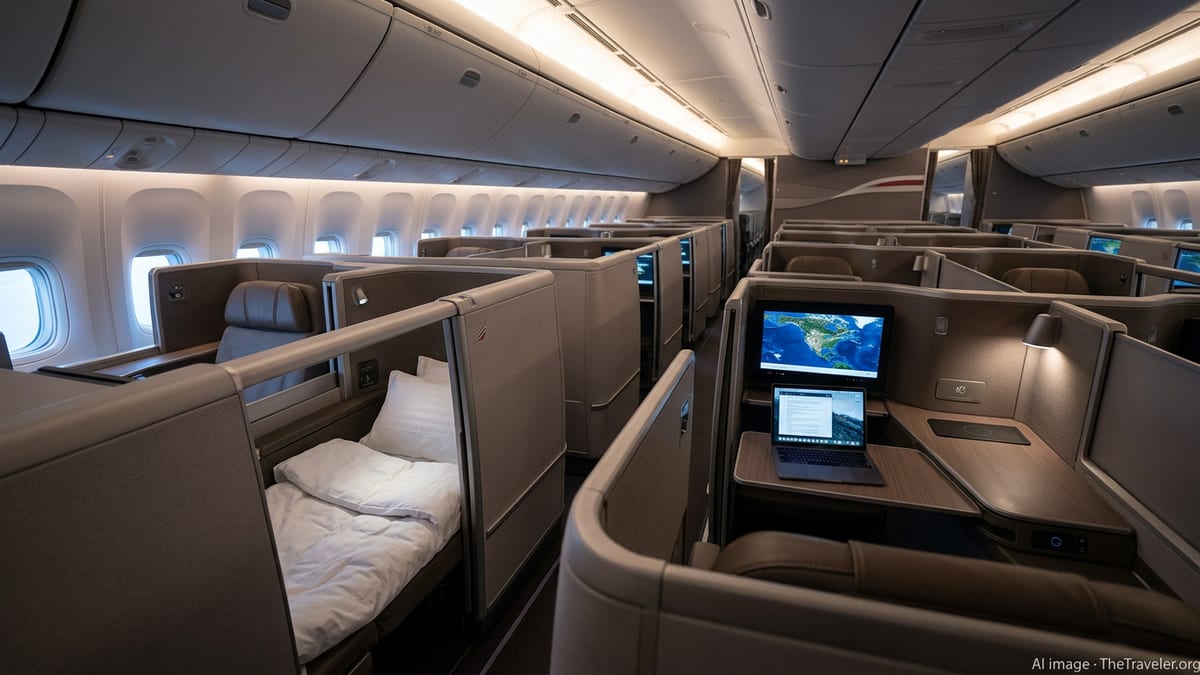
The 777-300ER experience is different and has evolved over the past two years. Public announcements from Turkmenistan’s aviation authorities and several independent reviews indicate that Turkmenistan Airlines has incorporated ex-Cathay Pacific 777-300ER aircraft into its fleet. On these jets, the airline has retained the original long haul reverse herringbone business class seats in a 1-2-1 layout, which provide direct aisle access and a fully flat bed at every seat, albeit in a slightly dated design compared with the newest generation of suites.
Travelers connecting through Ashgabat from London to Bangkok may therefore experience both variants on a single journey: the 777-200LR between London and Ashgabat and an ex-Cathay 777-300ER between Ashgabat and Bangkok. That combination offers aviation enthusiasts the novelty of flying two distinct 777 types and cabin designs on a single ticket, while placing Turkmenistan Airlines ahead of several regional competitors that still sell angled lie flat or recliner style seats as business class on similar distances.
Onboard Experience: Service, Dining and Entertainment
Turkmenistan Airlines markets a traditional two class service structure, with business and economy cabins on its long haul 777 fleet. Publicly available feedback suggests a relatively straightforward service style focused on efficiency rather than high end theatrics, in keeping with the airline’s utilitarian branding and state ownership. Travelers generally describe crews as polite and professional, though English language proficiency reportedly varies between flights.
Catering reports point to simple but filling hot meals on the London to Ashgabat leg and a more substantial second service on the longer Ashgabat to Bangkok sector. Typical offerings include a choice of meat or poultry based main course with rice or potatoes, salads, bread and a plated dessert. Presentation is described as basic compared with top tier Asian and Gulf carriers, but with portion sizes that satisfy on overnight or extended daytime flights.
One distinctive aspect repeatedly mentioned in traveler accounts is the absence of alcohol on board. Turkmenistan Airlines is a dry airline, which means that beer, wine and spirits are not served in any cabin. For some passengers this is a minor consideration offset by the low fares, while others treat it as an important factor when comparing the product with competitors on leisure heavy routes such as London to Bangkok.
The in flight entertainment offering has been gradually upgraded. Public information indicates the airline has been expanding digital content options on its international services, with newer systems and portable solutions appearing on parts of the 777 fleet. However, passengers still report a more limited movie and television library than that found on larger global carriers, and certain aircraft may feature older screens and interfaces. As a result, many frequent flyers advise bringing personal devices preloaded with content, particularly on overnight legs between Europe and Asia.
Ground Handling and Ashgabat Transit
While the onboard experience draws much of the attention, ground handling and transit arrangements in Ashgabat are central to Turkmenistan Airlines’ value proposition on the London to Bangkok route. Accounts from passengers who have connected through the Turkmen capital describe a modern terminal with relatively low passenger volumes, wide corridors and minimal retail compared with major hubs.
Published coverage and traveler discussions suggest that transit times of around 90 minutes are generally considered sufficient when traveling on a single Turkmenistan Airlines ticket, as arriving and departing flights are handled within the same terminal and security and immigration processes are streamlined for through passengers. However, because the carrier’s schedule is less frequent than those of global network airlines, irregular operations or significant delays on the inbound leg can have a greater impact on onward connections.
Check in procedures at London airports are typically handled by contracted ground staff, with separate counters for business class and priority customers. Reports indicate that business class passengers are generally granted access to third party lounges rather than a dedicated Turkmenistan Airlines facility, reflecting the airline’s relatively small presence in Western Europe. Facilities vary depending on the specific terminal and contracted lounge on the day of travel.
At Bangkok Suvarnabhumi, Turkmenistan Airlines uses standard international gates, where arriving passengers disembark into the main arrivals concourse. Feedback suggests that baggage delivery can be relatively prompt due to the modest size of the inbound operation, though overall arrival experience is ultimately governed by congestion at immigration, which lies outside the carrier’s control.
Pricing, Positioning and Passenger Profile
The most striking element of Turkmenistan Airlines’ long haul 777 business class offering on the London to Bangkok route is pricing. Published fare examples from online travel agencies, airline websites and fare alert communities frequently show business class itineraries via Ashgabat undercutting competing one stop products by large margins. On certain dates, business class fares on Turkmenistan Airlines between European points and Bangkok or other Asian destinations have appeared comparable to or only modestly higher than premium economy pricing on established carriers.
This aggressive pricing shapes the airline’s positioning. Rather than attempting to match the most luxurious Asian or Middle Eastern rivals, Turkmenistan Airlines appears to target value focused travelers who prioritize a flat bed, a quiet cabin and widebody aircraft over premium brand recognition, top shelf dining or expansive entertainment libraries. Aviation enthusiasts are another visible customer segment, drawn by the rare opportunity to log flights on the 777-200LR and sample ex-Cathay Pacific long haul seats on the 777-300ER.
Recent discussions within frequent flyer communities suggest that awareness of the product is slowly increasing, particularly as global geopolitical shifts and changing overflight patterns push some passengers to seek alternatives to traditional Gulf routings. However, the airline’s limited schedule, dry onboard policy and scarce online presence mean it remains a niche choice rather than a mainstream competitor in the London to Bangkok market.
For travelers prepared to accept a more utilitarian service style and a brief transit in a little known Central Asian hub, Turkmenistan Airlines’ 777 business class combination on the London to Bangkok corridor presents a rare mix of hard product quality, aircraft variety and sharp pricing that is atypical of such a long haul premium itinerary.