


More news on this day
A commercial passenger jet was forced to circle back and land at its departure airport after overshooting the available runway length during takeoff, a rare but serious incident that has renewed scrutiny of how airlines and pilots manage runway performance and operational pressure.
Get the latest news straight to your inbox!
Unusual Return After High-Speed Takeoff Run
According to published coverage from multiple aviation and general news outlets, the aircraft accelerated for departure from a major international airport when its takeoff roll extended beyond the intended point, leading to contact with ground equipment located past the normal end of the runway. Despite the abnormal departure, the jet continued its climb, leaving some on board initially unaware that anything out of the ordinary had occurred.
Flight-tracking data and publicly available incident summaries indicate that the crew leveled off shortly after takeoff and requested vectors to remain close to the field. The aircraft then entered a holding pattern as the pilots worked through checklists and coordinated with ground services to assess potential structural or landing gear damage.
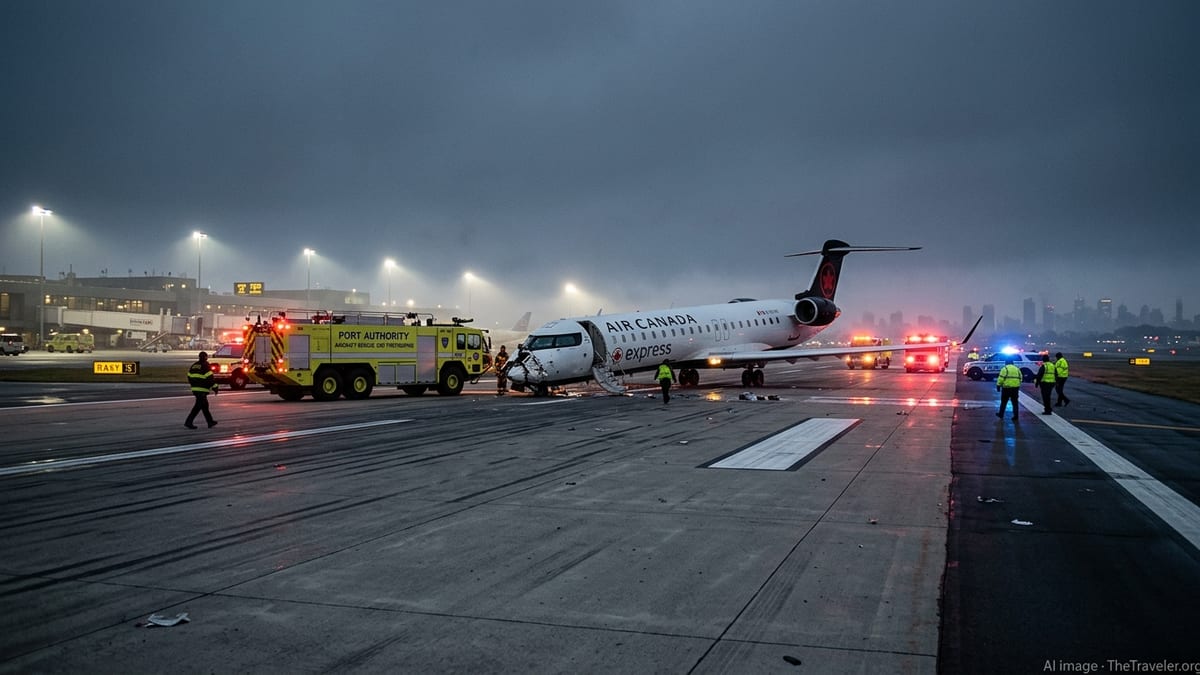
The jet ultimately returned to the departure airport after burning off fuel to reach an appropriate landing weight. On landing, emergency vehicles were positioned along the runway as a precaution, in line with standard procedures when damage to an aircraft’s undercarriage or braking systems is suspected.
No serious injuries were reported, and passengers were eventually taken back to the terminal for rebooking and further information. Photos and video posted on social media showed the aircraft surrounded by fire vehicles and maintenance crews following the event.
Overshooting Runway Limits and What It Means
Runway excursions at high speed are considered one of the most serious operational hazards in commercial aviation. In this case, reports point to the aircraft either using more runway than expected during the takeoff roll or beginning its roll from a point that left less available distance than performance calculations assumed. Striking ground lights or navigational equipment near the runway end can indicate that the available distance was effectively “overshot,” even if the aircraft becomes airborne.
Aviation safety literature notes that runway overruns and excursions often involve a combination of factors including aircraft weight, thrust setting, configuration, runway surface conditions, and potential misjudgment of available distance. When an aircraft accelerates beyond calculated parameters, continuing the takeoff can expose the airframe and landing gear to higher loads than intended, making a prompt technical inspection essential.
In the latest case, available information suggests that once the crew became aware that the jet had come into contact with objects beyond the runway’s protected area, the priority shifted from continuing to destination to verifying that the aircraft remained structurally sound. A controlled return and landing offered the most predictable environment for managing any subsequent emergency.
Analysts observing the event through open reporting have emphasized that while the outcome was ultimately safe, any runway overshoot that involves contact with ground objects is treated as a major safety occurrence rather than a routine rejected takeoff or go-around.
Passenger Experience and Operational Disruption
Accounts shared by passengers in media interviews and online posts describe a departure that initially felt normal, followed by a sudden change in atmosphere once the captain announced that the flight would be returning to the departure airport. Several travelers reported seeing emergency vehicles pacing the aircraft on arrival and being asked to remain seated while the situation was evaluated.
Operationally, the incident led to delays and cancellations across the airline’s network. Once the aircraft was parked for inspection, the runway and adjacent taxiways required checks for debris and possible damage to lighting, signs, or navigational aids. This type of inspection can temporarily reduce an airport’s capacity, creating knock-on effects for arriving and departing flights.
The jet involved in the event is expected to remain out of service until engineers finish structural and systems evaluations. Depending on the severity of any damage to the landing gear, fuselage skin, or wing structures, the aircraft could be grounded for an extended period. Airlines typically rotate spare aircraft into schedules following such events, but this can strain fleets during busy travel seasons.
For travelers, the incident serves as another reminder of how a single runway event can ripple through the air transport system, affecting connections, crew schedules, and airport congestion far beyond the initial departure point.
Investigators Focus on Human and Technical Factors
A formal safety investigation is being launched to determine exactly how the takeoff overshoot occurred and why the jet was allowed to reach the point of striking ground equipment before leaving the runway area. Investigative agencies are expected to review cockpit voice recordings, flight data, crew training records, and airport surveillance footage as part of their work.
Special attention is likely to center on whether performance calculations matched the actual runway length used, whether any last-minute changes such as intersection departures or weight adjustments were fully accounted for, and how the crew monitored acceleration data during the takeoff roll. Investigators commonly compare the aircraft’s actual ground speed and rotation point against theoretical models to detect deviations.
Technical aspects will also be examined, including whether any braking anomalies, thrust differences, or configuration warnings played a role. Weather, runway surface conditions, and visibility at the time of departure will be assessed to understand whether contamination or reduced friction contributed to the aircraft’s extended roll.
While comprehensive findings often take months, early safety recommendations sometimes emerge sooner, particularly if investigators identify procedural gaps that could affect other operators. Aviation regulators may issue temporary guidance related to runway performance calculations, intersection departures, or the placement of ground equipment near runway ends.
Renewed Scrutiny of Runway Safety Worldwide
The incident comes amid ongoing international efforts to reduce runway excursions and improve how crews manage takeoff and landing margins. Past events in various regions, including aircraft that have overrun runways in poor weather or struck obstacles after misjudged approaches, have led to upgrades in runway surveillance, clearer markings, and stricter performance rules.
Runway safety programs now emphasize both technological and human factors solutions. Enhanced surface monitoring systems help controllers track aircraft positions more precisely, while standardized training scenarios aim to reinforce pilots’ decision-making when acceleration or stopping performance does not match expectations. Airlines also increasingly use data analysis programs to flag unusual takeoff or landing profiles for review.
In the wake of the latest overshoot and return, industry observers note that even in an era of highly automated cockpits, seemingly small deviations in runway usage can quickly escalate into major safety concerns. The outcome in this case, with no serious injuries reported, is being viewed as an opportunity to reexamine procedures before a similar scenario leads to a more severe result.
For travelers, the visible presence of fire engines and emergency crews can be unsettling, but aviation safety records continue to show that such precautions are a sign of systems working as intended. When aircraft are forced to return due to suspected runway or equipment impacts, the objective is not only to protect those on board but also to gather the information needed to prevent the next incident.