


More news on this day
Germany has formally aligned itself with a renewed European Union drive to expand high-speed rail and upgrade key cross-border routes by 2040, joining Denmark, Bulgaria, Greece, France, Italy, Spain, Portugal and other member states in backing an ambitious overhaul of the continent’s core rail arteries.
Get the latest news straight to your inbox!
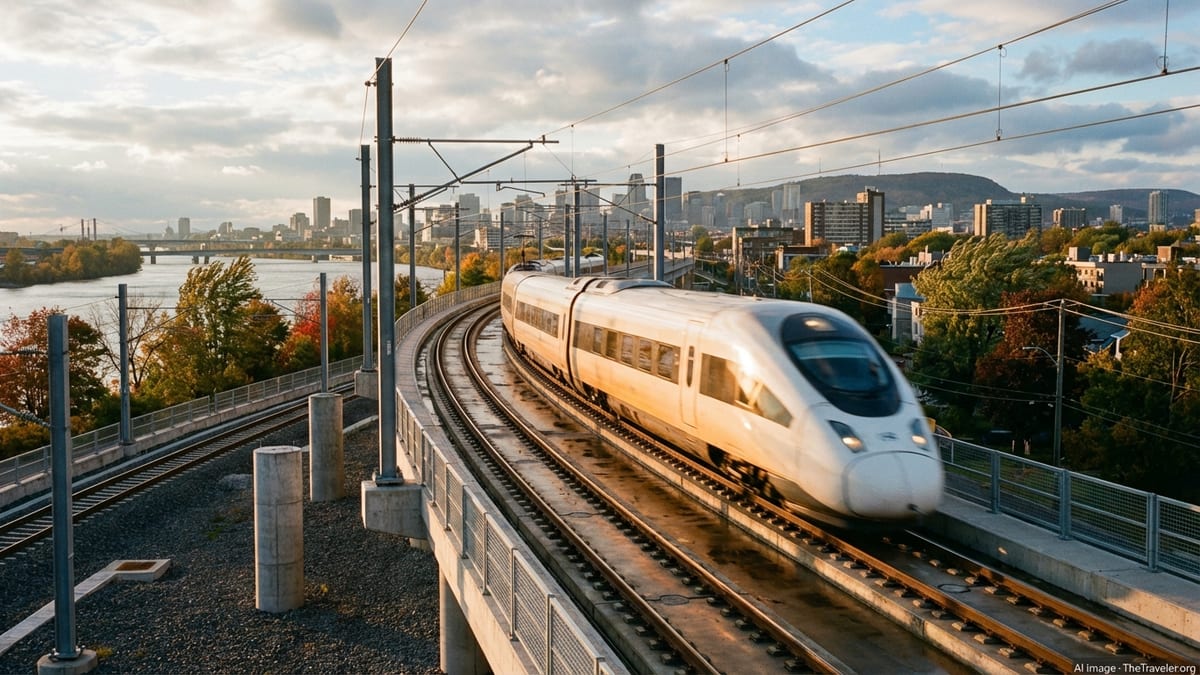
Expanded EU Vision for a Connected High-Speed Rail Grid
Publicly available information from European institutions shows that the updated regulation governing the Trans-European Transport Network, known as TEN-T, sets 2040 as a key milestone for an extended core rail network designed to link all EU capitals and major cities with faster, higher-capacity lines. The framework requires core and extended core passenger routes to support speeds of at least 160 kilometres per hour, with many high-speed corridors planned for considerably higher operating speeds.
The same framework lays out phased targets: completion of the core network by 2030, the extended core network by 2040 and the wider comprehensive network by 2050. Germany’s participation in this structure places it at the heart of several of the most strategic axes, running north to south between Scandinavia and the Mediterranean and west to east toward Central and Eastern Europe.
According to recent briefings and press material, the European Commission’s wider rail plan seeks to better coordinate funding, regulation and technical standards so that long-distance passenger services can move more seamlessly between national systems. The goal is not only to add new high-speed lines but also to upgrade existing tracks, signalling and cross-border junctions so that trains can travel more quickly and reliably across internal EU frontiers.
Analyses prepared for policymakers indicate that this package is expected to contribute to economic growth while supporting climate objectives by shifting more passengers from air and road to rail on medium and long-distance journeys. A stronger role for rail is seen as essential to the bloc’s strategy to cut emissions and reduce dependence on aviation for intra-European travel.
Germany’s Role on Scandinavian–Mediterranean and Atlantic Axes
Germany’s geographic position places it at the centre of several TEN-T corridors, and recent technical documentation highlights the importance of these routes for the 2040 vision. The Scandinavian–Mediterranean corridor, one of the longest in the network, runs from Finland and Sweden through Denmark and Germany, across the Alps and into Italy and Malta. High-speed and upgraded conventional lines along this spine are intended to link ports and industrial hubs from Hamburg and Bremen down to Northern Italy.
Cross-border projects between Denmark and Germany illustrate how this connectivity agenda is taking shape on the ground. The immersed tunnel under the Fehmarn strait, for example, is designed to shorten journeys between the Nordic region and continental Europe while freeing capacity for both passenger and freight trains. Once completed and integrated into upgraded German and Danish rail lines, it is expected to form a fast, direct rail and road link between Copenhagen, Hamburg and beyond.
Germany is also included in the extended Atlantic corridor, which connects Portugal and Spain with France and then onwards to western Germany. Plans published by EU bodies outline new or enhanced high-speed sections between Lisbon, Madrid and the French border, and then north toward Paris and into German territory via Strasbourg and the Rhine region. This axis is projected to strengthen links between Iberian ports, French logistics hubs and German industrial centres.
National planning documents from Germany emphasise that the country’s own long-term rail investment strategy is being aligned with TEN-T standards on speed, electrification and signalling. This alignment is intended to ensure that domestic modernisation, such as capacity improvements around major nodes like Hamburg, Frankfurt and Munich, contributes directly to the broader European high-speed grid.
Southern Europe: From Iberian Links to Balkan and Greek Corridors
Germany’s decision to align with the 2040 high-speed rail push comes as southern and south-eastern European countries work to close long-standing gaps in their own cross-border links. According to published coverage from rail industry outlets and EU sources, Spain and Portugal are moving ahead with accelerated plans on the Lisbon to Madrid high-speed connection and related Atlantic corridor upgrades, aiming to cut travel times between major Iberian cities and central Europe.
France and Italy, already among Europe’s largest high-speed rail markets, are also central to the 2040 vision. Major schemes such as the Lyon to Turin base tunnel across the Alps, together with complementary upgrades on both sides of the border, are intended to provide a faster, higher-capacity route between France and Northern Italy. These projects are identified within TEN-T as crucial for shifting freight and passengers away from road traffic through sensitive Alpine regions.
Further east, the regulation’s extended core network stretches into Bulgaria and Greece, where planned or upgraded lines are meant to connect the Balkans with Central Europe and the Eastern Mediterranean. While progress in these regions has historically been slower, the inclusion of key routes in the 2040 framework signals a renewed attempt to bring rail infrastructure standards closer to those of western member states.
Observers note that for countries in south-eastern Europe, the high-speed rail agenda is closely linked to cohesion and development goals. Better long-distance rail links are seen as a way to improve access to markets, ports and tourist destinations, while providing alternatives to road traffic on congested or environmentally sensitive corridors.
Technical Standards and the Push for Interoperability
A central plank of the 2040 rail strategy involves harmonising technical standards so that trains can move across borders without lengthy checks or changes in equipment. Official EU material describes plans to roll out a single European train control and signalling system across the entire TEN-T rail network, replacing a patchwork of national systems. This common platform is expected to improve safety and allow trains to operate more efficiently across multiple countries.
Regulatory texts and guidance also underline that electrification is to be extended to cover virtually all core and extended core rail lines within the 2030 and 2040 horizons. On top of this, minimum performance standards are being set for line speeds, axle loads and train lengths, with the aim of ensuring that new or upgraded high-speed routes can also carry modern, heavier freight trains where appropriate.
The 2040 vision goes beyond infrastructure alone. Recent Commission communications outline intentions to improve international ticketing and booking systems, reduce administrative barriers for new cross-border services and encourage cooperation between infrastructure managers. The expectation is that simplified procedures and more transparent access conditions will make it easier for operators to launch new high-speed and long-distance trains on routes that cross several national networks.
Travel industry analysts point out that these interoperability measures are likely to be particularly important for Germany and its neighbours, where dense timetables and multiple operators already share busy corridors. Aligning timetables, platforms and passenger information systems is seen as essential if the promised reductions in journey times between major cities are to be achieved in practice.
Implications for Travelers and Tourism Across Europe
For travelers, the combined effect of Germany’s participation and the wider EU 2040 plan is expected to be a gradual but noticeable shift in how medium-range trips across Europe are made. Public documents describing the initiative suggest that many cross-border rail journeys between major cities could be shortened significantly compared with current timings, in some cases cutting travel times by up to half where high-speed lines replace slower routes.
Tourism bodies and transport researchers argue that more competitive rail journey times between capitals and key leisure destinations could change booking patterns, particularly on routes where rail can offer centre-to-centre travel with fewer formalities than air. Examples frequently highlighted include links between the Iberian Peninsula and central Europe, north-south routes from Scandinavia through Germany to Italy, and east-west axes tying the Balkans and Greece to western markets.
The environmental angle is also important for the travel sector. As airlines and airports face tighter emissions constraints, a denser web of high-speed and upgraded long-distance rail routes offers tour operators, conference organisers and individual travellers an alternative for certain journeys. The 2040 network is intended to support this shift by providing consistent quality and performance standards across borders.
While delivery will depend on sustained investment and coordination at national level, Germany’s inclusion alongside Denmark, Bulgaria, Greece, France, Italy, Spain, Portugal and other member states adds further weight to the EU’s long-term attempt to create a truly continental high-speed rail system. For passengers planning future European trips, the result could be a map in which cross-border rail is a faster, more straightforward option on far more routes than it is today.