


Germany and the Netherlands are two of Europe’s most important destinations for internationally mobile professionals. Both compete for global talent yet differ significantly in labour market size, structure and current policy direction. This briefing compares Germany and the Netherlands specifically from the perspective of expats and skilled workers assessing where their skills are likely to be in demand and how sustainable career prospects appear over the coming years.
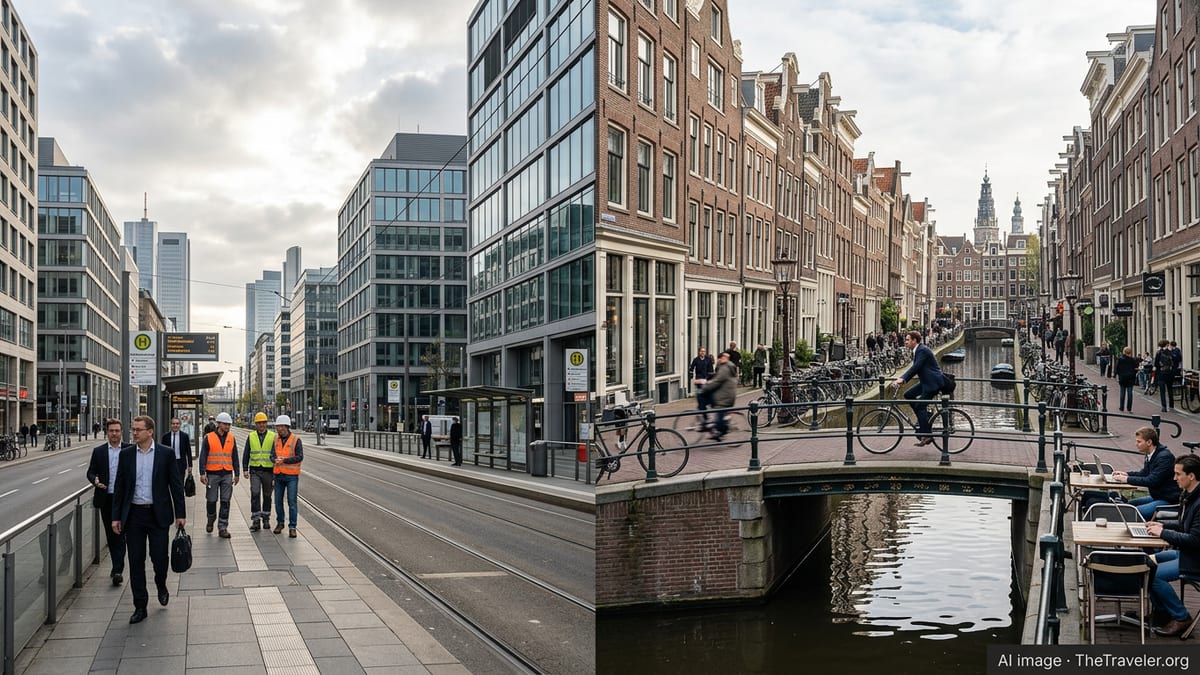
Overall Labour Market Scale and Structure
Germany and the Netherlands offer very different labour market scales. Germany, with a population of around 84 million, has one of the largest labour markets in Europe. The employment rate in Germany is high, at roughly the upper‑70s percent range for working age adults, and the unemployment rate has hovered around the mid‑3 percent range in 2024 and 2025, indicating a tight but cooling labour market environment compared with the immediate post‑pandemic period. Recent assessments still describe demand for qualified staff as structurally strong despite cyclical slowdown.
The Netherlands, with just over 18 million residents, operates on a much smaller absolute scale but with one of the highest employment rates in the EU. Labour market participation is strong, and unemployment is generally low by international standards. However, the smaller population base means that niche specialist roles may be fewer in number, and competition within specific metropolitan clusters, such as Amsterdam, Rotterdam and Eindhoven, can be intense, especially in downturns.
For expats and skilled workers this translates into a broad trade‑off. Germany offers a far larger absolute number of skilled positions across industry, manufacturing, engineering, healthcare and services, simply due to its economic size. The Netherlands offers a more compact market, with a strong orientation toward services, logistics, high‑tech and knowledge‑intensive sectors, but fewer total openings in each category. Professionals whose profile fits Germany’s large industrial and technical base may find more parallel opportunities across cities, while those aligned with digital, finance and logistics may see denser but smaller clusters in the Netherlands.
Both markets are facing demographic ageing and an increasing need to maintain labour supply. Germany in particular is projected to experience sharper medium‑term workforce shrinkage, which underpins its strong emphasis on attracting and retaining foreign skilled workers.
Demand for Skilled Workers and Shortage Occupations
Germany continues to experience broad and persistent shortages of skilled workers across many occupations. Official analyses classify more than one in eight skilled occupations as shortage fields, covering roughly 160 distinct job categories. These shortages are most acute in healthcare and nursing, technical trades, construction, engineering and certain service roles. Even with a weak economic cycle and higher overall unemployment in 2024, roughly half of advertised vacancies targeted qualifications in these bottleneck occupations, underlining continued structural demand for specific skill sets.
In the Netherlands, labour demand is also strong, but recent developments indicate a more mixed picture for foreign talent. The Dutch labour market relies heavily on non‑Dutch workers: estimates suggest around one million non‑Dutch workers are active in the economy, concentrated in sectors such as logistics, food processing, tech and healthcare. At the same time, advisory reports highlight that hundreds of thousands of migrants in the Netherlands remain underemployed or unemployed while willing to work, suggesting challenges with matching skills to available roles and with labour market integration for some migrant groups.
For high‑skilled workers, Germany currently sends a clearer demand signal. The country is the dominant issuer of EU Blue Cards for highly qualified non‑EU workers, accounting for a very large majority of all Blue Cards granted in the EU. This, combined with separate national skilled worker residence permits, makes Germany the primary European entry point for non‑EU professionals in engineering, IT, science and other high‑qualification roles. In the Netherlands, by contrast, the number of new highly skilled migrants and associated permits has fallen since 2022, reflecting both changing employer demand and an increasingly restrictive policy environment.
From a practical standpoint, expats with profiles in healthcare, engineering, technical trades, and industrial digitalisation will generally find Germany’s shortage lists more extensive and geographically spread. In the Netherlands, strong demand exists in IT, fintech, high‑tech manufacturing and logistics, but the combination of a smaller market and recent policy tightening means that competition for top roles may be higher and entry opportunities more sensitive to economic cycles.
Recent Trends in Skilled Migration and Policy Direction
Germany has moved in the direction of actively expanding channels for foreign skilled labour. In recent years, the number of non‑EU workers holding employment‑related residence permits, including EU Blue Cards and skilled worker visas, has increased steadily, with totals in the hundreds of thousands. European data show that in 2023 and 2024 Germany issued the overwhelming majority of all EU Blue Cards in the European Union, confirming its role as the main hub for highly qualified non‑EU talent.
Policy initiatives in Germany have explicitly framed skilled migration as central to addressing demographic decline and labour shortages. Reforms have lowered some qualification and salary thresholds for certain categories, broadened pathways for non‑academic skilled workers and expanded recognition of foreign vocational qualifications. While implementation timelines vary and administrative processes can still be demanding, the strategic direction is clearly toward facilitating labour market access for foreign professionals.
The Netherlands, in contrast, has entered a phase of tightening for high‑skilled migration. Official figures show that the number of highly skilled workers (knowledge migrants) entering the Netherlands declined by roughly 18 percent in 2023 compared with 2022, breaking a long trend of year‑on‑year increases. Provisional data and national analyses indicate that 2024 saw a further drop in applications and approvals in categories such as highly skilled migrants, European Blue Cards and intra‑company transfers. The government has also introduced additional restrictions and higher thresholds in the highly skilled migrant scheme from 2024 onward.
These divergent trends matter directly for expats. Germany is signaling an intention to absorb more skilled foreigners despite cyclical economic weakness, particularly in sectors facing chronic shortages. The Netherlands remains open to talent but is recalibrating entry channels through higher income thresholds, tighter conditions and political commitments to moderate overall migration numbers. As a result, the probability of policy‑driven constraints affecting skilled worker inflows appears higher in the Netherlands over the short to medium term than in Germany.
Sectoral Opportunities for Expats and Skilled Workers
Sectoral composition is a critical differentiator between the two countries for internationally mobile professionals. Germany maintains a large, diversified industrial base spanning automotive, machinery, chemicals, energy technology and advanced manufacturing. This underpins strong continuing demand for mechanical, electrical and software engineering, industrial IT, supply chain specialists and applied scientists, along with vocationally trained technicians, tradespeople and production specialists. Healthcare and eldercare demand is also expanding rapidly due to demographic trends.
The Netherlands has a more services‑oriented and trade‑dependent economy. Key sectors include logistics and transport, international business services, financial technology, high‑tech manufacturing concentrated around Eindhoven, and agri‑food technology. Multinational headquarters and regional hubs in cities like Amsterdam and Rotterdam generate demand for corporate finance, legal, compliance, data and digital roles. At the same time, significant segments of migrant labour work in lower‑wage or seasonal roles in logistics, agriculture and food processing, areas where career progression can be limited.
For highly educated expats, Germany offers a wide and deep industrial ecosystem that can absorb varying levels of specialization, which can be valuable for mid‑career professionals seeking lateral moves or sector changes over time. For example, skills in embedded software, industrial automation or quality engineering can be redeployed across multiple German regions and industries. In the Netherlands, high‑end opportunities are more geographically concentrated, especially in tech and R&D clusters, which can be attractive but may expose workers more strongly to local market fluctuations or sector‑specific policy changes.
Expats considering both countries should therefore assess not only where their current skills are in demand but also how portable those skills would be across sectors within each labour market. Germany’s breadth provides more redundancy for technical and industrial profiles, while the Netherlands can be advantageous for professionals in international business services, logistics management and digital‑platform ecosystems who value a very internationally oriented corporate environment.
Labour Market Integration, Underemployment and Career Progression
Formal demand for skills does not automatically translate into smooth integration or optimal career trajectories for foreign workers. In the Netherlands, recent advisory reports estimate that hundreds of thousands of migrants of working age are able and willing to work but are not employed, highlighting structural challenges such as language barriers, non‑recognition of qualifications, or mismatch between skills and job openings. For some migrants this can mean periods of underemployment, particularly outside of the highly skilled migrant category.
Germany also faces integration challenges, but the shortage of skilled workers across many occupations increases the likelihood that professionally qualified expats can find roles that match or come close to their existing skill level, particularly if they can meet language requirements in key sectors. At the same time, stringent professional licensing in healthcare, education and regulated professions can delay full utilization of foreign qualifications, and regional differences mean that labour market integration may be easier in some federal states than others.
For career progression, both countries offer structured corporate environments, but promotion pathways can be influenced by language proficiency and sector norms. In Germany, long‑term advancement in many firms, especially in client‑facing or leadership roles, typically requires strong German language skills. In the Netherlands, English is widely used in international firms, which can ease early‑stage integration for expats, especially in tech and corporate services. However, for senior roles that interact closely with domestic stakeholders, Dutch language competence can still be a practical requirement.
Overall, expats considering medium‑ to long‑term careers may find Germany more accommodating in terms of volume of professional‑level openings and lower risk of structural underemployment, especially in STEM and technical fields. The Netherlands can be particularly attractive for early‑career professionals in internationally oriented sectors, but the higher share of migrants who are not fully integrated into the labour market underlines the importance of careful sector choice and employer due diligence.
Future Outlook for Expats and Skilled Workers
The forward outlook for expats and skilled workers in Germany is shaped by demographic pressure, industrial transformation and gradual policy liberalisation. Population ageing and projected workforce decline mean that without continued migration, labour shortages in many fields would likely intensify. Concurrently, Germany is pursuing large‑scale investments in green technologies, digital infrastructure and defence, all of which demand specialised skills. Forecasts for 2025 and 2026 anticipate only modest GDP growth but continued high employment rates, suggesting that while cyclical risks exist, the structural need for qualified staff will remain.
In the Netherlands, the outlook combines ongoing reliance on foreign labour with a tightening policy environment. The government has signaled intentions to better manage overall migration volumes and adjust incentives such as favourable expat tax rules, which historically made the country highly attractive to certain categories of skilled workers. Declines in new high‑skilled migrant arrivals, along with political commitments to further refine the highly skilled migrant regime, indicate that entry pathways may become more selective. At the same time, sectors like high‑tech manufacturing, logistics and digital services are likely to continue seeking foreign talent where domestic supply is insufficient.
For expats, this suggests that Germany may continue to deepen its role as a primary European destination for skilled workers, particularly from outside the EU, with policy moving toward more, not fewer, options for entry and labour market participation. The Netherlands will remain an important hub for international business and technology, but with greater emphasis on targeted, higher‑value migration and closer scrutiny of labour market impacts.
Professionals planning relocation over a five‑ to ten‑year horizon should therefore factor in not only current job availability but also each country’s political stance on skilled migration, demographic pressures and sectoral transformation agendas, as these will shape demand for foreign talent beyond the current economic cycle.
The Takeaway
From the specific standpoint of labour market prospects for expats and skilled workers, Germany and the Netherlands present distinct profiles. Germany combines a very large, diversified economy with structural shortages in many skilled occupations and a policy trajectory that explicitly leans on foreign talent to sustain growth and manage demographic decline. The Netherlands offers a smaller but dynamic labour market with strong international sectors, yet is currently experiencing a reduction in new skilled migrant inflows and a shift toward more restrictive and selective migration policies.
For professionals in engineering, manufacturing, healthcare, technical trades and applied sciences, Germany generally offers broader and more resilient demand across multiple regions and industries. For those in international business services, logistics, fintech and digital sectors, the Netherlands can provide high‑value opportunities, though with a narrower set of entry points and greater sensitivity to policy changes and market cycles.
Ultimately, relocation decisions should be anchored in occupation‑specific realities. Mapping personal skills against documented shortage lists, recent migration policy changes and sectoral growth plans in each country will yield the most reliable picture of career potential. In today’s landscape, Germany appears more oriented toward expanding opportunities for skilled expats at scale, while the Netherlands is recalibrating the balance between openness to talent and domestic labour market and political considerations.
FAQ
Q1. Which country currently offers stronger overall demand for skilled foreign workers, Germany or the Netherlands?
Germany offers stronger overall demand, with broad shortages across many skilled occupations and a policy direction focused on attracting more foreign talent rather than less.
Q2. In which sectors does Germany provide the best prospects for expats and skilled workers?
Germany provides particularly strong prospects in engineering, advanced manufacturing, automotive, renewable energy, construction, healthcare, nursing, IT, and technical trades.
Q3. In which sectors does the Netherlands provide the best prospects for expats and skilled workers?
The Netherlands offers notable opportunities in logistics and transport, financial and business services, fintech, high‑tech manufacturing, and agri‑food technology, especially in major urban and tech hubs.
Q4. How do recent migration trends differ between Germany and the Netherlands for skilled workers?
Germany continues to expand skilled migration channels and issues most EU Blue Cards, while the Netherlands has recorded declines in new highly skilled migrant arrivals since 2022 and is tightening entry criteria.
Q5. Which country is better for long‑term career security for engineers and technical professionals?
Germany is generally better for long‑term career security for engineers and technical professionals due to its large industrial base and persistent shortages in technical and industrial occupations.
Q6. Are expats more likely to face underemployment in Germany or in the Netherlands?
Underemployment risks exist in both countries, but available data suggest a relatively higher share of migrants in the Netherlands wanting work but not employed, especially outside top‑tier skilled roles.
Q7. How important are local language skills for career progression in each country?
In Germany, strong German language skills are usually essential for long‑term progression in most sectors. In the Netherlands, English can carry careers in international firms, but Dutch becomes more important for senior or locally focused roles.
Q8. Which country is more likely to expand opportunities for skilled expats over the next decade?
Germany is more likely to expand opportunities, driven by demographic ageing and structural labour shortages, alongside ongoing policy reforms designed to attract and retain foreign skilled workers.
Q9. How do labour market sizes influence opportunities for expats in each country?
Germany’s much larger labour market creates more absolute openings across many fields, while the Netherlands offers a smaller, dense set of opportunities concentrated in key sectors and cities.
Q10. How should expats choose between Germany and the Netherlands based purely on labour market factors?
Expats should match their specific occupation to each country’s shortage fields, assess sectoral depth and policy trends, and prioritise the market that offers more parallel roles and clearer long‑term demand for their skills.