


More news on this day
Europe’s long romance with Venice is entering a new chapter as tourism pressure and stricter visitor rules in the Italian lagoon city push travelers to seek quieter canal destinations, with Germany and several neighboring countries now actively promoting lesser known waterways and historic canal towns as fresh alternatives.
Get the latest news straight to your inbox!
Venice Tightens Controls as Europe Rethinks Water-Based Tourism
Venice has become a global symbol of overtourism, with crowding, cruise-ship traffic and climate-related flooding placing the lagoon city under intense scrutiny. Recent monitoring by international bodies and Italian authorities has focused on limiting day-trip visitor numbers and redirecting flows away from the most fragile parts of the historic center. State of conservation documents prepared for UNESCO in 2025 and 2026 highlight the challenge of managing tourism within the “Venice and its Lagoon” site while encouraging visitors to explore the wider Veneto region and other Italian cities.
As debate continues over entry fees, caps on tour groups and restrictions on short-term rentals in Venice, tourism campaigns across Europe are beginning to shift their messaging. Publicly available strategy papers from national tourism boards increasingly pair images of classic canal views with lesser known destinations, positioning the continent’s wider network of waterways as a way to relieve pressure on marquee cities while still offering the romance of life on the water.
This change coincides with a broader policy push in the European Union toward “smart” and sustainable tourism. The European Capital of Smart Tourism initiative, whose 2026 communication plans were published earlier this year, calls on winning cities to showcase low-impact visitor experiences, better crowd management and alternatives to highly saturated sites. Canal districts and riverfront quarters, often outside historic cores, are central to those efforts.
Within this context, national tourism boards in Germany, the Netherlands, Belgium and France have started to package canal towns, river ports and man-made waterways into themed routes and multi-country itineraries designed to appeal to travelers looking beyond Venice.
Germany Turns Industrial Waterways Into Leisure Routes
Germany’s extensive inland waterway system, built primarily for freight and energy, is being reimagined as a network for leisure travel. Federal data indicate more than 7,000 kilometers of navigable rivers and canals, from the Rhine and Elbe to the Kiel Canal and the Rhine–Main–Danube link, connecting the North Sea to the Black Sea. Once associated with industry and logistics, many of these corridors now anchor river cruises, cycling trails and houseboat holidays.
The German National Tourist Board’s recent resource guides emphasize a shift toward “hidden treasures,” urging visitors to explore small towns and canal landscapes rather than focusing solely on major cities. Promotional material spotlights charter-licence areas in Mecklenburg–Western Pomerania and Brandenburg, where over 700 kilometers of waterways are open to houseboat travelers without a full boating licence. Historic spa towns such as Bad Ems and river ports like Limburg are marketed as stops where visitors can disembark directly into medieval centers and baroque quarters.
In North Rhine–Westphalia, regional tourism agencies are presenting the Datteln–Hamm Canal and adjacent waterways in the Ruhr as part of a broader “canal passage” experience. Cycling routes now trace the banks of shipping canals and the Lippe River, linking lake landscapes, nature reserves and old Hanseatic trading towns. Similar initiatives are emerging around the Mittelland Canal and Havel Canal, where redeveloped banks and small marinas provide access to towns that previously saw little international tourism.
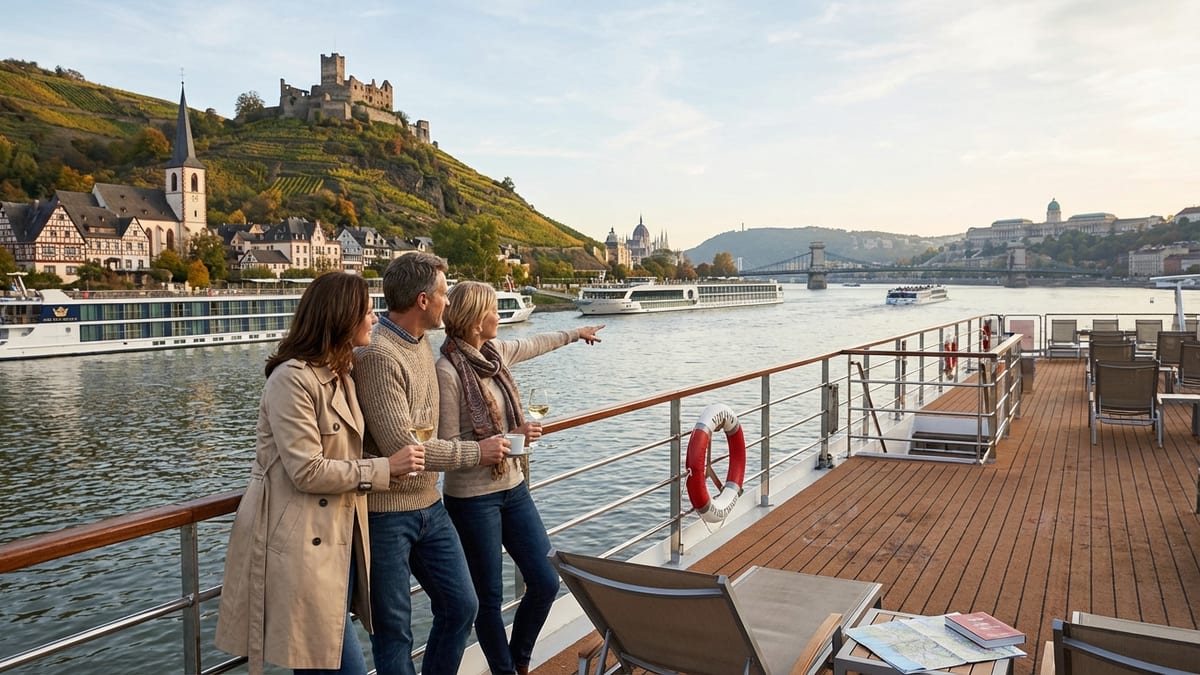
Germany’s river-cruise sector is also drawing attention to routes that make use of canals as connectors. Itineraries marketed to overseas visitors now commonly include segments along the Main–Danube Canal, promoted as a way to move between Bavarian towns and Franconian wine regions while avoiding bus transfers. Reports from cruise operators describe growing interest in itineraries that stop at smaller river ports rather than only at capitals such as Vienna or Budapest.
From Utrecht to Ghent, Neighbors Promote “Second Cities on the Water”
Germany’s repositioning of its waterways is mirrored in neighboring countries that also want to lessen reliance on a single flagship canal city. In the Netherlands, ongoing debates about crowding in Amsterdam have spurred campaigns that highlight alternative canal destinations. Travel features and official tourism messaging alike point to Utrecht, Haarlem and the car-free village of Giethoorn as places where visitors can experience historic canals with fewer crowds and lower environmental stress.
Utrecht, in particular, has received attention for restoring sections of its historic canal ring that were converted into roads in the 20th century. Revitalized quays and re-watered sections now host terraces, moorings and cultural venues, offering a canal experience distinct from Amsterdam’s UNESCO-listed ring. Dutch tourism authorities and regional boards have used examples like Utrecht to demonstrate how canal infrastructure can be redesigned for both residents and visitors.
Belgium is following a similar pattern. Bruges, long popular for its medieval canals, is being framed alongside Ghent and smaller Flemish canal towns in both media coverage and regional marketing. Ghent’s waterways, formed at the junction of the Scheldt and Leie rivers and extended by industrial canals to the North Sea, are increasingly presented as part of a broader “canal belt” where travelers can spread their stays between multiple cities.
Across the border in France, Annecy’s canals and lakefront promenades are featured as a mountain-framed alternative to Italy’s lagoon scenery. Travel publications continue to describe the town as a canal city in its own right, with strict local environmental regulations for Lake Annecy aligning with European calls for more sustainable water-based tourism.
Data-Driven Push for Sustainable Canal Tourism
The move to showcase hidden canal cities is also informed by tourism data and research into visitor behavior. Annual reports by the German National Tourist Board indicate that inbound travel has been recovering unevenly across regions, with urban hubs rebounding faster than rural or peripheral areas. Campaigns promoting lesser known waterways are described as a way to spread demand, support regional economies and reduce pressure on already saturated city centers.
Academic studies and policy papers across Europe point to waterways as valuable corridors for low-carbon mobility and recreation. Research on urban and regional planning frequently cites canal towpaths and riverfront greenways as infrastructure that can combine cycling, walking, boating and habitat protection. Tourism agencies have seized on this framing, presenting canal-based trips as compatible with climate targets while still delivering the slow-travel experiences many visitors now seek.
At the EU level, recent communications on smart and green tourism stress the importance of dispersing visitor flows and encouraging off-season travel. Canal networks and secondary water cities are highlighted as tools to achieve those goals: they can absorb visitors who might otherwise concentrate in a few iconic locations, and they often have capacity during shoulder seasons when major destinations are still busy.
While these strategies are still evolving, early signals from tour operators and regional visitor statistics suggest rising interest in itineraries that weave together several canal towns in one trip. Package holidays featuring houseboat segments, cycling along former industrial canals and overnight stays in small river ports are becoming more common in brochures and online platforms.
A New Map of Europe’s “Cities of Canals”
As Venice tightens visitor management and implements new rules for day-trippers and cruise calls, the symbolic role of the lagoon city is changing. Travel media and national tourism boards are starting to refer to a wider family of “cities of canals,” from Germany’s historic spa towns on narrow waterways to Dutch university cities, Belgian ports and French alpine lake towns.
This broader map does not replace Venice’s appeal but reframes it within a continent-wide network of waterborne destinations. For travelers, it opens possibilities to combine an iconic visit to the lagoon with quieter days on German rivers, Dutch polder canals or Belgian inner harbors. For local communities, it offers a chance to reinterpret working waterways as cultural assets and tourism gateways.
How durable this shift proves will depend on infrastructure investment, environmental regulation and the willingness of visitors to look beyond established icons. For now, the emergence of Germany’s hidden canal cities and their European counterparts suggests that the future of canal tourism will be more distributed, with a growing number of towns sharing the role that Venice once carried largely on its own.