


Adolfo Suárez Madrid Barajas is one of Europe’s best connected airports, but the number of options can feel overwhelming when you are trying to catch a flight or reach your hotel after landing. Metro line 8, Cercanías suburban trains, the Express Airport bus, official taxis, ride hailing apps and private cars all compete for your attention, each with its own price point, comfort level and quirks. This 2026 guide breaks down the choices with up to date information and concrete examples so you can pick the option that truly fits your time, budget and luggage, whether you are flying into Terminal 1, 2, 3 or 4.
Get the latest updates straight to your inbox!
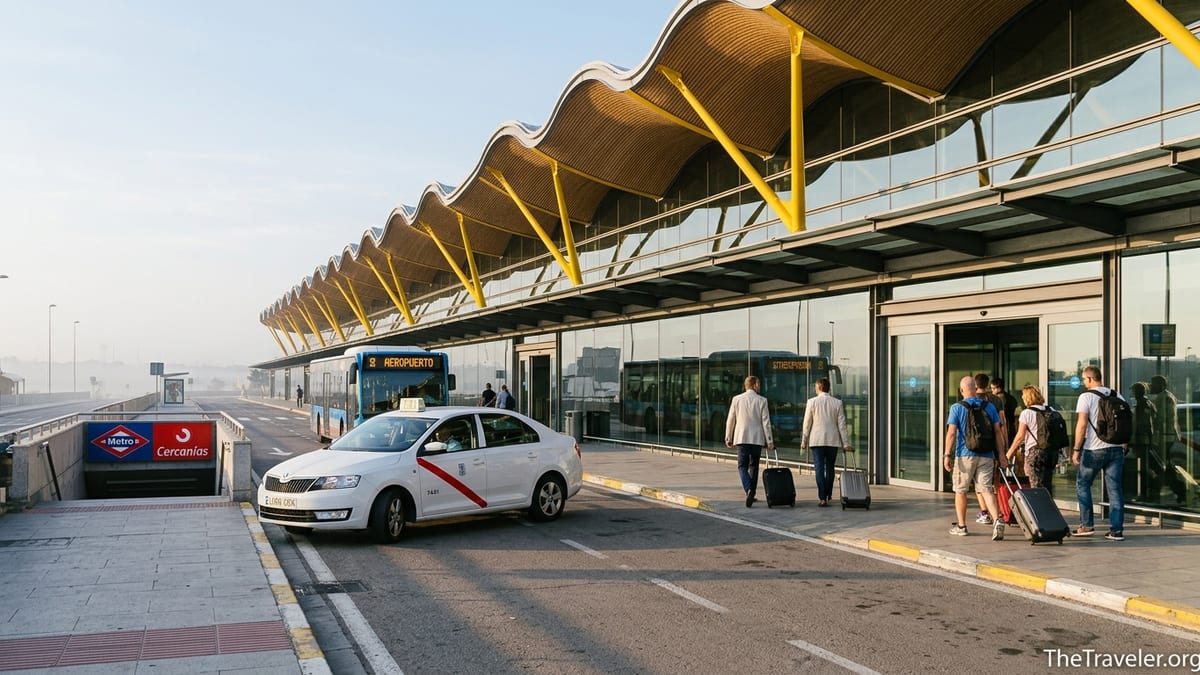
Understanding how Madrid Barajas is laid out
Madrid Barajas sits about 12 kilometers northeast of the city center and is spread across four main terminals: T1, T2, T3 and the newer T4 with its satellite building T4S. T1, T2 and T3 cluster together on one side of the runways, while T4 stands apart, reached by an internal shuttle or the automated train if you are connecting to T4S. Knowing your terminal is important because some transport options only serve certain terminals directly, and walking distances inside the airport can be longer than first time visitors expect.
Most European low cost carriers such as Ryanair and easyJet typically use T1 or T2, many Schengen flights concentrate in T2 and T3, and long haul or Iberia services often depart from T4 or T4S. If you are staying near Puerta del Sol or Gran Vía, you are roughly 20 to 30 minutes by road from any terminal in light traffic, though at peak times that can stretch toward 40 minutes. Public transport options fan out from both the T1–T2–T3 cluster and from T4, so in many cases you can choose the most convenient station or stop for your particular flight.
For first time visitors, it helps to think of your journey in two parts: reaching or leaving the airport perimeter, and then navigating between terminals. A free green shuttle bus links T1, T2, T3 and T4 around the clock, and it is common to combine that bus with your chosen mode of transport. For example, you might arrive by Cercanías train into T4, then jump on the shuttle to reach a low cost flight departing from T1.
Metro line 8: the pink line into the city
The metro is often the default choice for independent travelers who value predictable travel times and low fares over door to door convenience. Line 8, the pink line, runs from the Nuevos Ministerios transport hub in central Madrid to the airport, serving Aeropuerto T1–T2–T3 station and Aeropuerto T4 station. From Nuevos Ministerios, you can usually reach the airport in around 20 to 25 minutes, and trains typically run from roughly 6:00 in the morning until about 1:30 at night, with frequencies of a train every few minutes at peak and around every 7 to 10 minutes later in the evening.
In 2026 a single metro ticket from central Madrid to the airport, including the airport supplement, usually comes to roughly 4.50 to 6 euros depending on where you start and whether you are using a multi trip ticket or tourist pass rather than a one off journey. For example, traveling from Gran Vía to Aeropuerto T4 typically involves changing trains once, for instance at Nuevos Ministerios, and costs toward the lower end of that range with a standard ticket. The fare structure is integrated with the wider Madrid public transport system, so holding a tourist travel pass can significantly reduce what you pay per trip if you are in the city for several days.
In practical terms, the metro works best if you are traveling with one medium suitcase and a backpack rather than multiple oversized bags. While trains have dedicated luggage spaces, stations such as Sol and Gran Vía can become crowded at rush hour, and you may find yourself carrying bags up or down escalators or stairs when changing lines. On the positive side, metro stations like Nuevos Ministerios, Chamartín and Atocha connect you to a web of other lines, allowing you to reach neighborhoods such as La Latina, Malasaña or Retiro without touching a taxi.
Many business travelers staying in the office districts around Castellana or in the Nuevos Ministerios area rely almost exclusively on the metro, as it delivers them from their hotel to the terminal in a fixed time unaffected by surface traffic. If you are catching a mid morning flight on a weekday, leaving a hotel near Nuevos Ministerios 60 to 75 minutes before departure time is often sufficient for Schengen flights when you are already checked in online, although for long haul or peak holiday weekends you will still want to build in more margin.
Cercanías suburban trains: fastest for T4
Madrid’s Cercanías commuter rail network offers another public transport route into the airport, but only for Terminal 4. The Aeropuerto T4 station sits beneath the terminal and is served by lines such as C 1 and C 10, which link the airport to Chamartín, Nuevos Ministerios, Recoletos and Atocha Cercanías. Journey times from Chamartín to T4 are typically around 10 to 15 minutes, and from Atocha around 25 to 30 minutes, making the train arguably the fastest way into the city center when it aligns with your schedule.
A standard Cercanías ticket to or from Aeropuerto T4 costs roughly 2.50 to 3 euros one way in 2026, depending on your starting station and zone. If you have a long distance Renfe train ticket arriving in or departing from Madrid, it often includes a free Combinado Cercanías segment, which you can use to connect by suburban rail between the airport, Chamartín and Atocha. For example, a traveler arriving on a high speed AVE train from Barcelona into Atocha at lunchtime could use that entitlement to ride Cercanías to Chamartín and onward to Aeropuerto T4 without paying extra.
Service typically operates from around 6:00 in the morning until near midnight, with trains every 15 to 30 minutes depending on time of day and line. That makes Cercanías especially attractive for early evening or daytime arrivals at T4 who are heading for the main station areas or staying near Paseo del Prado. One scenario where it shines is if you land at T4 around 8:30 in the morning and have a long distance train from Atocha at 11:00. Rather than navigating the metro with luggage, you can follow the clear Cercanías signs, buy a ticket from the machines in the station concourse and ride directly to Atocha with a predictable connection.
The trade off is that if your flight uses T1, T2 or T3 you must first reach T4 by the free terminal shuttle, which adds 10 to 20 minutes depending on traffic and waiting time. With heavy luggage or small children, some travelers find the extra transfers less attractive than a direct taxi, even if the train is cheaper. In addition, elevators and escalators can become bottlenecks at peak times, so allow a little extra time if you are traveling with a stroller or mobility device.
Airport Express bus and city buses: 24 hour coverage
The bright yellow Airport Express bus, often labeled as line 203, is the main bus connection between Barajas and the center. It runs 24 hours a day, linking the airport terminals with key city stops such as O’Donnell, Plaza de Cibeles and Atocha railway station. During the day, buses typically run every 15 to 20 minutes, and at night that stretches toward every 30 minutes. In normal traffic, the ride from T4 to Cibeles takes around 30 to 40 minutes, a little longer in rush hour.
Tickets are sold on board and in 2026 cost around 5 euros per person, cash or contactless card. That makes the Express bus one of the simplest options for travelers who arrive after the metro and Cercanías have stopped around 1:30 in the morning. A common late night routine for visitors staying near the historic center is to ride the bus to Cibeles, then walk or take a short regular city bus or taxi hop to their accommodation around Sol or Gran Vía. For a couple landing at 2:00 in the morning, two Express bus tickets usually work out significantly cheaper than a 33 euro flat fare taxi, provided they are comfortable managing their luggage on a bus.
Besides the dedicated Express line, several regular EMT city buses serve the Barajas district and the airport perimeter. These are useful if you are staying near neighborhoods in the northeast of Madrid rather than right in the center. For instance, travelers booked into a hotel around Avenida de América or the O’Donnell area sometimes choose a combination of a standard bus and a short metro ride. Fares on these regular buses are lower than the Express service, typically a few euros, and they are integrated into the same ticketing system as the rest of Madrid’s urban transport.
Do keep in mind that buses share the same streets and ring roads as private cars and taxis, so they are more vulnerable to traffic jams on Friday evenings, during major football matches or in the Christmas shopping season. If you are traveling to the airport for a flight during these peaks, add a generous buffer to the official journey time and consider whether metro or Cercanías might provide a less stressful alternative.
Taxis and ride hailing apps: door to door convenience
Official white Madrid taxis with a red diagonal stripe line up outside each terminal and remain one of the easiest ways to get between Barajas and the city. In 2026 there is a fixed flat fare of around 33 euros for any taxi journey between the airport and destinations inside the M 30 ring road, which covers almost all of central Madrid including Sol, Gran Vía, Malasaña, La Latina, Retiro, Salamanca, Chueca and major stations like Atocha and Chamartín. The flat fare applies regardless of time of day and includes luggage, so you do not have to worry about supplements for suitcases or late night surcharges.
For example, a family of four landing at T1 and heading to an apartment near Plaza Mayor would pay the same 33 euro flat rate at 10:00 in the morning as they would at midnight, often making a taxi not only the most comfortable but also the best value when shared among several people. Journeys typically take 20 to 30 minutes in moderate traffic, though you should allow more at weekday rush hours or when there are major events in the city. For hotels beyond the M 30 ring, such as in residential districts on the outskirts, the meter will be used and final fares commonly fall somewhere between 35 and 50 euros depending on distance and traffic.
Ride hailing apps like Uber, Cabify and Bolt also operate at Barajas and usually offer airport pickups from designated zones near the terminals. Their pricing floats with demand, so in quiet periods you may find app fares similar to or slightly below the fixed taxi rate for central destinations, while at very busy times surge pricing can make them more expensive. Some travelers appreciate the ability to book from their phone while still in the baggage hall and to see the driver’s details and estimated time of arrival before stepping outside.
In real world terms, taxis are particularly attractive if you are traveling with bulky luggage such as ski equipment, if you are jet lagged after a long overnight flight, or if you are staying in a hard to reach old town street where metro or bus connections would involve multiple changes and walking on cobblestones. A common pattern is for visitors to choose a taxi on arrival when tired and uncertain about the layout of the city, then switch to metro or train for the return journey once they have become familiar with Madrid.
Driving yourself: parking and rental cars
Driving to Madrid Barajas is fairly straightforward if you are comfortable with ring roads and major junctions. The airport is reached primarily via the M 40 and M 11 motorways, with clear signage for each terminal well before the exits. Many locals choose to drive their own car to the airport and leave it in a long stay car park when heading off on holiday, while visitors often pick up rental cars at the start of a road trip through central Spain.
The airport offers a mix of official AENA car parks close to the terminals and private off airport facilities that include shuttle transfers. Near T1, T2 and T3, multi storey car parks P1 and P2 provide short and medium stay options, while T4 is served by car park P4 and premium spaces under or adjacent to the terminal building. As a rough guide in 2026, official terminal car parks can cost in the region of several tens of euros per day for short stays, with discounted multi day and weekly rates for longer trips. Off airport car parks around Barajas and neighboring districts often undercut these prices, especially if you book online in advance, and some include extras such as car washing or covered spaces.
When deciding whether to drive, you should weigh parking and fuel costs against the flat taxi fare and low public transport prices. For a three day city break for two people staying near Sol, it is often cheaper and less stressful to leave the car at home and rely on metro and taxis, especially given Madrid’s traffic restrictions and paid on street parking zones near the center. By contrast, a family of five heading on a two week holiday might find that an off airport car park offering a fortnight’s stay at a moderate rate compares favorably with buying multiple airport taxi journeys or individual tickets on public transport.
Car rental desks from major international brands and local companies are located at all terminals, typically in the arrivals halls or just beyond customs. Picking up a rental car at T4 after landing can be a sensible choice if you are driving straight to cities such as Segovia, Ávila or Burgos and want to avoid backtracking into central Madrid. Do allow extra time at vehicle return, as rental parking lots are often separate from the main terminal car parks and can require careful attention to signage as you approach the airport on the motorway.
How to choose: matching options to different types of trip
With so many ways to reach or leave Madrid Barajas, the best option depends less on abstract ideas of speed and more on the specifics of your trip. Time of day, luggage, group size, stamina and your comfort with public transport all play a role. For a solo traveler staying near Nuevos Ministerios or Chamartín with a rolling carry on bag, metro line 8 or the Cercanías train to T4 can be the ideal blend of price and predictability. If your flight leaves around 9:00 in the morning, leaving your hotel 2 hours before departure, hopping on a metro or train and stepping directly into the terminal concourse is simple and inexpensive.
Couples on a weekend away staying near Plaza de Santa Ana or La Latina often split the difference. They might arrive by taxi using the 33 euro flat fare after an evening flight, then buy a 3 day tourist travel card to make use of metro and buses while in the city and ride the Express bus back to the airport for an afternoon departure. That combination offers a relaxed arrival when they are tired, plus a chance to experience Madrid’s efficient public transport later in the trip.
Families and small groups tend to find taxis particularly cost effective. Four adults sharing a taxi at 33 euros pay a little over 8 euros each to reach a hotel in Salamanca or near Retiro, which compares favorably to four separate metro tickets plus airport supplements, especially once you factor in the convenience of being dropped at the front door. Likewise, travelers carrying sports equipment or multiple large bags often choose taxi or ride hailing on both legs of the journey, as negotiating stairs and transfers on the metro with heavy luggage can quickly erase any savings.
Night owls and very early risers need to plan around the limited operating hours of metro and Cercanías. If your flight lands at 2:30 in the morning from Latin America, your realistic options are the 24 hour Express bus or a taxi or ride hail. By contrast, for a first departing wave of flights around 6:30 in the morning, the first metro and train services may be enough if you are staying close to a well connected station, but many locals still prefer to book a taxi for peace of mind when catching long haul flights out of T4S.
The Takeaway
Madrid Barajas offers an unusually balanced menu of transport choices, from a fast metro line and suburban trains to a 24 hour airport bus, reliable taxis with a transparent flat fare and a broad selection of parking and rental car options. The trick is not to search for a single universally best way, but to match the mode of transport to your specific circumstances, even if that means using different options on different legs of the same trip.
If you prize low cost and do not mind a couple of transfers with a suitcase, metro line 8 and the Cercanías trains serve the airport efficiently and integrate smoothly into the rest of Madrid’s transport network. If you prefer to step into a vehicle and be delivered to your hotel door with minimal effort, especially after a long flight or when traveling as a group, the fixed fare taxi or a prebooked car service are difficult to beat. And if you are starting or ending a road trip through Spain, driving to the airport or picking up a rental car in the arrivals hall can make logistical sense, provided you budget for parking.
Whichever combination you choose, build in a little buffer time for connections, double check which terminal your airline uses, and keep an eye on operating hours if you are traveling late at night. With a small amount of planning, getting to and from Madrid Barajas becomes just another smooth part of your journey rather than a stressful hurdle between you and the city’s tapas bars, museums and plazas.
FAQ
Q1. What is the cheapest way to get between Madrid city center and Barajas Airport?
The cheapest options are usually the metro or Cercanías suburban trains. A single ticket with the airport supplement on metro line 8 typically comes to roughly 4.50 to 6 euros, while a Cercanías ticket to or from Aeropuerto T4 is often around 2.50 to 3 euros. Exact prices depend on zones and ticket type, but both are substantially cheaper than a taxi.
Q2. How long does a taxi from Madrid Barajas to the city center take and how much does it cost?
In normal traffic a taxi ride between any terminal and most central neighborhoods inside the M 30 ring, such as Sol, Gran Vía or Retiro, takes about 20 to 30 minutes. In 2026 the flat fare is around 33 euros for trips between the airport and destinations inside the M 30, day and night, with luggage included.
Q3. Is the metro to Madrid Barajas Airport safe and practical with luggage?
The metro is generally safe, modern and widely used by locals and visitors. Trains have space near the doors for suitcases, and stations are well signed, although you may face stairs and escalators when changing lines. It is very practical for a rolling suitcase or backpack, but less comfortable with multiple large bags or heavy sports equipment, when a taxi or train may be easier.
Q4. Does public transport to the airport run all night?
Metro line 8 and Cercanías trains typically run from early morning until around 1:30 at night, not 24 hours. If your flight arrives very late or leaves very early, the 24 hour Airport Express bus and taxis are your main public options. Night owls often take the Express bus from Cibeles or Atocha in the small hours when the metro is closed.
Q5. Which is better from the airport to Atocha station, the train, bus or taxi?
From Terminal 4, the Cercanías train is often the fastest and cheapest route to Atocha, taking around 25 to 30 minutes for a few euros. From T1, T2 or T3, you can either use the free terminal shuttle to T4 and then take the train, ride the Express bus directly to Atocha, or take a taxi. A taxi can be the most comfortable if you have tight timings or heavy luggage.
Q6. Is it worth renting a car at Madrid Barajas Airport just to reach the city?
For most visitors staying in central Madrid, renting a car solely to reach the city is not recommended. Between the fixed taxi fare, inexpensive metro and trains, and parking restrictions in central districts, you will usually spend more money and effort managing a car. Rental cars make more sense if you are driving on immediately to other regions of Spain.
Q7. How early should I leave central Madrid to catch an international flight from Barajas?
As a general guideline, many airlines advise arriving at the airport around 2 hours before a Schengen flight and 3 hours before a long haul departure. From the city center, budget about 30 to 45 minutes for the journey itself by taxi, metro or train, plus a buffer for delays. For a morning long haul from T4S, many travelers leave their hotel about 3.5 to 4 hours before scheduled departure.
Q8. Are ride hailing apps like Uber or Cabify cheaper than taxis from the airport?
Prices for ride hailing services vary with demand and time of day. At quiet times, app quotes can be similar to or slightly below the fixed 33 euro taxi fare to central neighborhoods, while at busy times surge pricing can push them higher. Many travelers choose based on personal preference, valuing advance booking and app tracking as much as small price differences.
Q9. Where do I catch the Airport Express bus at Madrid Barajas?
The Express bus stops at each of the main terminals, typically just outside arrivals in clearly signed bays marked with an airplane icon and the route number. In the city, the primary stops are O’Donnell, Plaza de Cibeles and Atocha station. On arrival, simply follow the yellow bus symbols after exiting customs and look for the Express Airport signs.
Q10. Is driving and parking at Madrid Barajas Airport a good idea for longer trips?
Driving to the airport can be worthwhile for longer holidays, especially for families, if you secure a reasonably priced long stay car park. Official terminal car parks are convenient but tend to cost more per day, while private off airport lots with shuttle buses often offer lower weekly or fortnightly rates. Comparing parking costs with the price of taxis or airport transfers for your group is the best way to decide.