


Madrid Barajas Adolfo Suárez Airport is one of Europe’s major hubs, and its dining scene has grown to match. Whether you are racing to a connection with ten minutes to spare or sitting out a long layover, you can now find everything from proper tapas and Rioja to plant-based bowls and all-night coffee. This guide focuses on concrete, real-world options across the terminals so you know exactly where to head when the hunger hits.
Get the latest updates straight to your inbox!
How Dining Works at Madrid Barajas
Madrid Barajas has four main passenger terminals open to travelers: T1, T2, T3 and the newer, much larger T4 with its satellite building T4S. Terminals 1, 2 and 3 are physically connected and share many services, so once you are airside it is often possible to walk between them for better food choice, time permitting. Terminal 4 and T4S are linked by an underground people mover and, together, host the largest concentration of shops and restaurants in the airport.
Most dining options are located after security in the departures areas, particularly around boarding zones and central plazas. Before security, you will still find a handful of cafés and fast-food counters in each terminal, but the range is more limited and usually geared to grab-and-go coffee, pastries and basic sandwiches. If you want a sit-down meal, it is almost always worth clearing security first and then looking for food.
Prices are in line with other major European hubs. A basic café con leche will typically run around 2 to 3 euros, a glass of house wine 3 to 5 euros, and a simple sit-down main course 12 to 18 euros. Fast-food combos at global chains usually fall in the 8 to 12 euro range. Because operators and prices can change, consider these ranges indicative rather than fixed, but they will give you a realistic idea of what to budget.
Opening hours vary widely. In the busiest Schengen departure areas of T4 and T4S, some coffee bars start serving around 5:00 in the morning, while a few fast-food outlets and bars stay open until late evening or match the last-wave departures. Overnight, between roughly 1:00 and 5:00, you should not count on full restaurant service inside the terminals, though vending machines and occasional 24-hour counters may still be available.
Where to Eat in Terminals 1, 2 and 3
Terminals 1, 2 and 3 serve many short- and medium-haul flights on a range of airlines and share a compact but useful selection of food options. Because these terminals are older and smaller than T4, you will not find the same depth of choice, but it is still possible to enjoy a decent meal without leaving your gate area.
In Terminal 1, look out for classic Spanish-style cafés and tapas counters where you can order a tortilla de patatas slice, a simple bocadillo with jamón serrano or a mixed plate of cheeses and olives. These places tend to be located close to central departure lounges and often double as bars serving draught beer and Spanish wines. For travelers watching the clock, refrigerated cases display pre-made sandwiches and salads that you can pay for and take back to your gate in under five minutes.
Terminal 2, which handles a significant share of European flights, offers a slightly busier dining scene. Here you will typically find at least one international fast-food brand, a coffee chain, and one or two Spanish cafeteria-style restaurants. These cafeterias are a good bet if you want hot food such as grilled chicken, pasta or a daily stew served with bread. Expect a canteen-style setup where you grab a tray, select from prepared dishes behind glass and pay at the till, which can be much faster than made-to-order restaurants during peak times.
Terminal 3 is the smallest and often used as an overflow or for specific carriers, so its food offer is limited but practical. You can usually count on a café-bar for coffee, soft drinks, beer and light snacks. If you have more than an hour before boarding and want better choice, it is usually feasible to walk airside from T3 into T2’s more extensive commercial area, as long as you keep an eye on the walking time back to your gate.
Top Spots in Terminal 4: The Main Food Hub
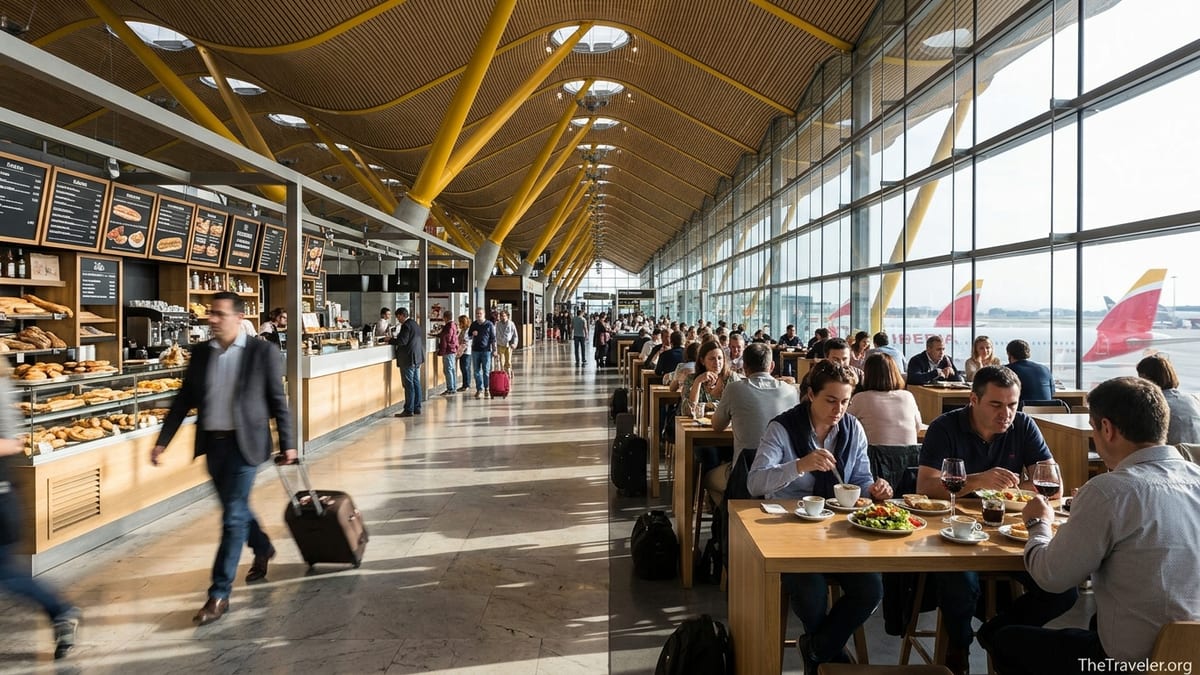
Terminal 4 is where Madrid Barajas really becomes a food destination. The terminal’s vast, light-filled departures hall includes the airport’s largest commercial zone, with dozens of eateries ranging from global fast-food names to Spanish concepts and health-focused brands. If you have a choice of where to spend a layover and your flights allow it, T4 is the best place in the airport to find a meal.
For travelers who prioritize healthy or plant-forward options, one of the standout concepts is Flax&Kale in T4’s airside area. This Barcelona-born brand focuses on flexitarian, vegetarian and vegan-friendly dishes, as well as gluten-conscious choices. Typical offerings include salad bowls built around quinoa or seasonal vegetables, veggie burgers and cold-pressed juices or smoothies. Prices are higher than a basic sandwich bar but reasonable for airport health food, with many mains in the low- to mid-teens in euros. It is a natural choice if you are facing a long-haul flight and want something lighter than fast food.
On the other side of the spectrum, Terminal 4 hosts several international fast-food chains, including a McDonald’s in the landside area and additional burger and pizza brands airside. These are predictable, quick and family-friendly, with value menus and combo deals that appeal to budget-conscious travelers. If you just want a familiar burger and fries before a domestic hop, following the signage toward the main food court area after security will typically lead you to these outlets within a few minutes’ walk.
T4 also offers good opportunities to enjoy specifically Spanish flavors. Tapas-style bars pour local beers and wines by the glass and serve small plates such as croquetas, albóndigas, patatas bravas or a simple plate of cured meats. In many of these venues you can order a menú del día-style combo at lunchtime with a starter, main course, drink and sometimes coffee or dessert for a set price. While airport versions of these menus are rarely a bargain compared to the city, they still represent one of the more satisfying ways to eat if you have 45 minutes or more before boarding.
Eating at Terminal 4S: Long-Haul and Non-Schengen Choices
Terminal 4S, the satellite connected to T4 by an underground people mover, handles many non-Schengen and long-haul flights, including transatlantic services. Because passengers here have often just finished or are about to start multi-hour journeys, the food mix reflects that reality, with more substantial sit-down options alongside fast snacks for tight connections.
One reliable option in T4S is La Place, a self-service restaurant known for fresh, lighter fare. Travelers will typically find salad bars, sandwiches made with crusty bread, hot soups and a decent selection of pastries. This kind of cafeteria is particularly useful if you want to see exactly what you are getting before you order. You select items from different stations, have them weighed or priced at the cashier, and either eat at the small tables or take your tray toward your gate. Expect prices to be slightly above street-level Madrid, but there is enough variety to satisfy both health-conscious travelers and those craving a warm, comforting bowl of soup.
For those looking for a complete meal with table service, T4S usually features at least one Mediterranean-style restaurant or gastro-bar concept. Menus commonly include grilled fish, steaks, pastas and classic Spanish starters such as tomato bread or Iberian ham. If you are connecting between continents and in need of something more like a “real” restaurant experience, these can be a welcome break from the airport environment, though you should allow at least an hour to be seated, order and eat at a relaxed pace.
While vegetarian and vegan options in T4S have historically been less visible than in T4’s main hall, that picture is slowly improving. You will increasingly see marked vegetarian dishes on menus, and some outlets offer plant-based sandwiches or salads. If eating plant-based is a priority, it is worth scanning the displays and menu boards before you commit, as choice can vary significantly from one venue to another even within the same concourse.
Coffee, Breakfast and Quick Bites on the Go
For many travelers passing through Madrid Barajas, the first priority is a strong coffee and something simple to eat rather than a sit-down meal. Fortunately, coffee bars, bakeries and grab-and-go counters are scattered through every terminal, and they generally open earlier than full-service restaurants.
Typical Spanish airport breakfasts revolve around coffee and bread. You will frequently see workers and travelers enjoying a café con leche alongside a tostada with tomato and olive oil, a slice of tortilla or a small pastry such as a croissant or napolitana. In many café-bars, a basic breakfast combo of coffee plus pastry or toast will fall into the 4 to 6 euro range. Ordering is usually done at the bar: you tell the staff what you want, receive your drink and food, and then pay at the register before sitting down or standing at the counter.
International chains add to the mix with muffins, bagels, yogurt pots and pre-packed fruit cups, which are convenient if you are dashing to an early flight. Vending machines are present in quieter corners of the terminals and can be a lifesaver during off-peak hours, offering bottled water, soft drinks, chips and candy when the main outlets are closed. While these machines charge a premium compared to city supermarkets, grabbing a bottle of water for a few euros before a flight is usually worth the peace of mind.
For snacks later in the day, look for kiosks and duty-free stores selling Spanish products such as turrón, cured meats under vacuum seal, canned seafood or packets of almonds. These make excellent in-flight nibbles and are also easy last-minute gifts. Just be sure that any liquids, including wine and olive oil, are purchased after you have cleared security for your final non-European leg, to avoid issues with liquid rules on connecting flights.
Lounges and Premium Dining Options
Travelers with access to airline or independent lounges at Madrid Barajas will find another layer of food options beyond the public restaurants. In Terminal 4, the Sala Plaza Mayor and Sala Retiro lounges, operated for multiple airlines and card programs, typically offer buffets with cold cuts, cheeses, salads, soup, simple hot dishes and desserts, along with self-service bars. The quality is broadly comparable to a mid-range hotel buffet: not fine dining, but more than adequate if you prefer to eat quietly while working or relaxing.
In T4S, international carriers and alliance lounges also provide food spreads tailored to long-haul travelers. You can usually expect hot dishes such as pasta, rice-based meals or stews, as well as sandwiches, fruit and desserts. Drinks selections often include coffee machines, soft drinks, bottled beers and a small range of spirits and wines. If you value having a guaranteed seat, power outlets and predictable food before a long flight, buying a one-time lounge pass where available can be a practical alternative to dining in the open terminal.
Outside of airline lounges, some higher-end wine bars and gastro-bars in T4 and T4S border on premium dining, with carefully plated tapas, decent wine lists and more attentive service. Prices reflect the upgrade: a glass of good Rioja or Albariño can easily cost several euros more than in the city, and a full meal here is likely to be at the top of the airport range. These venues make the most sense if you have time to linger and want your airport wait to feel like the start or end of a city evening rather than a purely functional stop.
Regardless of whether you opt for a lounge or a restaurant, it is wise to confirm how far you are from your gate and allow extra time for walking, especially in T4 and T4S, which are large and can require significant walking distances between the central commercial areas and outlying boarding zones.
Eating with Dietary Restrictions, Kids or on a Budget
Madrid Barajas has improved noticeably in recent years for travelers with specific dietary needs, though the experience can still depend heavily on the exact outlet you choose. Gluten-free options are increasingly labeled, especially in health-focused brands and some sit-down restaurants. Many places offer naturally gluten-free dishes such as salads, grilled meats with potatoes or rice, and simple vegetable sides. If cross-contamination is a concern, it is sensible to speak directly to staff and confirm how dishes are prepared.
Vegetarian and vegan travelers will find the best selection in Terminal 4, particularly at dedicated health-food concepts and international chains that mark plant-based items on their menus. In older terminals and smaller kiosks, meat-free options may be limited to cheese sandwiches, salads or basic vegetable dishes. Planning ahead by favoring the larger commercial areas and scanning menus before sitting down can save both time and frustration if you follow a plant-based diet.
Families traveling with children generally gravitate toward fast-food brands and casual cafeterias, where menus are familiar and service is quick. Many chains at Madrid Barajas offer kids’ meals that bundle a small main, side and drink at a modest price. In Spanish-style cafeterias, ordering a few shared dishes such as tortilla, croquetas and fries can be an easy way to feed picky eaters without committing to large individual plates. High chairs are usually available in bigger restaurants but may be limited in smaller bars.
For travelers on tight budgets, the most economical strategy is often to combine supermarket-style purchases before arriving at the airport with a smaller top-up inside, such as buying just coffee or water. Once airside, look for simple bakeries or sandwich counters rather than full-service restaurants, and consider eating your main meal during traditional Spanish lunch hours, when set menus and combos may offer relatively better value than ordering à la carte in the evening.
The Takeaway
Madrid Barajas is no longer a place where you have to settle for a stale sandwich and a lukewarm coffee. Across its terminals, but especially in T4 and T4S, the airport now offers a broad spectrum of dining choices, from quick pastries at the bar to proper sit-down meals that showcase Spanish flavors. Understanding how the terminals are laid out and where the main commercial areas are located will help you use your limited time wisely.
If you are connecting through the older T1, T2 or T3 buildings, you will find enough cafés, cafeterias and fast-food outlets to cover the basics, though choices are more limited. With a bit of extra time, you can usually walk to a busier neighboring terminal to improve your options. In T4 and T4S, by contrast, you will encounter health-forward brands, international chains and tapas-style bars clustered in bright, open halls where it is easy to linger with a glass of wine or a salad bowl while keeping an eye on the departure screens.
Whatever your budget, schedule or dietary needs, a little planning goes a long way at Madrid Barajas. Decide in advance whether you want a quick coffee, a substantial meal or something in between, head directly to the area that best matches your plan, and always leave extra time to walk to your gate. With that strategy, eating at Madrid’s main airport can feel less like a compromise and more like a small but satisfying part of your journey.
FAQ
Q1. Is it better to eat before or after security at Madrid Barajas?
It is usually better to eat after security. The widest range of restaurants, cafés and bars is in the airside departure areas, especially in Terminal 4 and T4S.
Q2. Are there 24-hour restaurants at Madrid Barajas Airport?
Some outlets in the busiest areas may open very early or stay open late, but fully 24-hour restaurants are limited. Overnight you should not rely on full dining service and may have to use vending machines or occasional late-opening cafés.
Q3. Where can I find the best food options if I have a long layover?
If your flights allow it, spend your layover in Terminal 4 or T4S. These areas have the largest commercial zones, with health-focused brands, tapas bars, fast food and sit-down restaurants.
Q4. Can I walk between Terminals 1, 2 and 3 to look for better food?
Yes. Terminals 1, 2 and 3 are in the same complex, and once you are airside it is often possible to walk between them, subject to security restrictions and your airline. Always allow time to return to your gate.
Q5. Are there good vegetarian or vegan options at Madrid Barajas?
Vegetarian and vegan options are strongest in Terminal 4, where health-oriented brands and some international chains clearly mark plant-based dishes. In older terminals, choice can be more limited, so it helps to check menus in advance.
Q6. How expensive is food at Madrid Barajas compared with central Madrid?
Food at Madrid Barajas is generally more expensive than in the city. Expect to pay airport-level prices, with coffee, snacks and meals typically costing more than in comparable street cafés or restaurants.
Q7. Are there traditional Spanish dishes available in the airport?
Yes. Many cafés and tapas bars serve Spanish staples such as tortilla de patatas, croquetas, jamón serrano, patatas bravas and local wines, especially in the larger dining areas of Terminal 4 and T4S.
Q8. What are the options for traveling with children who are picky eaters?
Families usually do best at fast-food chains and casual cafeterias, which offer familiar dishes, kids’ menus and quick service. Sharing simple plates like tortilla, croquetas and fries in Spanish-style cafeterias can also work well.
Q9. Do airport lounges at Madrid Barajas offer enough food to replace a meal?
Most lounges at Madrid Barajas provide buffets with cold and hot dishes plus snacks and desserts. While not fine dining, they are typically sufficient to replace a full meal, especially before or after a long flight.
Q10. Can I buy local Spanish food products in the terminals to eat on the plane?
Yes. Duty-free shops and gourmet kiosks sell items like turrón, vacuum-packed cured meats, canned seafood and nuts that are easy to eat on board. Just check liquid rules if your journey includes another security check.