


More news on this day
An FAA ground stop affecting several major airports in the Northeast on Monday, September 21, 2026, led to cascading delays and cancellations across one of the country’s busiest air corridors, with disruptions still rippling through airline schedules into Tuesday.
Get the latest news straight to your inbox!
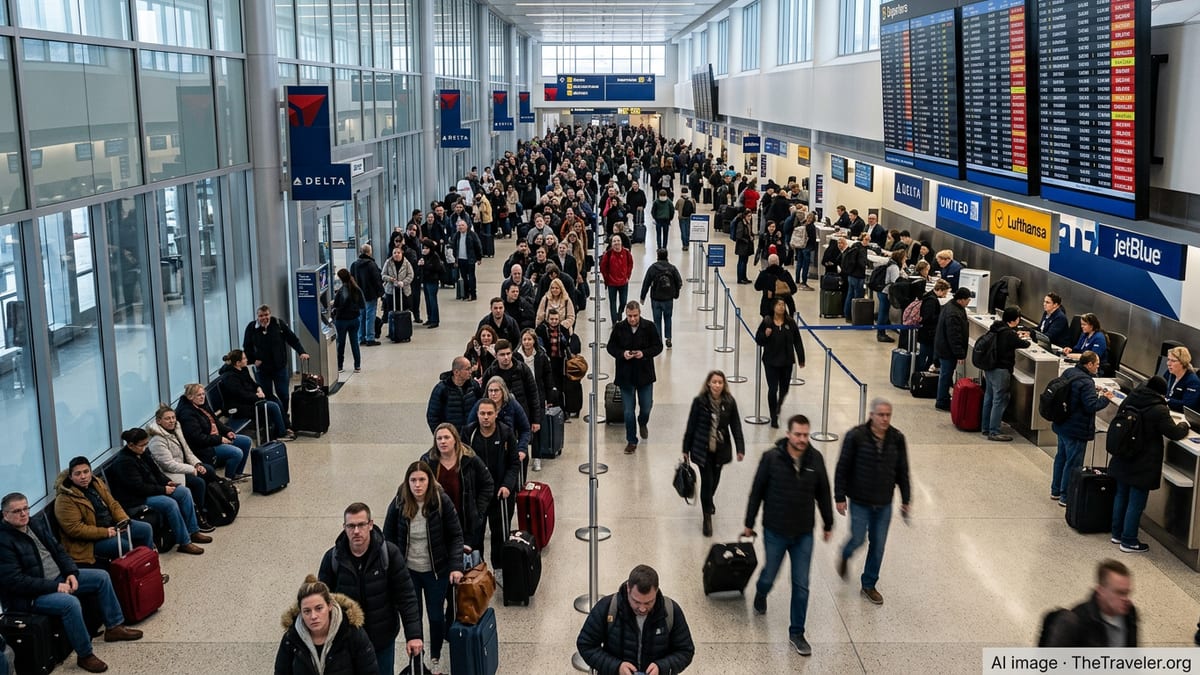
Equipment outage triggers sweeping ground stop
Publicly available FAA traffic management advisories and media coverage indicate that Monday’s disruption began with an equipment failure linked to air traffic control facilities serving the Philadelphia region. A circuit problem and damage to a backup line at a construction site in New Jersey were cited in multiple reports as the trigger for the outage, which affected communications and radar coverage over a wide stretch of the Northeast.
According to published coverage from national and regional outlets, the technical issue led the FAA to halt or severely restrict arrivals at several key hubs, including Philadelphia International Airport, the three major New York City airports at John F. Kennedy, LaGuardia, and Newark Liberty, as well as nearby Teterboro Airport. FAA status summaries and airline operations data showed that the order quickly evolved into a series of ground stops and ground delay programs as controllers worked around the outage and gradually restored service.
Reports indicate that Boston Logan International Airport was initially swept up in the disruption through knock-on effects from New York’s congestion and then placed under a separate ground delay program. That program was described in local coverage as a response to combined equipment constraints and runway construction, illustrating how a single technical fault can interact with existing infrastructure projects to amplify delays.
By Monday evening, transportation and aviation updates shared publicly suggested that primary communications had been restored and formal ground stops at the affected Northeast airports were lifted. However, schedule data and FAA daily reports showed that delays continued to accumulate as airlines worked through the backlog of aircraft and crews knocked out of position earlier in the day.
Major Northeast hubs report heavy cancellations and long waits
Operational statistics compiled from flight-tracking services and reported by national business and general news outlets show that Newark Liberty and Philadelphia were among the hardest hit. At Newark, more than 600 flights were delayed or canceled on Monday, with dozens of aircraft held at the gate or on taxiways as the ground stop and subsequent flow control took effect.
At Philadelphia International Airport, data cited in local news coverage pointed to more than 200 flights canceled and many more delayed during the height of the disruption. One summary of FAA delay figures reported average departure holds in Philadelphia exceeding three hours during the late afternoon peak, as departures were metered to match limited arrival and overflight capacity in the affected airspace.
New York’s Kennedy and LaGuardia airports also experienced extensive disruptions. Published accounts describe abrupt pauses in arrivals in early afternoon, followed by a gradual resumption of operations under tightly controlled arrival rates. Airlines resorted to reroutes, airborne holding, and diversions to outlying airports, including some flights sent to Boston and smaller regional fields when gates and taxiways at the main hubs became saturated.
Boston Logan, which had already been operating with reduced runway capacity due to construction, saw the effects of diverted aircraft and constrained Northeast airspace translated into long on-the-ground waits. A local tally referenced more than 400 delayed flights at Logan tied to the combination of FAA equipment issues and construction impacts, even though the airport was not at the center of the original outage.
Airspace complexity magnifies impact on travelers
The Northeast corridor is among the most tightly choreographed airspace systems in the world, with overlapping flows serving New York, Philadelphia, Boston, Washington, and numerous secondary airports. Public descriptions of the affected facilities note that radar and communications centers in the Philadelphia area manage approach and departure paths for multiple major hubs, which explains why a localized outage quickly translated into multi-airport ground stops.
Travelers experienced the consequences in the form of rolling gate holds, last-minute cancellations, and missed connections throughout the network. Airline schedule data for late Monday and early Tuesday showed disrupted operations far beyond the Northeast, as aircraft scheduled to operate later segments from hubs such as Dallas Fort Worth, Atlanta, and Chicago were unavailable or out of position because of the earlier ground stops.
By early Tuesday, FAA National Airspace System status pages showed that active ground stops had shifted away from the equipment issue toward routine weather-related programs in other parts of the country. However, delays at some Northeast airports persisted in the form of extended arrival management programs and departure metering, a common pattern after large-scale interruptions when crews reach duty-time limits and aircraft rotate back into sequence.
For passengers, the practical effect has been lingering crowding at customer service counters, limited same-day rebooking options on popular Northeast routes, and longer-than-usual lines at security and boarding gates as airlines attempt to consolidate lightly booked flights and restore normal rotations.
What passengers flying through the Northeast should know
For travelers with itineraries touching New York, Philadelphia, or Boston over the next one to two days, publicly available airline advisories emphasize the importance of monitoring flight status closely. Many major carriers have issued temporary travel waivers for the affected airports, allowing customers to change dates or rebook onto alternate flights without standard change fees, subject to fare differences and specific eligibility windows.
Airline operational updates suggest that early morning and late-night departures may recover more quickly, as overnight maintenance and repositioning allow fleets to reset. Midday flights, particularly those that rely on aircraft cycling through multiple Northeast cities before continuing onward, may still face residual delays as crews and planes work back into their original patterns.
Travelers reliant on regional connections, such as short-haul flights linking smaller East Coast cities into the large hubs, may encounter the greatest uncertainty. These routes are often the first to be thinned or consolidated when airlines need to free up aircraft for long-haul and high-demand trunk services. Publicly posted schedules for Tuesday and Wednesday already show selective cancellations in some regional markets.
Those with fixed travel plans through the affected airports are being encouraged in public-facing advisories to build extra buffer time into connections, consider carry-on baggage to increase flexibility when rebooking, and check for reissued boarding passes or gate changes before leaving for the airport.
Ongoing questions around infrastructure resilience
The incident has renewed attention, in media and policy discussions, on the resilience of critical communications and radar infrastructure that underpins U.S. air travel. Background reporting over recent years has highlighted longstanding modernization efforts within the FAA, including the gradual replacement of legacy systems and the introduction of newer traffic management tools intended to cope with rising demand.
Recent coverage has pointed out that the Philadelphia-area facility involved in Monday’s problem had experienced previous communications outages affecting Newark-area traffic in 2025, raising questions about redundancy and protections around physical lines and backup circuits. Descriptions of this week’s event, where a construction mishap reportedly damaged a backup line, have prompted calls in industry commentary for tighter coordination between infrastructure projects and aviation operations.
Analysts cited in public reports note that while ground stops and ground delay programs are designed as safety-first tools that temporarily sacrifice schedule reliability, each large-scale disruption carries economic and reputational costs for airports, airlines, and the wider tourism sector. For travelers heading to or from the Northeast in the coming days, the focus will be less on the technical origins of the outage and more on how quickly normal reliability returns across key routes.
As airlines and aviation agencies release more detailed post-incident information in the days ahead, travelers and industry observers alike will be watching for signs of strengthened safeguards meant to prevent similar cascading ground stops from recurring during the busy upcoming holiday and conference travel periods.