


More news on this day
Thousands of air travelers across the United States faced severe disruption on Monday, September 21, 2026, after a radar and communications failure triggered ground stops at several major airports in the Northeast, halting many departures and causing long delays that stretched well into the night.
Get the latest news straight to your inbox!
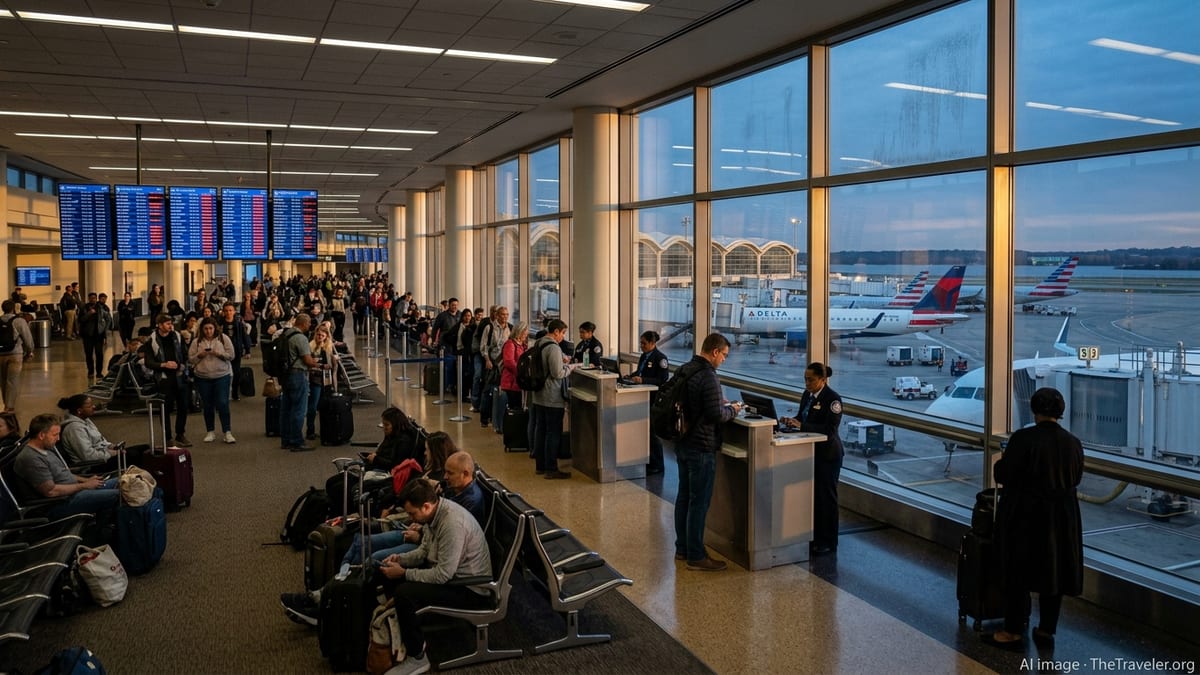
Technical outage hits core Northeast air traffic hub
Publicly available aviation data and news coverage indicate that the disruption originated at an air traffic control facility serving Newark Liberty International Airport and Philadelphia International Airport, part of the radar and communications network that manages a dense section of Northeast airspace. Reports describe a cut telecommunications line in New Jersey affecting systems used to track aircraft and relay instructions between controllers and pilots.
According to coverage from national and regional outlets drawing on Federal Aviation Administration status feeds, the outage prompted the agency to order ground stops at major New York area airports, including John F. Kennedy International Airport, LaGuardia Airport and Newark Liberty, along with Philadelphia and nearby Teterboro. Ground stops temporarily halt most departures headed to an affected airport, allowing controllers to stabilize traffic flows while essential systems are restored.
Flight-tracking services cited in published reports showed Newark particularly hard hit, with no commercial arrivals recorded for several hours during the middle of the day on Monday. One widely referenced data snapshot indicated that arrivals were paused at Newark from roughly 9:40 a.m. to just after 5:20 p.m. local time, contributing to hundreds of delayed and canceled flights by late evening.
By early Tuesday, September 22, the FAA’s public National Airspace System status summaries no longer listed ground stops for the New York or Philadelphia airports, suggesting that the most acute phase of the outage had passed. However, the volume of displaced aircraft and crews meant that delays and scattered cancellations continued to affect schedules into the new day.
Major hubs feel the impact across the Northeast corridor
The outage’s effects were felt most acutely at the largest Northeast hubs. Reports summarizing airline and FAA data point to substantial disruptions at Newark Liberty, JFK, LaGuardia and Philadelphia, with Boston Logan and regional airports experiencing secondary impacts as flights diverted or crews and aircraft failed to arrive on time.
Coverage from national newspapers and wire services notes that at the height of the disruption more than 600 flights into and out of Newark were delayed, alongside significant knock-on effects at JFK and LaGuardia. Philadelphia also experienced multiple hours of departure holds before the FAA shifted from a full ground stop to a ground delay program, metering departures with extended wait times rather than a complete halt.
Regional television reports compiled Monday evening highlighted long lines at check-in and customer-service counters, with travelers describing missed connections and extended waits on board aircraft. Some flights bound for the affected airports diverted to Boston and other nearby fields, temporarily increasing congestion at those facilities and creating additional surface delays.
By Monday night, many airlines had adjusted schedules, canceled selected flights and repositioned aircraft in an effort to restore operations. Nonetheless, publicly visible airline dashboards still showed sizable delay totals for Tuesday morning departures from the New York and Philadelphia areas, demonstrating how a single multi-hour outage can ripple through airline networks for at least a full day.
Airlines issue waivers as disruptions ripple nationwide
In response to the disruption, several major U.S. carriers introduced flexible travel policies for customers booked through the affected airports. Industry-focused outlets report that United Airlines published an air traffic control travel waiver covering Newark and Philadelphia, allowing eligible passengers to change itineraries without standard fees. Delta Air Lines was reported to have introduced a similar waiver tied to the broader Northeast outage, including Boston, Newark and Philadelphia for travel on September 21 and 22.
These waivers are designed to give travelers more options when large-scale irregular operations occur, particularly when the root cause lies outside airline control. For many passengers facing long delays or missed connections, the waivers can enable rebooking through alternative hubs or shifting trips by a day without incurring additional charges beyond any fare differences.
The disruption was not confined to the Northeast region. Because New York and Philadelphia serve as critical connecting points in multiple airline networks, disruptions there quickly affected flights across the country. Travelers departing from cities in the Midwest, South and West Coast reported delayed departures as aircraft awaited clearance to head into the constrained Northeast airspace or as crews timed out due to extended duty days.
As of early Tuesday, the FAA’s own live traffic-management summaries pointed to new weather-related ground stops farther south, such as at Dallas Fort Worth International Airport, underscoring how different factors can compound one another within the national system. For passengers, the distinction between a technical outage and a thunderstorm is less important than the practical result: longer travel days and increased uncertainty.
What a ground stop means for travelers
A ground stop is one of the more severe traffic-management tools available to U.S. aviation authorities. Under a ground stop order, most flights destined for a specific airport are held at their origin until the restriction is lifted or modified. Aircraft already in the air generally continue to their destinations, though they can be rerouted or placed into holding patterns if airspace conditions require.
For travelers, this can translate into extended waits at departure gates, sudden changes to connection times and, in some cases, outright cancellations if crews exceed regulated duty limits or if aircraft are no longer positioned where they are needed. Even when a ground stop is lifted, airports often shift into a ground delay program, meaning flights depart at controlled intervals to prevent overloading arrival capacity.
Public guidance from airlines and consumer travel advocates consistently emphasizes several steps during such events. Passengers are urged to monitor their flight status through airline apps or text alerts before leaving for the airport, as schedules can change rapidly. Those with tight connections are advised to consider earlier flights or alternative routings if options are available under carrier waivers.
Travelers caught mid-journey commonly need to work through rebooking options in real time, either via mobile tools, customer-service phone lines or staffed desks at the airport. During widespread disruptions like this Northeast outage, wait times for assistance can lengthen, so using multiple channels at once often improves the chances of securing an acceptable alternative.
Ongoing concerns over infrastructure and resilience
The incident has renewed attention on the resilience of the systems that underpin air travel in one of the world’s busiest aviation corridors. Publicly available federal documents published before the outage had already noted staffing and infrastructure challenges at key facilities that manage New York area airspace, including the complex mix of legacy and modern equipment involved in radar and communications.
Transportation coverage in national media has linked Monday’s meltdown to broader modernization efforts under way within the U.S. air traffic control system. Recent reporting describes an ongoing, multibillion-dollar program intended to upgrade equipment and improve redundancy, a process that aims to reduce the likelihood that a single cut line or failed component can disrupt operations at multiple major airports simultaneously.
At the same time, policymaking records from the Federal Register highlight how chronic congestion and staffing limitations in the New York region have already prompted temporary schedule relief at Newark, JFK and LaGuardia in recent years, allowing airlines to trim flights without risking long-term slot losses. The latest outage adds another layer to ongoing debates over how best to balance capacity, efficiency and resilience in the nation’s most constrained airspace.
For travelers, the immediate concern is more practical. As airlines and controllers work to clear backlogs and reposition aircraft following the Northeast ground stops, schedules across the network may remain fragile for at least another day. Passengers with near-term itineraries through the affected hubs are being encouraged by publicly available airline advisories to reconfirm departure times and to build extra time into their connections while operations stabilize.