


More news on this day
Thousands of Gulf travelers are scrambling to get home as regional conflict and drone attacks on Kuwait International Airport trigger more than 2,000 urgent return requests, straining Kuwait Airways and fellow Gulf carriers Emirates, Qatar Airways, and Air Arabia while casting a shadow over the region’s hard-won tourism gains.
Get the latest news straight to your inbox!
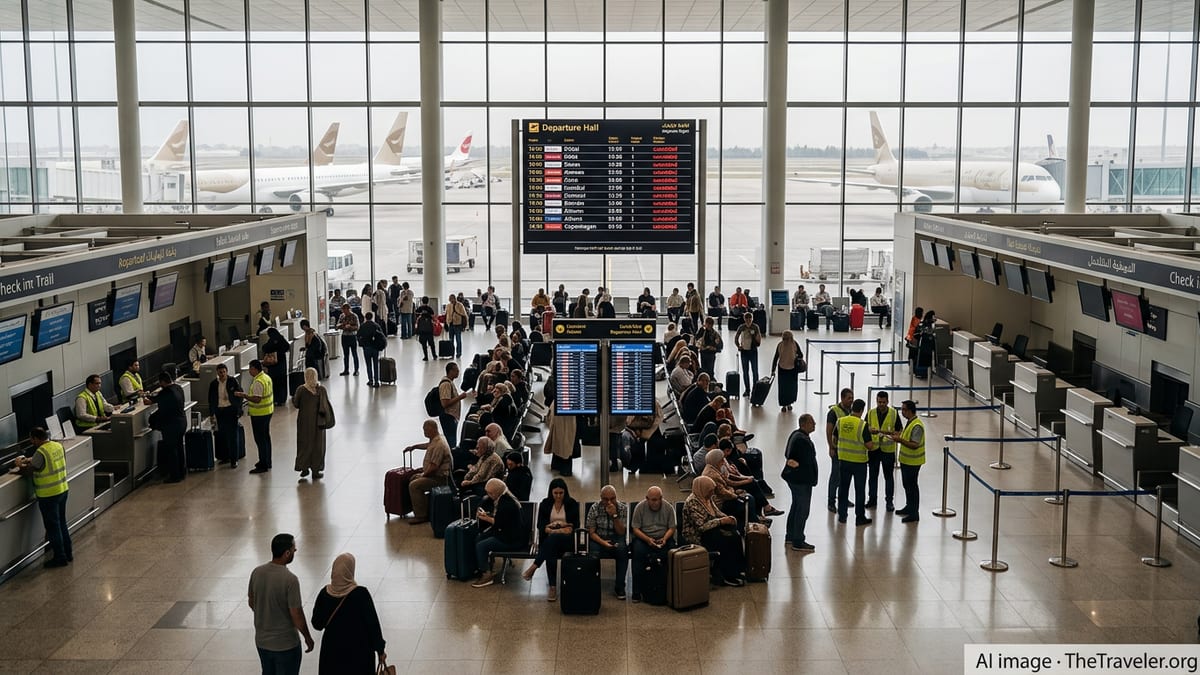
Surge in Repatriation Demand After Kuwait Airport Strikes
The latest wave of disruption follows a series of drone strikes on Kuwait International Airport that began on February 28, 2026, and forced the near-total shutdown of commercial operations. Publicly available information shows that Kuwait Airways has shifted its focus toward moving stranded citizens and residents via alternative gateways in Saudi Arabia, with onward travel by land back into Kuwait as airspace and airport facilities remain constrained.
Regional aviation trackers and local media coverage indicate that more than 2,000 passengers have lodged urgent requests for early return or repatriation with Kuwait Airways alone in recent weeks, as itineraries through Kuwait, Dubai, Doha, and Sharjah were upended by rolling airspace restrictions. Many of these travelers had originally planned leisure or business trips that were meant to last days, not weeks, and are now seeking the fastest possible route back to the Gulf.
The knock-on effect is being felt right across the Gulf’s major carriers. Reports from regional travel agencies and airport handling firms suggest that Emirates, Qatar Airways, and Air Arabia have all faced a sharp increase in rebooking and waitlist activity associated with Kuwait-origin passengers who were diverted when flights were canceled or rerouted. The carriers’ already reduced schedules, shaped by conflict-related airspace closures, have limited the room to absorb this sudden demand spike.
While no airline has released detailed passenger counts, industry briefings point to repatriation and early-return traffic displacing a significant share of regular tourist flows on some routes. In practice, that means fewer seats for new visitors into the Gulf and more capacity tied up simply getting residents home.
Gulf Hubs Under Pressure as Schedules Shrink
The conflict has upended the operating model that turned Dubai, Doha, and Sharjah into powerful connecting hubs. According to published aviation and tourism analysis, airspace over Iran, Iraq, Kuwait, and parts of the northern Gulf remains heavily restricted, forcing Gulf carriers to thin out frequencies, reroute long haul services, and rely on narrow operating corridors rather than the dense web of connections that prevailed at the start of 2026.
Emirates has been operating at roughly two-thirds of its usual capacity during the height of the crisis, based on data shared in recent industry forums. The airline is now gradually rebuilding its schedule as Emirates and the United Arab Emirates’ regulators move from emergency waivers to more normal commercial policies, yet capacity remains below pre-conflict levels and is being carefully prioritized. That prioritization increasingly favors long haul trunk routes and repatriation demand over discretionary short break travel into the Gulf.
Qatar Airways has pursued a similar strategy, focusing on limited repatriation flights and a phased expansion back toward around 120 destinations by mid year. Executive briefings for corporate travel buyers emphasize that every new sector has to be evaluated against corridor safety, aircraft availability, and strong demand from residents and expatriates seeking to reposition. This leaves less room for aggressively priced tourism-driven capacity that once underpinned stopover programs and weekend city breaks.
Air Arabia, with its core hubs in Sharjah and other secondary Gulf cities, has also pared back schedules to Kuwait and select conflict-adjacent markets. Published route updates show temporary suspensions on some point-to-point leisure routes to free aircraft for higher-yield or essential connectivity services. In the short term, that has redirected Gulf leisure demand toward relatively unaffected gateways such as Muscat and Jeddah, while further tightening seat availability on the most direct itineraries.
Tourism Plans on Hold Across the Northern Gulf
The tourism fallout is already visible in Kuwait and its neighbors. Prior to the conflict, regional economic reports projected record visitor spending in the Middle East in 2026, with smaller Gulf states including Kuwait, Bahrain, and Qatar working to reposition themselves as niche city-break and events destinations. Hotel investment, new cultural attractions, and expanded cruise and aviation infrastructure were all being rolled out to reduce reliance on hydrocarbons.
The sudden disruption has pushed those ambitions into an unplanned holding pattern. Tourism-focused analysis suggests that visitor activity in Kuwait has effectively collapsed, with most foreign guests either evacuated or waiting on repatriation flights and ground movements. In some markets, hotel occupancy has shifted from tourists to military and humanitarian personnel, undermining average daily rate performance and wiping out peak-season leisure revenue.
For Bahrain, Qatar, and parts of the eastern United Arab Emirates, the impact is more uneven but still acute. While some inbound tourism continues through controlled air corridors, the loss of overflight rights and the nervousness of European and Asian travelers about transiting conflict-adjacent hubs have reduced arrivals, pushed up insurance costs, and led major long haul carriers to suspend or reroute services. Analysts tracking the sector estimate that the Gulf is now losing hundreds of millions of dollars in visitor spending each week compared with early 2026 forecasts.
Travel search data and booking patterns compiled by private research firms point to a shift in demand toward alternative hubs such as Istanbul, Cairo, and Athens for East–West connections. This diversion further erodes the Gulf’s share of connecting traffic, a key feeder for short stays and stopover tourism in the region’s cities.
Winners, Losers, and the Battle for Traveler Confidence
Not every Gulf destination is affected in the same way, and some are benefiting in the short term from Kuwait’s misfortune. Coverage from regional business media notes that hotels and resorts in Dubai, Abu Dhabi, Ras Al Khaimah, and coastal Saudi Arabia have seen a bump in demand from displaced travelers and companies rerouting meetings and incentives away from Kuwait City. With Kuwait’s airport largely offline, the United Arab Emirates and Saudi Arabia are capturing part of the hospitality and aviation revenue that would previously have flowed through Kuwait’s national carrier and airport.
Yet this redistribution of traffic within the Gulf does not fully offset the overall loss of demand. High-spending international visitors who once treated Dubai or Doha as safe, predictable hubs are facing weeks of negative headlines, advisories, and complicated routings. Industry commentary emphasizes that once traveler confidence is shaken on issues such as airspace security and the reliability of connections, it can take years rather than months to fully recover.
Emirates, Qatar Airways, and Air Arabia are responding by refining their messaging around safety protocols, flexible booking options, and the gradual reopening of airspace corridors. Public schedules show a cautious increase in frequencies into Europe and Asia as corridors stabilize, supported by more targeted promotional fares. However, with repatriation and urgent-return cases still consuming seat inventory, tourism boards across the Gulf are taking a subdued tone on short-term growth, focusing instead on preserving brand equity and reassuring core source markets.
Analysts note that the recovery trajectory will depend on how quickly full commercial access is restored to Kuwait’s airspace and infrastructure and whether the broader regional conflict de-escalates. Continued uncertainty risks embedding a perception of fragility around Gulf travel that competitors in the Mediterranean and Southeast Asia may be keen to exploit.
What Travelers and the Industry Should Expect Next
For individual travelers, the immediate implication of the 2,000-plus urgent return requests is simple but stark: capacity is tight, and flexibility is essential. Published airline advisories and travel agency guidance consistently recommend that passengers with itineraries touching Kuwait, Dubai, Doha, or Sharjah in the coming weeks monitor schedules closely, allow longer connection times, and be prepared for rerouting via secondary hubs or even mixed air-land journeys where border arrangements permit.
From an industry perspective, the crisis is exposing how concentrated global air connectivity has become around a handful of Gulf super-connectors. With even a partial outage at Kuwait International Airport reverberating through Kuwait Airways, Emirates, Qatar Airways, and Air Arabia, aviation strategists are reassessing the balance between efficiency and resilience in network planning. Some analysts argue that carriers and governments alike may accelerate investment in alternative routings, dual hubs, and deeper interline partnerships to avoid being caught out by future airspace closures.
Tourism authorities across the Gulf are simultaneously updating their playbooks. Instead of focusing solely on volume growth, more attention is turning to visitor mix, length of stay, and crisis communication. The experience of early 2026 suggests that destinations with diversified source markets, strong domestic tourism, and clear safety messaging are better able to weather geopolitical shocks than those heavily reliant on a single hub or segment.
In the months ahead, the pace at which urgent return requests subside and regular capacity returns to Kuwait-linked routes will serve as a barometer for broader Gulf tourism recovery. For now, the convergence of conflict, constrained airspace, and concentrated hub operations means that getting residents home takes precedence over welcoming new visitors, rewriting short-term expectations for one of the world’s most ambitious tourism regions.