


More news on this day
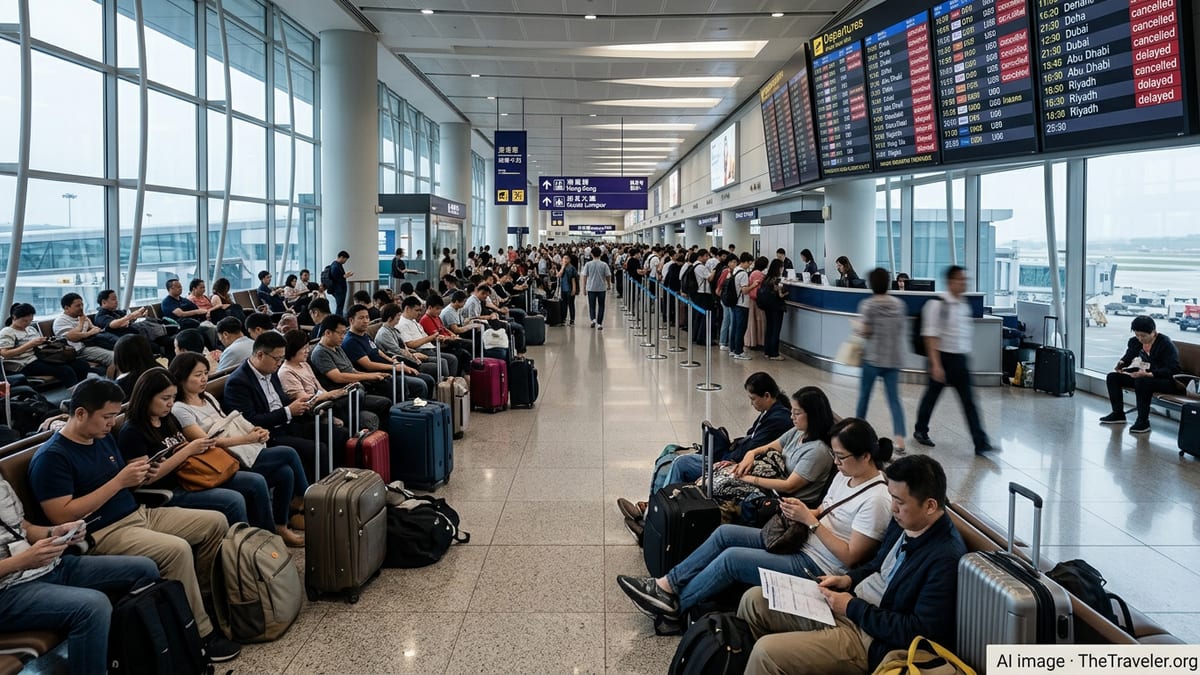
Passengers across the Gulf are facing renewed disruption after a fresh wave of flight cancellations from major UAE airports left travelers bound for Bahrain, Riyadh, Hong Kong and Islamabad scrambling to rebook journeys and secure overnight accommodation.
Get the latest news straight to your inbox!
Fresh Cancellations Hit Major UAE Hubs
Published aviation data and regional travel coverage indicate that at least 18 departures were cancelled across Dubai International, Abu Dhabi, Sharjah and Al Maktoum airports in the latest round of disruption, affecting routes to key regional and Asian destinations. Services operated by Emirates, Etihad Airways, Air Arabia and Royal Jordanian figure among those withdrawn from timetables, compounding weeks of volatility for passengers using Gulf hubs as transit points.
The cancellations are concentrated on high-demand corridors linking the United Arab Emirates with Bahrain, Riyadh, Hong Kong and Islamabad, according to publicly available flight-status boards and airline updates. Some flights were scrubbed outright, while others were removed from online schedules with passengers advised via email or app notifications not to proceed to the airport unless holding a reconfirmed departure time.
Travel advisories tracking the region note that operations at Dubai and Abu Dhabi have largely recovered from the blanket closures that followed the late February conflict in the Gulf, but they warn that schedules remain vulnerable to late changes. For travelers, the result is a patchwork of normal operations interspersed with short-notice cancellations that can upend itineraries even as airspace restrictions ease.
The latest disruption follows months in which thousands of flights were cancelled or rerouted across Gulf states as airlines navigated shifting risk assessments and restricted corridors. While airspace over the UAE has formally reopened, airlines appear to be making rolling adjustments as they balance crew duty limits, aircraft positioning and evolving demand on certain routes.
Emirates and Etihad Adjust Schedules Amid Ongoing Volatility
Publicly available guidance from Emirates shows that the carrier continues to run a dedicated disruption page advising customers that flights may be cancelled or retimed and that anyone receiving a cancellation notice should avoid travelling to the airport. Recent updates emphasize that passengers can rebook or request refunds through digital channels within specified windows around their original departure date.
Limited-schedule notices published in late March and April showed that Emirates heavily curtailed operations during the peak of the airspace shutdown before gradually restoring services to dozens of destinations. Industry trackers now indicate that while the airline is broadly back to a near-normal network, individual departures, including some transiting to and from Bahrain, Riyadh and South Asia, remain exposed to late operational changes.
Etihad Airways, based in Abu Dhabi, followed a similar pattern. Aviation intelligence reports show that the airline resumed operations earlier than some rivals once partial reopening of UAE skies was confirmed, but with a reduced network and specific long-haul and regional services still suspended. Recent disruptions at Abu Dhabi International have tended to be targeted rather than systemic, with scattered cancellations such as select connections to the Saudi capital and major South Asian markets.
Both carriers are steering affected travelers toward self-service tools for rebooking, while advising that only passengers with confirmed onward connections will be accepted for transit through their hubs. For many travelers, that has meant repeated checks of booking references and potential last-minute rerouting via European or Asian gateways to reach final destinations.
Air Arabia and Royal Jordanian Routes Particularly Exposed
Air Arabia, which operates from Sharjah as well as Abu Dhabi and Ras Al Khaimah, has been one of the most visible regional carriers hit by schedule turbulence. Earlier waves of cancellations saw multiple departures grounded across UAE airports, and recent traveler accounts and schedule data point to renewed disruption on select services to South and Southeast Asia as well as Gulf neighbors.
Some passengers booked from Sharjah to Asian destinations report that flights were removed from schedules or cancelled relatively close to departure, triggering a scramble for alternative routings via Dubai or Abu Dhabi on other airlines. Industry analyses of Sharjah operations suggest that while the airport is functioning normally overall, Air Arabia’s point-to-point model leaves little spare capacity when aircraft or crews are out of position.
Royal Jordanian has likewise adjusted its Middle East network in response to the broader regional security picture. Published coverage tracking airline responses to the conflict notes that the Amman-based carrier has periodically suspended or reduced frequencies on routes crossing or skirting affected airspace, including some services touching Bahrain and the Gulf. When fresh waves of cancellations occur at UAE airports, connecting passengers on Royal Jordanian itineraries can find their onward segments disrupted even if the Amman leg is operating.
These targeted route suspensions have ripple effects in markets such as Pakistan, where travelers often rely on a combination of Gulf and Levantine carriers to reach Europe, North America and East Asia. Islamabad in particular has seen increased reliance on alternative hubs when planned transits through Dubai, Abu Dhabi or Sharjah fall through.
Regional Conflict and Airspace Restrictions Still Cast a Shadow
Analysts point to the recent conflict involving Iran, the United States and Israel as the catalyst for the current period of instability in Gulf aviation. Regional governments imposed sweeping airspace closures in late February, forcing mass cancellations and diversions across the United Arab Emirates, Saudi Arabia, Bahrain, Qatar and other states. Travel advisories from governments and risk consultancies documented several thousand flights cancelled in the early phase of the crisis.
Although the UAE has now lifted its remaining air traffic restrictions and formally returned to standard operations, the knock-on effects continue to filter through airline schedules. Carriers have had to reconfigure routings, adjust block times, and in some cases temporarily withdraw from markets where the operational complexity or commercial risk remains high.
Hong Kong and Riyadh have emerged as emblematic examples of how longer-haul connectivity has been affected. Hong Kong-based coverage recently highlighted that a major Asian carrier extended the suspension of its Dubai and Riyadh passenger flights through the end of May, reflecting caution about overflying sensitive areas or relying on still-recovering Gulf hubs as intermediate points.
Within the Gulf itself, Bahrain and Saudi airports have gradually ramped up operations but continue to experience episodic disruption linked to regional route adjustments. Travelers who once treated Dubai, Abu Dhabi and Sharjah as highly reliable super-connectors now face a more nuanced risk environment where even a small cluster of 18 cancellations can reverberate across multiple continents.
Stranded Passengers Navigate Long Queues and Limited Options
For travelers caught in the latest wave of cancellations, the immediate impacts are familiar: long queues at rebooking desks, fully booked nearby flights and the challenge of securing short-notice accommodation. Social media posts and traveler forums in recent weeks have carried recurring accounts of passengers in Dubai, Abu Dhabi and Sharjah learning of cancellations only after arriving at the airport, in some cases following earlier delays linked to the same conflict.
Consumer guidance from aviation bodies and travel insurers has consistently recommended that passengers avoid setting out for the airport until they receive a reconfirmed departure time directly from the airline. With airlines prioritizing digital notifications, travelers who are offline or who rely solely on printed itineraries are at particular risk of making unnecessary trips to terminals where their flights no longer appear on the departure boards.
Those stranded in transit face further difficulties if their visas, travel insurance or budget do not easily accommodate an unplanned stay. While some carriers provide hotel vouchers in cases of significant disruption that are within their control, many of the recent Gulf cancellations are being framed as the result of extraordinary circumstances, limiting entitlements under various compensation regimes.
Travel advisors note that passengers booked on complex itineraries involving multiple carriers, including combinations of Emirates, Etihad, Air Arabia and Royal Jordanian, may find that each airline’s policies differ. That can create gaps where accommodation or meal coverage is not clearly assigned, particularly if a cancellation occurs partway through a journey and rebooking is handled by a different partner airline.
What Travelers Can Do as Disruptions Continue
With regional schedules still in flux, travel experts are emphasizing preparation and flexibility for anyone transiting UAE hubs in the coming weeks. Publicly available guidance from airports and airline help pages stresses the importance of checking flight status repeatedly in the 24 hours before departure and again just before leaving for the airport.
Passengers are being encouraged to keep airline apps updated, enable notifications and monitor both operating carriers and codeshare partners for changes. In the event of a cancellation, online rebooking tools often provide faster options than crowded desks in the terminal, particularly when many departures are affected at once.
On the booking side, analysts suggest that fully flexible or refundable fares, while more expensive, may offer useful protection in an environment where route suspensions and day-of-travel adjustments have become more common. Where possible, building longer connection windows and considering alternative routings that do not rely on a single Gulf hub can reduce exposure to cascading delays.
For now, travelers heading to or through Dubai, Abu Dhabi, Sharjah and Al Maktoum are likely to face an extended period in which short-notice changes remain part of the landscape. The cluster of 18 cancelled departures underscores that even as airspace normalizes, the path back to predictable, high-frequency operations for Emirates, Etihad, Air Arabia and Royal Jordanian is still a work in progress.