


More news on this day
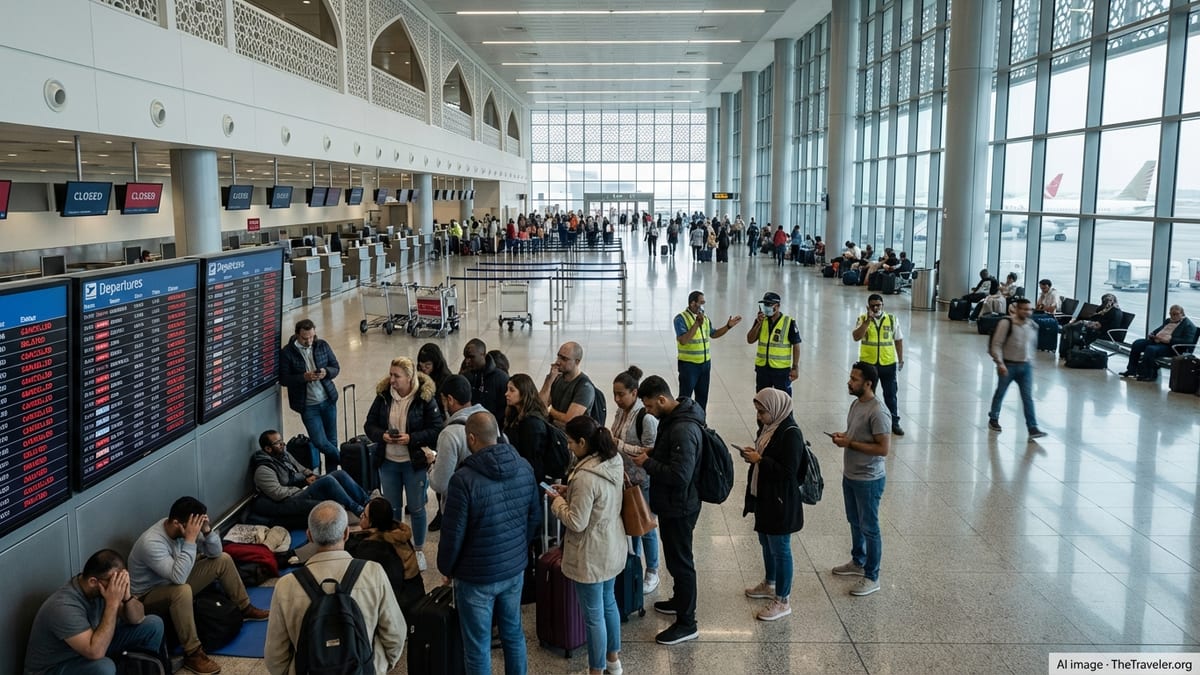
A fresh wave of disruption at Bahrain International Airport and the cancellation of a key Dubai-bound flight have stranded travellers across the Gulf, underscoring how fragile the vital Manama to Dubai air corridor remains even after the partial reopening of regional airspace.
Get the latest news straight to your inbox!
Sudden Disruption Hits Bahrain Hub Again
Reports from airline tracking platforms and regional aviation outlets indicate that Bahrain International Airport experienced a renewed operational setback, with a cluster of short-haul departures abruptly pulled from the schedule. Among them was a heavily used Bahrain to Dubai service, part of the tight shuttle-style pattern that normally links the two financial centres in under three hours.
The disruption comes after Bahrain only recently resumed civilian flights following a prolonged airspace closure triggered by regional tensions earlier this year. Publicly available airline schedules show that carriers based in Bahrain had been steadily rebuilding their networks, restoring a majority of pre-disruption routes in April and May.
On the morning of the latest incident, at least one Dubai-bound flight that forms part of the core Manama to Dubai rotation was cancelled at short notice, according to flight status aggregators. Passengers expecting a routine hop to connect with onward long-haul services in Dubai instead found themselves grounded in Manama, facing long queues at service desks and limited same-day alternatives.
While full operational details have yet to be released in a consolidated statement, regional aviation analysis notes that airports like Bahrain remain exposed to knock-on effects from shifting airspace permissions, crew rostering limits and congestion at nearby hubs that are still operating on constrained schedules.
Connectivity Between Manama and Dubai Under Strain
The Manama to Dubai route has long been treated as a high-frequency bridge between two closely linked economies rather than a standard point-to-point service. Schedules compiled by route-tracking services list multiple daily nonstops from Bahrain to Dubai on a mix of local and regional carriers, with typical block times of under three hours and tight minimum connection windows at Dubai for onward travel.
Any sudden cancellation on this corridor therefore has an outsized impact. Travellers using Bahrain as a feeder to reach Emirates and other long-haul operators in Dubai rely on early morning and late-night shuttles to connect to North America, Europe and Asia-Pacific. When one of those key Bahrain to Dubai flights disappears from the board, entire itineraries unravel, with missed transoceanic departures and rebooking challenges rippling through the day.
Recent network updates for Gulf-based airlines highlight that Dubai, Jeddah and Riyadh have been prioritised as early-restoration markets as carriers rebuild from earlier shutdowns. Yet the latest Bahrain disruption suggests that even on flagship regional routes, schedules remain vulnerable to last-minute operational adjustments as airlines juggle reduced fleets, crew availability and evolving risk assessments.
For the Manama to Dubai pairing, this means passengers can no longer assume that a confirmed seat automatically translates into a guaranteed connection, particularly when itineraries depend on narrow transfer windows at either end.
Travellers Stranded and Rerouted Around the Gulf
Accounts shared via public forums and travel communities in recent weeks describe passengers stuck overnight at Bahrain International Airport when short-haul Gulf sectors were cancelled after earlier airspace problems. Those experiences provide a template for what many affected by the latest Dubai-bound cancellation are now facing.
Typical scenarios include travellers arriving from South or Southeast Asia into Bahrain expecting a brief layover before continuing to Dubai, only to learn that the onward leg has been scrubbed. With many regional carriers still running trimmed-down schedules, same-day rebooking options can be scarce, forcing passengers to accept circuitous detours via other hubs or extended hotel stays near the airport.
Some long-haul travellers have reported turning to indirect routings through Istanbul, European gateways or alternative Gulf hubs when direct access to Dubai via Bahrain became unreliable. In practice, that can add a full day of travel, extra connections and higher costs, particularly during peak periods when remaining seats sell at a premium.
Publicly available commentary from passenger rights specialists notes that, in such cases, travellers may be entitled to re-routing or refunds depending on the airline, point of sale and governing legal regime. However, the combination of regional security concerns and complex multi-airline itineraries can make it difficult for passengers to secure swift resolutions when a critical Bahrain–Dubai link is abruptly removed.
Airlines Juggle Recovery and Ongoing Instability
The renewed turbulence on the Bahrain to Dubai route is unfolding against a broader backdrop of fragile recovery across the Gulf aviation sector. Industry summaries show thousands of flights were cancelled or diverted region-wide earlier in the year as airspace restrictions spread, with Dubai International Airport and Bahrain International Airport both experiencing temporary suspensions.
Since then, major Gulf carriers have been gradually bringing capacity back online, publishing updated timetables that restore a growing share of suspended destinations. Recent network disclosures suggest that at least one Bahrain-based airline has returned to roughly three-quarters of its pre-disruption footprint, with Dubai positioned as a priority market in that rebuild.
At the same time, several European and Asian airlines continue to maintain partial or full suspensions on services to both Bahrain and Dubai, citing what they describe in public notices as ongoing airspace instability. This patchwork of returning and still-absent operators has left Gulf hubs heavily reliant on their home carriers, creating pressure points whenever operational disruptions arise.
Industry observers note that even a single cancelled short-haul sector can be symptomatic of broader challenges, such as aircraft repositioning constraints, crew duty time limitations or conservative risk management policies while regional conditions remain fluid.
What Travellers Need to Watch on the Bahrain–Dubai Corridor
For travellers planning to use the Manama to Dubai corridor in the coming days and weeks, publicly available guidance from travel advisories and airline notices highlights several practical steps. First, passengers are being urged to monitor booking management tools and flight status pages closely in the 24 to 48 hours before departure, as same-day schedule changes remain more common than in previous years.
Second, itinerary planners recommend building longer layovers into connections that rely on Bahrain as a feeder into Dubai, particularly for journeys onwards to North America or Oceania. While this may lengthen total travel time, it reduces the risk that a single cancelled Bahrain–Dubai sector will cause the loss of a long-haul flight operated only once per day.
Third, travellers are encouraged to review fare rules, rebooking conditions and travel insurance coverage before departure. Some tickets issued during the current period include more flexible change options than traditional advance-purchase fares, which can prove crucial when attempting to reroute around a suddenly cancelled Dubai-bound flight.
The latest disruption at Bahrain International Airport, and the cancellation of a key Dubai shuttle, reinforces a clear message for the region’s frequent flyers: despite visible signs of recovery at Gulf hubs, the Manama to Dubai lifeline remains subject to rapid change, and even routine business hops demand a level of contingency planning that would have seemed excessive only a year ago.