


Landing at Hanoi’s Noi Bai International Airport can feel hectic, especially after a long-haul flight and in an unfamiliar language. The good news is that getting from the airport to the Old Quarter or other parts of the city is straightforward if you know where to find official taxis, what a normal fare looks like, and how to avoid the handful of scams that cluster around arrivals. This guide walks you through the process step by step, using real examples and recent incidents to help you start your Hanoi trip safely and with minimum stress.
Get the latest updates straight to your inbox!
Understanding Noi Bai Airport and Where Taxis Wait
Noi Bai International Airport sits roughly 25 kilometers north of central Hanoi, typically 30 to 60 minutes by car depending on traffic and time of day. The airport has two main passenger terminals that matter for visitors. Terminal 2 handles most international flights, while Terminal 1 is used for domestic services. Both have clearly marked ground transportation areas on the arrivals level where licensed taxis and prebooked cars are allowed to pick up passengers.
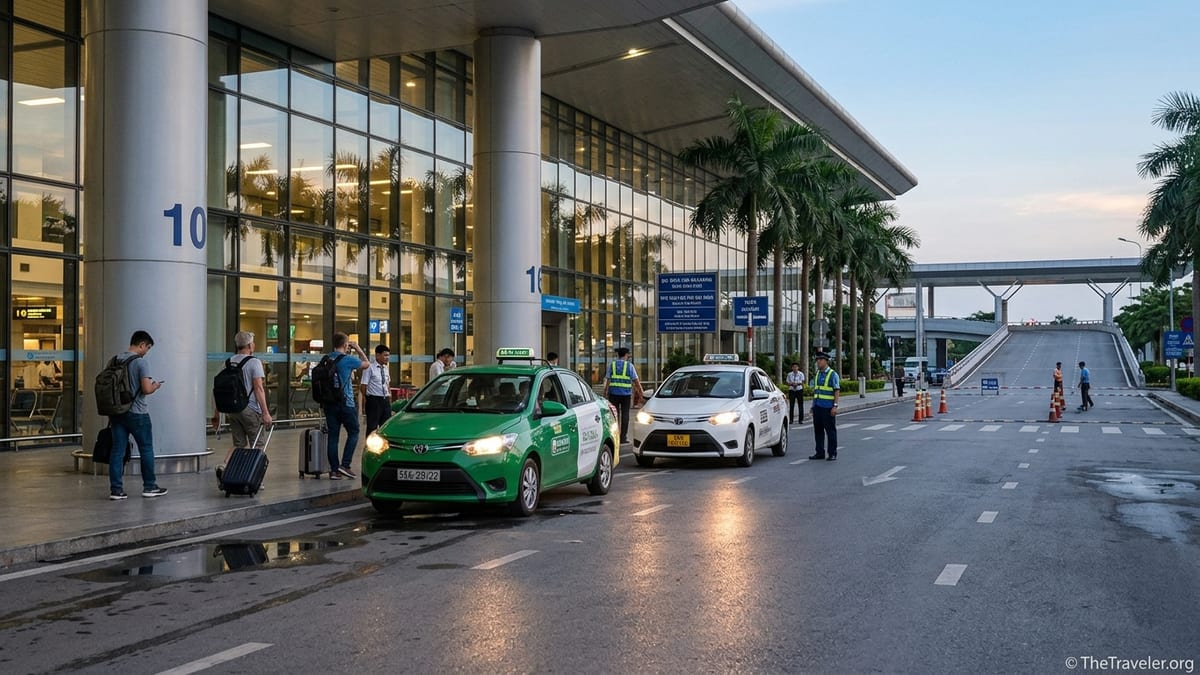
At Terminal 2, after clearing immigration, baggage claim and customs, you exit into the arrivals hall on the first floor. The legitimate options are directly outside: a line of official taxi company counters inside the hall and a signed public taxi rank just beyond the sliding doors with numbered pillars. Airport authorities and Vietnam’s civil aviation regulator have repeatedly reminded travelers to use only these designated areas and not accept rides from people approaching them inside the building near the exit columns.
Terminal 1 for domestic flights is laid out in a similar way, with taxis queuing in front of the arrivals level. You will see branded cars from firms such as Mai Linh, G7, and other licensed fleets, along with private transfer drivers holding name boards. Unofficial touts usually linger just inside or slightly away from these queues, often not wearing any uniform and sometimes claiming to represent popular ride-hailing apps. A simple rule of thumb: if someone comes to you first and tries to lead you away from the main line of cars or counters, you should decline.
Because of increased reports of overcharging and impersonation, Noi Bai’s airport authority and police have stepped up patrols in the arrivals zone and periodically publicize enforcement actions against touts. Recent cases involved individuals standing near specific pillars outside Terminal 2 and approaching newly arrived passengers before they reached the official taxi line. These crackdowns show that the airport is paying attention, but visitors still need to stay alert and choose their transport in the official zones.
Official Taxi Counters and Pickup Areas
One of the easiest and lowest-stress options at Noi Bai is to buy a ticket at an official taxi or transfer counter inside the terminal. After customs at Terminal 2, you will see booths with clear signage indicating taxi or car services, often with printed fare ranges to central Hanoi. Staff at these counters take your destination address, quote an approximate price range or flat rate, and then escort you or point you to a marked car waiting in the official pickup lane just outside.
These counters are especially useful if you land late at night, are tired, or do not want to negotiate directly with drivers. For instance, a solo traveler arriving around midnight might walk up to a counter, show the address of a hotel on Hang Bac Street in the Old Quarter, and be told to expect around 350,000 to 450,000 Vietnamese dong depending on traffic and any tolls. The counter staff hand over a slip with the car’s plate number and a phone contact, which can help resolve disputes later if anything goes wrong.
If you prefer to take a metered taxi directly without using a counter, head outside the arrivals doors and follow signs that indicate taxi or ground transport. There is usually an organized queue where airport marshals guide passengers to the next available car. Look for well-known city taxi brands on the doors, rooftop signs and meter units. The driver should start the meter as you depart the airport. If they refuse and try to push a lump-sum price much higher than what you have read in recent guides, it is safer to politely step out and pick another car from the queue.
For ride-hailing services such as Grab, the airport has separate pickup areas that may be a short walk from the main taxi lines. The app will normally give specific instructions like “Proceed to Domestic Terminal pick-up point A” and show a numbered pillar where your driver will meet you. A legitimate driver will match the car make, color and license plate shown in the app, and you will not pay cash beyond minor tolls because the fare is set in advance on your phone. If someone holding a phone or a paper sign tries to convince you to cancel your booking and go with them instead for “same price” but leads you away from the designated pickup spot, you are likely dealing with a scam.
What a Normal Fare from Noi Bai Should Cost
Traffic, route and time of day all affect the final price, but by mid 2026 there is a broad consensus among regular travelers and local authorities on what counts as a reasonable taxi fare from Noi Bai to central Hanoi. For a standard metered taxi or ride-hailing car to the Old Quarter or Hoan Kiem district, visitors typically report paying in the region of 320,000 to 420,000 dong, which is roughly 13 to 18 US dollars depending on exchange rates. That usually covers the 25-kilometer distance, airport access fees and the tolls on the highway bridge into the city.
For example, a business traveler arriving at 9 p.m. might order a GrabCar to a hotel on Ly Thai To Street and see a quoted fare of around 360,000 dong on the app, with the final charge after tolls coming to just under 400,000 dong. Another visitor taking an official metered taxi from the public queue to a guesthouse near St. Joseph’s Cathedral during daytime could watch the meter climb from an initial airport flag-fall to around 380,000 dong by the time they reach the city center.
When you start seeing numbers far beyond those ranges, warning bells should ring. Reports collected in recent years describe new arrivals being charged between 800,000 and 1.5 million dong for the same trip, often after following someone from inside the terminal to a car that was not in the official lane. In one widely publicized incident, a Taiwanese passenger was charged roughly triple the normal fare by a couple posing as a ride-hailing driver near an outdoor pillar at Terminal 2. Airport police later identified and sanctioned the pair, but the case illustrates how quickly a simple transfer can become an expensive mistake.
As a rule, if a driver or tout quotes you anything close to or above 700,000 dong for a single standard car to the Old Quarter, you should decline and head back to an official counter or queue. For destinations farther away, such as the Tay Ho district around West Lake or the My Dinh area with its bus station and stadium, a fair price from the airport is still typically in the 350,000 to 500,000 dong range in a normal taxi or booked car. You can always ask your hotel what they consider a typical meter fare from Noi Bai to double-check expectations.
Late-Night Arrivals, Luggage and Traveling With Kids
Arriving in Hanoi close to midnight or in the early hours often magnifies anxiety about airport transfers. Noi Bai operates around the clock, and there are usually still taxis outside after the last flights land. However, fewer staff are on duty and more passengers are tired and jet-lagged, which is one reason scams frequently target travelers stepping out of the terminal after long-haul arrivals from Europe or North America.
If your flight is scheduled to land after about 10 p.m., consider arranging a hotel pickup or private transfer in advance so you can walk out holding a confirmation page or email with your name and vehicle details. A family arriving at 1 a.m., for instance, might book a minivan through their Old Quarter boutique hotel for around 450,000 to 600,000 dong, depending on the number of seats. The driver waits at the exit with a sign that includes the lead guest’s name and the hotel logo, and payment is usually handled at check-in or in cash at the agreed price, reducing the risk of confusion at a vulnerable time.
For travelers with large suitcases, sports equipment or strollers, most official sedans can handle two large bags and carry-ons without extra fees, provided luggage fits in the trunk. If you have more than that, it is wise to request a larger vehicle when you book. Some airport counters and transfer services offer seven-seat SUVs or minivans for a slightly higher flat rate, often still under the equivalent of 25 US dollars to central Hanoi. Drivers might ask you to pay small additional toll charges in cash if they are not already included, but they should not charge separate per-bag fees.
Those traveling with young children should note that child seats are not typically provided in Vietnamese taxis by default. If you require one, it is best to prearrange with a private transfer company or hotel that explicitly offers child seats for an additional cost. You can also bring your own travel seat and secure it with the car’s seatbelt system, as long as you are comfortable installing it yourself. Planning this in advance removes the pressure to make fast decisions in the noisy arrivals area late at night.
Another practical consideration is mobile connectivity. If you plan to rely on ride-hailing, look for SIM card counters in the arrivals hall before exiting, so your phone is online by the time you step outside. Travelers who walk out without data are often the easiest targets for people offering to “help book Grab” or other cars on their own phones, then demanding inflated cash payments at drop-off.
Common Taxi and Ride-Hailing Scams at Noi Bai
While many airport taxi rides in Hanoi are uneventful, several recurring scams are reported often enough that first-time visitors should recognize them. One of the most common involves individuals inside or just outside the terminal who approach travelers saying they are with Grab or another app. They may show a screenshot of the typical app fare to your hotel, agree on a similar price in cash, then lead you to a car parked away from the official pickup area. Only once you are on the road do they raise the price dramatically, sometimes demanding double or triple the amount originally discussed.
In a recent case reported by a traveler arriving in 2026, a man near the domestic terminal approached with an open Grab app, pointed at a fare of 250,000 dong, and led the passengers to a vehicle in the parking zone instead of the marked ride-hailing pickup. After arrival in the Old Quarter, the driver demanded several times that amount, claiming extra charges and misrepresenting the distance driven. Because there was no actual booking in the app, the passengers had no way to complain through the platform.
Another pattern involves drivers who appear legitimate at first glance but manipulate the situation once you are inside the vehicle. Tactics include insisting that the meter is broken and quoting a high fixed price, taking unnecessarily long routes to inflate the fare, or switching to a separate “receipt” or “airport fee” slip that lists an invented surcharge. Some passengers have described rides where, midway to Hanoi, the driver pulled off to a side area, claimed a problem with the meter or booking, and attempted to renegotiate the fare on the spot, banking on the traveler’s desire to reach their hotel without confrontation.
In the most worrying stories, passengers who got into unmarked or poorly marked cars at the airport found multiple people in the vehicle, or doors locked after departure, creating a sense of intimidation. While such incidents remain the exception rather than the rule, they underline why it is worth the small extra effort to choose an official taxi rank, a clearly branded car, and a driver whose details can be traced through a company or app. When in doubt, it is always safer to step out of a car before leaving the airport grounds than to continue a ride that feels wrong.
Practical Ways to Protect Yourself From Scams
Most problems at Noi Bai can be avoided by following a handful of simple habits. First, ignore anyone who approaches you inside the terminal offering transport, no matter how friendly or insistent they seem. Walk past them and choose your taxi from the official queue or a reputable counter. If you intend to use a ride-hailing app, complete the booking on your own phone, and meet the driver only at the pickup point indicated in the app. Check both the license plate and the driver’s name before getting in.
Second, clarify the expected price or method of payment before the car starts moving. For metered taxis, ask the driver to switch on the meter and confirm whether tolls are included or to be added in cash. For fixed-rate transfers, keep a screenshot or printed confirmation of the agreed amount. If the driver refuses to use the meter or insists on an obviously inflated fixed fare, thank them and step out. There are usually multiple other cars available, and you are under no obligation to stay in a vehicle that does not feel right.
Third, keep your luggage close until the fare is settled at the destination. Some travelers prefer to exit the car with their carry-on bag and ask the driver to open the trunk only once they have the payment in hand, so they are not pressured into paying more to reclaim their suitcase. Paying in smaller denominations of dong can also help avoid disputes over change. If you feel you are being overcharged but the difference is modest and you are in a public, well-lit area, many travelers choose to pay and treat it as an unlucky lesson. For extreme cases of overcharging or threatening behavior, you can take a photo of the license plate and report the incident to your hotel and, if you feel safe doing so, to airport authorities or local police.
Finally, trust your instincts. If the driver seems evasive, refuses to state a clear fare range for a nonmetered ride, or deviates significantly from well-lit main roads without a clear reason such as roadworks, speak up. You can show the route on an offline map on your phone and ask why the car is taking a different way. In many situations, simply signaling that you are paying attention is enough to prevent any attempt at exploitation.
Private Transfers, Hotel Cars and Other Alternatives
For travelers who value convenience over shaving off a few dollars, prebooked private transfers and hotel cars are often the most comfortable way to leave Noi Bai. Many midrange and upscale hotels in the Old Quarter, Tay Ho and newer business districts offer airport pickup services that you can add when booking your room. Prices for a standard car to central Hanoi typically range from around 400,000 to 700,000 dong depending on the hotel’s category and whether the ride is bundled with other services, such as early check-in.
A guest staying at a boutique property near Hoan Kiem Lake, for example, might receive an email before arrival offering a private car from the airport for 450,000 dong. On landing, they walk out to find a driver holding a sign with the hotel name and their own. The car is usually newer, air conditioned and reserved only for them, and the fare is already recorded with the hotel. The main advantage is predictability: you know the cost and do not have to negotiate or search for a taxi while tired and jet-lagged.
Specialized transfer companies in Hanoi also sell airport-to-hotel rides online as part of packages or standalone services. These operators often publish typical price ranges to major areas like the Old Quarter, West Lake and My Dinh, and accept payment by card in advance. They may provide English-speaking drivers or at least hotline support in case of issues. For groups traveling together, booking a larger vehicle through such a service can be cost-effective, sometimes coming out cheaper per person than multiple taxis.
Travelers on tighter budgets or those who prefer to avoid taxis entirely can consider airport buses that connect Noi Bai with central Hanoi. Several public and express bus routes link the terminals to points such as the city’s main railway station, Long Bien, and various inner districts. Fares are usually a small fraction of a taxi ride. However, buses have fixed schedules and stops, and may not run as frequently late at night. For many first-time visitors arriving with luggage after dark, a taxi or prebooked car remains the most practical choice, but knowing about buses gives you a backup if you return to the airport during daytime.
The Takeaway
Getting from Hanoi’s Noi Bai Airport into the city does not have to be stressful or risky. Most journeys in licensed taxis, app-based cars and hotel transfers end without incident and cost roughly what seasoned travelers and local authorities consider normal. The problems that do arise tend to follow familiar patterns centered on touts inside or just outside the terminal, unmetered rides at inflated prices, and drivers who exploit confusion over distance and tolls.
If you remember a few key points, you will be well prepared. Use official counters, taxi queues and app pickup zones rather than following unsolicited offers. Expect to pay in the general range of 320,000 to 420,000 dong for a standard car from Noi Bai to the Old Quarter, with modest variations for traffic, time and vehicle type. Confirm fares or meter use before departure, and keep control of your luggage until payment is settled. For late-night arrivals or family trips, consider private transfers or hotel cars to trade a bit of savings for extra peace of mind.
Hanoi is one of Southeast Asia’s most atmospheric capitals, and your first impression begins the moment you step out of the airport. With a clear idea of how taxis and transfers are supposed to work at Noi Bai, you can walk past the chaos in arrivals, choose a safe and fair ride, and watch the city’s illuminated bridges and motorbike traffic unfold from your window rather than from the middle of an argument over the fare.
FAQ
Q1. How much should a taxi from Noi Bai Airport to Hanoi Old Quarter cost?
A typical metered or app-based car from Noi Bai to the Old Quarter usually comes to around 320,000 to 420,000 dong under normal traffic conditions, with larger vehicles or hotel cars sometimes costing a bit more.
Q2. Where is the official taxi area at Noi Bai Airport?
At both Terminal 1 and Terminal 2, official taxis wait in marked lanes directly outside the arrivals level. Follow signs for taxis or ground transport and join the organized queue rather than leaving with someone who approaches you inside.
Q3. Are Grab and other ride-hailing services allowed at Noi Bai?
Yes. Ride-hailing services such as Grab can pick up at Noi Bai, but they use specific pickup zones. The app will show you the exact meeting point and your driver’s license plate, which you should verify before getting in.
Q4. What are the most common taxi scams at Hanoi’s airport?
The most common scams involve touts posing as Grab or taxi drivers inside the terminal, cars that do not use the meter and demand high fixed prices, and drivers who take needlessly long routes or add invented surcharges at the end of the trip.
Q5. Is it safe to arrive at Noi Bai late at night and still find a taxi?
Yes. Taxis operate around the clock at Noi Bai, but there are fewer staff and more tired passengers late at night. For arrivals after about 10 p.m., many travelers prefer to prebook a hotel pickup or private transfer for extra peace of mind.
Q6. Can I pay for my airport taxi by credit card?
Some official taxi companies and private transfer services accept cards, but many still operate on cash. It is wise to have enough Vietnamese dong on hand for the expected fare plus tolls, or confirm card acceptance before departure.
Q7. Do taxis from Noi Bai charge extra for luggage?
Standard taxis generally do not charge separate fees for typical luggage that fits in the trunk. If you have unusually large or numerous bags, it can be better to book a larger vehicle and confirm the total price in advance.
Q8. How can I tell if a taxi at the airport is legitimate?
Legitimate taxis will be waiting in the official queue, have clear company branding, a visible meter and license information displayed inside. Avoid unmarked cars, vehicles parked away from the main lane and anyone who refuses to use the meter or give a clear price.
Q9. What should I do if I think I am being overcharged?
If it feels safe, you can calmly challenge the amount, refer to the meter or your booking confirmation, and negotiate a fairer price. Take note of the license plate and receipt, then report the incident to your hotel and, if appropriate, to airport or police authorities.
Q10. Are there non-taxi options from Noi Bai to Hanoi city center?
Yes. Several bus routes connect Noi Bai with central Hanoi at very low fares, and many hotels and private companies offer prebooked car transfers. Taxis and ride-hailing apps remain the most convenient door-to-door options, especially late at night or with heavy luggage.