


For many expats, consultants and long-stay visitors, Hanoi really begins not in the Old Quarter but around West Lake, in the Tay Ho district. If you are landing at Noi Bai International Airport and heading straight to a serviced apartment on Xuan Dieu, a boutique hotel on Quang An, or a lakeside residence in Quang Khanh, the transfer you choose will shape your first impressions. This practical guide focuses on real-world routes, current prices and late-night realities for getting from Noi Bai to West Lake the way expats actually do it.
Get the latest updates straight to your inbox!
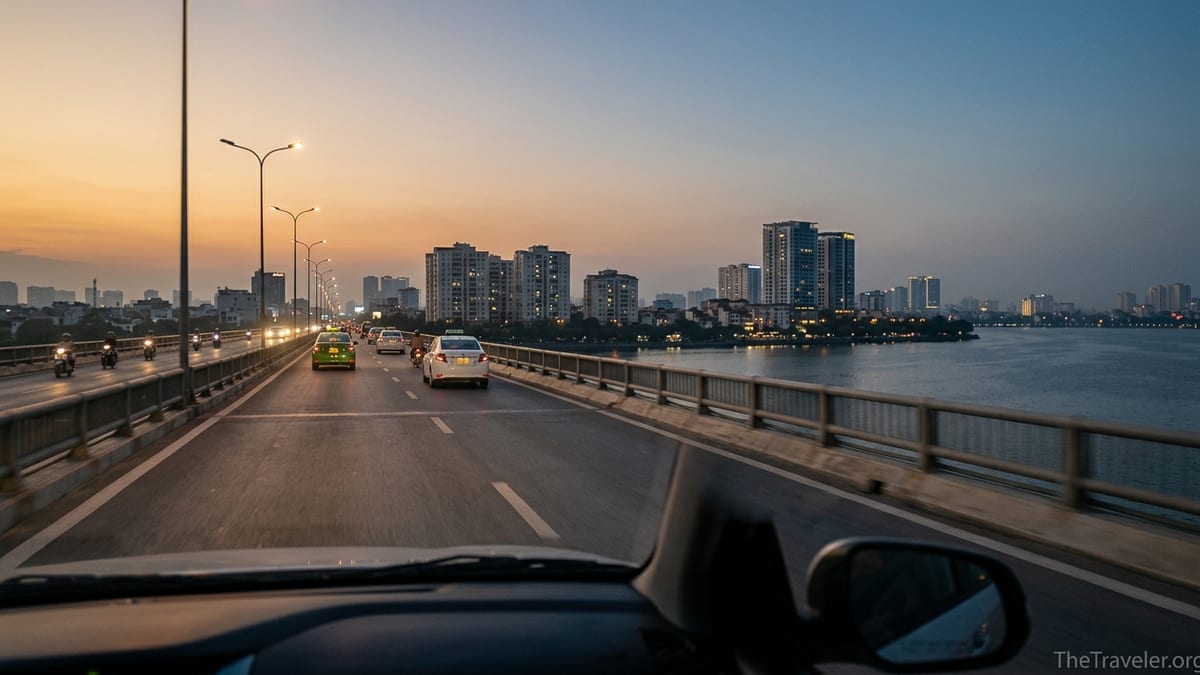
Understanding the Route from Noi Bai to Tay Ho
Noi Bai International Airport sits about 25 to 30 kilometers north of central Hanoi, depending on your final address in Tay Ho. Most journeys to West Lake follow the same broad pattern: you leave the airport on the Noi Bai expressway, join Hanoi’s Ring Road 2 or Vo Chi Cong, then cut across toward Xuan Dieu, Quang An or one of the smaller peninsula streets. In normal conditions, the ride to Tay Ho takes around 25 to 35 minutes by car. In peak traffic, you should expect 45 minutes or slightly longer, especially on weekday late afternoons when commuters funnel back into the city.
For an expat-style stay, you are likely bound for the dense strip between Xuan Dieu and the lakeside lanes of Quang An, Quang Khanh and Tu Hoa, or for one of the newer apartment towers along Lac Long Quan and Vo Chi Cong. Serviced residences such as Somerset West Point on Tay Ho Road or Oakwood Residence on Quang Khanh sit directly on or just off the lake, while many smaller serviced apartments occupy alleys off Xuan Dieu and To Ngoc Van. Drivers are very familiar with the larger properties, but lesser-known buildings can be harder to find at night, so having the exact Vietnamese address ready on your phone is critical.
Navigation apps are widely used in Hanoi and are standard for both Grab and many traditional taxi drivers. Even if your driver’s English is limited, showing a pin on Google Maps or a Vietnamese address message from your landlord will resolve most confusion. This is particularly helpful in Tay Ho where many properties sit deep in narrow alleys that look similar even to long-term residents.
Taking a Taxi: Metered, Airport Counters and What to Expect
For business travelers who want minimal hassle, a metered taxi remains the most straightforward option out of Noi Bai. Official airport taxis queue outside both terminals 24 hours a day. Familiar companies on rotation typically include larger Hanoi fleets such as Taxi Group and Airport-branded operators. You walk to the taxi rank, join the organized line and an attendant will usually direct you to the next available car. It is common practice to confirm that the meter is on as you depart; if it is not, politely insist before the car reaches the main road.
The meter from Noi Bai to central Tay Ho generally yields a fare in the region of 300,000 to 400,000 Vietnamese dong, depending on traffic and the exact address, plus a small toll fee for the expressway section. In total, many recent travelers report paying in the mid-300,000s for a drop near Xuan Dieu or Quang An. This puts a taxi in the 12 to 16 US dollar range at typical exchange rates, which is reasonable for a 25 to 40 minute, door-to-door ride in an air-conditioned sedan. Paying in cash is still the norm, and taxi drivers generally accept only Vietnamese dong, so you may want to withdraw cash from an airport ATM before heading to the rank.
Inside the arrivals halls you may see small counters offering fixed-price taxi or car vouchers to anywhere in the city. These often quote flat rates to Tay Ho that are slightly above what you would pay on the meter but include tolls and can be paid by card. For a first-time visitor arriving late at night, or for a company traveler expensing the ride, that premium can be worth it. A typical fixed fare quoted in mid-2026 for Tay Ho from such counters hovers around the upper-300,000s to low-400,000s dong for a standard car, with higher pricing for seven-seat vehicles if you are traveling with colleagues and large suitcases.
Booking a Grab Car: App-Based Convenience
For many expats and returning visitors, Grab has become the default way to get from Noi Bai to Tay Ho, especially if you already use the app elsewhere in Southeast Asia. Once you have mobile data working, you can book a GrabCar straight to your West Lake address. At the airport, Grab drivers are typically instructed to meet passengers at designated pick-up points just outside the terminal buildings. The app will show you the zone or column number; follow the signage and expect to message or call the driver so they can confirm your exact location.
Pricing for a GrabCar from Noi Bai to Tay Ho tends to be competitive with taxis and sometimes slightly cheaper in off-peak periods. Many travelers in 2025 and 2026 report app estimates in the 260,000 to 350,000 dong range for a standard car to Xuan Dieu, with surcharges pushing this higher at busy times or during heavy rain. The final price is locked in at booking, which removes the risk of meter games or wrong turns, and you can pay by card through the app if your profile is set up that way. This is convenient if you land without local currency, but you will still want at least some cash for your first day in Tay Ho.
The main requirement for using Grab effectively is reliable mobile data on arrival. Many frequent visitors either arrange an eSIM before flying or buy a local SIM card from one of the official counters in the arrivals area. Once connected, they book while still inside, then walk out only when the driver is one or two minutes away, reducing waiting time in the heat. If you are traveling with multiple large suitcases, consider booking a GrabCar 7-seater, particularly when heading to apartment-heavy streets like To Ngoc Van where you may have to stop and unload at a tight curb in traffic.
Private Airport Transfers and Hotel Cars
For corporate trips, relocations and family moves, a pre-booked private airport transfer is often the smoothest option. Many serviced apartments and higher-end residences in Tay Ho, such as the lakeside complexes along Quang Khanh and Tay Ho Road, can arrange a car and driver to meet you at arrivals with a name sign. These services usually cost more than a Grab or metered taxi but provide additional peace of mind, particularly after long-haul flights or when transporting valuable work equipment.
Prices for private transfers from Noi Bai to Tay Ho quoted by local car services and some property managers in 2026 typically fall between 400,000 and 600,000 dong for a standard sedan, and higher for SUVs or vans. At the upper end of that range you can expect an English-speaking driver, bottled water and sometimes on-board Wi-Fi. For an expat arriving with several checked bags, a bike in a box, or children and strollers, the added capacity and calmer pace of a private transfer can be worth the premium.
One useful approach for long-term stays is to coordinate the transfer through the landlord or building manager of your Tay Ho apartment. Agents who regularly handle foreign tenants on streets like Quang An, Xuan Dieu or Au Co often have a trusted driver they use repeatedly. The driver will already know your building, the best way to access the parking entrance, and how to navigate tight alleys that might confuse a driver who relies only on GPS. This can save you from being dropped at the wrong end of a lane late at night with heavy luggage.
Travel Time, Traffic Patterns and When to Leave the Airport
Although Google Maps may optimistically show a 25-minute ride to Tay Ho, it is safer to plan for 40 minutes door to door, especially if you are heading to an address on the narrow peninsula roads. Morning rush hour in Hanoi typically builds from around 7:30 to 9:00, while the afternoon peak runs from about 4:30 to 6:30. Flights that land during these windows can add 10 to 15 minutes to your drive as you hit denser traffic on Vo Chi Cong and around the Nhat Tan bridge approach.
Evening arrivals tend to move more quickly. A flight landing around 9:00 p.m. often allows you to clear immigration, collect bags and be in a car by about 9:45, reaching a Tay Ho apartment before 10:30 when many convenience stores and small restaurants on Xuan Dieu and To Ngoc Van are still open. After midnight, the roads are quiet and the drive can shrink to 20 to 25 minutes, though your options narrow to taxis and pre-booked cars rather than Grab if driver supply is low.
Weather can also influence your journey. Hanoi’s summer months bring heavy, short rainstorms that can pool water on some lanes near West Lake and slow traffic to a crawl. If your driver suggests taking a slightly longer route around the lake to avoid flooding, it is usually wise to agree. In winter, heavy smog and drizzle are more common than disruptive storms, so they rarely affect travel times significantly but may make navigation less visually clear when searching for an unmarked alley.
Tay Ho Hotel and Apartment Clusters to Aim For
Knowing the main accommodation clusters in Tay Ho helps you brief your driver and gauge how long the final few minutes of your journey will take. The densest expat-oriented strip runs along Xuan Dieu, Quang An and the small lanes that thread between them. Here you will find a mix of serviced residences, boutique lakeside hotels and dozens of mid-range apartment buildings, many of them with English-language signage. Properties such as Somerset West Point or various West Lake hotel and residence complexes on Thuy Khue are well-known to drivers and serve as easy reference points.
Another cluster sits slightly inland along To Ngoc Van and its web of side alleys. This area is popular with long-stay expats thanks to its concentration of cafes, international restaurants, gyms and small supermarkets. An address on To Ngoc Van typically involves your car turning off Xuan Dieu or Au Co and navigating narrower streets where scooters may be parked on both sides. Travel time from the main road to a specific building can add five minutes to your journey, which is worth considering if you are arriving in heavy rain or balancing multiple suitcases.
Further south, around Lac Long Quan and Vo Chi Cong, new high-rise apartment blocks and mixed-use towers have emerged, attracting professionals who want quick access to both Tay Ho amenities and the main road network. If you are staying in one of these towers, the entry driveways are usually clear and signed, making late-night arrivals easier. The trade-off is that you are a short walk or quick ride from the more atmospheric lakeside streets, rather than directly on West Lake itself.
Luggage, Gear and Practical Arrival Tips
If you are relocating or settling in Tay Ho for several months, you may be traveling with bulkier luggage than a typical tourist. Both standard airport taxis and GrabCar sedans can handle two large checked bags and two smaller cases in the trunk, but once you add sports equipment, musical instruments or boxed monitors, space becomes tight. In those situations it is worth explicitly requesting a seven-seat vehicle or larger when booking, or asking the taxi coordinator at the airport for an MPV instead of a compact sedan.
Keep important work gear and valuables in a carry-on that stays with you on the back seat. Hanoi traffic, while generally safe, can be chaotic, and trunks are occasionally opened in dimly lit side streets as drivers shuffle bags. If you are being dropped at an unmarked alley entrance off Xuan Dieu or Quang An and need a minute to identify your building, it is reassuring to have laptops and passports in sight rather than in the trunk. When you arrive, do a quick scan to ensure nothing has slipped under the seat or into a dark corner of the boot.
Most drivers in Hanoi expect a modest tip only if they have provided extra assistance, such as helping carry heavy luggage up several steps or waiting while you locate a landlord in a confusing lane. Rounding the fare up by 10,000 to 20,000 dong is common in those cases. For apartment check-ins arranged through agents, it is standard for the building staff or landlord, rather than the driver, to help with luggage inside the property.
Late-Night and Red-Eye Arrivals
Landing in Hanoi after midnight is common on long-haul routes from Europe and the Middle East. Fortunately, Noi Bai operates around the clock, and both official taxis and many private car services remain available through the night. The terminal taxi ranks are usually quieter, and you can still expect to find cars waiting at 1:00 or 2:00 a.m. If you prefer more certainty or are traveling with children, arranging a private pick-up in advance is advisable so you are not dependent on driver availability in the small hours.
One detail that late-night arrivals to Tay Ho often underestimate is building access. While hotels and larger serviced residences typically run 24-hour front desks, smaller apartment buildings and homestays may lock their front doors after midnight. Before flying, confirm with your landlord or hotel how late check-in is handled. Many expats arrange to meet a building manager who will wait on site, or they are given a keypad code and clear instructions, sometimes including photos of the front door and gate so they can recognize it in the dark.
Food and supplies are more limited in Tay Ho after midnight, but not completely absent. A handful of late-opening convenience stores and street food vendors still operate on main roads like Xuan Dieu and Au Co, though their exact locations change over time. If you are arriving after 11:00 p.m., it is sensible to buy water and a snack at the airport before leaving, then plan to do a proper grocery run the following day at one of the larger supermarkets or specialty shops that serve the expat community.
The Takeaway
Getting from Noi Bai International Airport to West Lake is straightforward once you understand the real-world options and what suits your style of stay. For a classic business or expat arrival, a metered taxi or GrabCar offers the best balance of cost and convenience, with travel times that typically sit under 40 minutes. Those moving with families, bulky luggage or company equipment often prefer a pre-arranged private transfer, especially for red-eye landings, while budget-conscious arrivals with time to spare may experiment with cheaper options later in their stay.
Whichever mode you choose, two habits make a noticeable difference: have your full Tay Ho address written in Vietnamese with a map pin ready on your phone, and think through building access and check-in before you board your flight. Do that, and your first journey into Hanoi will feel less like a logistics puzzle and more like what it should be: a straightforward ride to the lake, past the lit arches of Nhat Tan bridge, and into the neighborhood that has become northern Vietnam’s unofficial expat hub.
FAQ
Q1. How much should I expect to pay for a taxi from Noi Bai to Tay Ho?
For a standard metered taxi from Noi Bai to most parts of Tay Ho around West Lake, many recent travelers report total fares in the region of 300,000 to 400,000 dong, including tolls, depending on traffic and your exact address.
Q2. Is Grab available late at night at Noi Bai Airport?
Grab cars do operate late at night, but driver availability can dip after midnight. You may see slightly longer wait times, and in very quiet hours a traditional airport taxi or pre-booked private car is a more reliable choice.
Q3. How long does the drive from Noi Bai to West Lake usually take?
In light to moderate traffic, you can expect around 25 to 35 minutes door to door. During rush hour or heavy rain, it is safer to allow 40 to 45 minutes, especially if your apartment is in a narrow alley off streets like To Ngoc Van or Quang An.
Q4. Do I need cash, or can I pay by card for the airport transfer?
Traditional taxis usually expect payment in Vietnamese dong, though some hotel cars and airport counters accept cards. Grab allows in-app card payment if your account is set up, but it is still wise to carry some local cash for flexibility.
Q5. Which part of Tay Ho is best for expats and longer stays?
Many expats favor the strip around Xuan Dieu, Quang An and To Ngoc Van for its cafes, international restaurants and serviced apartments. Others choose newer high-rises along Lac Long Quan and Vo Chi Cong for easier car access and modern facilities.
Q6. Is it safe to arrive in Tay Ho very late at night?
Tay Ho is generally considered one of Hanoi’s safer districts, and late-night airport transfers are routine. The main risk is confusion over locked building doors or hard-to-find alleys, so confirm check-in arrangements and keep your phone charged for contact.
Q7. Should I pre-book an airport transfer if I have a lot of luggage?
If you are traveling with several large suitcases, sports gear or work equipment, pre-booking a private car or at least requesting a larger vehicle type is sensible. It ensures enough trunk space and a driver who expects a slower, more luggage-heavy drop-off.
Q8. Can I use public buses from Noi Bai to get close to West Lake?
Hanoi operates airport buses that connect Noi Bai with the city, and some routes pass relatively close to West Lake, but they are less convenient if you are carrying luggage or arriving late at night. Most expats use buses only after they are settled and know the routes well.
Q9. What is the best way to share my Tay Ho address with the driver?
The most effective method is to show the full Vietnamese address on your phone, ideally copied from your landlord or hotel, along with a map pin in a navigation app. Many drivers are comfortable following GPS even if they do not speak much English.
Q10. Are there 24-hour hotels in Tay Ho if my apartment is not ready?
Yes. Tay Ho has a range of hotels and serviced residences that can handle late-night check-in, including larger lakeside properties and smaller boutique hotels. If your long-term apartment will not be available until the next day, spending your first night in one of these is a common and practical solution.