


Hanoi’s Noi Bai International Airport can be confusing, especially if you are connecting between domestic and international flights. The two main terminals, T1 and T2, are separate buildings a short drive apart, and choosing the wrong one can cost you time, stress, and sometimes even a flight. This guide explains exactly which terminal you need, how they differ, and how to move between them without hassle.
Get the latest updates straight to your inbox!
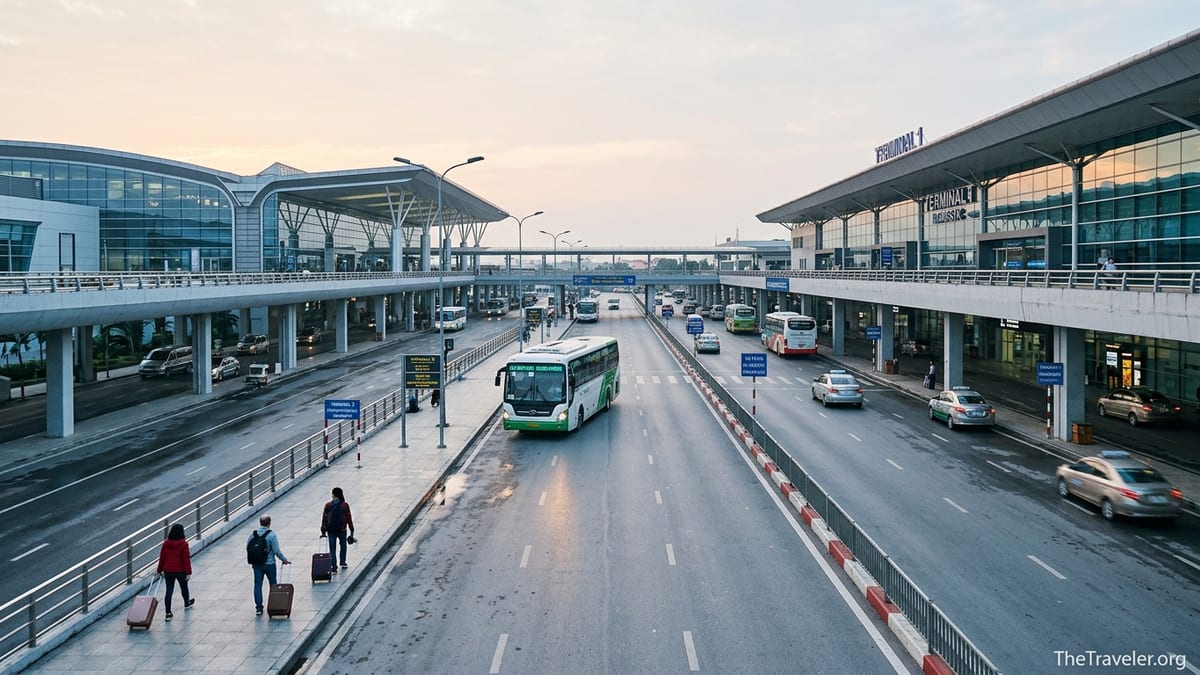
Terminal 1 vs Terminal 2: The Big Picture
Noi Bai International Airport serves Hanoi and northern Vietnam, and operates with two main terminals for passengers. Terminal 1 handles almost all domestic flights within Vietnam, while Terminal 2 is dedicated to international flights to and from foreign destinations. Since December 2014, international airlines have been moved to T2, so if you are flying in from or out to another country, you will almost always be in Terminal 2, even if your ticket is with a Vietnamese carrier.
In practice, that means a flight from Ho Chi Minh City to Hanoi on Vietnam Airlines, Vietjet Air, or Bamboo Airways will arrive at Terminal 1, while a flight from Bangkok, Singapore, Seoul, Paris, or Tokyo will use Terminal 2. Many travelers pass through both: for example, a journey from Da Nang to Hanoi to Seoul would depart Da Nang from the domestic terminal there, arrive into Terminal 1 at Hanoi, then transfer to Terminal 2 for the international leg.
It is important to understand that the two terminals at Noi Bai are not connected airside. Unlike some airports where you can walk from one terminal to another after security, at Noi Bai you must exit to the public area, then transfer by shuttle, taxi, or on foot. If your booking involves both terminals, factor this into your connection time and expectations.
On the ground, Terminal 2 is newer and more spacious, built to handle rising international traffic. Terminal 1 is older but recently refurbished in stages, with separate halls for different domestic carriers. Facilities such as lounges, duty free, and immigration are concentrated in T2, while T1 is geared toward quick domestic turnarounds, local shops, and regional routes.
Which Terminal Do You Need for Your Flight?
The simplest rule is this: if all your flights are within Vietnam, you will use Terminal 1. If your itinerary includes leaving or entering Vietnam, that flight will be from Terminal 2. A passenger flying Hanoi to Hue, or Phu Quoc to Hanoi, will check in and depart from T1. A passenger flying Hanoi to Tokyo, Hanoi to Frankfurt, or Hanoi to Sydney will check in and depart from T2.
Domestic carriers such as Vietnam Airlines, Vietjet Air, and Bamboo Airways use Terminal 1 for their internal routes. For example, Vietjet Air flight VJ151 from Ho Chi Minh City to Hanoi arrives at T1, not T2. The very same airline might operate an international flight, such as VJ915 from Hanoi to Bangkok, from Terminal 2. If you fly into Hanoi from Ho Chi Minh City on Vietjet and then connect to Bangkok on Vietjet, you will still change terminals in between.
Most international flag carriers and regional airlines operate only from Terminal 2. That includes airlines such as Korean Air, Asiana Airlines, Japan Airlines, ANA, Singapore Airlines, Thai Airways, and many Chinese and European carriers. If your ticket shows an international route and a foreign airline code, you can safely assume T2, but it is always worth checking your e-ticket or the airport website the day before you travel in case of operational changes.
If you are unsure, look at your booking confirmation for “Terminal” details or for clues like “HAN T1” or “HAN T2” next to your flight number. Some online travel agencies and airline apps show this clearly. If it is not visible, searching your exact flight number and date, along with “Noi Bai,” usually returns the terminal, especially for major routes like Hanoi to Seoul, Bangkok, or Singapore.
Navigating Domestic vs International: Check-in and Security
Terminal 1 is organized for quick domestic processing. Check-in counters are grouped by airline, and most domestic passengers arrive about 90 minutes before departure. Security is focused on hand luggage scanning without immigration checks, so once you have your boarding pass you simply pass through screening and head to your gate. Passports are still required for foreign nationals, but there will not be an exit immigration stamp when you depart from T1 to another city inside Vietnam.
Terminal 2, by contrast, has full immigration and customs procedures. Departing passengers check in at their airline counters, proceed through outbound immigration, and then clear security. On a peak evening when multiple long-haul flights to Europe and East Asia depart between 10 pm and midnight, queues at security and immigration can be long. Travelers flying Hanoi to London, Paris, or Frankfurt should plan to arrive at T2 at least three hours before departure, particularly during busy periods such as Tet or summer holidays.
On arrival at Terminal 2 from a foreign country, you will pass through immigration to receive a visa stamp or e-visa validation, then collect your luggage in the international baggage hall, and finally walk through customs to reach the public arrivals zone. Only after exiting customs will you be able to transfer to Terminal 1 if you have a domestic connection. There is no way to stay within a secure transit corridor between international and domestic at Noi Bai.
An example helps illustrate this. A traveler flying from Paris to Hanoi and on to Da Nang on a single Vietnam Airlines ticket will disembark at T2, go through immigration, collect their suitcase, and clear customs. They then exit into the public hall, follow signs for the inter-terminal shuttle or taxi to reach T1, and recheck the bag for their domestic flight to Da Nang. Even on one booking, the passenger is responsible for moving themselves and their luggage between terminals.
Transferring Between T1 and T2: Shuttle, Walking, or Taxi
The most convenient way to travel between Terminal 1 and Terminal 2 is the free shuttle bus operated by the airport. This shuttle runs between the arrivals areas of both terminals at regular intervals during the day, typically every 10 to 15 minutes from early morning until late at night. The ride itself is short, often around five minutes, because the terminals are only a couple of kilometers apart on the same airport road.
To use the shuttle from T1, you exit the domestic arrivals area to the curbside and look for signs indicating the inter-terminal bus. Staff often point travelers in the right direction if you simply say “T2 shuttle.” From T2, the stop is outside the arrivals level as well, with clear signage in both Vietnamese and English. You do not need to book this service in advance, and there is no ticket or fee; you simply queue and board with your luggage, which you keep with you in the bus.
Some travelers prefer to walk between terminals, especially with light luggage and in cooler weather. The walk can take roughly 15 to 20 minutes along the access road, which is straightforward but not especially scenic. In Vietnam’s hot season or during heavy rain, the shuttle is far more comfortable. Taxis and ride-hailing cars are also available, but for most passengers they are unnecessary for such a short transfer and cost more than the time saved.
Connection planning is critical. A typical itinerary might involve landing on an international flight at 5:30 am in T2 and continuing to Da Nang from T1 at 8:00 am. Factoring around 30 to 45 minutes for immigration and baggage, 15 minutes for customs and walking to the shuttle, 10 to 15 minutes total waiting and riding on the bus, and then another 30 to 45 minutes to check in and clear security domestically, this kind of 2.5-hour connection is usually workable. Tight connections of under 90 minutes between terminals are risky and should be avoided where possible.
Baggage Claim, Customs, and Rechecking Luggage
Baggage handling differs significantly between T1 and T2 because of customs and immigration rules. At Terminal 2, international arriving passengers must collect all checked bags before customs. Even if you have a through ticket from an overseas city to a domestic destination, your luggage will generally not be transferred automatically between T2 and T1. You must pick up your suitcase at the T2 carousel, clear customs, and then recheck it at the T1 check-in counters.
At Terminal 1, domestic arrivals are simpler. After disembarking, you walk to the baggage hall, locate the carousel number posted for your flight, and wait for your bags. Once you collect them, you head straight out into the public area without going through customs inspection unless randomly selected. For example, someone flying from Hue to Hanoi with only domestic segments will likely be outside the terminal with their bag in 20 to 30 minutes, depending on how busy the belt is.
Unclaimed bags from international flights are usually handled at the lost and found counter housed in Terminal 2, which is where most airlines coordinate tracing and delivery for delayed luggage. A traveler whose suitcase has been left behind on a flight from Kuala Lumpur to Hanoi will follow up with the airline’s counter in T2, even if their onward domestic segment later departs from T1. It is useful to keep this in mind if your bag does not appear on the carousel, as you would not resolve an international bag issue at the domestic terminal.
Because there is no integrated baggage system between T1 and T2 for most itineraries, travelers should always allow sufficient buffer time between an international arrival and a domestic departure to accommodate baggage delays. It is not unusual for bags to take 20 to 40 minutes to appear at T2 during busy evening waves of flights. Booking a tight onward domestic flight from T1 scheduled less than two hours after landing can leave little margin for such delays.
Common Wrong-Terminal Mistakes and How to Avoid Them
One of the most frequent problems at Noi Bai is passengers turning up at the wrong terminal. A typical scenario is a traveler who has flown into Terminal 2 from abroad a few days earlier, then returns to the airport for a domestic flight to Da Nang or Nha Trang and instinctively goes back to T2. Only at the check-in area do they realize domestic departures use Terminal 1, forcing a hurried transfer by shuttle or taxi and adding unnecessary stress.
Another common mistake occurs with low-cost carriers that operate both domestic and international routes. For instance, a passenger who flew from Bangkok to Hanoi on Vietjet Air at Terminal 2 might assume their subsequent flight from Hanoi to Phu Quoc on the same airline also departs from T2. In reality, it leaves from Terminal 1. The airline brand is the same, but the route type has changed from international to domestic, and so has the terminal.
Mistakes also happen when travelers read only part of their itinerary. Some tickets list “Hanoi Noi Bai International” with no terminal detail on the top page, while a smaller note further down says “Terminal 1” next to the domestic segment. Others rely on outdated information from friends or forums that describe “the international terminal” without clarifying that domestic flights are handled separately. In late-night or early-morning hours, such confusion is magnified because fewer staff speak fluent English and signage can feel overwhelming when you are tired.
The easiest way to avoid these issues is to triple-check your terminal the day before departure. Confirm using at least two sources: your airline app or booking confirmation, plus the latest information on the airport’s own site or a current-day flight information board. When in doubt on arrival at Noi Bai, ask an airport staff member or security guard by stating your airline and destination city; they can quickly indicate “T1” or “T2” and point you in the right direction.
Facilities, Lounges, and Services: What to Expect in Each Terminal
Terminal 2, being newer, tends to offer a more spacious and modern environment. After security and immigration, international passengers will find a range of duty-free stores, coffee shops, and sit-down restaurants. There are several airline and contract lounges, including premium spaces used by full-service carriers and priority-pass style memberships. For example, a business-class passenger on a Japanese or Korean airline will generally relax in a lounge in T2 with showers, hot meals, and quiet seating before boarding.
Terminal 1’s facilities are more oriented toward quick domestic travel. You will find local coffee chains, simple eateries serving Vietnamese dishes like pho and banh mi, and convenience-style shops for snacks and bottled water. There are also domestic lounges operated by airlines or independent providers, used by frequent flyers or travelers who purchase access. These lounges are usually smaller than those in T2 but convenient for a short stay before a flight to cities such as Hue, Da Nang, or Ho Chi Minh City.
Both terminals provide free Wi-Fi, with networks clearly advertised in the public halls. Speeds can fluctuate during peak hours, but for checking emails or messaging ride-hailing services the connection is generally adequate. ATMs and currency exchange counters are more heavily concentrated in Terminal 2 because most currency exchanges and foreign card withdrawals are associated with international arrivals and departures.
If you have a long connection and prefer to rest properly, there are small transit hotels and guesthouses near the airport, especially around Terminal 2. Many offer simple private rooms and airport pickup for a modest fee, catering to travelers arriving late at night who have a domestic flight next morning. A traveler arriving from Europe at 10 pm, for example, might check into a nearby hotel for six hours of sleep before returning to T1 at dawn for a flight to Hue.
Practical Tips for Smooth Connections at Noi Bai
For international to domestic connections, aim for at least two and a half to three hours between your scheduled arrival at T2 and departure from T1. This window allows for immigration, baggage collection, customs, the shuttle transfer, and domestic check-in and security, even if one or two steps run more slowly than expected. More time is advisable during peak holiday periods or late-evening arrival banks, when queues are longest.
When arriving internationally with a same-day domestic connection, keep essential items like medication, a change of clothes, and important documents in your carry-on. In the rare event your checked luggage is delayed, you can still board the domestic flight if the airline permits, while your bag is sent later. Make sure your onward domestic airline knows how to reach you at your next destination for delivery.
If you are starting your journey in Hanoi on a domestic flight, build in extra time to find the correct terminal and check-in area. Depending on traffic from central Hanoi to the airport, the drive can take 45 minutes to more than an hour. Many travelers leave the Old Quarter roughly three hours before a domestic departure, which normally results in arriving at T1 about 90 minutes before takeoff. For international flights from T2, leaving the city at least three and a half to four hours before departure is sensible.
Finally, remember that signage at Noi Bai continues to improve. Look closely at overhead boards listing departures along with “T1” or “T2” icons, and listen to announcements that clarify whether a bus or car is going to the domestic or international terminal. When language is a barrier, showing your ticket on your phone to a staff member is often the fastest way to get clear directions without misunderstanding.
The Takeaway
Understanding the split between Terminal 1 and Terminal 2 at Hanoi’s Noi Bai Airport can turn a potentially stressful transit into a straightforward part of your trip. Domestic flights stay in T1, international flights operate from T2, and transfers between them require exiting to the public area and using a shuttle, taxi, or a short walk.
If you know in advance which terminal you need, budget sensible connection times, and are prepared to recheck your luggage when moving from international to domestic, Noi Bai functions predictably. Paying attention to details on your booking, asking questions when in doubt, and using the free shuttle rather than last-minute taxis all help avoid the classic wrong-terminal dash that so many travelers experience at least once.
FAQ
Q1. How do I know if my flight uses Terminal 1 or Terminal 2 at Noi Bai?
Most domestic flights within Vietnam use Terminal 1, while international flights to or from other countries use Terminal 2. Check your e-ticket or airline app, which usually shows “Terminal 1” or “Terminal 2” beside your Hanoi flight. If in doubt, search your flight number and date together with “Hanoi airport” or ask your airline directly before you travel.
Q2. Is there a free shuttle between Terminal 1 and Terminal 2, and how long does it take?
Yes, there is a free official shuttle bus operating between the two terminals. It typically runs every 10 to 15 minutes during the day and evening, and the ride itself takes around five minutes. You board outside the arrivals area at each terminal, and no booking or ticket is required.
Q3. Can I walk between Terminal 1 and Terminal 2 instead of taking the shuttle?
It is possible to walk between T1 and T2 using the airport access roads, and many travelers with light luggage do so. The walk usually takes around 15 to 20 minutes at a normal pace. In hot, humid, or rainy weather, most people prefer the shuttle bus, which is both free and more comfortable.
Q4. Do I have to collect my checked luggage at Terminal 2 before connecting to a domestic flight from Terminal 1?
In almost all cases, yes. International arrivals at Terminal 2 must collect checked bags, clear customs, and then carry them to Terminal 1 for recheck on their domestic flight. Even if your tickets are on the same airline, luggage is rarely transferred automatically between the international and domestic terminals, so you should plan to handle your bags yourself.
Q5. How much connection time do I need when changing from an international flight in T2 to a domestic flight in T1?
A connection time of at least two and a half to three hours is recommended. This allows for immigration and visa processing, baggage claim, customs, waiting for the shuttle, the short ride to T1, and then domestic check-in and security. During peak travel seasons or late-night arrival waves, adding extra time for possible queues is wise.
Q6. What happens if I go to the wrong terminal for my departure?
If you arrive at the wrong terminal, you can still make your flight as long as you have enough time. Use the free shuttle or a taxi to get to the correct terminal as quickly as possible. Airline staff are accustomed to this mistake and can guide you to the shuttle stop, but if your flight departure is close, you may have to pay for a taxi to save a few minutes.
Q7. Are there good food and lounge options at both terminals?
Terminal 2 has a wider range of international options, including duty-free shops, cafes, and airline or independent lounges with showers and hot meals. Terminal 1 focuses more on quick domestic travel, with Vietnamese coffee chains, local food stalls, and a few domestic lounges. If you value lounge access and shopping, T2 is better equipped, but T1 has enough for a typical short domestic wait.
Q8. Can I stay airside when transferring between domestic and international flights at Noi Bai?
No, you cannot. Noi Bai does not offer an airside connection corridor between Terminal 1 and Terminal 2. You must exit through immigration and customs if arriving internationally, enter the public landside area, and then travel by shuttle, taxi, or on foot to the other terminal. Once there, you recheck your bags if necessary and pass through security and, for international departures, immigration again.
Q9. How far is Noi Bai Airport from central Hanoi, and how early should I leave the city?
Noi Bai is roughly 30 kilometers north of central Hanoi, and the drive usually takes between 45 minutes and over an hour, depending on traffic. For domestic flights from T1, many travelers leave the Old Quarter about three hours before departure. For international flights from T2, leaving at least three and a half to four hours before scheduled takeoff offers a comfortable buffer for traffic and airport formalities.
Q10. Is Noi Bai Airport easy to navigate for first-time visitors?
For a first-time visitor, the split terminals can be confusing, but signage has improved and most key areas are labeled in both Vietnamese and English. If you know in advance whether you need T1 or T2, follow the overhead signs and confirm with staff if you are unsure, navigation is generally manageable. Keeping your printed or digital ticket handy to show staff is one of the fastest ways to get clear directions.