


Most visitors think they have “done” the Absheron Peninsula once they have posed at Ateshgah Fire Temple and Yanar Dag’s eternal flames. In reality, those famous sights are only a thin strip of a much larger, stranger and more rewarding landscape. Step away from the standard half-day tour, and Absheron reveals quiet capes where gazelles graze, sleepy villages of stone houses and pomegranate trees, forgotten Soviet-era resorts and working oilfields sliding into the Caspian Sea. All of this lies within an hour or two of central Baku, yet very few foreign visitors see it.
Get the latest updates straight to your inbox!
Why Absheron Deserves More Than a Half-Day Tour
Look at any brochure rack in a Baku hotel lobby and you will see the same combination: Ateshgah, Yanar Dag and perhaps a quick stop at a beach club in Bilgah. Tours are usually sold as four to six hour packages, bundled with lunch and a hotel pick-up. It is an easy template for agencies to sell and for visitors to understand, but it creates the illusion that these three stops are all Absheron has to offer. In fact, they sit in just one corner of a peninsula that stretches east toward the Caspian and curls north in a low, sandy hook dotted with wetlands, villages and industrial relics.
On the ground, the distances are deceptive. From central Baku to the far tip of Absheron National Park is roughly 60 kilometers, yet the last 20 kilometers pass through an almost empty, protected landscape that feels far removed from the city. Likewise, the older villages of Mardakan, Qala or Pirshagi are technically suburbs but retain their own rhythm, markets and religious sites. When you let go of the idea of “the Absheron tour” and think instead of a small region worth several day trips, you start to notice the areas tour minibuses fly past.
For travelers with two or three days in Baku, that shift in mindset matters. Rather than dedicating one afternoon to a pre-packaged tour, you can plan one day for fire and mud, another for sea and steppe, and a slow final day dipping into historic villages and working-class quarters of the peninsula. You will see the same famous sights, but also gain a sense of how people actually live here, between oil wells and fruit orchards.
Just as importantly, you will spend more time outside of the tour bubble. That might mean buying tomatoes by the kilo from a vendor who weighs them on rusted scales, joining families drinking tea at a nameless seaside café, or waiting in the wind for a marshrutka minibus that rattles back into Baku. Those unplanned moments are where Absheron begins to feel real.
Absheron National Park: The Empty Cape Few People Reach
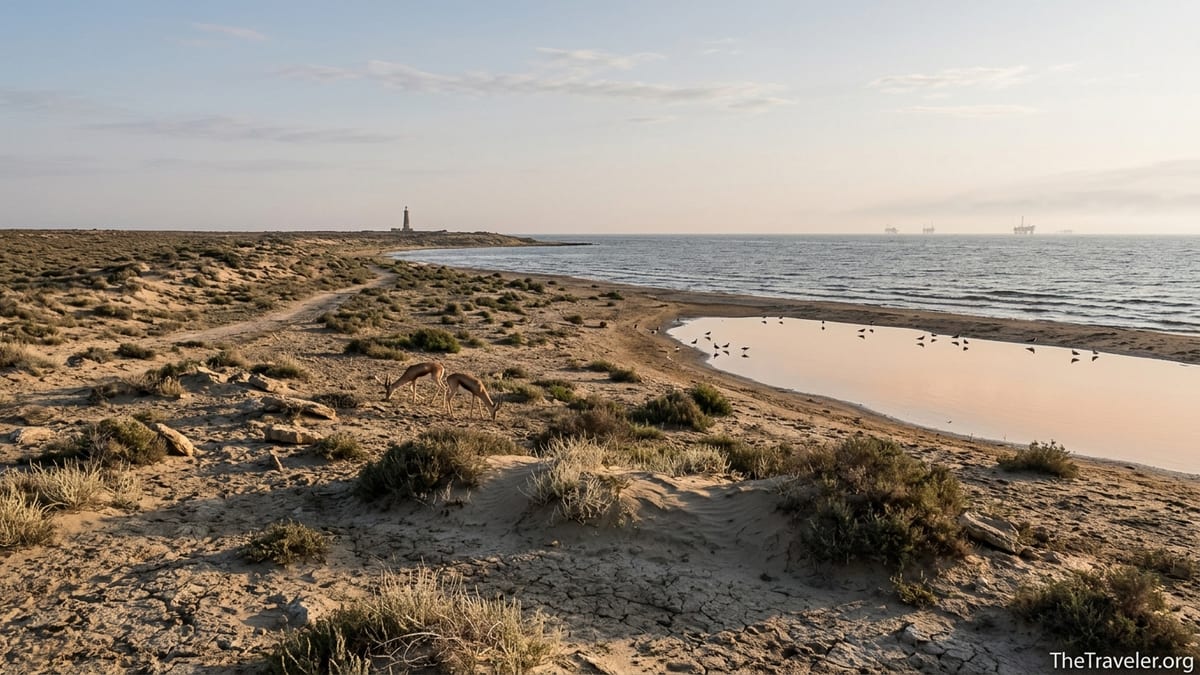
Very few Yanar Dag visitors realize that if they kept driving east instead of looping back to the city, they could be walking in Absheron National Park within an hour. This small, protected area occupies the far eastern tip of the peninsula, where the land thins to a windswept cape protruding into the Caspian. It is one of Azerbaijan’s smallest national parks, at under 800 hectares, yet it protects a mix of semi-desert, coastal dunes and shallow lagoons that attract birds and other wildlife.
The experience here is about space and silence rather than dramatic scenery. The landscape is largely flat, colored in shades of straw and salt, with low scrub and patches of reed-fringed water. Look closer, and you may spot goitered gazelles picking their way across the steppe, fox tracks in the sand, or tortoises ambling between bushes. In cooler months, migratory birds congregate in the lagoons and along the shoreline, from herons and stilts to flocks of flamingos that leave pink smears against the grey water on overcast days. Offshore, in late spring and summer, lucky visitors sometimes see the small heads of Caspian seals bobbing beyond the waves.
Practically, reaching Absheron National Park is straightforward but rarely advertised. Most travelers hire a taxi in Baku and negotiate a round-trip price for the full day, which often falls somewhere in the range of 60 to 90 Azerbaijani manat depending on your bargaining skills and whether the driver waits for several hours. Budget-conscious travelers sometimes take a combination of city bus and local marshrutka toward the settlement of Zirə or the industrial areas near the cape, then pick up a taxi for the last stretch. Entrance fees to the park itself are modest, typically the cost of a coffee back in Baku, though you should carry cash and your passport for registration.
Conditions in the park catch many unprepared visitors by surprise. There is very little shade and almost no services: no café, no rental umbrellas, and only simple restroom facilities near the gate. In summer, the heat on the exposed tracks can be intense, with the wind offering more dust than relief. Outside of weekends, however, the emptiness is part of the appeal. You can walk for an hour along the coast with only the shrill call of shorebirds and the hum of distant offshore platforms for company, a very different experience to Baku’s manicured seaside promenade.
Village Life in Mardakan, Qala, Pirshagi and Beyond
Closer to the city, the older settlements scattered across Absheron offer a different kind of quiet. Places like Mardakan, Qala, Buzovna, Shuvalan and Pirshagi once functioned as semi-rural retreats for Baku’s wealthy families, while also sustaining their own farming and fishing traditions. Today, they sit within the extended metropolitan area, linked to the capital by regular buses, yet their backstreets still feel far removed from the glass towers on Neftchilar Avenue.
Mardakan is among the most accessible starting points. About 30 kilometers from downtown, it can be reached in roughly 45 minutes on a direct bus from Baku’s 28 May or Koroglu transport hubs, with a ticket typically costing under 1 manat when paid by BakuCard. Behind the main road, lanes of stone walls hide dachas and gardens, many sprouting fig and pomegranate trees. The village also holds two medieval stone fortresses and small mosques, which you can visit for a nominal fee or donation. Exploring on foot, you may stumble upon corner bakeries pulling tandir bread from clay ovens, or small parks where older residents sit drinking strong tea from pear-shaped armudu glasses.
Qala, further south, is often rushed through as a stop at the open-air ethnographic museum. Spend more than an hour and you will notice working wells, traditional ovens and courtyard houses that still function as homes rather than exhibits. Local guesthouses occasionally advertise rooms for rent online in high summer, but it is just as common to find informal homestays by asking at a teahouse or small grocery. Even if you do not stay overnight, Qala’s backstreets are a good place to see the kind of stone architecture that once dominated the whole peninsula, gradually disappearing under modern renovations.
On the northern coast, Pirshagi has become a favored weekend escape for Baku residents, yet remains almost invisible in foreign guidebooks. Older sections of the village, a short walk inland from the beach, retain semi-abandoned Soviet sanatorium buildings and low houses with purple grapevines crawling across walls. In summer, families rent simple rooms in these houses for a night or a week, often advertised only through handwritten signs in Azerbaijani. This type of stay is best suited to travelers comfortable with basic conditions and communication via gestures, but it offers a rare chance to experience Absheron as domestic tourists do, rather than as a packaged product.
Forgotten Sanatorium Beaches and Working Seafronts
Absheron’s coastline is not the untouched sweep of sand some visitors imagine. For over a century, the Caspian shore here has been shaped by two parallel industries: oil and health. Early oil wells and later offshore platforms transformed parts of the coastline into industrial landscapes, while sanatoriums and health resorts sprang up in areas where mineral-rich waters or clean breezes were thought to aid recovery. The result is an oddly compelling mixture of working jetties, faded medical retreats and new, private beach clubs.
Well-known beaches like Bilgah and Shuvalan now attract day-trippers to manicured private clubs with entrance fees that might run from 10 to 25 manat during peak summer weekends, often including a sunbed and access to a café. Just a few kilometers up or down the coast, however, you can still find undeveloped or semi-abandoned stretches of shore. Near Mardakan and Pirshagi, sections of public beach remain free to enter if you are willing to forgo changing cabins and loungers. The sea can appear grey-brown rather than postcard blue, but on calm days locals happily swim, fish from jetties or picnic on low dunes while looking out toward the silhouettes of offshore rigs.
Perhaps the most evocative corners are the grounds of old sanatoriums whose glory days faded with the Soviet Union. Around Bilgah and Mardakan, complexes built around mineral springs or sea air still operate, but often with peeling facades and a fraction of their original clientele. Some accept drop-in visitors to their beaches or café terraces for a small fee, allowing you to wander among colonnades and tiled treatment rooms that feel frozen in time. Others have been converted into more conventional hotels while retaining details like mosaic murals of swimmers or vast, high-ceilinged dining halls.
As a visitor, navigating this seafront patchwork requires both curiosity and common sense. Not every stretch of water is equally clean, and local residents generally know which parts of the coast are currently considered safe for swimming. Asking at a nearby shop or café can save you from wading into a polluted inlet. Likewise, some informal beach areas back onto active oil infrastructure or derelict buildings; they may make for compelling photographs but are not places to climb fences or wander after dark. With those caveats in mind, the less manicured edges of Absheron’s coast often leave stronger memories than the ticketed beach clubs.
Mud Volcanoes and Thermal Corners Away from the Crowds
Gobustan’s mud volcano fields, typically visited together with the rock art reserve to the southwest of Baku, receive most of the attention in international itineraries. Yet Absheron itself hosts numerous smaller mud cones and geothermal sites that remain largely off the tourist radar. They lack the scale of the great mud cauldrons near Gobustan, but they offer a more intimate glimpse of the region’s geology and its long link with oil and gas.
One of the more accessible sites is the Lokbatan mud cone, on the southwestern side of the peninsula, not far from the Baku–Alat highway. Lokbatan has erupted spectacularly in the past, sending flames and columns of mud into the air, but most days it is a quiet hill of dried, cracked grey earth with small pools of bubbling clay near the summit. There is no visitor center, guide system or ticket window; visitors usually reach the area by hiring a taxi from Baku, negotiating a price based on time rather than distance, as routes may vary depending on roadworks and security checkpoints near industrial facilities.
Closer to the more familiar fire temple of Ateshgah, old texts and local accounts describe simple mud baths and sulfurous springs that once attracted people for their supposed healing properties. Some of these balneological wells and baths still function in low-key ways, especially in and around Mardakan and Bilgah, where sanatorium complexes tap mineral waters from nearby wells. Foreign travelers who arrange a treatment day at one of these institutions should be prepared for basic, somewhat old-fashioned facilities: tiled rooms, metal treatment tubs and procedures delivered in Russian or Azerbaijani. Prices are often modest by Western standards, with half-day access sometimes comparable to or cheaper than a beach club admission.
Visitors interested in geology can make Absheron’s mud phenomena the focus of a full day trip. A popular approach is to visit one of the lesser-known cones such as Lokbatan in the morning, then continue to more polished sites like Yanar Dag in the afternoon to appreciate the contrast between raw, unmarked mounds and commercialized “eternal flames.” Hiring a geology-savvy guide or driver can add context, explaining how the same subsurface pressures that drive oil exploration also feed the region’s gas seeps and mud volcanoes.
Birdlife, Wetlands and Seasonal Surprises
Absheron’s climate and position on migration flyways make it surprisingly rich in birdlife, a fact that has begun to draw niche birdwatching tours but remains unknown to most casual visitors. The shallow lagoons and reedbeds around Absheron National Park, as well as smaller wetlands closer to Baku, serve as resting and feeding grounds for numerous species of ducks, waders and gulls. In autumn and spring, keen-eyed observers might spot herons, bitterns or flocks of shorebirds working the mudflats as they pause on their journeys between breeding and wintering grounds.
For non-specialists, the most visually striking visitors are groups of flamingos that gather in some of the lagoons during the cooler months. From a distance, they appear as pale, shimmering patches on the water; closer up, their pink hue and slow, synchronized movements stand out against the muted browns and greys of Absheron’s winter landscape. Conditions change year by year, depending on water levels and disturbance, so recent local advice is essential if you hope to see them. Rangers at Absheron National Park and local nature guides in Baku usually know which corners are currently active.
Beyond the national park, smaller, less formal wetlands exist on the fringes of industrial zones and villages, where drainage ponds and low-lying fields collect water. These can be surprisingly productive for birdwatchers, especially outside the heat of summer, but they require a cautious approach. Access paths may cross private land, and some ponds are adjacent to working oil facilities or landfills. Travelers interested in exploring such areas are best off hiring a local guide familiar with both birdlife and landowner sensitivities, rather than wandering independently with binoculars.
Even for travelers not specifically focused on wildlife, keeping an eye out for birds can enrich any day on the peninsula. Gazelles often share space with ground-nesting larks, while gulls and terns patrol the shoreline even in the off-season when swimming is unappealing. Carrying a small pair of binoculars and taking the time to stop at promising stretches of shoreline or reedy corners can turn an ordinary drive between villages into a small expedition.
Practicalities: Getting Around, Costs and Local Etiquette
Part of the reason many visitors limit their Absheron experience to organized tours is a perception that independent logistics are complicated. In reality, the basics are straightforward once you understand a few patterns. Baku’s public transport network extends far into the peninsula, with frequent city buses connecting central hubs like 28 May, Koroglu and Neftchilar metro stations to villages such as Mardakan, Qala, Buzovna and Pirshagi. Fares on municipal buses are low, typically under 0.50 manat per ride when paid with the rechargeable transport card that locals use.
For more remote areas, including the final stretches toward Absheron National Park or quieter beach segments, taxis or ride-hailing apps fill the gap. Official, metered taxis in central Baku often start around 1 to 1.5 manat, with per-kilometer rates that make even a 30-kilometer journey to a village surprisingly affordable by Western standards. When hailing an unmetered taxi near village squares or bus stops, you should always agree a total fare before getting in. Drivers commonly quote round-trip prices that include waiting time, especially for destinations with no alternative transport back.
Food and small purchases on Absheron are generally inexpensive if you stick to local places rather than high-end beach restaurants. A simple lunch of kebab, salad and bread at a village café might cost the equivalent of a few US dollars, while fresh fruit at markets is often priced per kilogram at rates that encourage you to buy generously. Some beach clubs and modern restaurants along the northern coast price closer to European levels, particularly in high season, but menus are usually displayed at the entrance so surprises are rare.
When visiting villages, beaches and religious sites, a few simple etiquette points go a long way. Dress modestly enough that you would feel comfortable entering a small mosque or family-owned shop: shorts are acceptable on beaches, but covering knees and shoulders in villages avoids unwanted attention. Always ask before photographing people at close range, especially children or older residents. In more remote corners of the peninsula, an offer of tea may turn into a long conversation using a mix of English, Russian and gestures; allow time in your schedule for such interactions, as they are often the most memorable parts of the day.
The Takeaway
Absheron Peninsula is far more than a supporting act for Baku’s Old City and a few famous flames. It is a region in its own right, where semi-desert steppe slides into a working sea, villages preserve memories of oil booms and summer retreats, and wildlife clings to pockets of protected land and water. Most mainstream tours show only the most photogenic and easily packaged pieces. To understand the place, you have to slow down, look beyond the set stops and accept that some of the most interesting sights are also the least polished.
That might mean standing alone on a windy cape while gazelles flicker in the distance, wandering the backstreets of Pirshagi in search of a family-run guest room, or watching the sun set behind offshore rigs from a free public beach instead of a designer infinity pool. None of these experiences require specialist knowledge or large budgets. They demand only time, curiosity and a willingness to navigate a little uncertainty. In return, Absheron offers a glimpse of Azerbaijan that most visitors never see, even as they pass within a few kilometers on the highway.
FAQ
Q1. Is it safe to explore Absheron Peninsula independently, without a tour?
Yes, most of Absheron is safe to explore independently during daylight hours if you use normal city common sense, avoid restricted oil facilities and derelict industrial sites, and stick to marked roads and tracks. In remote corners like Absheron National Park, carry water, sun protection and a charged phone, and let your accommodation know your plans.
Q2. How many days should I plan for Absheron beyond the standard fire temple tour?
If you are basing yourself in Baku, one full extra day allows you to combine a village such as Mardakan with a quieter beach, while two days let you add Absheron National Park and perhaps a mud volcano or sanatorium visit for a more rounded picture of the peninsula.
Q3. Do I need a 4x4 vehicle to reach the lesser-known areas?
No, you can reach most villages, sanatorium areas and the gate of Absheron National Park with a standard taxi or bus on paved roads. A high-clearance vehicle may be helpful only if you plan to venture down unmaintained tracks along the coastline or closer to some mud volcanoes, in which case hiring a local driver who knows the area is preferable.
Q4. Are there any accommodations on the peninsula, or should I stay in Baku?
You can do everything as day trips from Baku, but there are also options on Absheron itself. These range from simple family-run guest rooms in villages like Pirshagi and Mardakan, often arranged informally, to more conventional hotels and sanatorium resorts near Bilgah and along the northern coast. Staying locally for a night or two lets you experience evenings by the sea when day-trippers have gone.
Q5. When is the best time of year to visit Absheron’s lesser-known spots?
Spring and autumn are the most comfortable seasons, with mild temperatures for walking in Absheron National Park and exploring villages on foot. Winter can be chilly and windy but is good for birdwatching in wetlands, while high summer brings strong heat and crowded beach clubs but also opportunities for swimming and long evenings outdoors.
Q6. How much cash should I carry, and are cards widely accepted?
In village shops, small cafés, local buses and informal beach areas, cash is still more reliable than cards. It is wise to carry enough manat for transport, entry fees and simple meals for the day, with cards reserved for larger restaurants, supermarkets and some beach clubs that have modern payment terminals.
Q7. Can I swim anywhere along the Absheron coast, or are there restricted zones?
You should not swim near visible oil infrastructure, ports or clearly polluted inlets, where water quality is poor and access may be restricted. Instead, use established public beaches near villages like Mardakan and Pirshagi, or pay for entry to beach clubs and sanatorium beaches where locals regularly swim and where facilities such as showers and changing rooms are available.
Q8. Is it realistic to visit Absheron National Park and a village or beach in the same day?
Yes, with an early start and a pre-arranged taxi, you can spend several hours walking in Absheron National Park, then stop at a village café or beach on the way back to Baku. Distances are moderate, but factor in rougher roads near the park and the likelihood that you will want time to linger along the coast.
Q9. Are English-speaking guides available outside the main tourist sights?
English-speaking guides are easiest to find in Baku-based agencies and at major sites, but with advance arrangement some independent guides and drivers can accompany you into villages, sanatoriums and the national park. In smaller places, Russian or Azerbaijani are more common, so using a phrasebook or translation app helps with everyday interactions.
Q10. What should I wear and pack for a day of exploring beyond the famous attractions?
Comfortable walking shoes, layered clothing for wind and sun, a hat, sunscreen and a refillable water bottle are essential for most of Absheron, especially in the exposed steppe and coastal areas. A small packable towel and swimwear are useful if you plan to stop at a beach, while binoculars and a light jacket make shoulder-season visits to wetlands and the national park more enjoyable.