


On a map, the Absheron Peninsula is a simple tongue of land jutting into the Caspian Sea. On the ground, it feels like a pocket-sized cross-section of Azerbaijan itself, compressed into a landscape of burning hillsides, crumbling medieval towers, semi-desert steppe and working oil fields. For travelers based in Baku, Absheron is the easiest place to experience the country’s "Land of Fire" identity in a single day, with the comfort of being back on the capital’s seaside promenade in time for dinner.
Get the latest updates straight to your inbox!
The Land of Fire Within Easy Reach of Baku
The Absheron Peninsula begins almost as soon as Baku’s dense streets thin out, which makes it one of the most accessible day trips in the country. Driving east from Fountain Square, you can reach Absheron’s headline sights such as the Ateshgah Fire Temple and Yanar Dag in around 40 to 50 minutes by car, depending on traffic. That short distance means visitors with only a spare afternoon in the city can still stand in front of a naturally burning hillside before sunset.
Most visitors experience Absheron on an organized tour, which reflects how integral the peninsula has become to the standard Baku itinerary. Local operators commonly bundle Ateshgah, Yanar Dag and the open-air ethnographic reserve at Gala into five or six hour excursions, often departing around 10 a.m. and returning by late afternoon. Prices at the time of writing typically range from the equivalent of 35 to 70 US dollars per person for small-group tours, with private tours priced higher depending on vehicle type and guide language.
Independent travelers are increasingly using Baku’s suburban railway, buses and ride-hailing apps to put together their own Absheron day trips. A BakuCard or single-use transit ticket lets you hop onto the metro or bus network to reach suburban hubs like Koroglu or Keshla, then continue by taxi to more remote sites. Because distances between each major attraction are relatively short, it is realistic to combine several locations into one loop without feeling rushed.
The peninsula’s semi-arid climate also favors day-trippers for much of the year. Winters are usually cool rather than harsh, and while summer afternoons can be hot and dry, there is often a breeze from the Caspian. That means you can comfortably explore Absheron outside of the peak summer travel period, when Baku’s hotels and Old City cafes are at their busiest.
Tracing Ancient Fire Worship at Ateshgah Temple
If there is a single place that explains why Azerbaijan is known as the Land of Fire, it is the Ateshgah Fire Temple in the Surakhany district of Absheron. Built in its current form between the 17th and 19th centuries, this fortified complex sits above natural gas vents that once fed an eternal flame. Today the fire is maintained artificially for safety and consistency, but the setting still evokes the era when traders and pilgrims followed the Silk Road to worship at the ever-burning altar.
Inside the pentagonal courtyard, low stone cells line the walls, each once used as a chamber by ascetic pilgrims or visiting merchants. Simple museum-style displays in several of these rooms explain the overlapping histories of Zoroastrian fire worship and the later Hindu and Sikh communities that used the site. Travelers who arrive with only a vague idea of Zoroastrianism leave with a clearer sense of how fire symbolized purity and divine presence across different faiths on the Caspian rim.
Visiting Ateshgah is straightforward in practice. The complex sits about 30 kilometers from central Baku, just off the main road that runs through the Surakhany district. Small-group tours usually include hotel pickup and all entrance fees in their overall cost. Independent visitors can take a combination of metro and bus to Surakhany and then a short taxi ride. At the entrance, tickets for foreign visitors are typically priced in the range of a few US dollars equivalent in Azerbaijani manat, which makes it a modestly priced outing compared to many European heritage sites.
Time your visit carefully if you want to avoid crowds. Mid-mornings and late afternoons on weekdays are often quieter, when you can stand in the center of the courtyard and hear little more than the low hiss of the flames and the occasional call to prayer drifting across the industrial outskirts of Absheron. For many travelers, that juxtaposition of ancient ritual site and modern oil infrastructure in the distance is exactly what makes the temple memorable.
Watching a Hillside Burn at Yanar Dag
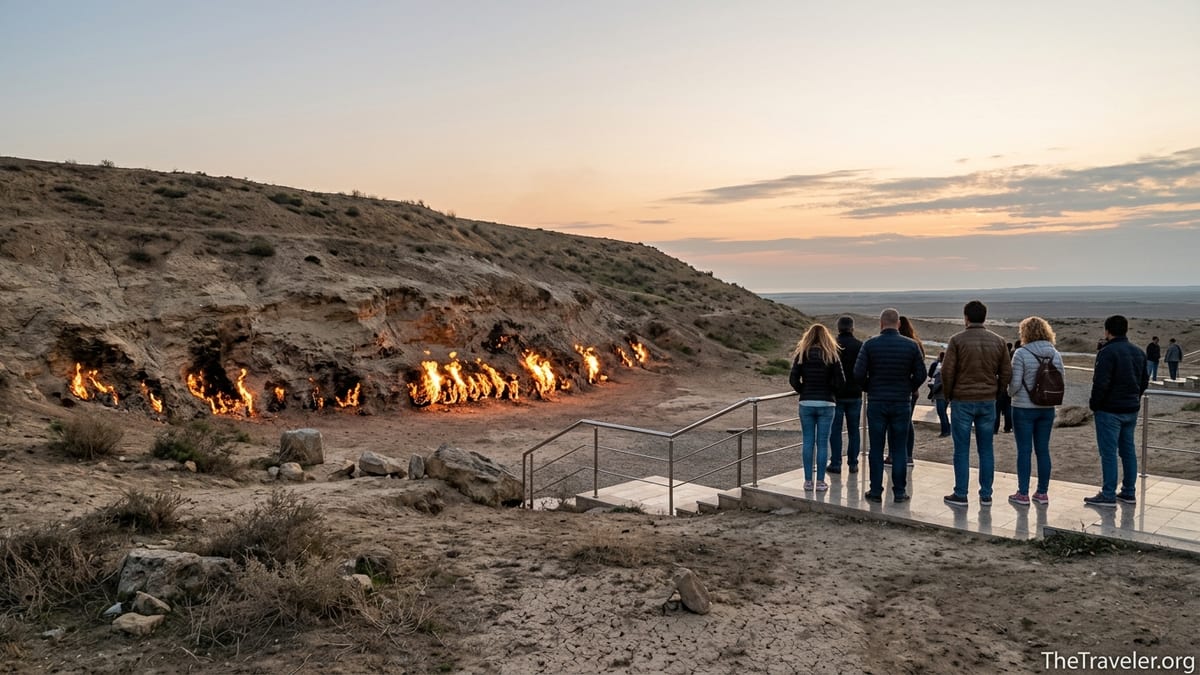
From Ateshgah, many travelers continue to one of Absheron’s defining natural spectacles: Yanar Dag, the so-called Burning Mountain. Here, a line of flames up to a few meters wide licks continuously along a low sandstone hillside, fueled by gas seeping through the rock. Unlike some gas-fueled fires that are fenced off or commercialized into large-scale shows, Yanar Dag still feels surprisingly intimate, especially on cool evenings when locals gather to chat, warm their hands and take photos against the flickering orange light.
The site lies roughly 25 to 30 kilometers north of central Baku, close enough that taxi drivers are accustomed to the request and tour buses arrive steadily throughout the day. The entrance fee for foreign visitors is again modest by international standards, generally a few dollars equivalent. Once inside, there is a paved viewing area, a small museum explaining the geology and cultural history of natural gas flames in the region, and a café where you can sit with tea while watching the fire.
Yanar Dag is particularly atmospheric around sunset. In late spring and autumn, tours often time their arrival so travelers can watch the hillside gradually glow brighter as daylight fades. On clear days, the sky over Absheron shifts from hazy blue to soft pastels while the fire line remains constant, throwing reflections on the polished handrails and stone steps. Photographers often favor a tripod and a slightly slower shutter speed to capture both the flames and the twilight colors without overexposing the scene.
Safety at the site is managed with barriers that keep visitors a safe distance from the flames while still allowing clear views. Children often peer through the railings, fascinated by the idea of a fire that never goes out. Guides fill in the details with anecdotes about shepherds who accidentally ignited gas vents in the past or travelers along the Caspian coast who once navigated at night using the glow from natural flames as reference points.
Medieval Fortresses, Village Life and the Gala Reserve
Absheron is not only a story of fire. The peninsula is dotted with medieval fortifications and traditional villages that reveal how people have lived and traded in this landscape for centuries. Many organized tours make a stop at the Gala State Historical and Ethnographic Reserve, an open-air museum about 40 kilometers from Baku that reconstructs aspects of village life on the peninsula. Wander its stone lanes and you will find traditional houses furnished with carpets and copperware, underground irrigation systems, and exhibits on crafts that sustained Absheron’s settlements.
Beyond Gala, the coastline and interior hide a network of towers and walls that once protected caravan routes and local communities. The Mardakan Fortress, with its tall square tower rising from a circular outer wall, is a favorite stop for history-focused travelers. The structure dates back several centuries and offers a commanding view over the surrounding low-rise houses and scrubland from the top of its narrow staircase. Travelers who climb it on clear days can trace the faint line of the Caspian Sea on the horizon, understanding how strategic this perch once was.
These heritage sites are typically quieter than Yanar Dag or Ateshgah, which is part of their appeal. Ticket prices are similarly low, usually the equivalent of a few US dollars or less. Local children sometimes play in the lanes around the fortresses or ride bicycles across the dusty squares, giving visitors casual glimpses of everyday life that go beyond curated museum exhibits. Stopping at a corner shop for a bottle of ayran or a loaf of fresh bread becomes as memorable as seeing yet another stone wall.
Travelers interested in photography will find Absheron’s villages rewarding. The contrast between weathered limestone houses, corrugated metal roofs and the occasional ultra-modern villa mirrors the economic changes Azerbaijan has experienced in recent decades. Morning light tends to be softer on the pale stone, while late afternoon brings longer shadows and a stronger sense of texture on the fortress walls and cobbled streets.
Oil Fields, Semi-Desert and the Modern Absheron Landscape
Part of Absheron’s fascination lies in how unapologetically industrial and raw it feels compared to the polished streets of central Baku. As you drive out of the city, nodding pump jacks and low oil platforms come into view, reminders that this peninsula helped fuel the early oil boom of the late 19th and early 20th centuries. For some visitors, the sight is jarring; for others, it adds depth to the story of how Baku grew from a port town into a capital shaped by hydrocarbons.
Along certain stretches of road, especially near older extraction sites, you may see rusting equipment and pools of oily water that speak frankly of the environmental costs of rapid industrialization. Newer fields often appear more ordered and regulated, with pipelines and pumping rigs arrayed along fenced perimeters. Guides on day trips sometimes point out locations used in Soviet-era films or talk about how local families once leased small plots of land to foreign oil companies.
Beyond the oil infrastructure, the natural landscape of Absheron has a stark beauty. The semi-desert terrain is dotted with low shrubs and salt-tolerant grasses, punctuated occasionally by small lakes or seasonal wetlands that attract birds. In late spring, wildflowers briefly add ribbons of color along the roadside. From the crest of low hills, the Caspian Sea appears as a silvery sheet, often hazy at the horizon, with offshore platforms barely visible as dark specks.
This industrial and natural mix is not to every traveler’s taste, but it is precisely what sets Absheron apart from more conventionally scenic day trips into the Caucasus Mountains. Here, you are reminded at every turn that Azerbaijan is a country where energy, commerce and ancient beliefs intersect in the same landscape. Spending a day on the peninsula helps put the gleaming Flame Towers and new developments in central Baku into a broader context.
Beaches, Windswept Shores and Seasonal Escapes
While the cultural and geological sites grab most of the attention, the Absheron Peninsula also offers access to the Caspian Sea for those who want a more relaxed day out from Baku. The northern and eastern shores of the peninsula host a string of beaches and resorts where locals escape the summer heat. Some stretches are simple public beaches with basic changing cabins and tea stalls, while others belong to private beach clubs with entrance fees that typically range from the equivalent of 5 to 20 US dollars depending on facilities.
Closer to the city, sections of coast can feel crowded on peak summer weekends, with loud music, jet skis and families picnicking side by side. Farther out toward smaller coastal settlements, the atmosphere is more subdued. Simple fish restaurants serve grilled sturgeon, kutum or other Caspian species, often with fresh herbs, bread and tangy pickles. Travelers pairing a morning visit to Ateshgah with a late lunch at a seaside café get to see yet another aspect of life on the peninsula.
It is worth approaching Caspian swimming spots with realistic expectations. Water quality can vary by location and season, and some beaches are primarily social spaces rather than pristine natural escapes. The sea is usually calm, with gentle waves and a slightly oily feel that reflects its status as an endorheic basin rather than an open ocean. Breezes across the water can provide welcome relief from the dry inland heat, making a beach stop appealing even for those who prefer to stay on the sand.
In shoulder seasons outside of July and August, many beach clubs reduce operations, but the shoreline remains pleasant for walks, photography and watching storms move in across the water. The sight of low clouds over the Caspian, punctuated by the silhouettes of cranes and offshore platforms, reinforces the sense that Absheron is a working coastline rather than a purely recreational one.
How to Plan Your Absheron Day Trip in Practice
Planning an Absheron Peninsula day trip from Baku begins with a simple choice: join a tour or go independently. For many first-time visitors with limited time, a combined tour that includes hotel pickup, transportation, a guide and entrance fees offers the most straightforward experience. These tours commonly run as half-day or full-day excursions, combining Ateshgah, Yanar Dag, Gala and sometimes a stop at a fortress such as Mardakan or at a modern shopping center on the return to Baku.
Independent travelers willing to navigate public transport and local taxis can tailor their own routes. One practical option is to start with the metro to Koroglu or another suburban station, then hail a taxi using a ride-hailing app to reach Ateshgah. From there, negotiate a fare that includes waiting time and onward travel to Yanar Dag, or use separate taxis for each leg. Because distances between major sites are not large, overall taxi costs for a couple or small group can remain competitive with tour prices, especially if shared.
Entrance fees across Absheron’s main attractions remain relatively modest, but it is wise to carry cash in Azerbaijani manat alongside any cards you plan to use. Small cafés, corner shops and some ticket offices may prefer or only accept cash. Dress comfortably for semi-desert conditions: light layers, a sun hat, and footwear suitable for walking across uneven stone surfaces around fortresses or on the steps near Yanar Dag.
Timing your day is perhaps the most important planning decision. A common pattern is to leave Baku after breakfast, explore Ateshgah and a nearby village or museum by early afternoon, then continue to Yanar Dag for sunset before heading back to the city for dinner along the seafront promenade. Travelers visiting in peak summer may prefer the reverse order, starting earlier in the morning at Yanar Dag to avoid heat and finishing under the shade of museum courtyards or at a seaside café.
The Takeaway
What makes the Absheron Peninsula such a compelling day trip from Baku is not a single spectacular site, but the way multiple stories converge within a compact area. In the space of a few hours, you can watch flames dance across a hillside, step into the cells of a centuries-old fire temple, climb a fortress tower above a village and drive past working oil fields that still shape Azerbaijan’s economy. Few destinations so close to a national capital offer this combination of geology, religion, industry and daily life.
For travelers, Absheron provides context. It explains why Baku’s skyline is crowned with towers shaped like flames, why references to fire appear in souvenirs and museum exhibits, and how the city’s rapid development is rooted in a longer history of extracting and harnessing underground energy. At the same time, it offers simple, human moments: shared tea at a roadside stall, children waving near fortress walls, locals warming cold hands by Yanar Dag on a winter evening.
Whether you choose a guided tour or weave together buses and taxis on your own, a day on the Absheron Peninsula can be one of the most rewarding experiences of a visit to Azerbaijan. It demands only a few hours of travel, yet it leaves you with images and impressions that linger far longer than a stroll along any single boulevard or museum corridor in the capital itself.
FAQ
Q1. How far is the Absheron Peninsula from central Baku? The main sights on the Absheron Peninsula, such as Ateshgah and Yanar Dag, are roughly 25 to 30 kilometers from central Baku, usually 40 to 50 minutes away by car in normal traffic.
Q2. Can I visit Ateshgah and Yanar Dag in a single day? Yes. Many travelers combine Ateshgah, Yanar Dag and at least one additional stop like the Gala Reserve or Mardakan Fortress into a single half-day or full-day trip from Baku.
Q3. Is it better to take a tour or visit Absheron independently? Tours are more convenient and include transport and guidance, while independent travel using public transport and taxis can be cheaper and more flexible if you are comfortable navigating on your own.
Q4. Are entrance fees on the Absheron Peninsula expensive? No. Entrance fees to major sites such as Ateshgah, Yanar Dag and local fortresses are generally modest, typically the equivalent of a few US dollars in Azerbaijani manat.
Q5. What is the best time of day to visit Yanar Dag? Late afternoon into sunset is ideal, when temperatures are milder and the natural gas flames become more visually striking against the darkening sky.
Q6. Do I need special clothing or equipment for an Absheron day trip?No special equipment is required, but comfortable walking shoes, sun protection, light layers and a refillable water bottle are recommended due to the semi-desert conditions.
Q7. Is swimming at Absheron’s beaches recommended? Swimming is possible at many beaches, especially in summer, but water quality and facilities vary, so it is wise to seek recent local advice and choose managed swimming areas where available.
Q8. Can I reach Absheron’s main sights by public transport?Public transport can take you close to some sights, but you will usually need to combine it with taxis or ride-hailing services for the final stretches to places like Ateshgah and Yanar Dag.
Q9. Is the Absheron Peninsula suitable for children and families?Yes. Families often enjoy the fire temple, Yanar Dag and the open-air museum at Gala, though parents should supervise children closely near viewing platforms and fortress staircases.
Q10. How much time should I allocate for an Absheron Peninsula trip?A well-planned half-day of five to six hours is enough for the main highlights, while a full day allows a more relaxed pace and time for additional stops such as villages or beaches.