


Look at a map and the Absheron Peninsula seems like an afterthought, a skinny hook of land poking into the Caspian Sea east of Baku. Stand on it, though, and you realize how different it feels from almost anywhere else in Azerbaijan. Within an hour of leaving the manicured boulevards of central Baku you trade glass towers for rusted derricks, city beaches for wild dunes, and polished museums for wind‑scoured shrines where natural gas still seeps from the earth. This contrast, packed into such a compact area, is precisely what sets Absheron apart from other destinations near Baku.
Get the latest updates straight to your inbox!
A Peninsula Where Oil Derricks Meet Wild Nature
The Absheron Peninsula is the setting that made modern Baku possible. As you drive out of the city on the main highway toward villages like Surakhani or Mardakan, you quickly pass fields of rusting pumpjacks and skeletal oil rigs. These remnants of the first oil boom in the late 19th and early 20th centuries still dot the landscape, often just behind new apartment blocks or beside small farms. Nowhere else near Baku do you see this stark juxtaposition of heavy industry and local life quite as intensely as on Absheron.
Yet beyond those industrial belts, the peninsula gradually gives way to semi‑desert steppe and coastal wetlands. Head east into Absheron National Park and the terrain becomes a flat, sandy tongue of land thrust into the Caspian, with hardy shrubs, salt‑crusted ponds and migratory birds rather than oil wells. Hikers who walk the Shahdili Spit at the park’s far end often report not seeing another person for hours, despite being little more than an hour’s drive from central Baku. This mix of industrial heritage and unexpectedly raw nature is not easily replicated in other popular day‑trip areas like the forested mountains around Quba or the historical rock art of Gobustan.
For travelers, this means that a single day on Absheron can shift from photographing an abandoned rig under flocks of gulls to watching gazelles and jackals in the dunes of Absheron National Park. The peninsula feels like a living textbook of how Azerbaijan’s oil story, and its environment, are still unfolding just beyond the capital’s polished core.
Practically, it is also one of the easiest escapes from the city. Local taxi apps frequently quote 25 to 40 manat for one‑way trips to major Absheron sights depending on distance and demand, keeping it accessible to independent travelers who want to explore without joining a group tour.
Fire, Faith and the “Land of Fire” Myth
Many destinations near Baku have ancient history, but Absheron is where Azerbaijan’s “Land of Fire” identity is most tangible. Two of the country’s most iconic sights, Ateshgah Fire Temple and Yanar Dag “Burning Mountain,” both lie on this narrow peninsula and are powered by the same natural gas that once seeped from countless vents here.
At Ateshgah, a stone caravanserai‑style complex at Surakhani, visitors enter a courtyard ringed by cells that once housed traders and pilgrims. In the center stands a small fire altar where a flame burns steadily, now fed by a modern gas line. Interpretive panels explain how, in the 18th and 19th centuries, Zoroastrians and Hindu communities revered the naturally burning gas vents on this spot. Today, you might see local school groups mixing with Indian tourists tracing old spiritual routes, a reminder that Absheron’s gas fields once drew worshippers from across Eurasia rather than only oil engineers.
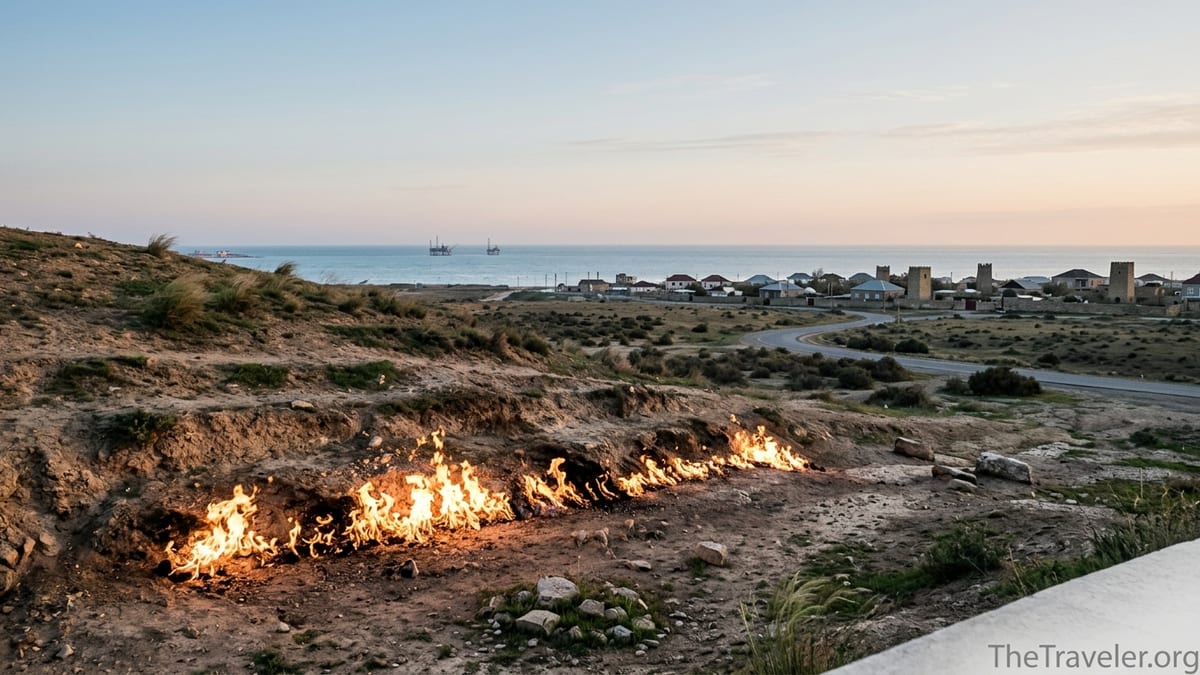
Yanar Dag, on a hillside not far from the village of Digah, offers a different take on the same phenomenon. Here a long, low wall of earth burns continuously, a ribbon of flame licking out of the exposed hillside. Recent upgrades have added a small visitor center, terraced seating and safety barriers, but the scene remains disarmingly simple: bare slope, raw fire and the smell of gas carried by the wind. Unlike a staged light show, the appeal lies precisely in how unadorned it feels, especially at dusk when the flames throw long shadows across the stone terraces.
This kind of elemental spectacle is harder to find in other day‑trip areas around Baku. Gobustan offers petroglyphs and some mud volcanoes, and the mountains to the north showcase alpine scenery, but the combination of continuous natural fire, centuries of documented worship and immediate proximity to the world’s first commercial oil fields is unique to Absheron. For travelers curious about how natural phenomena evolve into myth, religion and then industry, few regions anywhere compress the story as neatly.
Ancient Villages, Open‑Air Museums and Everyday Life
Another way Absheron stands apart from other destinations near Baku is in how densely its everyday villages layer history. In places like Gala, Mardakan and Ramana, medieval fortification towers rise beside modest courtyards, while satellite dishes cling to stone houses built long before television existed. Rather than being isolated archaeological parks far from local communities, many of these sites are woven directly into living neighborhoods.
The Gala Archaeological and Ethnographic Museum Complex, often simply called the Gala Museum, turns this overlap into a curated experience. The open‑air museum, established in the late 2000s, gathers traditional stone houses, underground dwellings, mounds and ancient grave markers from across the Absheron Peninsula and reconstructs them in one walkable space. Travelers wander between a recreated village square, old bread ovens, and pens with local sheep and donkeys, with explanatory signs describing how families stored water, made cheese or defended their homes in centuries past.
What makes Gala feel different from more formal museums in Baku itself is the outdoor, tactile nature of the visit. Children clamber up watchtowers, adults step into low‑roofed rooms to test the cool interior in summer heat, and local vendors sell dried fruits and qutab pancakes just outside the gates. It feels more like exploring a preserved corner of a village than moving through a series of glass cases and labels.
Elsewhere on the peninsula, village life flows around heritage in similarly casual ways. In Mardakan, for instance, the 14th‑century Mardakan Tower rises above gardens and narrow lanes, but locals are just as likely to be buying fresh herbs at a roadside stand as contemplating the tower’s history. This lived‑in quality contrasts with the more delineated tourist experience at places like Gobustan, where the archaeological zone is clearly separated from nearby communities.
From Wild Dunes to Well‑Serviced Beach Clubs
For many Baku residents, Absheron’s main draw is not its history but its coastline. The peninsula wraps the city in a long string of beaches, from simple public stretches used by local families to slick private clubs with imported sand and DJ booths. That variety, combined with sheer proximity, separates Absheron’s seaside from more distant Caspian resorts such as Nabran or Lankaran.
On the northern shores near Bilgah, Nardaran or Mardakan, summertime beach clubs advertise full‑day packages that typically include a sun lounger, umbrella and access to changing cabins and showers. Prices fluctuate with demand and location, but mid‑range clubs often charge in the region of 15 to 30 manat per person for weekday entry, rising on busy weekends. Many also operate cafes or restaurants where a simple lunch of kebabs, salad and a soft drink might cost another 15 to 25 manat. For travelers with limited time in Baku, this makes a lazy half‑day by the sea logistically simple.
Head farther east and south, however, and the tone shifts. Around Absheron National Park, the coast becomes wilder, with wind‑carved dunes, shallow lagoons and stretches where you are more likely to see birdwatchers than beach umbrellas. Swimming is not always advisable because of currents and environmental conditions, and facilities are minimal, so travelers need to bring water, snacks and sun protection. Yet precisely this absence of infrastructure gives the area a sense of solitude that more commercialized spots cannot match.
Compared with other destinations near Baku, Absheron lets visitors choose between a polished, almost Mediterranean beach‑club experience and a raw, wind‑scoured shoreline within the span of a single day. That flexibility, and the ability to adjust your plans according to weather and mood, is a practical advantage for short‑stay visitors.
Mud Volcanoes and Semi‑Desert Landscapes at the City’s Edge
While Azerbaijan’s most famous mud volcano fields sit near Gobustan, the Absheron Peninsula has its own clusters of smaller cones and bubbling mud pits that are easier to reach from central Baku. Driving south toward Lökbatan or west toward the minor volcano fields, you quickly exchange urban sprawl for cracked earth, scrub and low grey mounds that look deceptively solid until you approach and hear the mud gurgling inside.
In several areas, taxi drivers will turn off the asphalt and follow informal tracks to reach compact groups of cones. Conditions vary with recent weather, and there is little in the way of formal signage or safety barriers, so visitors should wear sturdy shoes and be prepared for sticky mud and strong winds. Some local guides pair a short stop at these Absheron mud volcanoes with visits to nearby sights such as the Bibiheybat mosque or the historical Sangachal Caravanserai on the southern edge of the peninsula.
The landscapes here feel more improvised and less curated than in Gobustan’s official mud volcano reserves. That lack of development is part of the appeal for some travelers, who enjoy the sensation of stepping into a quietly surreal badlands only a short drive from their hotel. Others may prefer the clearer paths and interpretive panels available at more established sites farther from the capital.
Either way, Absheron’s semi‑desert environment is a counterpart to the greener mountains and forests in Azerbaijan’s north. Sand, wind and wide skies dominate, and many visitors are surprised at how quickly this harsh, open terrain begins just beyond Baku’s ring of suburbs and industrial zones.
Caravanserais, Soviet Legacies and Industrial Heritage
Beyond its headline sights, Absheron stands out for travelers interested in layers of trade and industry that predate and postdate the oil boom. On the southern fringe of the peninsula near Sangachal village, for example, a restored caravanserai sits astride an old route that once linked Baku with the southern Silk Road corridors toward Salyan and Lankaran. Its thick stone walls enclosed merchants, camel caravans and travelers who could reach it in roughly a day’s journey from the city. Today, wandering its courtyard and vaulted rooms brings home how long Absheron has served as a gateway rather than a dead end.
Overlaying that merchant history is a dense stratum of Soviet‑era infrastructure. Old worker settlements, disused rail spurs and rusted industrial plants still stand near many Absheron villages, sometimes alongside new residential complexes and roadside cafes. Photographers often gravitate toward these half‑forgotten zones, where faded murals and peeling Cyrillic signage hint at an era when the peninsula was one of the Soviet Union’s key energy hubs.
Unlike purpose‑built open‑air museums, these remnants have not been repackaged into neat narratives. A traveler might glimpse an abandoned pumping station from the window of a crowded bus to Mashtaga or see rows of derelict storage tanks in the distance while heading to the beach. The constant, casual presence of such structures makes Absheron feel markedly different from more purely scenic excursions into the Caucasus foothills, where Soviet and industrial traces tend to be more scattered.
This mix of caravan routes, oil infrastructure and post‑Soviet reinvention is visible even in everyday logistics. New motorways, logistics parks and energy facilities continue to spread across the peninsula, so visitors driving between sites often witness Azerbaijan’s current development playing out in real time alongside the ruins of previous economic cycles.
How Absheron Compares to Other Easy Day Trips from Baku
When travelers plan side trips from Baku, Absheron competes with several well‑established options: the UNESCO‑listed rock art and canyons of Gobustan to the southwest, the wine routes of Shamakhi, and the mountain villages in the Greater Caucasus around Quba or Lahij further afield. Each has its own appeal, but Absheron distinguishes itself through proximity, variety and the way modern life intermingles with heritage.
In practical terms, Absheron sights are closer and easier to combine. A typical small‑group tour might visit Ateshgah, Yanar Dag and the Gala Museum in a single six‑hour outing, with hotel pickup and drop‑off in Baku. Trying to bundle Gobustan’s rock carvings, mud volcanoes and a seaside lunch into the same timeframe is possible but more rushed because of longer driving distances. For independent travelers using taxis or ride‑hailing apps, the short hops between Absheron sites keep transport costs moderate and allow for spontaneous detours.
In terms of atmosphere, Gobustan and the northern mountains offer stronger feelings of escape. Their landscapes are more obviously scenic, with dramatic cliffs or lush forests that feel far removed from the capital. Absheron, by contrast, never quite lets you forget that Baku is close. You might watch a sunset at Yanar Dag while faintly seeing the glow of city lights on the horizon, or stand on a village rooftop in Mardakan while supertankers slide along the Caspian offshore. For some travelers this proximity is a drawback, but for others it provides a fascinating front‑row seat to how a modern capital radiates outward.
Culturally, Absheron also keeps its focus on everyday life more than curated performance. You are more likely to see local families picnicking near Ateshgah, teenagers taking photos at a viewpoint or pensioners playing backgammon outside a village shop than organized folklore shows. That modest, unpolished energy, layered over fire temples and oil rigs, is part of what gives the peninsula its distinct character among Baku’s nearby destinations.
The Takeaway
Absheron Peninsula is not the prettiest corner of Azerbaijan, nor the most famous among international travelers. Its beauty is often subtle: a lone tower above flat rooftops, a gust of wind whipping sand across a coastal road, a line of flames burning quietly in the dusk. What makes it different from other destinations near Baku is how many of Azerbaijan’s defining stories collide here in a relatively small area.
Within an hour’s drive you can move from sacred fire temples to Soviet‑era oil fields, from reconstructed ancient villages to raw mud volcanoes and semi‑desert national parkland. You can spend your morning tracing caravan routes at Sangachal, your afternoon sunbathing at a beach club near Bilgah, and your evening watching the eternal fire at Yanar Dag. Few other day trips from Baku offer this breadth of experience without demanding long drives or complex logistics.
For travelers who want their time around Baku to reveal more than a single postcard image, Absheron is a compelling choice. It offers not just sights but perspective: on how natural gas shaped faith and industry, how villages adapt around ruins, and how a capital city still leans on the narrow peninsula that first powered its rise. Those layered, sometimes contradictory impressions are what linger after you return to the polished streets of central Baku.
FAQ
Q1. How far is the Absheron Peninsula from central Baku?
The peninsula effectively begins at the edge of Baku, and major sights like Ateshgah or Gala are usually 30 to 40 minutes by car from the city center in normal traffic.
Q2. Can I visit Absheron Peninsula sights without joining a tour?
Yes. Most key locations are reachable by taxi or ride‑hailing apps, and many travelers arrange a private driver for several hours to combine multiple stops in a single day.
Q3. How much time do I need to see the main Absheron highlights?
A full‑day outing of 7 to 9 hours is enough to visit Ateshgah, Yanar Dag, the Gala Museum and at least one beach or viewpoint, with time for lunch in between.
Q4. Is Absheron Peninsula suitable for families with children?
Yes, but planning matters. Children usually enjoy the open‑air exhibits at Gala, the flames at Yanar Dag and time on the beach, while mud volcano areas and semi‑desert hikes require closer supervision.
Q5. What is the best season to visit the Absheron Peninsula?
Late spring and early autumn are generally most comfortable, as summer heat and wind can be intense and winters feel raw and damp along the coast and semi‑desert.
Q6. Are the beaches on Absheron safe and clean for swimming?
Conditions vary. Some private beach clubs maintain cleaner, better‑supervised swimming areas, while more remote stretches may have currents, litter or limited services, so local advice is important.
Q7. Do I need special clothing or gear for Absheron National Park and mud volcano areas?
Sturdy closed shoes, a windproof layer, sun protection and plenty of water are advisable, as surfaces can be uneven or muddy and shade is limited in the semi‑desert terrain.
Q8. Are there restaurants and cafes near the main Absheron attractions?
Yes. Popular spots such as Ateshgah, Yanar Dag and the main beach clusters have nearby cafes or simple restaurants, though options thin out in the national park and remote areas.
Q9. How does Absheron differ from Gobustan as a day trip from Baku?
Absheron is closer, more varied and more intertwined with everyday village and industrial life, while Gobustan focuses on dramatic landscapes, rock art and larger mud volcano fields.
Q10. Is Absheron Peninsula a good choice for photographers?
Yes. The mix of oil infrastructure, village life, historic towers, coastal light, semi‑desert and fire or mud phenomena offers diverse subjects within short driving distances.