


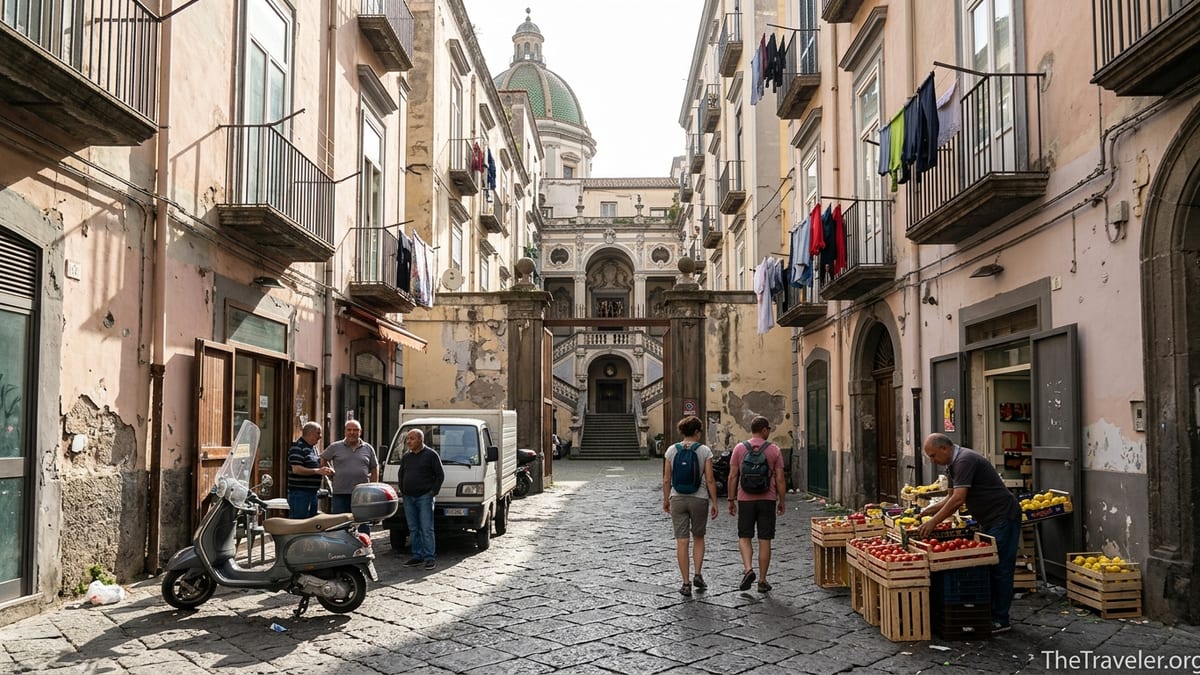
Walk a few blocks north of Naples’ historic center and the mood shifts. Scooters still weave past laundry lines and market stalls, but the crowds thin and voices become more familiar. This is Rione Sanità, once a noble suburb, later a neglected working-class district, and today one of the city’s most compelling neighborhoods. Many visitors rush here for a quick catacomb tour and then head straight back downtown. Those who linger discover something different: aristocratic staircases hidden behind anonymous doors, churches that double as community centers, and tiny kitchens turning out some of the most characterful food in Naples. This guide focuses on the lesser-known corners of Rione Sanità that rarely make it into standard itineraries but reward anyone willing to wander a little further.
Get the latest updates straight to your inbox!
Understanding Rione Sanità Beyond the Stereotypes
Rione Sanità grew up just outside the ancient city walls, in a valley that was once used as a burial ground by Greeks and Romans and later by early Christians in vast catacombs carved into the soft tuff rock beneath the streets. Over time, aristocratic families built grand palaces here, attracted by the healthier air above the crowded center. The result is a curious mix: underground cemeteries below, noble staircases above, all wrapped today in the noise and color of a dense working-class district.
For much of the 20th century, the area was associated with crime and poverty, and many Neapolitans warned visitors away. In the last fifteen years, local cooperatives, churches and residents have pushed for a different story. Community-run tours of the catacombs, cultural projects in abandoned convents, and the careful opening of private courtyards have slowly changed perceptions. You still feel the grit here, but you also sense pride and a strong neighborhood identity that make encounters authentic rather than curated.
Most tourists who do reach Rione Sanità visit the Catacombs of San Gennaro or San Gaudioso and then leave by taxi or bus. Spend a full morning or afternoon instead, and you can walk the main arteries like Via Vergini and Via Sanità, duck into side alleys, and get a feel for daily life: kids playing football in tiny piazzette, neighbors lowering shopping baskets from balconies, and older residents claiming their usual seats outside the bar. The hidden gems of Sanità are not only “sights” but these lived-in scenes that reveal how Naples functions beyond the postcards.
Practically speaking, Rione Sanità is easiest to reach on foot from the National Archaeological Museum area: from Piazza Cavour, walk under the old Porta San Gennaro gate and follow Via Vergini as it narrows into the neighborhood. Mid-morning, around 10:00 or 11:00, tends to be lively but not overwhelming, with markets in full swing and most churches and palaces open.
Palaces Behind Plain Doors: Palazzo Sanfelice and Palazzo dello Spagnolo
From street level, Rione Sanità can seem like a uniform wall of mid-rise apartment blocks, but behind seemingly modest portals lie two of Naples’ most striking Baroque palaces. Palazzo Sanfelice, on Via Arena della Sanità, is the quieter of the pair. Built in the 18th century by architect Ferdinando Sanfelice as his own residence, it features a soaring double staircase that splits and recombines in a theatrical play of arches and light. The façade is worn and the courtyard still lived-in, with bicycles, mopeds and potted plants scattered where carriages once arrived, which only heightens the sense of discovery.
A five-minute walk away, Palazzo dello Spagnolo on Via dei Vergini feels more familiar to architecture buffs but remains largely overlooked by casual visitors. Its nickname, “the Spanish man’s palace,” comes from a later owner, but the star is again Sanfelice’s staircase: a curving, almost sculptural set of ramps stacked around an open courtyard. In the late afternoon, when sunlight filters between the arches and local residents return home, you might see someone carrying groceries up one ramp while kids race down another. Remember that both buildings are private residences; photography in the courtyards is generally tolerated, but be respectful, keep your voice low, and avoid pointing cameras directly into apartments.
Unlike the major museums in central Naples, these palaces generally have no ticket booths or posted hours. Access depends on whether the heavy wooden door is open, usually during the day when residents come and go. If you find it closed, wait a few minutes; a resident may push through and you can slip politely inside the courtyard. A short visit of ten or fifteen minutes is enough to appreciate the architecture before moving on, and combining the two palaces with a stroll along Via Vergini makes a satisfying, low-key morning walk.
Because these staircases have become modest icons of Neapolitan Baroque, some guided neighborhood walks now include them as stops, often combining an architectural explanation with stories about how life inside the palaces has changed. Joining one of these small-group tours can be a good option if you want context and Italian-to-English interpretation that goes beyond what you can glean from a quick look around.
Underground Secrets: Beyond the Famous Catacombs
Most guidebooks mention the Catacombs of San Gennaro, but fewer highlight San Gaudioso, tucked directly beneath the Basilica of Santa Maria della Sanità. Here, early Christian burial chambers from late antiquity mingle with macabre early modern frescoes where skulls are painted atop anonymous bodies, a visual reminder of how the site was reused in later centuries. Small-group guided visits typically last about an hour and are run by a local cooperative, with young guides who grew up in the neighborhood and mix historical facts with personal anecdotes.
If you want a deeper experience, ask about the “Miglio Sacro,” or Holy Mile, a longer route that links the basilica, the catacombs and several nearby sites in one continuous walk. Rather than treating the catacombs as isolated attractions, this itinerary frames them as part of a spiritual and social landscape: the churches above, the palaces on the slopes, and the everyday streets that thread through them. Tours are generally offered on weekends and can sell out, especially in spring and autumn, so advance booking is wise.
Another lesser-known stop for those fascinated by Naples’ relationship with death is the Cemetery of the Fontanelle, an ossuary in a cave-like former quarry on the edge of Rione Sanità. Inside, thousands of skulls and bones are arranged on shelves and in niches, remnants of past plagues and famines. For centuries, residents practiced the “anime pezzentelle” cult here, informally adopting anonymous skulls, cleaning them, and praying for their souls in exchange for protection. Today the site’s opening hours can vary, sometimes changing within the year; it is worth asking locally or checking the latest information before making a dedicated trip.
Because these underground spaces can feel intense, especially the ossuary, consider pairing them with an unhurried wander on the surface afterward: sit in a café, watch daily life in a small piazza, and give yourself time to process. Carry a light jacket even in summer, as temperatures below ground stay noticeably cooler and floors can be damp. Closed shoes with good grip are advisable; flip-flops are not ideal on tuff steps polished by centuries of use.
Churches as Community Anchors
Rione Sanità’s churches are more than repositories of art; many function as informal community centers, especially for children and older residents. The Basilica of Santa Maria della Sanità, easily recognized from its green-tiled dome that rises above the neighborhood, is a good place to start. Inside, Baroque decoration glows in filtered light, but if you linger before or after mass you will also notice volunteers organizing activities, from catechism classes to after-school programs. The basilica’s sacristy doubles as the access point to the catacombs below, further blurring the line between sacred space and historical site.
A short walk away along the narrow streets is the Church of Santa Maria dei Cristallini, which reopened to visitors after a long restoration. From the modest street entrance, you descend into a compact complex of hypogea, early underground burial chambers decorated with faded frescoes. Visitor numbers are limited and visits usually require booking, often with a local guide who unlocks the gate and accompanies small groups. Because it remains under the radar, this site offers a quieter, more intimate glimpse into Naples’ ancient funerary world than the better-known catacombs.
Equally atmospheric, though entirely above ground, are the many small shrines known as “edicole votive” that dot the neighborhood. You will see them set into walls at street corners or beside staircases: glass-fronted boxes filled with candles, plastic flowers, and images of the Madonna or local saints, sometimes with fairy lights powered by a tangle of improvised wires. Many were originally installed centuries ago to bring literal light to dark alleys; today they still serve as focal points for prayer and neighborhood gossip alike. If you pause respectfully, you may find locals happy to explain the stories behind their favorite shrine.
When visiting these religious spaces, dress modestly by local standards: shoulders covered and shorts at least to mid-thigh are appreciated, especially if you plan to step inside churches rather than merely peek from the doorway. Donations, even just a few coins, help support ongoing restoration and social projects that many parishes run in cooperation with neighborhood associations.
Everyday Life: Markets, Alleys and the Ghost of Totò
To feel the pulse of Rione Sanità, follow Via Vergini and Via Sanità during the morning market hours. Greengrocers pile Sicilian oranges and tomatoes in bright pyramids, fishmongers display silvery anchovies and small octopus on crushed ice, and vendors shout daily specials over the buzz of scooters squeezing past. Prices are generally lower than in the city’s more touristy areas, and you can pick up fruit for a picnic or ask for a small bag of olives or taralli to nibble as you walk.
Detour into side alleys like Via Santa Maria Antesaecula, where the comedian Totò, one of Naples’ most beloved cultural figures, was born in the late 19th century. The building associated with his childhood is not a formal museum and opens fully to the public only on a few commemorative days each year, but murals, plaques and small shrines dedicated to him appear around the neighborhood. Even without going inside, walking these streets gives a sense of how densely packed and modest the housing was for families who later became national icons.
Because Sanità remains a residential district first and foremost, visitors should move with the awareness that they are guests in someone’s daily life. Ask before photographing people, avoid blocking building entrances, and keep valuables out of sight, as you would in any busy southern European city. Stories of the area’s rougher years linger, but today you are more likely to encounter a teenager asking where you are from than anything threatening, particularly if you stick to the main streets and visit in daylight.
For a different perspective, climb the stairways that rise toward the Capodimonte area. Even a short ascent rewards you with oblique views across tiled domes, rooftop terraces, and laundry-strung alleys toward Vesuvius. Late afternoon, when the sun drops behind the surrounding hills and the sky softens to pastel, is an especially evocative time to see the neighborhood transitioning from market bustle to evening social life.
Eating and Drinking Where the Locals Do
Rione Sanità has quietly become one of Naples’ most interesting food neighborhoods, not because of flashy restaurants but thanks to small, often family-run places responding to a largely local clientele. At modest trattorias on and around Via Sanità, you might find a lunch menu featuring pasta e patate con provola, a thick pasta and potato soup enriched with smoked cheese, or genovese, a slow-cooked onion and beef sauce served over pasta. Portions tend to be generous and prices moderate compared with more central districts. It is common to pay a modest amount for a substantial plate of pasta, a glass of house wine, and a coffee at the end.
For a quick bite, look for tiny storefronts selling fried snacks: cuoppi filled with mixed fried seafood or vegetables, crocchè (potato croquettes with cheese), and frittatine di pasta, cubes of fried pasta in béchamel. These are popular with students and workers on their lunch break and make an ideal on-the-go snack between visits. If you see a short queue that includes postal workers, construction crews and older locals, that is usually a good sign.
Sweet-toothed travelers should keep an eye out for neighborhood pastry shops turning out classic Neapolitan sfogliatelle, rum babà and seasonal treats around holidays. Many of these bakeries serve espresso at the counter, where you can stand shoulder-to-shoulder with regulars for a quick coffee and pastry instead of sitting at a table. In the late afternoon, bars along the main streets fill with people enjoying a spritz or a simple beer outdoors; the scene feels noticeably more local than in the Spanish Quarter or by the seafront.
If you are curious about the intersection of food and social activism, consider contacting a local cooperative that offers walking tours combining history with tastings at small vendors. Some groups based around the catacombs have experimented with itineraries that include stops for street food or simple home-style dishes while guides explain how tourism revenue is reinvested in youth programs and job training within the neighborhood.
Planning Your Visit Safely and Respectfully
Rione Sanità rewards unstructured wandering, but a little planning goes a long way. Aim to arrive in the morning or early afternoon when markets, churches and catacombs are open and the streets are busiest. Evening visits can be atmospheric, especially around church festivals, but first-time visitors may feel more comfortable getting to know the layout by day. If you plan to include the catacombs or the Cemetery of the Fontanelle, check current opening times and whether advance booking is required for guided visits, as schedules may shift from season to season.
From central Naples, you can walk to Rione Sanità in about 15 to 20 minutes from the Archaeological Museum area, mostly downhill when entering the neighborhood. Public buses run along Via Santa Teresa degli Scalzi and Via Foria, skirting the edges of Sanità, while taxis and app-based rides are easy to arrange for the return if you prefer not to walk back uphill. Traffic in the narrow streets is hectic, so give scooters plenty of room and avoid stepping into the roadway while distracted by photos or shop displays.
Dress for comfort rather than style: cobbled streets and steep stairways mean sturdy shoes are far more useful than delicate sandals. In warmer months, a hat and water bottle will make longer walks more pleasant, while in cooler seasons the valley can feel damp and chilly in the shade. As in any busy urban neighborhood, keep bags closed and carry only what you need for the day; petty theft is not rampant but does occur, particularly in crowded market areas.
Most importantly, approach interactions with openness and courtesy. A simple “buongiorno” as you enter a small shop, or a “permesso” as you edge past people chatting in a narrow lane, goes a long way. Many residents are curious about visitors and proud to see their neighborhood appreciated, and you may find yourself receiving impromptu recommendations for the best coffee bar or the quietest corner to sit and watch the world go by.
The Takeaway
Rione Sanità is not a polished open-air museum. Its facades peel, scooters roar, and daily life can feel chaotic to outsiders. Yet that same roughness shelters some of Naples’ most evocative spaces: aristocratic staircases forgotten behind plain doors, early Christian tombs beneath parish churches, improvised shrines glowing in shadowy alleys, and family kitchens serving dishes that rarely appear on tourist menus. Visiting here offers a chance to see how the city’s layers of history, faith and survival coexist in a single, compact neighborhood.
Give Rione Sanità at least half a day, ideally a full one, and let your time unfold between headline sights and small discoveries. Walk from palace courtyard to market stall, from underground catacombs to rooftop views, following curiosity as much as any fixed plan. In doing so, you will encounter not only hidden gems in the conventional sense but also the everyday rhythms that make this valley of the living one of Naples’ most rewarding detours.
FAQ
Q1. Is Rione Sanità safe for travelers to visit?
Rione Sanità has a complicated past but has improved significantly in recent years thanks to community projects and increased visitors. During daylight hours, especially along main streets like Via Vergini and Via Sanità, most travelers find it feels lively rather than threatening. Normal big-city precautions apply: keep valuables out of sight, avoid isolated alleys after dark, and stay aware of scooters in narrow streets.
Q2. How much time should I plan for Rione Sanità?
If you only visit one set of catacombs and stroll the main streets, you can get a taste of the neighborhood in about three hours. To explore more slowly, include both the catacombs and Cemetery of the Fontanelle, visit at least one palace courtyard, pause for lunch or coffee and wander side streets, plan on a half day or a full day.
Q3. What is the best way to reach Rione Sanità from central Naples?
Many visitors walk from the National Archaeological Museum or Piazza Cavour, entering through Porta San Gennaro and following Via Vergini into the heart of the neighborhood. The walk takes around 15 to 20 minutes. Buses run nearby along Via Foria and Via Santa Teresa degli Scalzi, and taxis are a straightforward option if you prefer door-to-door travel.
Q4. Do I need to book tickets in advance for the catacombs?
For the Catacombs of San Gennaro and San Gaudioso, advance booking is increasingly recommended, especially on weekends and in peak seasons such as spring and early autumn. Same-day spots are sometimes available, but tours have limited capacity. If you know your travel dates, reserving online a few days ahead gives more flexibility in choosing time slots.
Q5. Is the Cemetery of the Fontanelle currently open to the public?
Opening policies at the Cemetery of the Fontanelle have changed several times in recent years for conservation and safety reasons. Before planning a dedicated trip, ask locally at your accommodation, check recent visitor reports, or inquire at one of the catacomb ticket offices in Rione Sanità to confirm current access and hours.
Q6. Are there guided tours that cover the whole neighborhood, not just the catacombs?
Yes, several local cooperatives and associations offer walking tours that combine visits to the catacombs with palaces, churches and everyday streets. One popular option is a “Holy Mile” route linking the Basilica of Santa Maria della Sanità, the catacombs and key spots in the neighborhood. These tours often include social and historical context that you might miss exploring alone.
Q7. What should I wear when visiting churches and underground sites?
Comfortable closed shoes with good grip are important for cobbled streets and damp stone steps underground. For churches and catacombs, it is respectful to cover shoulders and avoid very short shorts. Even in summer, consider bringing a light layer for cooler temperatures below ground.
Q8. Can I visit Palazzo Sanfelice and Palazzo dello Spagnolo inside?
Both palaces are residential buildings without formal museum-style opening hours. Visitors are usually allowed to enter the main courtyard and view the staircases when the entrance doors are open, but apartments and upper levels are private. Photography is generally tolerated in common areas if you are discreet and considerate of residents.
Q9. Are there good places to eat in Rione Sanità or should I return to the center?
Rione Sanità has a growing number of excellent, mostly informal options, from family-run trattorias serving classic Neapolitan dishes to tiny shops specializing in fried street food or pastries. Prices tend to be moderate and the atmosphere distinctly local. Unless you are seeking fine dining, there is no need to leave the neighborhood to eat well.
Q10. Is Rione Sanità suitable for travelers with limited mobility?
The neighborhood’s steep streets, frequent staircases and uneven cobblestones can be challenging for visitors with limited mobility or those using wheelchairs. Some catacomb areas and palace courtyards may involve steps or narrow passages. If mobility is a concern, consider contacting tour organizers or specific sites in advance to ask about accessible routes and support options.