


I arrived in Rione Sanità with the same vague warnings many travelers hear about Naples: that it is chaotic, messy, maybe even a little dangerous once you stray from the polished historic center. What I found instead was one of the most disarmingly authentic neighborhoods I have encountered in Europe, a place where centuries of history, social struggle and everyday Neapolitan life spill out together onto the same cramped streets. The rawness is real, but so is the warmth, the beauty and the sense of a community that has decided to reclaim its own story.
Get the latest updates straight to your inbox!
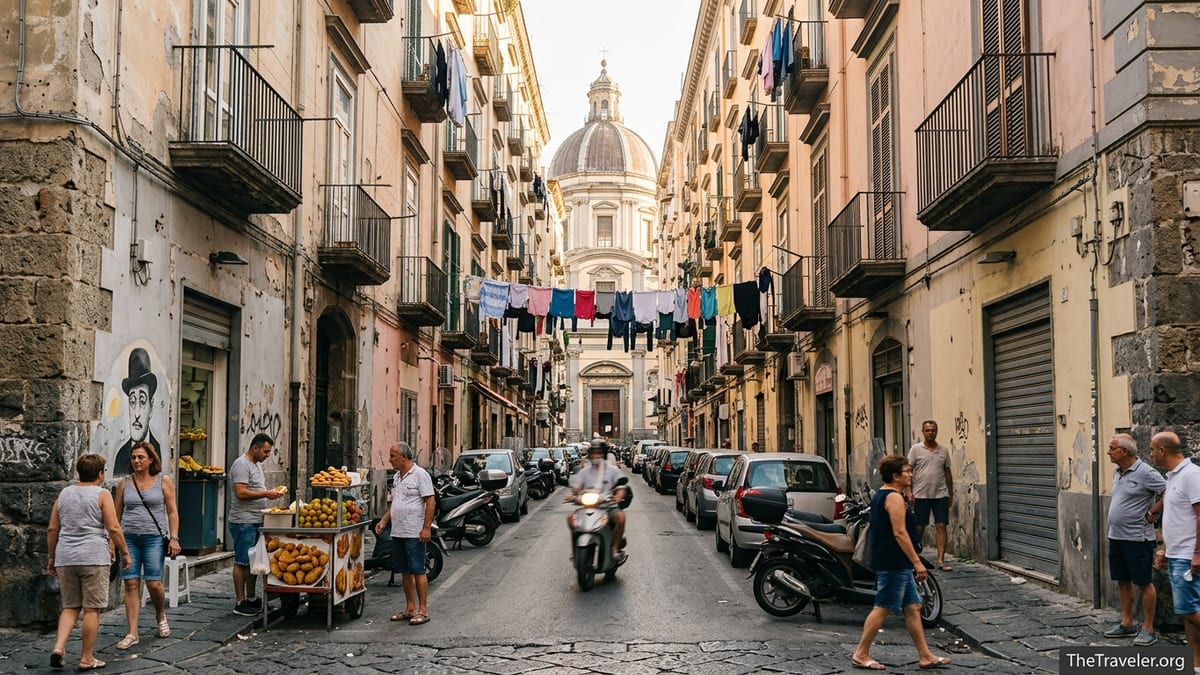
First Impressions: A Valley Of Laundry, Scooters And Voices
My first glimpse of Rione Sanità came as I stepped through Porta San Gennaro, the old city gate that once marked the northern entrance to Naples. Almost immediately, the city changed texture. The streets narrowed, scooters threaded past with inches to spare, and a tangle of laundry lines turned the sky into a patchwork of shirts and bedsheets. Compared with the grand piazzas around Via Toledo, La Sanità felt like a different Naples entirely, less curated, more lived-in.
It was the noise that surprised me most. Vendors called out prices for tomatoes and eggplants at makeshift stalls, kids chased footballs between parked cars, and the low rumble of conversation floated down from balconies. At a corner bar, a group of older men watched a football match on a tiny TV, arguing in Neapolitan dialect that barely resembled the Italian I had studied. The neighborhood’s reputation as gritty felt accurate, but it was not menacing so much as intensely alive.
What I did not expect was how quickly I would feel folded into this everyday theatre. When I paused to figure out the way to Piazza Sanità, a woman in her slippers, leaning on a balcony railing above me, shouted down directions and ended by asking where I was from. By the time I reached the square, a fruit seller had pressed a ripe fig into my hand “to taste Neaples properly,” as he put it in broken English, refusing my attempt to pay.
That combination of visual chaos and spontaneous kindness is the essence of Rione Sanità’s raw authenticity. The neighborhood is not performing for visitors. It is simply carrying on with its life, and if you happen to be walking through, you are temporarily part of it.
Walking On Centuries Of Death And Devotion
What really reshaped my sense of the neighborhood was realizing how much of Rione Sanità exists beneath your feet. For centuries this valley was a necropolis, a place of tombs and catacombs stretching under the modern streets. The name “Sanità” itself hints at health and salvation, a reminder that this was once considered a spiritually powerful place to be buried.
The Basilica of Santa Maria della Sanità is the most visible symbol of that history. Outside, it rises above Piazza Sanità with a baroque facade that, while worn by time and pollution, is still imposing. Inside, the church is unexpectedly light and airy, with an almost theatrical dome and side chapels decorated in a style that feels more Spanish than Italian, a reminder of the city’s long period under Spanish rule. Yet the most striking detail is not a painting or altar, but a simple staircase: a stone descent in the floor that leads from the polished basilica straight down into the darkness of the Catacombs of San Gaudioso.
On the guided tour, which costs roughly the same as a simple lunch in the city, you step back to the 4th and 5th centuries. The tunnels are dug into tuff, the soft volcanic rock that underpins Naples. Faded frescoes and carved niches still mark where early Christians were buried. Later, in the 17th century, a more macabre tradition emerged: skulls of the deceased were placed into the walls, while their bodies were painted beneath in the uniforms or dresses that indicated their social status. Walking past these half-real, half-painted figures, with scooters buzzing somewhere overhead, is a jarring reminder of how thin the line between past and present is here.
Nearby, the larger Catacombs of San Gennaro and the paleo-Christian basilica of San Gennaro extra Moenia form part of the so-called “Holy Mile,” a route linking churches and underground sites from the neighborhood toward Capodimonte. Today many visitors follow it on a guided walk led by local cooperatives. The fact that the same young people who once might have left the area now work as guides and custodians of these catacombs says a great deal about how Rione Sanità is rewriting its relationship with its own past.
From Neglect To Regeneration: A Neighborhood Reclaims Itself
For a long time, Rione Sanità was a place many Neapolitans warned visitors to avoid. Cut off from the rest of the city by traffic-heavy roads and steep slopes, it felt physically and socially isolated. Historic palazzi decayed, churches remained closed, and the only headlines the district generated were about crime and poverty. That legacy has not magically vanished, and visitors still see signs of struggle in the crumbling facades and improvised repairs.
What makes the neighborhood compelling today, however, is how visibly it is changing from within. Much of the transformation began around the early 2000s, when the parish of Santa Maria della Sanità and a group of local youths started cleaning and reopening the catacombs. Their work eventually grew into the cooperative that now manages visits to San Gennaro and San Gaudioso, reinvesting revenue into cultural and social projects in the area. When you buy a ticket for a tour, you are not just paying for access to a historic site; you are contributing to a very local experiment in community-led regeneration.
Walking through the streets, you can see the results in small but telling details. A former Dominican cloister next to the basilica has been repurposed as simple guest accommodation, providing jobs and giving travelers a way to stay in the neighborhood instead of only passing through for a day trip. An abandoned 18th-century church has become the Nuovo Teatro Sanità, where young actors rehearse contemporary plays beneath flaking frescoes. On some evenings, locals who once considered theatre something “for others” now line up to watch performances set in their own streets, spoken in their own dialect.
It is not polished, and that is exactly the point. Rione Sanità has not been gentrified into a postcard district of boutiques and design hotels. Instead, it feels like a community trying to carve out opportunity while holding on tightly to its identity. That tension between vulnerability and pride is part of what makes the area feel so profoundly real.
Street Art, Shrines And Everyday Beauty
Another surprise was how much contemporary art is embedded in the fabric of Rione Sanità. The neighborhood’s walls are layered with graffiti tags, yes, but also with carefully planned murals that tell stories about the city’s cultural heroes. Near Porta San Gennaro, a large portrait of the actor Totò, the neighborhood’s most famous son, looks down over the street with exaggerated comic solemnity. Elsewhere, you find tributes to filmmaker Massimo Troisi and playwright Eduardo De Filippo, their faces rendered in soft, weathered tones that blend into the peeling plaster.
These murals are not isolated art projects dropped into a neighborhood for tourists. They are linked to ongoing efforts by local associations to use culture as a tool of social renewal. Some depict scenes from Neapolitan films shot in the area; others reference neighborhood tragedies, such as the statue and artworks dedicated to a local teenager killed by stray gunfire, now transformed into a symbol of collective memory and resistance. Standing in Piazza Sanità, you can trace a kind of emotional map of the community in the faces painted around you.
Layered among the murals are dozens of small religious shrines, the edicole votive that are such a defining feature of Naples. Some are elaborate, with glass cases framing statues of the Madonna draped in artificial flowers and electric candles flickering beside football-team stickers. Others are simple, a laminated image nailed to the wall above a basket of plastic roses. I watched an elderly woman stop at one corner shrine on her way back from the market, make the sign of the cross, and then continue on with her grocery bags. These gestures, repeated countless times a day, give the area a sense of spiritual continuity that no museum could replicate.
Even the laundry lines have a kind of accidental artistry. On one balcony, baby clothes fluttered next to a Napoli football scarf; on another, a neatly arranged row of white shirts hung above a smoking pizza oven on the ground floor. As you walk, the smell of detergent mixes with frying anchovies and espresso. It is messy, unplanned beauty, the kind that would disappear if the neighborhood were tidied up too much.
Eating Your Way Through La Sanità
Food is at the heart of life in Rione Sanità, and it is one of the clearest ways visitors can experience the neighborhood’s authenticity. Rather than polished, design-forward restaurants, you find family-run spots where the decor may be basic but the flavors are deeply rooted in local tradition. Prices reflect this too. A slice of classic Neapolitan pizza folded to go, bought from a neighborhood pizzeria and eaten on the street, can cost less than an espresso in some northern European capitals.
One of my most vivid memories is stepping into a tiny pastry shop near Piazza Sanità on a weekday morning. The counter was piled high with sfogliatelle, rum-soaked babà and trays of simple brioche. Locals came in and out in a practiced rhythm, ordering a caffè and a pastry, chatting with the staff, and disappearing again in a matter of minutes. I chose a still-warm pastry filled with sweetened ricotta and a cappuccino served in a chipped cup. The bill was modest, but the sensation of eating something that tasted exactly like it had been made for regulars, not for visitors, felt priceless.
Street food is another way the neighborhood’s character comes through. On Via Sanità, carts sell paper cones of fried delicacies: potato crocchè, rice arancini, zucchini blossoms in a crisp batter. People eat them standing at tall metal tables or perched on steps, chatting in rapid bursts of Neapolitan. It is noisy, informal and a little greasy, but it is also a genuine snapshot of how people here actually eat, especially in the evenings when the heat starts to lift.
Even in more sit-down settings, the menus are grounded in tradition. Expect plates of pasta with ragù cooked for hours, local greens sautéed with garlic and chili, and simple fish dishes when the day’s catch has been good. Portions tend to be generous, and staff often slip in an extra taste of something “alla casa” simply because you showed interest in the food or the neighborhood’s story. Eating here is less about ticking off famous restaurants and more about accepting the invitation to share the daily table of a working-class district.
Practical Realities: Safety, Sensitivity And How To Experience It
Given its history, it is natural to wonder how safe Rione Sanità feels today. The answer is nuanced. This is not a polished tourist quarter, and visitors will notice signs of economic hardship: peeling buildings, overflowing rubbish on some corners, clusters of young people hanging around with nothing obvious to do. Yet during daytime and early evening hours, the atmosphere when sticking to main streets like Via Sanità and the area around the basilica generally feels more like a tight-knit community than a threatening zone.
Locals themselves often say that the biggest safety risk for visitors is the traffic. Scooters weave between pedestrians, and crossings are more a suggestion than a rule. Walking with awareness, avoiding dark, empty side alleys late at night, and keeping valuables out of sight are sensible precautions, just as in any large southern European city. Many travelers now join guided walking tours organized by local cooperatives or independent guides, both to support the neighborhood economy and to gain context that is not obvious if you are wandering alone.
Respect is just as important as common sense. Rione Sanità is still a place where people work, struggle and grieve, not an urban safari. Pointing cameras into apartment windows or photographing people without permission, especially in small markets or near shrines, is understandably resented. A simple “Posso?” before raising your phone, or even just a nod and a smile, goes a long way. If someone says no, accept it and move on. The same goes for conversations about crime or poverty: curiosity is natural, but reducing the neighborhood to its darkest stereotypes is exactly what many residents are fighting against.
Allow yourself time. Rione Sanità is not a quick box to tick between the Archaeological Museum and the waterfront. Spending at least half a day, or better a full one, lets you explore the catacombs, linger over coffee, and perhaps sit through a rehearsal at the neighborhood theatre if doors are open. Some travelers now choose to base themselves here for a few nights, staying in simple guesthouses run by locals. Waking up to the sounds of the neighborhood, rather than just glimpsing it for two hours on a tour, brings its authenticity into even sharper focus.
The Takeaway
What surprised me most about Rione Sanità was not its reputation for toughness or its visible scars, but the way these coexist with an almost stubborn humanity. This is a neighborhood that began as a city of the dead, a valley of tombs and catacombs, then became a symbol of urban neglect, and is now cautiously, imperfectly, reinventing itself through the energy of its own residents. The baroque basilicas and ancient burial sites are extraordinary, yet it is the everyday scenes that linger most in memory: a grandmother calling down from a balcony, kids riding bikes between murals of Totò, a barista insisting you taste the house pastry “because here we do it like this.”
Naples as a whole is often described as raw, but in Rione Sanità that rawness takes on a very specific flavor. It is the rawness of a place that has not been smoothed over for visitors, that still carries its contradictions and challenges in plain sight, and that invites you, if you are willing to look closely and respectfully, to witness both its pain and its pride. Travelers who come expecting a sanitized version of Italy may be discomforted. Those who come looking for the complicated, beating heart of Naples will find it here, in these crowded streets where the past is buried just a few steps below the present.
FAQ
Q1. Is Rione Sanità safe for travelers to visit during the day?
Rione Sanità is a working-class neighborhood that can look rough around the edges, but during the day and early evening main streets and key sights are generally fine for visitors who use normal city awareness. Many travelers feel more comfortable joining a guided tour with local organizations, especially on a first visit.
Q2. How do I get to Rione Sanità from central Naples?
Most visitors walk from the historic center, entering through Porta San Gennaro near the Archaeological Museum and continuing along Via Sanità into the heart of the neighborhood. Taxis and ride-hailing services are also options if you prefer not to navigate the busy streets on foot at first.
Q3. What are the must-see sights in Rione Sanità?
The Basilica of Santa Maria della Sanità and the Catacombs of San Gaudioso are essential, as are the Catacombs of San Gennaro and the church of San Gennaro extra Moenia. Many visitors also seek out Palazzo Sanfelice, street art murals dedicated to figures like Totò, and small local shrines and markets.
Q4. Do I need to book catacomb tours in advance?
Advance booking is recommended, especially in high season or on weekends, because tours are guided and group sizes are limited. Same-day tickets may be available in quieter periods, but reserving ahead helps you choose your preferred time and language.
Q5. What should I wear when visiting the churches and catacombs?
Dress comfortably but respectfully. Shoulders and knees should ideally be covered in churches, and layers are useful because the catacombs are cool and slightly damp even in summer. Closed, non-slip shoes are best for walking on uneven stone floors.
Q6. Can I stay overnight in Rione Sanità or is it just a day-trip area?
You can stay overnight. There are a handful of small guesthouses and B&Bs, some run out of historic buildings like former cloisters. Accommodation is generally simple rather than luxurious, but staying locally allows you to experience the neighborhood’s rhythm beyond the typical tour times.
Q7. Are there good places to eat in Rione Sanità?
Yes. You will find traditional pizzerias, trattorias serving classic Neapolitan dishes, and popular pastry shops known for local specialties. Prices tend to be moderate compared with more touristy areas, and many places cater primarily to locals, which keeps the food honest and portions generous.
Q8. Is Rione Sanità suitable for children and families?
Families often enjoy the neighborhood, particularly the sense of street life and the adventure of visiting the catacombs. However, parents should be prepared for heavy traffic, noisy streets and many stairs. A baby carrier is usually more practical than a stroller, and children need close supervision around busy roads.
Q9. How much time should I plan for a visit to Rione Sanità?
A minimum of half a day allows you to see a catacomb, visit the main basilica and wander a few streets. To explore more calmly, perhaps joining a guided walk, having a sit-down meal and visiting multiple sites, a full day is ideal.
Q10. What is the best way to be a respectful visitor in Rione Sanità?
Keep in mind that you are walking through people’s homes, not an open-air museum. Ask before photographing individuals, avoid intrusive behavior around shrines and private courtyards, dress modestly in religious spaces, and support local businesses and community-led tours so your visit contributes positively to the neighborhood.