


Many visitors arrive in Naples, head straight for Spaccanapoli and the seafront, and never cross the bridge into Rione Sanità. Locals still joke that the neighborhood sits “under” the city, both literally and in reputation. Yet to skip Rione Sanità is to miss one of Naples’ most revealing districts, a place where underground catacombs, faded aristocratic palaces and a gritty but warm street life tell the story of the city more honestly than any postcard panorama.
Get the latest updates straight to your inbox!
From Valley of the Dead to Beating Heart of Naples
Rione Sanità has always stood a little apart from Naples. In Roman and Hellenistic times, this valley outside the city walls was a necropolis filled with rock-cut tombs and underground burial chambers. The early Christian catacombs of San Gennaro and San Gaudioso still thread beneath the modern streets, reminders that this was once known as the Valley of the Dead. Today, scooters roar past shrines and laundry lines hang above old hypogea, but the sense of deep time is everywhere.
The neighborhood changed dramatically in the 17th and 18th centuries, when noble families began building grand palaces here to escape the crowded old center. Their Baroque and Rococo mansions, including Palazzo Sanfelice and Palazzo dello Spagnolo, turned Sanità into a fashionable address. That aristocratic phase did not last. In the 19th century a high bridge was driven straight across the valley to speed traffic toward the new royal palace at Capodimonte. The bridge severed Sanità from the rest of Naples, funneling cars above and leaving the streets below in relative isolation.
Over time, Rione Sanità slid from aristocratic enclave to working-class quarter and acquired a reputation for poverty and crime. For decades, even many Neapolitans hesitated to cross the bridge unless they had family here. What has changed in the last fifteen years is a quiet, citizen-led revival. Local associations have reopened catacombs, launched social cooperatives and invited visitors to discover a different side of the district. Walking its alleys today, you notice both the scars of neglect and the pride of residents determined to reclaim their streets.
For travelers, this evolution matters. Sanità is still a real neighborhood, not an open-air museum. You will not find designer boutiques or manicured piazzas. Instead you get kids kicking footballs under 18th-century arches, nonnas shelling peas in doorways, and church bells echoing over the shouts of market sellers. It is precisely this mix of history and unvarnished everyday life that makes the district one of Naples’ most fascinating places to explore.
Walking Under the Bridge: First Impressions and Street Life
Most visitors enter Rione Sanità by crossing the Ponte della Sanità, the high stone bridge also known as the Maddalena Cerasuolo bridge. On one side lies the broad, traffic-choked Via Santa Teresa degli Scalzi, on the other a drop into a dense tangle of low-rise buildings, domes and rooftop water tanks. Descending the ramps or stairs, you feel the atmosphere shift almost immediately: the air smells of frying dough, tomato sauce and exhaust; radios blast Neapolitan pop; conversations spill from balconies above your head.
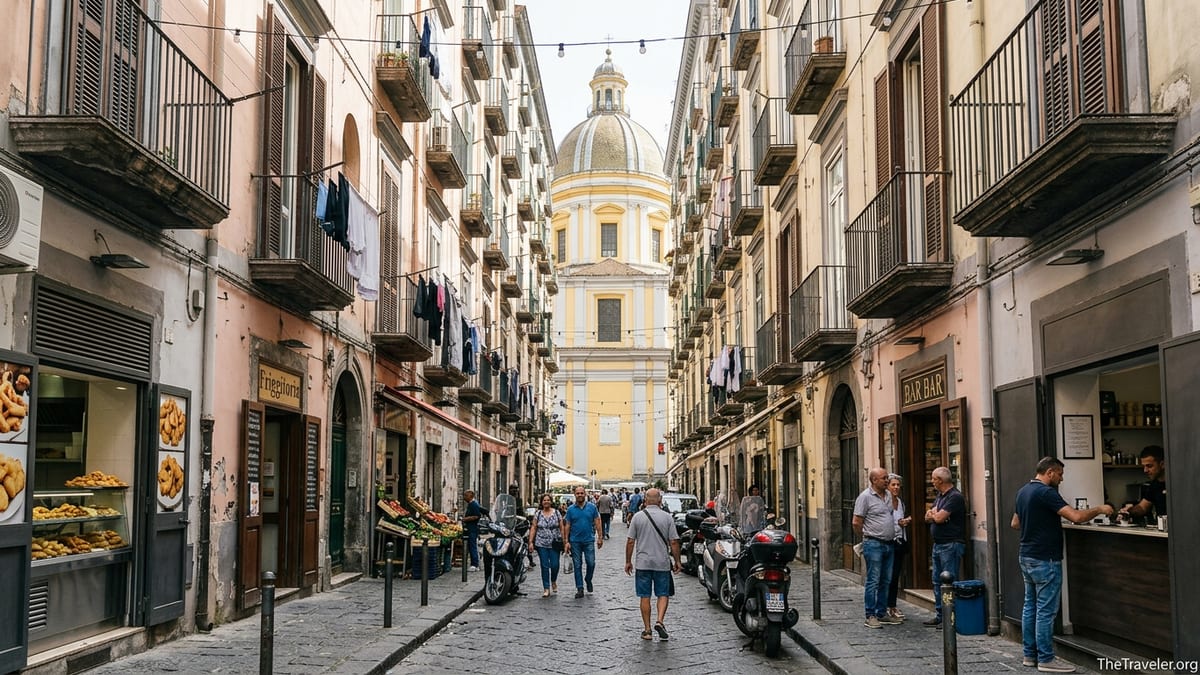
The heart of the neighborhood is Piazza Sanità, dominated by the yellow-and-white dome of the Basilica di Santa Maria della Sanità. Around the square, small bars serve quick espresso at the counter for about one euro, while locals grab cornetti from glass cases before work. On weekday mornings, vans and Ape trucks unload crates of vegetables, crates of tomatoes and basil destined for the ragù pots upstairs. It is a working piazza, more a crossroads than a stage-set, and standing here for ten minutes does more to explain Naples than an hour in any museum.
A few streets away, Via Vergini and Via Arena alla Sanità form the neighborhood’s most atmospheric corridor. Here the ground floors are a patchwork of tiny groceries, second-hand clothing shops, devotional goods and hole-in-the-wall bakeries. A fruit vendor may be weighing cherries at one stall while, next door, a workshop welds metal security grates. Overhead, strings of colored lights and banners for local festivals crisscross the alley. Visitors who are used to hushed historic centers sometimes mistake this intensity for danger, but what you are really seeing is an old-fashioned urban community still using its streets as shared living room.
Stopping for a coffee or a pastry is one of the best ways to tune into the tempo. A typical choice is a sfogliatella riccia or frolla from a neighborhood pasticceria, usually costing under three euros and served still warm. Ask staff quietly about their favorite nearby spots and you will likely be given directions with animated hand gestures and recommendations that include a cousin’s trattoria around the corner. Even a brief interaction at the bar counter can make the area feel far less intimidating and far more welcoming.
Underground Worlds: Catacombs and Ossuaries
One of the strongest reasons not to skip Rione Sanità lies underground. Just uphill from Piazza Sanità, the Catacombs of San Gennaro and San Gaudioso offer an unusually intimate look at early Christian Naples. Tours are run by a local cooperative and typically include a guide from the neighborhood, which changes the experience from a generic archaeological visit into a conversation about Sanità’s past and present.
At the Catacombs of San Gennaro above Via Capodimonte, visitors descend into two levels of soft tuff rock pierced by long galleries of niches and burial chambers. Frescoes of saints and geometric decorations dating back as far as the 2nd and 3rd centuries cling to the walls. The guided visit usually lasts about an hour and is offered several times per day in Italian and English; tickets are in the range of 10 to 15 euros for adults, with reduced prices for children and students. The ticket often includes or discounts entry to the nearby Catacombs of San Gaudioso, making it worthwhile to plan both on the same morning.
Back near Piazza Sanità, the Basilica di Santa Maria della Sanità hides another entrance to the underworld. A stairway behind the altar leads down into the Catacombs of San Gaudioso, where late Roman and early medieval burials once accommodated Naples’ Christian community. Among the most striking remains are the so-called “macabre” frescoes, where skulls are painted above sculpted bodies on the walls, a combination of skeletal heads and stylized torsos created when skulls of the deceased were placed into niches and the rest of the body depicted in paint. It is at once eerie and oddly tender, a reminder of the close relationship between the living and the dead that still informs local religious practices.
Not far away, on the edge of the district, lies the Cimitero delle Fontanelle, an immense cave-like ossuary filled with thousands of skulls and bones stacked on wooden shelves and stone ledges. For centuries, Neapolitans maintained informal relationships with these anonymous remains, adopting individual skulls, or capuzzelle, in exchange for favors or protection, a practice sometimes referred to as the cult of the pezzentelle souls. Today the cemetery is usually open to visitors without charge, though hours can change and closures for maintenance are not uncommon, so it is worth asking at your hotel or checking with the city’s tourist office shortly before you go.
Together, these subterranean sites tell a story that standard Naples itineraries often miss: a city obsessed not only with death, but with continuity between generations. Experiencing them in Sanità, where kids play football above ancient tombs and funeral processions still weave through the alleys, makes that continuity feel vividly real.
Palazzi with Patina: Architectural Gems Hiding in Plain Sight
Rione Sanità’s aristocratic past survives most clearly in its palazzi, which rise almost unexpectedly from narrow streets. Palazzo dello Spagnolo on Via Vergini is perhaps the most famous, its pale facade concealing an internal courtyard wrapped by a double flight of scenographic staircases. Built in the 18th century in a late Baroque style, the stairs curl upward in elegant curves that have featured in countless films and fashion shoots. Today the building is divided into ordinary apartments, and the courtyard typically remains open during the day, allowing visitors to step inside respectfully and look up at the soaring, weathered arches.
A short walk away stands Palazzo Sanfelice, designed in the same period by architect Ferdinando Sanfelice as his own residence. Its twin staircases, pierced by wide arches, create a dramatic sense of depth when seen from the entrance. Like its neighbor, the palace is now largely residential. There is no ticket desk or visitor center. Instead you simply find the doorway, step carefully into the courtyard and share the space with residents checking their mail or chatting on the landings. This everyday use is part of the palaces’ charm, but it also means visitors should behave more like guests than tourists: keep voices low, avoid blocking stairs for photos and be prepared for the possibility that gates may be closed in the evenings or at certain times.
These buildings are not polished monuments. Their stucco is chipped, their paint faded by decades of exhaust and salty air. Laundry hangs from ornate wrought-iron balconies and motorbikes are parked under stone cornices carved for carriages. For some travelers used to restored historic centers, this patina can be a surprise. Yet it is precisely the coexistence of grandeur and wear that makes Sanità’s architecture so affecting. You are seeing how Neapolitans have adapted 18th-century shells to 21st-century needs, often on limited budgets but with fierce attachment to their homes.
If you are particularly interested in architecture, consider timing your visit for daylight hours when the play of sun and shadow in the stairwells is most dramatic. Arriving mid-morning or early afternoon also makes it easier to combine the palazzi with a catacombs tour and a lunch stop nearby, without feeling rushed. There is no need to book anything in advance to see these courtyards, but it is sensible to verify current opening customs with a local guide or your accommodation, as access norms can evolve with resident concerns.
Flavors of Sanità: Street Food, Pastry Shops and Social Enterprises
Food is another compelling reason not to write off Rione Sanità as a place to avoid. The district offers some of Naples’ best-value street snacks and desserts, often at prices noticeably lower than those on the main tourist arteries nearer the port. Walking along Via Sanità and Via Vergini, you will pass friggitorie selling folded slices of pizza fritta, paper cones of fried courgette flowers or small frittatine di pasta for around 2 to 4 euros each. These are essentially local fast food, eaten standing on the sidewalk or perched on a doorway step.
Pasticcerie around Piazza Sanità compete for the title of best babà or sfogliatella in the neighborhood. A coffee and pastry rarely exceed 5 euros, and many shops still serve desserts made to traditional recipes rather than adjusted for tourist tastes. Ordering at the counter can be brisk, especially during school and work breaks, so it helps to decide what you want beforehand by glancing at the trays and simply pointing if you are unsure of the names.
Some of the most interesting food and hospitality projects in Sanità are run as social enterprises. The cooperative that manages the catacombs employs local young people as guides and staff, channeling ticket revenue back into education, restoration and community programs in the district. A few small bistros and bars have similar missions, training teenagers in hospitality or culinary skills while offering simple menus of pasta, seasonal vegetables and local wine. Prices are generally modest compared with waterfront neighborhoods, and spending money here directly supports residents rather than absentee owners.
Timing your food stops can make your visit smoother. Many places in Sanità still follow traditional hours, with a pronounced lull in the early afternoon when shutters come down and families eat lunch at home. If you are planning to visit the catacombs at midday, consider an early snack around 11:00 or a later coffee and pastry after 15:30, when the streets gradually come back to life. Evening brings a different energy, with locals gathering at bars and pizzerias, but first-time visitors may feel more comfortable sticking to daylight or early-evening hours when the neighborhood’s details are easier to read.
Safety, Perception and How to Visit Respectfully
Rione Sanità’s reputation has long lagged behind its reality. Older guidebooks and some travel forums still label the area as dangerous and advise visitors to avoid it entirely. Residents and recent travelers paint a more nuanced picture. Like much of Naples, Sanità is a dense, lower-income urban neighborhood with a history of organized crime and limited public investment, but serious incidents involving tourists are relatively rare. The most common risks are petty theft such as pickpocketing or bag-snatching, which can be mitigated with ordinary big-city precautions.
Practically, that means keeping phones and cameras tucked away when not in use, wearing a cross-body bag that closes securely, and avoiding walking with wallets or passports in back pockets. It is sensible to arrive and leave via main routes like the Ponte della Sanità or Via Santa Teresa degli Scalzi, especially after dark, rather than wandering aimlessly down the smallest side alleys at night. Solo travelers, particularly those who are anxious about unfamiliar environments, may feel more at ease visiting in the morning or early afternoon, when shops are open and families are on the streets.
Booking a guided walk or catacombs tour that includes a stroll through the neighborhood is a good way to experience Sanità on a first visit. Many tours labeled as the “Sacred Mile” link the Catacombs of San Gennaro, the Basilica di Santa Maria della Sanità and nearby churches, often with commentary from guides who grew up locally. This not only deepens your understanding of the sites, it also directs some of your visitor spending to community-based projects. Costs for half-day small-group walks typically fall in the range of 25 to 50 euros per person, depending on inclusions and group size.
Respectful behavior goes a long way toward being welcomed. Ask permission before photographing people, avoid pointing cameras directly into private courtyards or windows, and resist the temptation to treat the area as an exotic backdrop. Dress comfortably but modestly, especially if you plan to enter churches or catacombs where shoulders should be covered. Learning a few phrases of Italian such as “buongiorno,” “permesso” and “per favore” can soften interactions and signal that you see residents as neighbors rather than scenery.
Planning Your Visit: Practical Tips and Suggested Routes
Including Rione Sanità in a Naples itinerary does not require elaborate logistics, but a bit of planning helps you make the most of your time. Many visitors choose to spend a half day here, combining a catacombs tour, a walk through the streets around Piazza Sanità and a stop at one or two palazzi. If you are staying near the historic center, it is roughly a 20- to 30-minute walk uphill from areas like Piazza Dante or the National Archaeological Museum, much of it along busy streets with narrow sidewalks. Alternatively, local buses and taxis can bring you close to the bridge, from where it is a short descent into the heart of the district.
A simple route starts at the Ponte della Sanità in the late morning. From the bridge, descend toward Piazza Sanità, pausing to take in the view of the basilica’s dome squeezed among low buildings. Once in the piazza, step inside the church to admire its bright interior and check current information about tours of the Catacombs of San Gaudioso, which often depart from here. After your visit underground, return to street level for coffee and a pastry, then wander along Via Vergini toward Palazzo dello Spagnolo and Palazzo Sanfelice, detouring down side alleys that catch your eye while keeping track of your route back to the main streets.
Those with a full day can extend the walk uphill to the Catacombs of San Gennaro near the entrance to Capodimonte Park, then continue to the Capodimonte Museum or the park’s viewpoints over the city. This creates a thematic arc from underground tombs to aristocratic art collections and leafy royal grounds, all within walking distance of Rione Sanità. Wear comfortable shoes suitable for uneven pavements and stairs, and carry water, particularly in the summer months when the valley can trap heat.
Accommodation options within Sanità itself remain limited compared with more central districts, though a growing number of small guesthouses and B&Bs have opened in recent years. Most first-time visitors still prefer to sleep in the historic core near Spaccanapoli or in neighborhoods like Chiaia, using Sanità as a day-trip within the city. This approach balances convenience with the chance to explore a less touristy side of Naples, while keeping your evenings based in areas with more restaurant variety and late-night transport connections.
The Takeaway
Rione Sanità is not the most polished part of Naples, nor the easiest to interpret at a glance. It is a district that asks visitors to look beyond graffiti and cracked facades, to see the stories embedded in staircases, shrines and catacombs. Skipping it in favor of only Naples’ seafront and postcard viewpoints means missing a crucial layer of the city’s identity, one that ties together ancient burial grounds, Baroque ambition and contemporary grassroots resilience.
For travelers willing to approach with curiosity and respect, Sanità offers a concentrated dose of what makes Naples so compelling. You can descend into 1,500-year-old catacombs with a young local guide, emerge into a piazza buzzing with scooters and market chatter, stand under the arches of a once-aristocratic palace now filled with families, and finish with a pastry at a bar where your coffee costs little but comes with genuine conversation. In a city often reduced to stereotypes, Rione Sanità provides nuance and depth.
There will always be parts of Naples that feel more comfortable to the cautious visitor. Yet comfort and insight rarely travel together. Building even a short visit to Rione Sanità into your itinerary allows you to see Naples as more than a collection of famous sights. It reveals a living neighborhood still negotiating its past and future, and invites you to be, briefly, part of that story.
FAQ
Q1. Is Rione Sanità safe for tourists to visit?
Rione Sanità is a busy, lived-in neighborhood where ordinary big-city precautions are advisable. Petty theft can occur, as in many urban areas, so keep valuables secure, avoid displaying expensive items and stick to main streets, especially after dark. Most visitors who come during the day for the catacombs and a walk report feeling comfortable.
Q2. How much time should I plan to spend in Rione Sanità?
A half day is enough to see the main highlights, including one set of catacombs, a stroll through Piazza Sanità and a visit to at least one of the historic palaces. If you want to visit both San Gennaro and San Gaudioso catacombs and continue to Capodimonte, plan for most of a day.
Q3. Do I need to book tickets for the catacombs in advance?
Booking ahead is recommended, especially in high season and on weekends, to secure an English-language tour time. Same-day tickets may be available at quieter times, but popular slots can sell out, so checking availability and reserving in advance gives you more flexibility.
Q4. What is the easiest way to get to Rione Sanità from central Naples?
From the historic center, you can walk uphill in about 20 to 30 minutes via the National Archaeological Museum and Via Santa Teresa degli Scalzi. Alternatively, local buses and taxis can drop you near the Ponte della Sanità, from where it is a short walk down into the neighborhood.
Q5. Is it appropriate to visit the Cimitero delle Fontanelle and catacombs with children?
Older children and teenagers who are comfortable with spooky or historical sites often find the catacombs and ossuary fascinating. For younger or more sensitive children, the large number of visible bones may be overwhelming. It is worth discussing the nature of the visit beforehand and being prepared to cut it short if needed.
Q6. Are there good places to eat in Rione Sanità?
Yes, the neighborhood has excellent, good-value street food, bakeries and a few simple trattorias and bistros. Expect traditional Neapolitan dishes, fried snacks and pastries at prices often lower than in more touristy areas. Many venues are small and informal, with most activity at lunch and early evening.
Q7. Can I visit Palazzo dello Spagnolo and Palazzo Sanfelice inside?
You can usually enter the courtyards and stairwells during the day, as these buildings function as residential complexes rather than formal museums. Access can vary depending on residents’ preferences and time of day, so gates may occasionally be closed. When open, visitors should move quietly and avoid disturbing those who live there.
Q8. What should I wear when visiting Rione Sanità and its churches?
Wear comfortable shoes for uneven pavements and stairs, and dress modestly enough for church interiors: shoulders covered and shorts or skirts of reasonable length. In summer, light breathable fabrics are best, but carrying a scarf or light layer makes it easier to adapt when entering religious sites.
Q9. Is it better to explore Rione Sanità on my own or with a guide?
Confident urban travelers can explore on their own, especially during the day, using the catacombs or Piazza Sanità as anchors. However, joining a guided walk, particularly one led by a local cooperative, offers richer context and can help first-time visitors feel more comfortable while directly supporting community projects.
Q10. Are there any cultural sensitivities I should be aware of when visiting?
Rione Sanità is a close-knit community, so it is important to be discreet when photographing, avoid blocking narrow alleys, and treat religious spaces and shrines with respect. Greeting shopkeepers, keeping noise down in residential courtyards and being mindful that you are walking through people’s daily lives all contribute to a positive experience for both visitors and locals.