


Walk a few minutes away from a crowded British seafront and, in some places, it can feel as if the map simply runs out. Paths thin to sheep tracks, cliffs rear up, and suddenly there it is: a sweep of sand or a shingle crescent with hardly a footprint in sight. Across the United Kingdom, there are still beaches that feel like secrets, rewarding those willing to drive that extra hour, time the tide, or shoulder a daypack. These are not the promenades and pier-head resorts of postcards, but quieter corners where the elements still set the agenda and the rewards are all the richer for it.
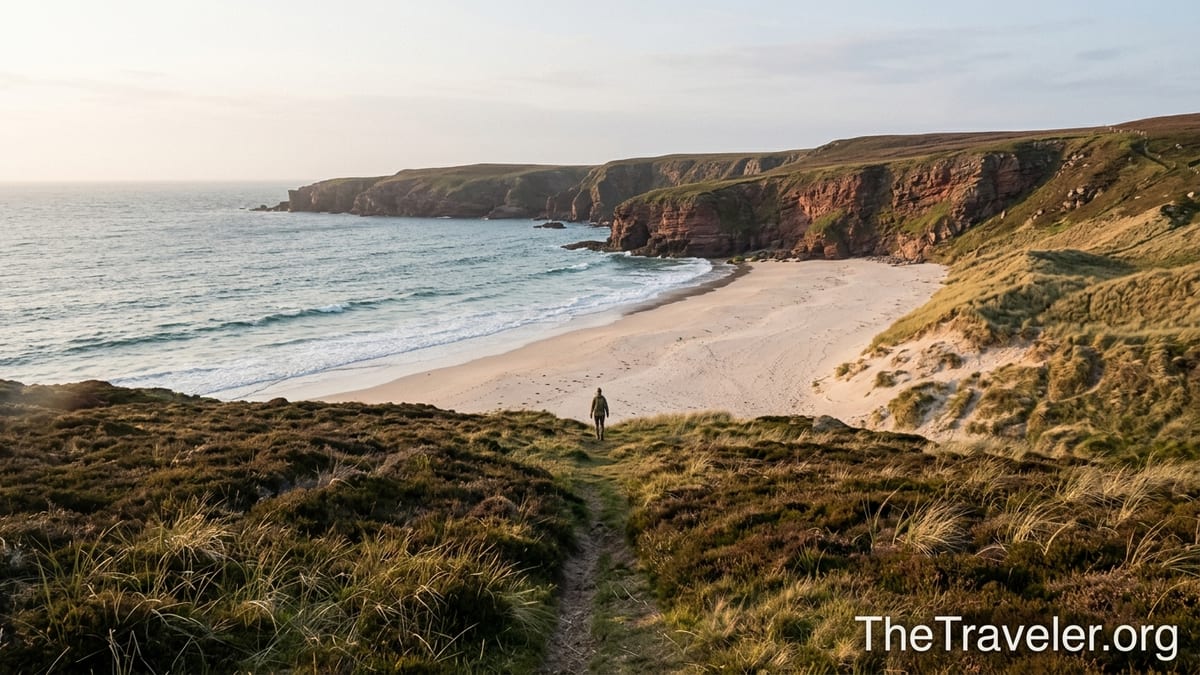
Why Hidden UK Beaches Are Worth the Detour
For many travellers, the UK coast means familiar names such as Brighton, Bournemouth or St Ives. Yet some of the country’s most memorable shores lie far from car parks and ice cream kiosks. Remote bays in the Scottish Highlands, tucked-away coves in Cornwall and steep-sided valleys in Wales often demand more commitment to reach, but repay it with space, atmosphere and a sense of discovery that busy resorts cannot match.
These quieter beaches tend to feel more “wild.” At places like Sandwood Bay in northwest Scotland or Traeth Llyfn in Pembrokeshire, there are no rows of deckchairs or amusement arcades. Instead, you are more likely to encounter sheep on the path or seals in the surf. Facilities are minimal or non-existent, which means you must bring what you need and take responsibility for your own safety, but it also keeps development at bay. Many of these stretches are protected or managed in ways that prioritise conservation and low-impact access.
Part of the appeal is psychological as much as visual. Reaching a beach after a four-mile hike over moorland, or after picking your way down a cliff path known mostly to locals, creates the satisfying feeling that you have earned it. Watching Atlantic rollers under a huge sky in Sutherland, or sitting among rounded boulders in an Orkney valley with nobody else in sight, gives a very different kind of coastal experience from one framed by arcades and seafront hotels.
Of course, “hidden” is a relative term. Social media and road-trip routes have put some former secrets firmly on the map. Yet even on routes that are now well known, such as the North Coast 500 or the Wales Coast Path, it is still possible to find beaches where you can spread out your picnic rug and hear nothing but wind and waves. The key is timing, research and a willingness to explore a little further than the nearest car park.
Sandwood Bay, Sutherland: The Wild Edge of Mainland Scotland
Few beaches in the UK feel as gloriously remote as Sandwood Bay in the far northwest of Scotland. Often described by walkers and Scottish travel writers as one of the country’s most beautiful and remote beaches, it is a mile-long strip of pale, pink-tinged sand framed by high dunes and cliffs, with the Atlantic rolling in across an open horizon. Inland lie the moorlands and freshwater of Sandwood Loch; offshore, the distinctive sea stack known as Am Buachaille stands guard at the bay’s southern end.
Reaching Sandwood Bay is part of the adventure. There is no road access and no toilets or cafes. Instead, you park in the small hamlet of Blairmore and follow a track for roughly four miles across peat and low moor. Most adults take about 1.5 to 2 hours each way, walking at a relaxed pace with a daypack. The path is generally clear and not particularly steep, but it can be wet underfoot. Many visitors opt for sturdy waterproof boots and bring layers, even in July or August, as the weather can change quickly in this exposed corner of Sutherland.
Once you emerge over the final rise, the sense of space is striking. On calmer days, the bay can feel almost meditative: just the hiss of receding waves and the occasional call of seabirds. On windy days, the Atlantic shows its strength, with heavy surf crashing against the shore. Swimming here is only for very confident, cold-water acclimatised swimmers and then only in settled conditions. There are no lifeguards and currents can be strong, so most visitors content themselves with paddling at the water’s edge, exploring the dunes, or simply sitting back on a blanket with a flask and letting the drama play out in front of them.
Because there are no facilities, everything you bring in must come back out with you, including rubbish. Wild camping on or near the beach has become popular with experienced backpackers, but it remains a sensitive environment. Responsible campers favour lightweight tents pitched well back from the dunes, use small fuel stoves instead of open fires and follow “leave no trace” principles, including careful disposal of human waste away from watercourses. For day-trippers, a practical approach is to base yourself in nearby villages such as Kinlochbervie or Durness, where you can find small guesthouses and inns, then make Sandwood Bay a dedicated day hike.
Rackwick Bay, Hoy: Orkney’s Hidden Valley of Light
On the island of Hoy in the Orkney archipelago, Rackwick Bay has quietly developed a reputation as one of the most atmospheric beaches in northern Europe. Enclosed by high red sandstone cliffs and backed by a shallow, heather-clad valley, its shore is made up of pinkish sand and huge rounded boulders that have been smoothed by centuries of Atlantic storms. Local writers and visiting photographers alike often describe Rackwick as one of Orkney’s most beautiful places, a “hidden valley” that feels quite distinct from the gentler landscapes of nearby islands.
Getting to Rackwick is part of what keeps it tranquil. Travellers typically take a ferry from mainland Orkney to Hoy, then a bus or car across the island’s interior. As you drop down towards the bay, the road winds through a small crofting settlement before ending near a simple parking area, hostel and stone bothy. From here, a short walk leads past traditional houses and down to the beach itself. There are basic public toilets but no shops directly at the bay, so most day visitors bring picnics or stock up at small stores elsewhere on Hoy or in Stromness before crossing.
The atmosphere on the beach changes with the tide and the weather. On a calm summer afternoon you might find families picnicking among the boulders, children paddling in the shallows and walkers starting out for the famous cliff path to the Old Man of Hoy sea stack. On a rough autumn day, however, the same bay becomes a study in wildness, with heavy surf crashing against the boulder bank and spray drifting across the valley. Seals are often seen bobbing just beyond the breakers, and the surrounding cliffs are busy with nesting seabirds in season.
Rackwick is also a useful base for exploring the wider island. The hostel near the beach offers simple, budget-friendly beds, while the nearby bothy provides very basic shelter for experienced walkers. From here, several well-known routes climb out of the valley onto the moorland and along the cliffs. Many visitors combine a few peaceful hours on the shore with a half-day hike, returning in the evening to watch the light change across the bay. Even in peak summer holiday weeks, it is common to find the beach almost empty outside the middle of the day, especially if the forecast puts off less hardy travellers.
Traeth Llyfn, Pembrokeshire: A Secret Shelf of Sand
On the rugged north Pembrokeshire coast between the tiny harbour of Porthgain and the dramatic Blue Lagoon at Abereiddi lies Traeth Llyfn, a beach that rewards those with a head for heights. This pretty strip of sand and rock pools is backed by sheer cliffs and accessed only from the Pembrokeshire Coast Path. Official regional tourism guides describe it as a sandy and rocky beach reached by a very steep flight of metal stairs that descend directly from the clifftop down to the shore.
The remoteness is relative. From either Porthgain or Abereiddi you can follow the waymarked coast path, enjoying views back towards whitewashed cottages and old quarry buildings. After around 20 to 30 minutes of undulating cliff-top walking, depending on your pace, you reach the top of the steps. In dry conditions, confident walkers tend to descend in just a few minutes, but the staircase is exposed and can feel intimidating for those with vertigo. Sensible footwear and keeping a hand on the rail are advisable, and visitors with mobility issues are likely to find this beach inaccessible.
Once down on the sand, Traeth Llyfn feels worlds away from busier Pembrokeshire spots. There are no facilities at beach level: no lifeguards, no toilets, no cafe. The waves can be powerful and rip currents are known, so swimming is best left to strong, experienced sea swimmers familiar with local conditions. Many families with older children instead focus on exploring the rock pools, flying kites, or simply relaxing with a picnic spread out above the high-tide line. Dogs are allowed year-round, which makes this a popular choice for walkers travelling with pets who want somewhere quieter than the more accessible beaches near St Davids.
Because the beach all but disappears at high tide, planning around the tide tables matters. At lower tides, there is ample space for ball games and beachcombing. Some visitors choose to base themselves in nearby coastal villages or in St Davids itself, then plan a circular walk that takes in Porthgain’s art galleries and pub, a picnic at Traeth Llyfn, and perhaps a late-afternoon coffee from a kiosk near the Blue Lagoon before returning to their accommodation. This combination of modest effort and high reward is typical of many of the UK’s “hidden” beaches: you trade a little extra planning and exertion for a much more peaceful day by the sea.
Porthchapel Beach, Cornwall: A Quiet Corner of the Penwith Coast
The far west of Cornwall’s Penwith peninsula is known for its cinematic beaches and cliff-top theatres, and in peak summer many of its coves fill quickly. Yet tucked between better-known stretches such as Porthcurno and Perranuthnoe lies Porthchapel Beach, a small south-coast cove that remains relatively low key. Public information sources describe Porthchapel as a secluded beach on the south coast of Penwith, with access by a narrow, sometimes muddy footpath and a final scramble over rocks or sand, depending on recent storms.
Porthchapel is favoured by those who like their beach days simple. There is no promenade and no line of cafes within a few strides of the tide line. Instead, you park in a small lay-by or farm car park above the village church, then follow a tree-lined path that gradually descends through a valley before emerging near the sea. The last section can involve stepping down rough stone or tree roots, so shoes with some grip are a better choice than flip-flops. The approach, shaded by hedgerows and alive with birdsong in spring, adds to the sense of arrival when the first glimpse of turquoise water appears between the rocks.
On a calm day at mid to low tide, Porthchapel offers a swathe of soft sand backed by low cliffs and scattered boulders, with clear water that can appear almost Mediterranean when the sun is high. Seals are sometimes seen offshore, and the relative difficulty of access keeps the numbers modest even in school holidays compared with nearby beaches with large car parks. There are no lifeguards, however, and the shore shelves in places, so parents of younger children tend to supervise paddling closely and keep inflatable toys for calm, near-shore use only.
In practical terms, visiting Porthchapel encourages a slower pace. Many travellers staying in holiday cottages around Mousehole, Newlyn or Sennen build it into a day of exploring the wider Penwith coast, perhaps pairing a morning at the more visited Porthcurno or a matinee at the clifftop theatre with a quieter afternoon at Porthchapel. Bringing a picnic, water and basic beach gear with you from your accommodation is essential, as the nearest reliable shops and cafes are in neighbouring villages rather than at the beach itself.
Traeth Bach, Ceredigion: Little Beach on a Big Coast
Between the Welsh seaside villages of Penbryn and Llangrannog lies a particularly rugged stretch of the Ceredigion coastline, where cliffs plunge into the sea and the Wales Coast Path clings to the edge. Tucked among these cliffs is Traeth Bach, literally “little beach” in Welsh, a small cove that remains largely off the radar even for many domestic visitors. Local accommodation providers describe this cove as spectacular yet hard to access, reached by one of the more strenuous segments of the coastal path followed by a steep, rough descent down a valley and over rocks to the shore.
The effort involved is precisely what limits numbers. From Penbryn or Llangrannog, walkers follow the signed coast path as it climbs and dips along the clifftops, with far-reaching views across Cardigan Bay. The final approach to Traeth Bach involves leaving the established path, descending a rough track through bracken and gorse, then making a controlled scramble down the last section of cliff using hands as well as feet. This route is not suitable for young children, people uncomfortable with heights or anyone unsteady on their feet, and it should be avoided entirely in wet or windy conditions.
For confident, prepared walkers, however, the payoff is a pocket-sized cove that feels about as far from a traditional resort as one can imagine. The beach itself varies with tide and recent storms, sometimes presenting a patch of sand, at other times more rounded pebbles and rock platforms. The cliffs on either side rise almost vertically, giving a sense of enclosure and shelter from prevailing winds. There are no facilities, no mobile signal in places, and often no other people. This is a spot for quiet contemplation, a quick cold-water dip for experienced wild swimmers with a companion, or a simple lunch with a thermos while watching seabirds wheel overhead.
Because Traeth Bach is so committing to reach, it suits travellers who are already planning multi-hour walks along the Ceredigion coast and who have suitable footwear, spare layers and a flexible schedule to allow for changes in weather. Many visitors choose to stay in coastal cottages or small guesthouses near Llangrannog or Tresaith, then pick a clear, calm day to tackle this section of the path. In this context, the “hidden” beach becomes a highlight of an already scenic walk rather than a sole objective for a quick afternoon outing.
Castle Cove, Dorset: A Sheltered Slice of the Jurassic Coast
On the edge of Weymouth in Dorset, within sight of old coastal defences and the wider sweep of the Jurassic Coast, lies a beach that many visitors miss as they drive towards the town’s main sands. Castle Cove, also known locally as Sandsfoot Cove, is a small, sheltered sand and shingle beach west of Weymouth’s centre. Public descriptions emphasise that it is a secluded spot in a residential area, popular with local families and paddleboarders but relatively little known beyond the immediate community.
Unlike the remote Scottish and Welsh examples, Castle Cove’s seclusion is more about its tucked-away location than sheer distance. Access is typically on foot via short paths that lead down from nearby streets, with many visitors combining a visit with a walk along a local coastal trail or a stop at nearby castle ruins that overlook the harbour. Because car parking is limited and mostly consists of on-street spaces in surrounding neighbourhoods, it rarely draws large coach groups or day-trippers who prefer the convenience of Weymouth’s central waterfront.
The beach itself is modest in scale, a crescent of sand and pebbles that shelves gently into usually calm, sheltered water. This, together with the comparatively easy access, has made it a favourite for stand-up paddleboarding, kayaking and family paddling on warm summer days. At low tide, there is enough room for small groups to spread out on the sand and for children to explore the foreshore; at high tide, the beach narrows, and visitors tend to alternate between sitting on the upper shingle and getting in the water.
Facilities at Castle Cove are minimal compared with bigger Dorset resorts. Seasonal kiosks or small local businesses may offer refreshments within walking distance, but there are no large-scale developments at beach level. This suits travellers who enjoy bringing a simple picnic and treating the visit as a short, restorative stop during a wider exploration of the Jurassic Coast. For those basing themselves in Weymouth, it offers an easy way to escape the bustle of the main esplanade without committing to a long car journey.
Planning a Trip to Hidden UK Beaches: Practical Tips
However romantic the idea of a secret beach might be, visiting lesser-known stretches of UK coastline requires more preparation than driving to a well-serviced resort. Many of these beaches involve steep paths, long walks or limited infrastructure, and conditions can change quickly. A little planning goes a long way towards ensuring that the experience is memorable for the right reasons.
Timing is one of the most important variables. Tidal ranges in the UK can be significant, and several of the beaches mentioned above, such as Traeth Llyfn and Traeth Bach, lose much of their sand at high tide. Checking tide times for the nearest harbour before setting out allows you to aim for a falling or low tide, giving more space to relax and explore. Weather forecasts also matter: a calm, overcast day can be safer and more enjoyable for cliff-top walking than a blazing hot afternoon, while strong onshore winds may make exposed beaches feel wild and uncomfortable.
Footwear and clothing deserve attention too. Routes to places like Sandwood Bay, Rackwick Bay and Traeth Bach cross rough, sometimes boggy ground and can involve steep, uneven steps or rocky scrambles. Lightweight walking boots or sturdy trainers with grip are more suitable than open-toed sandals. Even in midsummer, carrying a windproof layer, warm top and something waterproof is wise in locations where Atlantic weather systems can arrive with little notice. A small backpack with water, snacks, a basic first-aid kit and perhaps a compact emergency blanket is a sensible companion for more remote walks.
Finally, remember that the absence of facilities is part of the charm but also a responsibility. On beaches without lifeguards, anyone considering a swim should be realistic about their abilities, stay within their depth, and avoid entering the water alone or when conditions look unsettled. In remote locations without toilets, environmentally considerate practices are essential: use toilet facilities before setting out, pack out all rubbish, and avoid disturbing wildlife or trampling dunes and fragile vegetation. By travelling thoughtfully, visitors help to ensure that these special places remain unspoilt for those who come after them.
The Takeaway
The United Kingdom’s coastline is more varied than many visitors realise. Beyond the famous piers and promenades are stretches of sand and shingle that require a little more determination to reach, but that offer some of the most rewarding coastal experiences in the country. From the pink-tinged sands of Sandwood Bay and the boulder-strewn valley of Rackwick in the far north, to the steep-access coves of Pembrokeshire, Ceredigion and Penwith, and the tucked-away corners of Dorset, these hidden beaches invite a slower, more attentive form of travel.
What unites them is not a particular look, but a feeling. It is the hush that falls when the car park is far behind you, the satisfaction of descending the last set of steps to an almost-empty shoreline, or the simple pleasure of brewing a cup of tea on a camping stove while watching the light shift over distant headlands. With thoughtful preparation and realistic expectations about access, weather and safety, travellers can weave these places into wider road trips or walking holidays and come away with some of their most lasting memories of the UK.
FAQ
Q1. Are these hidden UK beaches suitable for families with young children? Many of the beaches mentioned have steep paths, long walks or strong currents, so they are best suited to families with older children who are confident walkers. For younger children, gentler options such as Castle Cove in Dorset or short visits to Porthchapel at low tide can work well, provided adults closely supervise near the water and on any uneven paths.
Q2. Do I need special equipment to visit remote beaches like Sandwood Bay or Traeth Bach? You do not need technical climbing gear, but you should treat these trips like proper countryside walks. Sturdy footwear with good grip, waterproof and windproof layers, a small backpack with water and snacks, a fully charged phone, and a printed or downloaded map of the route are all sensible. For very remote spots, some walkers also carry a basic first-aid kit and a head torch in case they return later than expected.
Q3. Can I rely on mobile phone coverage at these hidden beaches? Coverage on the UK coast is highly variable, and many of the more remote beaches have weak or no signal, especially in enclosed valleys or below cliffs. You should plan your visit assuming that you may not be able to make calls or consult online maps. Let someone know your intended route and return time, and carry offline navigation such as a paper map or downloaded route on a device you know how to use without a data connection.
Q4. Is wild camping allowed on or near these beaches? Wild camping rules differ across the UK. In Scotland, informal camping is widely tolerated when done responsibly, but even there you should follow access guidelines, avoid busy spots, and stay only a night or two. In much of England and Wales, wild camping without the landowner’s permission is generally not allowed. In all cases, discreet behaviour, small tents, no open fires, and strict leave-no-trace practices are essential, and camping directly on popular beaches is often discouraged or prohibited.
Q5. How can I find out about tides and local hazards before I go? Tide times are published for major UK harbours and can be checked in advance through official nautical almanacs, local harbour offices or visitor information centres. For local hazards such as rip currents, unstable cliffs or restricted access, regional tourism websites, coastal path information boards, lifeboat stations and local accommodation providers are good sources. When in doubt, observe the beach carefully on arrival and speak to locals if possible before entering the water.
Q6. Are dogs allowed on these hidden beaches? Rules vary by region and season. Beaches such as Traeth Llyfn explicitly welcome dogs year-round, while others have seasonal restrictions to protect wildlife or to keep busier summer areas cleaner. Always check local signage at access points and be prepared to keep dogs on a lead near livestock, cliff edges, nesting birds and other visitors. Carry bags to remove dog waste and pack it out with your rubbish.
Q7. What time of year is best for visiting remote UK beaches? Late spring and early autumn often provide a good balance of milder weather, longer daylight and fewer crowds. In Scotland and the far north, April, May and September can be particularly rewarding, though you should still be prepared for cool, changeable conditions. Summer offers warmer water and more predictable ferry and transport schedules but can be busier on popular routes. Winter visits are possible for experienced walkers, but short daylight hours and rough seas make preparation and caution especially important.
Q8. How crowded do these “hidden” beaches get in peak season? Even the quietest beaches can see more visitors during school holidays and sunny weekends, but they are still generally far less crowded than major resorts. Places requiring long walks or steep access, such as Sandwood Bay, Traeth Bach and Rackwick Bay, tend to stay relatively peaceful, with people spread out along the shore. More accessible coves, like Porthchapel or Castle Cove, may feel busy at midday in August but are often quiet in the early morning or evening.
Q9. Are there public transport options to reach these beaches without a car? Some hidden beaches are accessible by combining public transport with walking. For example, buses and ferries can get you to Hoy for Rackwick Bay, and local bus services connect villages along parts of the Pembrokeshire and Ceredigion coasts. However, service frequencies may be low, especially outside summer, and onward walks from bus stops can be long. If you are relying on public transport, build in generous time buffers, check current timetables carefully, and consider basing yourself in a hub town linked to coastal walking routes.
Q10. What safety precautions should I take when swimming or paddling at these beaches? On beaches without lifeguards, you should be cautious and conservative. Avoid swimming alone, stay within your depth, and enter the water gradually to check for sudden changes in the seabed. Be alert to rip currents, which can appear as channels of choppier or discoloured water, and never jump into unknown water from rocks. Cold water shock is a real risk in UK seas, even in summer, so consider a wetsuit for longer swims and exit the water immediately if you feel chilled, dizzy or short of breath.