


On a summer afternoon when Cape May’s main oceanfront hums with umbrellas, coolers, and kids darting between lifeguard stands, Higbee Beach feels like a different world. Hidden behind a curtain of woods on the Delaware Bay side of the peninsula, this protected stretch of sand offers a quieter, wilder version of the Jersey Shore that many visitors never find.
Get the latest updates straight to your inbox!
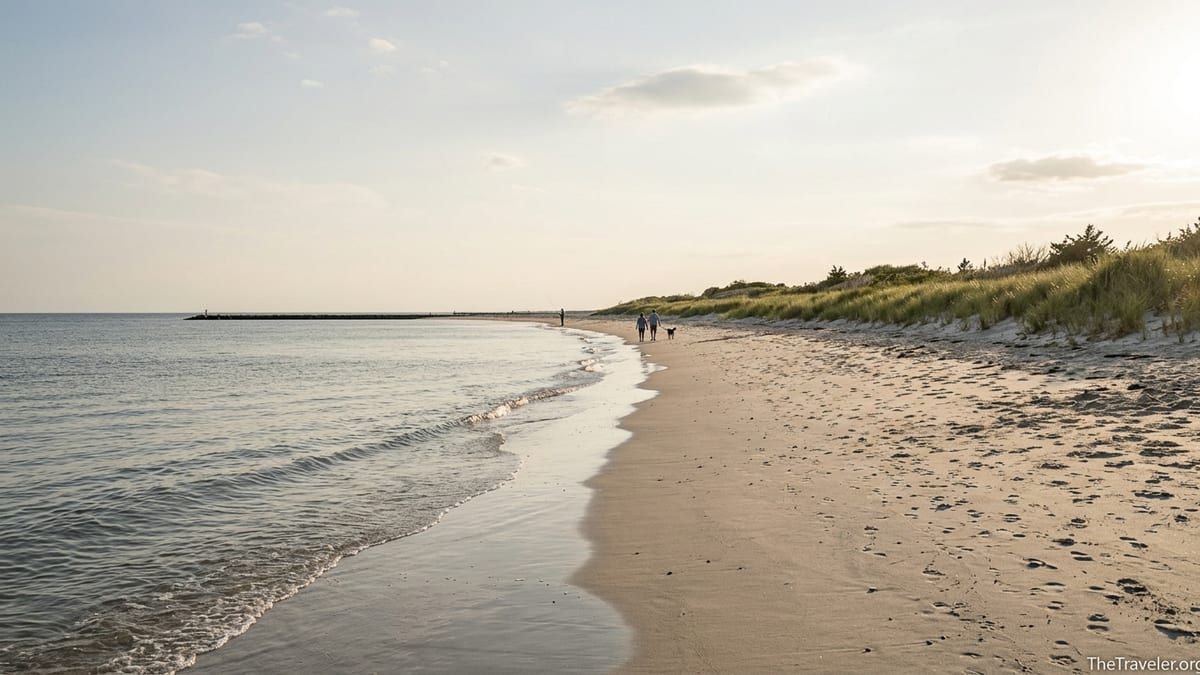
A Hidden Delaware Bay Shoreline Just Beyond Cape May
Higbee Beach sits just north of Cape May’s historic core, yet it feels far removed from the bustle of Beach Avenue and the Washington Street Mall. Technically part of the Higbee Beach Wildlife Management Area in Lower Township, this is not an in-town bathing beach with cabanas and snack stands. Instead, a narrow sandy path off New England Road threads through thick woods and scrubby dunes before suddenly spilling out onto an open ribbon of bayfront. On clear days you can see the low outline of Delaware across the water and watch ships heading for the Cape May–Lewes Ferry channel.
The shoreline here runs for roughly a mile and a half, curving gently from the terminus of New England Road toward the jetty at Sunset Boulevard. Instead of the tightly packed rows of beach chairs you see at Grant Street or Congress Street, Higbee’s sands are usually dotted with just a handful of anglers, dog walkers in the off-season, and birders training binoculars toward the tree line. Even at the height of July, visitors commonly report sharing long sections of the beach with only a few other people, a rarity anywhere along Cape May County’s 30 miles of shoreline.
Part of Higbee’s seclusion comes from what it lacks. There are no lifeguards, no boardwalk, no permanent restrooms and no food vendors. The only soundtrack tends to be surf slapping the sand, red-winged blackbirds calling from the marsh, and the low churn of a commercial fishing boat in the distance. For travelers used to the energy of Wildwood or the music drifting from Cape May’s beachfront bars, the quiet here can be startling in the best possible way.
A Wildlife Management Area First, a Beach Second
Higbee Beach is officially managed as a 1,100-plus acre Wildlife Management Area by the New Jersey Division of Fish and Wildlife, and the beach is only one element of a larger protected landscape. Just inland from the bay, a patchwork of fields, hedgerows, and scrub forest creates critical habitat along one of North America’s most famous bird migration corridors. In September and October, thousands of songbirds funnel down the peninsula and pause in these woods before attempting the long flight over Delaware Bay, making Higbee one of the star locations on birding maps of the region.
The dunes behind the beach are thick with holly, red cedar, sassafras, wild black cherry, and beach plum, plants that help anchor the sand and shield the shoreline from storms. In late summer, monarch butterflies drift along the edge of the fields, drawn by stands of milkweed. Local naturalists also point out that a rare orchid, sometimes known as fragrant ladies’ tresses, can be found in wet pockets of the management area, highlighting how sensitive this ecosystem is to heavy foot traffic.
Because wildlife comes first here, visitors are expected to tread lightly. Hunting is permitted in certain seasons inland, and state regulations limit activities like camping, open fires, and off-road driving. Large interpretive signs at the trailhead and in the small parking areas outline rules such as keeping to established paths, leashing dogs during periods when they are allowed, and avoiding dune vegetation. For travelers used to conventional resort beaches, it is useful to remember that Higbee is more akin to a nature preserve that happens to have a beautiful strand of sand.
Why Higbee Feels So Much Quieter Than Cape May’s Main Beaches
On the ocean side of Cape May, beaches like Steger, Jefferson, and Perry Street can feel pleasantly crowded by mid-morning in July and August, with hotel guests and day-trippers setting up chairs two or three deep. Those beaches are patrolled by lifeguards, lined by Beach Avenue, and require daily or seasonal beach tags. In contrast, there is no fee to access Higbee, but there are also far fewer conveniences to draw casual visitors looking for an easy swim between shopping trips.
Reaching the sand at Higbee typically involves a five to ten minute walk from the car through soft sand, which naturally filters out anyone seeking a quick dip with full beach gear in tow. Families with small children or coolers often gravitate instead to more accessible bayfront spots such as Sunset Beach or the beaches in North Cape May, where roadside parking, snack stands, and gift shops make logistics simpler. Even locals who love Higbee tend to describe it as a place for a focused outing rather than an all-day campout.
Recent management decisions have reinforced that feeling of escape. To ease pressure on the fragile dunes and interior habitat, state officials have seasonally closed some parking areas between Memorial Day and Labor Day in recent years, leaving room for only a limited number of vehicles at a time. Regular visitors report that on typical summer weekdays, lots may fill in the morning with birders and anglers and then thin out as people head elsewhere for lunch, helping keep overall numbers low. That ebb and flow stands in sharp contrast to the near-constant turnover of beachgoers at the city’s more commercial strands.
What You Can (and Cannot) Do at Higbee Beach
For many travelers, Higbee Beach is at its best when treated as a destination for walking, photography, and quiet contemplation rather than full-service recreation. A popular routine is to arrive mid-afternoon, follow one of the marked trails through the interior fields and dunes, then loop back along the water’s edge as the sun slides lower over the bay. In late summer and early fall, the combination of soft side-light, tall dune grasses, and silhouetted fishing boats can make this one of the most atmospheric strolls in Cape May County.
Fishing is a major draw. Anglers regularly cast for species such as striped bass and weakfish along the shoreline or from the rock jetty at the northern end near the Cape May Canal. It is common to see locals wearing breathable waders and using sand spikes to hold surf rods while they sit back in low beach chairs. As with all New Jersey coastal fishing, you should register for the state’s free saltwater angler registry and check the latest size and season regulations before keeping any catch.
Swimming, on the other hand, is not recommended here. Officially, signs note that swimming is prohibited because there are no lifeguards and currents in Delaware Bay can be deceptively strong, even on calm days. Local emergency responders report swift-moving tides and drop-offs in various bay locations, and occasional rescues make it clear that this is not a controlled swimming environment. While you will sometimes see visitors wading ankle-deep to cool off, especially on very hot days, treating Higbee as a swimming beach is risky and strongly discouraged.
Another aspect travelers should know is Higbee’s reputation, earned decades ago, as an unofficial clothing-optional spot. While New Jersey regulations do not formally designate it as a nude beach, online discussions and the occasional news article mention that some visitors still sunbathe topless or nude in more remote sections. Enforcement tends to focus on safety and environmental impacts rather than attire, but families or travelers who might be uncomfortable with such a scene may prefer to stay closer to the main access path or choose another bayfront option like Sunset Beach or the Cove.
Access, Closures, and Practical Planning Details
Reaching Higbee Beach from central Cape May typically takes about ten minutes by car. Most visitors follow Sunset Boulevard west out of town, then turn onto Bayshore Road and New England Road to reach the wildlife management area. Signage is modest, and first-time travelers sometimes overshoot the small parking areas, so it helps to study a map before you go. There is no public transportation that drops directly at the trailhead, so a car or bike is needed.
When planning a visit in 2026, it is important to be aware of ongoing habitat restoration work in the Pond Creek section of the management area. Portions of Higbee Beach were temporarily closed starting in early 2024 for this multi-year project, with some trail segments and interior areas expected to remain off-limits into late 2026. On-the-ground signs and state wildlife agency updates provide the most accurate current information about which paths and access points are open at any given time, and visitors should respect any posted closure notices.
Because the area is essentially undeveloped, you will not find restrooms, changing facilities, or concessions at Higbee. Many travelers stop at a gas station or café along Bayshore Road beforehand and bring all the water and snacks they will need. Footwear that handles both sand and packed dirt is useful, as trails can be damp or muddy after heavy rain. In summer, insect repellent is a must: mosquitoes and ticks are part of the reality in a coastal marsh and forest environment, and long, light clothing can make birding and sunset walks more comfortable.
Parking can be a pinch point. On a mild September morning during peak migration season, it is not unusual to see vehicles with license plates from Pennsylvania, New York, and Maryland lining up early for limited spaces. If you arrive and find the main lot full, do not create informal spots along narrow shoulders or block gated access roads, as enforcement officers do ticket and tow when necessary. A common strategy among seasoned visitors is to pair a short Higbee outing with a later trip to nearby Sunset Beach or Cape May Point State Park, where parking is more robust.
How Higbee Compares to Other Quiet Corners of Cape May
Cape May is known for its Victorian houses, upscale inns, and lively central beaches, but several nearby spots cater to travelers seeking quieter sand and fewer crowds. Poverty Beach, at the far eastern end of town, often feels spacious even in July thanks to its relatively isolated location near the Coast Guard base. The Cove, near the western end of Beach Avenue, offers a more natural feel and beautiful views of the Cape May Lighthouse. Sunset Beach, in Lower Township, draws visitors for flag-lowering ceremonies, views of the remains of the concrete ship Atlantus, and the chance to search for wave-polished quartz pebbles sold locally as Cape May diamonds.
Compared with those destinations, Higbee stands out for how thoroughly it is embedded in a wild landscape. Poverty Beach still sits in front of hotels and a paved promenade, and Sunset Beach, though scenic, has gift shops, mini-golf, and a seasonal snack bar just off the sand. Higbee, by contrast, has no commercial development directly adjacent to the beach and no nearby houses visible from the waterline. When you stand at the high-tide line and look inland, the view is almost entirely trees, dunes, and sky.
For travelers crafting a weeklong stay, it often works well to pair one or two afternoons at Higbee with more conventional beach days in town. For example, a family might reserve beach cabanas and rent boogie boards along Grant Street early in their trip, then choose a cooler weekday for a low-key excursion to Higbee focused on walking, photography, and birdwatching. In the evening, they could return to town for dinner at one of the Washington Street Mall’s restaurants and live music at a beachfront bar, enjoying the best of both Cape May’s polished resort side and its quieter, wilder edges.
Tips for Responsible, Respectful Visits
Because Higbee Beach is a wildlife management area, travelers play a direct role in preserving its character. The most visible principle is simple: pack in and pack out. Carry a small bag for your own trash and any litter you happen to find along the high-tide line. Discarded fishing line and plastic bait containers are especially harmful to shorebirds and marine life, and removing them makes an immediate difference. Local birding organizations often praise visitors who quietly leave a place cleaner than they found it.
Staying on established trails is equally important. The temptation to cut a new path through the dunes is strong when you glimpse the water ahead, but those plants are the only thing holding the sand in place. After major storms in recent years, state biologists have documented how fragile the dune system can be, and even a few unofficial footpaths can accelerate erosion. Using marked routes protects not just vegetation but also nesting areas for ground-nesting birds.
Pet owners should pay close attention to seasonal rules. In peak shorebird migration and horseshoe crab spawning periods, typically in late spring and early summer, dogs may be restricted or fully prohibited on certain beaches along Delaware Bay, including segments of Higbee, to prevent disturbance to birds feeding on the rich intertidal zone. At other times of year, leashes are usually required. Before you go, it is wise to check the latest state wildlife guidance rather than assuming dog policies match those on Cape May’s city beaches.
Finally, treat Higbee’s relative seclusion with the same caution you would apply in any remote natural setting. Cell coverage can be patchy in spots, and with no lifeguards or regular patrols on the sand, visitors should be conservative about wading, climbing on jetties, or exploring after dark. Let someone know your plans, bring more water than you think you will need, and keep your group together on the trails. That bit of forethought helps ensure that the beach remains a place associated with peaceful escapes, not preventable emergencies.
The Takeaway
Higbee Beach occupies a rare niche on a shore better known for grand hotels and bustling promenades. Just minutes from Cape May’s busy oceanfront, it provides a window into what this coastline might have looked like before boardwalks, beach tags, and summer crowds. Towering dune vegetation, migrating birds, and the wide, understated sweep of Delaware Bay combine to create a sense of scale and quiet that is increasingly hard to find at popular seaside resorts.
For travelers willing to trade lifeguard stands and snack bars for sandy paths and songbirds, Higbee can be the most memorable stop of a Cape May vacation. A slow walk along the high-tide line at sunset, with only the splash of small waves and the distant call of gulls for company, can make it feel as if the rest of the Jersey Shore is very far away. In a region that welcomes hundreds of thousands of summer visitors, this protected pocket of wild beach is Cape May’s reminder that solitude is still part of the coastal experience.
FAQ
Q1. Where exactly is Higbee Beach in relation to downtown Cape May?
Higbee Beach is on the Delaware Bay side of the Cape May peninsula in Lower Township, roughly a ten-minute drive northwest of downtown Cape May’s oceanfront and historic district.
Q2. Is there a fee or beach tag required to use Higbee Beach?
No, there are no beach tags or fees required at Higbee Beach because it is part of a state-managed Wildlife Management Area rather than a municipal guarded beach.
Q3. Can I swim at Higbee Beach?
Swimming is officially prohibited and strongly discouraged, as there are no lifeguards and Delaware Bay can have strong currents and sudden drop-offs that create hazardous conditions.
Q4. Are there restrooms or food stands at Higbee Beach?
No, there are no permanent restrooms, changing facilities, or food vendors at Higbee, so visitors should plan ahead and bring their own water, snacks, and supplies.
Q5. Is Higbee Beach suitable for families with young children?
Families who are comfortable with a rustic, undeveloped setting may enjoy walking and exploring here, but the lack of lifeguards, restrooms, and nearby facilities means many parents prefer guarded city beaches for swimming and full beach days.
Q6. How crowded does Higbee Beach get in summer?
Even in peak summer, Higbee is typically much quieter than Cape May’s oceanfront beaches, though parking is limited and popular times such as weekend mornings can see the small lots fill early.
Q7. Is Higbee Beach still considered clothing-optional?
Higbee is not officially designated as a nude beach, but it has a long-standing reputation for some clothing-optional use in more remote areas, so visitors who wish to avoid that should stay near main access points or choose other beaches.
Q8. What is the best time of year to visit Higbee Beach?
Late spring and early fall are especially rewarding, with cooler temperatures, fewer biting insects, and excellent bird migration, though calm winter days can also offer strikingly quiet walks along the bay.
Q9. Can I bring my dog to Higbee Beach?
Dog access is subject to state wildlife regulations and may be restricted during sensitive bird and horseshoe crab seasons, so it is important to check current rules and, when allowed, keep pets leashed and away from dunes.
Q10. How does Higbee Beach compare with Sunset Beach or Poverty Beach for a quiet day?
All three are quieter than central Cape May, but Higbee is the most natural and undeveloped, while Sunset Beach and Poverty Beach offer easier access and, in the case of Sunset, nearby shops and amenities.