


If you only have one day in Great Smoky Mountains National Park, choosing where to spend it can feel overwhelming. Cades Cove, Clingmans Dome, waterfalls, old-growth forests and historic cabins all compete for your limited time. In the middle of those choices sits Newfound Gap Road, the 30-plus-mile highway that crosses the heart of the park from Gatlinburg, Tennessee, to Cherokee, North Carolina. The question many visitors ask is simple: is driving Newfound Gap Road actually worth it if you only have a single day?
Get the latest updates straight to your inbox!
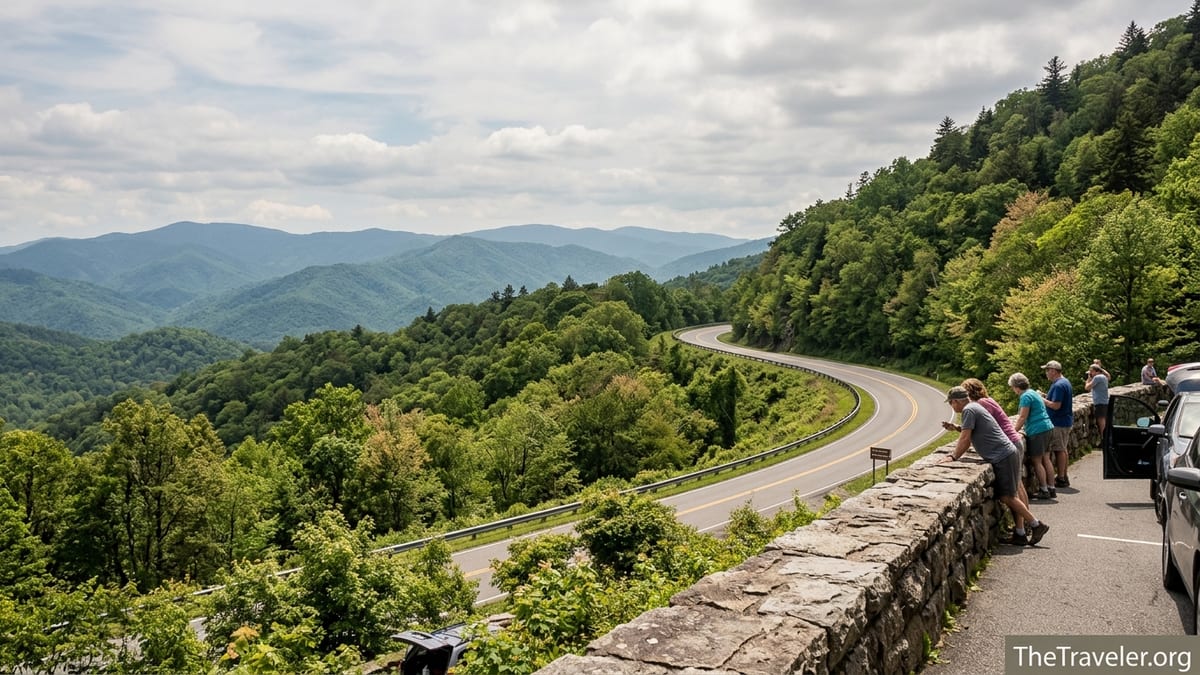
What Newfound Gap Road Actually Is
Newfound Gap Road is the main spine of Great Smoky Mountains National Park, running roughly 30 to 33 miles between Gatlinburg and Cherokee as U.S. 441. It is designated as a National Scenic Byway, which already hints that this is more than just a way to get from point A to point B. The road climbs from valley floors lined with rushing streams to Newfound Gap itself at just over 5,000 feet, the lowest drivable pass through the Smokies and the state-line crossing between Tennessee and North Carolina.
Along that relatively short distance, the character of the forest changes repeatedly. Travel writers and even official materials often compare the drive to going from Georgia to Maine in a couple of hours, because you pass through several distinct forest zones as elevation increases. On a summer day, that can mean leafy hardwoods and rhododendron tunnels in the lower sections, then spruce-fir forest and cool, misty air at the high gap. In winter, the contrast is often even more dramatic, with brown, bare branches in Gatlinburg and several inches of snow clinging to the evergreens at Newfound Gap.
In practical terms, Newfound Gap Road is drivable year-round, weather permitting, and is one of the park’s priority roads to plow and reopen after winter storms. It is paved, two lanes wide, and suitable for most passenger vehicles. Commercial traffic is not allowed, which helps keep the drive quieter and more relaxed than a typical highway. For a one-day visitor, that combination of central location, reliability and variety is exactly why this road comes up so often in trip-planning discussions.
If you drove it end-to-end without stopping, you could cover the road in about an hour and a half in light traffic. But most visitors spend two to four hours on the route without even adding a major hike, simply because of the number of viewpoints, picnic areas and short walks you can easily fold into the day.
The Case For: Why Newfound Gap Road Is Worth Your Limited Time
If you have only one day and you want the classic Smokies experience in a single sweep, Newfound Gap Road is one of the strongest candidates. It is the only road that fully traverses the park from north to south, which means you can realistically start the morning in Gatlinburg, eat a late lunch in Cherokee, and still be back in your lodging on either side by evening. For many first-time visitors staying in Gatlinburg or Pigeon Forge, that loop alone is a memorable highlight.
Scenically, the drive punches far above its mileage. Within the first 10 to 12 miles from Gatlinburg you already have pullouts that reveal deep green valleys, layered ridges fading into blue distance, and the kind of smoky haze that gives the park its name. On a typical summer weekend, you might find families piling out of rental SUVs at Morton Overlook in the early evening, watching the sun drop behind the western ridges, while photographers line up tripods along the stone walls.
The road also links several of the park’s signature stops. Newfound Gap itself features a large parking area, stone overlook, monument to President Franklin D. Roosevelt’s dedication of the park, and a clear crossing of the Appalachian Trail. A few miles off the main road on a spur, you can continue to Clingmans Dome, one of the highest points in the eastern United States, reached via a steep half-mile paved path and an observation tower with 360-degree views on a clear day. On the North Carolina side, the Oconaluftee Visitor Center and Mountain Farm Museum offer easy access to elk watching in the meadows at dawn or dusk.
Because so many trip essentials are spaced along Newfound Gap Road, it is relatively simple to build a full, satisfying one-day itinerary without a lot of backtracking or complex navigation. Visitors who arrive late morning can still drive to the Gap, walk a short stretch of the Appalachian Trail, enjoy a picnic lunch and be back down in time for dinner in town, all without committing to a strenuous all-day hike.
When Skipping the Drive Might Make Sense
Even with all its strengths, Newfound Gap Road is not automatically the right choice for every one-day visit. The first consideration is what kind of experience you want. If your priority is wildlife viewing, for example, Cades Cove’s open fields and historic loop road can offer better odds of seeing black bear, deer and wild turkey, especially in the early morning and evening. In peak summer, you might spend most of your time in the forest along Newfound Gap Road without the same chances of spotting large animals.
Traffic and personal patience levels matter, too. On busy fall-color weekends in October, or during major holidays, you can encounter slow moving convoys behind cautious drivers as the road twists and climbs. Parking lots at Newfound Gap, Chimneys Picnic Area and the Clingmans Dome spur road can fill by late morning, leading to circling for spaces or moving on. For travelers who dislike crowds and stop-and-go driving, committing a big slice of a single day to a potentially congested road may not be ideal.
Weather is another key factor. Because the road reaches more than 5,000 feet, it can experience fog, low clouds and storms even when Gatlinburg and Cherokee are clear. On a socked-in day with no views, a dedicated scenic drive may not feel worthwhile, especially if you are staying on the Tennessee side and would have to drive the same miles back with limited visibility. In winter and early spring, sudden snow squalls can temporarily close the upper section of the road for safety, which can disrupt tight itineraries.
Finally, visitors with very specific goals might reasonably skip the full traverse and treat Newfound Gap Road simply as an access route. A serious hiker coming just to climb Mount Le Conte, for instance, may drive only the short segment needed to reach Alum Cave trailhead, then devote most of the day to the trail rather than the viewpoints. In those cases, the road is still part of the day, but not the central attraction.
How Long the Drive Takes in Real Life
On paper, the 30 to 33 miles between Gatlinburg and Cherokee look straightforward. In practice, the time it takes you to drive Newfound Gap Road depends heavily on how often you stop and what season you visit. In quiet winter conditions with dry pavement, locals report that they can drive from Gatlinburg to Cherokee in roughly 75 to 90 minutes without pulling over. That assumes you are comfortable with mountain curves and there is no snow or ice in the higher stretches.
For most visitors in spring, summer and fall, a more realistic baseline is about two and a half to three hours one way if you plan to stop at several overlooks, spend 20 to 30 minutes walking around Newfound Gap, and perhaps take a short, half-mile forest stroll near one of the picnic areas. That means that a full up-and-back drive from Gatlinburg, with leisurely stops and photo breaks, can easily occupy six or more hours of your day.
As an example, a family based in Gatlinburg might leave town at 9 a.m., reach the lower overlooks by 9:30, arrive at Newfound Gap around 10:15 after a couple of ten-minute stops, linger there until 11, then continue to the Oconaluftee Visitor Center on the North Carolina side by around noon. With a picnic lunch and a 30-minute visit to the Mountain Farm Museum, they might not be heading back toward Tennessee until 1:30 p.m., arriving back in Gatlinburg after 3 p.m. without adding any long hikes.
Given those time realities, the drive is easiest to recommend if you are comfortable dedicating at least half your day to the road and its immediate sights. If your only window is a five- or six-hour afternoon, or you are trying to combine the drive with a half-day visit to Dollywood or another major attraction outside the park, you may feel rushed and frustrated rather than inspired.
Best Stops Along Newfound Gap Road for a One-Day Visit
If you decide the drive fits your day, a few specific stops will give you the strongest sense of what makes the road special. Starting from Gatlinburg, many travelers take the Gatlinburg Bypass to avoid in-town congestion, then join Newfound Gap Road at the park boundary and quickly reach Sugarlands Visitor Center. Sugarlands offers maps, up-to-date information on any temporary closures or bear activity and very short, flat trails for stretching your legs before the climb begins in earnest.
As you ascend, early pullouts like Campbell Overlook offer classic views back toward Mount Le Conte and the surrounding ridges. This is one of the first places where visitors tend to pull out smartphones and wide-angle lenses. A bit farther up, the Chimneys Picnic Area sits beside a rushing mountain stream and makes a convenient spot for a mid-morning snack or a simple grocery-store picnic lunch, with restrooms and picnic tables in the shade.
Newfound Gap itself is the heart of the drive. The large stone terrace offers sweeping views into both Tennessee and North Carolina on clear days. The Appalachian Trail crosses right through the parking area; even walking five or ten minutes along the white-blazed path gives you a taste of the long-distance route’s atmosphere. The stone Rockefeller Memorial, where President Roosevelt formally dedicated the park in the 1940s, is worth a brief visit for its history and for the photo of the Tennessee–North Carolina state line.
On the North Carolina side, the Oconaluftee Valley Overlook, a short distance beyond the gap, reveals a different set of ridges dropping toward Cherokee. Farther down, the Oconaluftee Visitor Center and its adjacent Mountain Farm Museum showcase historic log buildings and traditional farm plots gathered from around the region. In the cooler months, herds of elk often graze in the open fields nearby in the morning and evening, giving patient visitors a chance to watch quietly from the roadside or the visitor center’s field edge.
How to Design a One-Day Itinerary Around Newfound Gap Road
The key to making Newfound Gap Road “worth it” in one day is intention. Rather than treating it as an aimless wander, anchor the drive with a few well-chosen activities that match your energy level. For many casual visitors, a mix of scenic overlooks, a picnic and one or two short hikes works well. For example, you might start mid-morning in Gatlinburg, stop at Sugarlands for a quick orientation, pause at two or three overlooks on the climb, and then walk a half-mile along the Appalachian Trail from Newfound Gap before eating lunch at the picnic tables.
In the afternoon, you could add a modest hike such as the first mile or so of the Alum Cave Trail, which begins just off Newfound Gap Road and winds through old-growth forest along a mountain stream before climbing more steeply toward the bluffs. Turning around at the Arch Rock area gives you a two- to three-hour outing that feels substantial without overrunning the entire day. Alternatively, families with young children might opt for easier riverside walks near Chimneys Picnic Area or the flat path behind Oconaluftee Visitor Center.
If you prefer more driving and less walking, consider structuring the day around time of day and light. Depart Gatlinburg soon after sunrise to catch soft morning light on the ridges, reach Newfound Gap before the largest crowds, then descend to Cherokee for lunch. Spend the warmest midday hours exploring the Mountain Farm Museum or shopping for crafts in town, then drive back toward the gap later in the afternoon, timing a stop at Morton Overlook or another west-facing pullout for sunset before returning to your lodging.
Either way, building in extra time for restroom breaks, slow vehicles and impromptu photo stops will help your day feel relaxed. Treating the road as the experience rather than simply a connector between towns usually leads to higher satisfaction, especially for those who may not be back in the park for several years.
Seasonal, Weather and Safety Considerations
Because Newfound Gap Road climbs thousands of feet in elevation, conditions can change quickly. In summer, afternoon thunderstorms can develop, reducing visibility and leaving slick pavement on tight curves. In autumn, heavy leaf-peeping traffic can slow the pace to a crawl on peak weekends around mid-October. In winter, the upper sections around Newfound Gap can receive several feet of snow over the season, with patches of ice lingering in shady corners even when the lower elevations are bare.
The National Park Service keeps Newfound Gap Road open year-round as conditions allow, but temporary closures for snow, ice or downed trees are common between roughly November and March. Closures may last a few hours or a full day, depending on weather and the workload of road crews. Before committing your one day to the drive in the cooler months, it is wise to check the park’s official road status page or recorded hotline early in the morning, then again just before you head out.
Regardless of season, basic mountain-driving habits make the experience safer and more enjoyable. Use low gears on long descents to avoid overheating brakes, particularly if you are driving a rental SUV packed with passengers and luggage. Pull into paved turnouts if you notice a line of cars building behind you; local drivers and experienced mountain travelers often prefer a slightly brisker pace, and letting them pass reduces stress for everyone. Watch for sudden fog banks and wildlife crossing the road, especially at dawn and dusk.
Parking can be its own challenge at popular spots like Newfound Gap, Alum Cave trailhead and Clingmans Dome Road. Arriving before 9 a.m. or later in the afternoon often helps, while midday on peak summer and fall weekends is most congested. In recent years, the park has also implemented a modest daily parking tag requirement for most areas beyond brief roadside stops, so factor that cost and the time to purchase it at a visitor center or kiosk into your planning.
The Takeaway
For many travelers, Newfound Gap Road is absolutely worth driving even with only one day in Great Smoky Mountains National Park. It offers a compressed tour of the park’s changing forests, sweeping mountain views, key visitor centers and even a taste of the Appalachian Trail, all along a single, well-maintained route. If what you want is an overview of the Smokies and a sense of how the landscape unfolds from valley streams to high spruce-fir ridges, this is arguably the best use of limited time.
That said, the drive is not mandatory. Visitors laser-focused on wildlife viewing in open meadows, long backcountry hikes or quiet historic churches and cabins might prioritize Cades Cove or a specific trail system instead, using only part of Newfound Gap Road as an access route. Weather, seasonal traffic and your own tolerance for winding mountain roads should also shape the decision.
Ultimately, the question is less “Is Newfound Gap Road worth it?” and more “Is Newfound Gap Road aligned with what I want from this particular day?” If your goal is a scenic, relatively low-effort day that links iconic viewpoints, short walks and two gateway towns, then yes, it is very likely worth the time. With moderate planning, realistic expectations about drive times and a flexible attitude toward changing mountain weather, a day built around Newfound Gap Road can deliver exactly the Smokies experience most first-time visitors are hoping to find.
FAQ
Q1. How long does it take to drive Newfound Gap Road end to end?
In light traffic and without stopping, most drivers can cover the roughly 30 to 33 miles between Gatlinburg and Cherokee in about 75 to 90 minutes. With scenic stops and short walks, plan on two and a half to three hours one way.
Q2. Is Newfound Gap Road open year-round?
Yes, the park keeps Newfound Gap Road open year-round as conditions allow, but temporary closures for snow, ice or downed trees are common in winter and early spring. Always check the latest road status before starting your drive in the colder months.
Q3. Is the drive scary or dangerous for people uncomfortable with heights?
Newfound Gap Road is a paved, two-lane mountain highway without extreme drop-offs right at the pavement, but it does have curves, elevation changes and some sections where the valley drops away beyond the guardrail. Cautious drivers usually manage fine by taking their time and using pullouts to let faster traffic pass.
Q4. Can I drive Newfound Gap Road in a standard rental car?
Yes. The road is fully paved and suitable for most standard rental sedans, compact cars and SUVs. In winter conditions, it is still best to drive slowly and avoid travel during active snow or ice events, but specialized four-wheel drive is not typically required when the road is open.
Q5. What are the must-see stops if I only have one day?
For a single day, most visitors prioritize Sugarlands Visitor Center, one or two early overlooks near Gatlinburg, Newfound Gap itself with a short walk on the Appalachian Trail, and the Oconaluftee Visitor Center and Mountain Farm Museum near Cherokee. If time and conditions allow, adding the spur drive to Clingmans Dome is a major bonus.
Q6. Is Newfound Gap Road better at sunrise or sunset?
Both can be beautiful, but sunrise generally brings lighter traffic and softer light on the ridges. Sunset is especially striking from west-facing pullouts like Morton Overlook, though parking space can be limited on popular evenings.
Q7. Can I see wildlife along Newfound Gap Road?
You may see deer, smaller mammals and occasionally black bears in the forest or near picnic areas, but dense woods make wildlife viewing less predictable than in open areas like Cades Cove. Elk are more commonly seen in the meadows around the Oconaluftee Visitor Center on the North Carolina side.
Q8. Do I need a parking tag to stop along Newfound Gap Road?
For brief, under-15-minute stops, you generally do not, but if you plan to park longer at overlooks, trailheads or visitor centers, the park’s standard parking tag rules apply. It is wise to purchase a tag at a visitor center or kiosk before beginning your day.
Q9. Is Newfound Gap Road suitable for RVs and trailers?
Large RVs can physically travel the road, but the curves, grades and limited parking at overlooks make the drive stressful for some drivers. Trailers are discouraged, and many visitors choose to leave RVs in campgrounds and explore the road with a smaller vehicle when possible.
Q10. If I only have one afternoon, should I still attempt the full drive?
If your time window is just a few hours, it may be better to drive from your side of the park up to Newfound Gap, enjoy the overlooks and a short walk, then return the same way rather than trying to reach the opposite gateway town. That approach gives you the best views without turning the afternoon into a rushed, all-driving marathon.