


If you have only one snorkel day on Ambergris Caye, the decision between Hol Chan with Shark Ray Alley and the quieter Mexico Rocks patch reefs suddenly matters a lot. Both trips leave from San Pedro, both are excellent, and both are heavily recommended in current traveler discussions. Yet they offer very different moods in the water. This guide compares them side by side so you can pick the right experience for your time, confidence level and travel style.
Get the latest updates straight to your inbox!
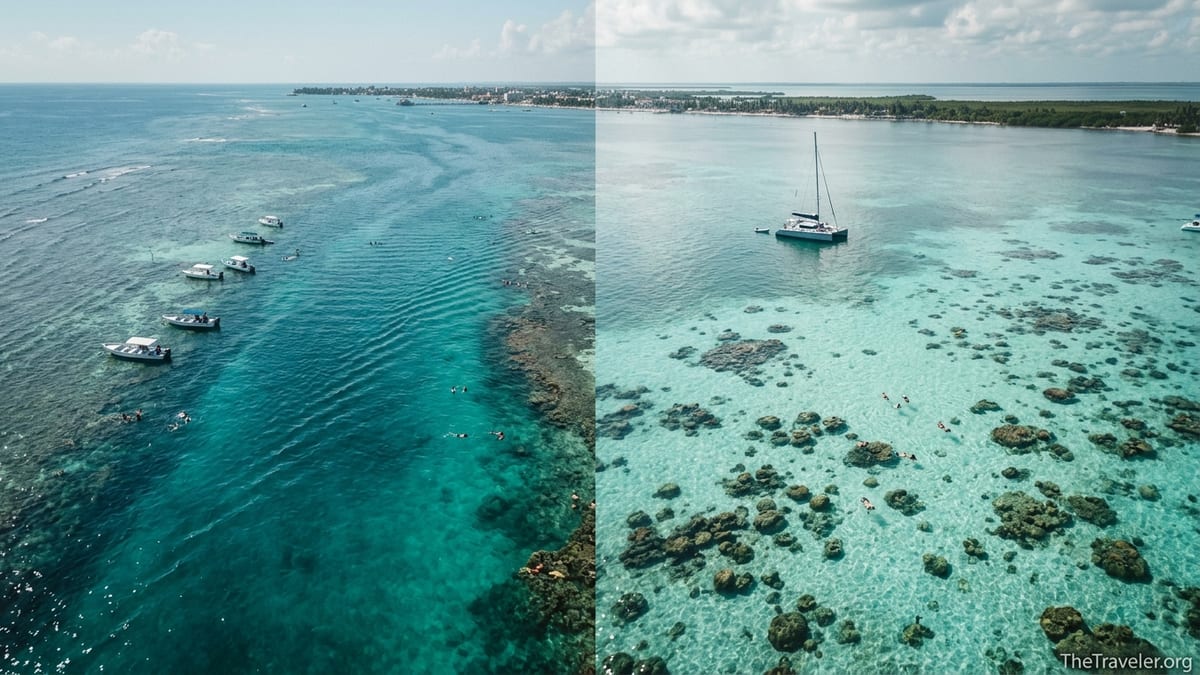
Hol Chan vs Mexico Rocks at a Glance
Hol Chan Marine Reserve sits in a natural cut through the Belize Barrier Reef about 4 miles south of San Pedro, while Mexico Rocks lies roughly 6 miles north, inside the reef on a shallow limestone ridge covered in patch reefs and coral heads. Hol Chan is a classic “channel” snorkel: you drift over a steep drop-off where the shallow reef suddenly gives way to deeper blue, with schools of fish moving in and out of the cut like a highway. Mexico Rocks is more like a coral garden: a maze of low coral mounds, soft corals and sandy patches in consistently shallow water.
In practice this means Hol Chan tends to feel more dramatic, especially for confident swimmers and photographers who want that “edge of the reef” feeling. Mexico Rocks feels gentler and slower, with lots of time hovering over coral heads at 4 to 8 feet deep. Guides who run both trips often describe Hol Chan as the higher-impact, higher-energy option and Mexico Rocks as the more relaxed, less crowded counterpart.
Most half-day Hol Chan trips are paired with Shark Ray Alley, the famous nurse shark and stingray hotspot in an adjacent zone. A comparable Mexico Rocks outing may combine Mexico Rocks with Tres Cocos or a stop in a sandy “aquarium” area for rays and turtles, but usually without the dense shark feeding spectacle. When travelers on recent forums say “Hol Chan vs Mexico Rocks,” they are almost always talking about these standard combinations.
Coral Gardens, which comes up often in current trip-planning questions, is a separate site in the Caye Caulker Marine Reserve, usually reached from Caye Caulker or as part of a longer full-day loop from San Pedro. It has lovely reef and calmer water, but for one limited snorkel day based on Ambergris Caye, most guests end up choosing between Hol Chan plus Shark Ray Alley and Mexico Rocks-based itineraries.
Boat Time, Typical Itineraries and Costs
From San Pedro town, most small snorkel boats reach Hol Chan in about 20 to 30 minutes, depending on sea conditions and where you are picked up along the beach. Mexico Rocks is similar in pure distance time, often 25 to 35 minutes from central docks, but boats head north instead of south. In both cases, operators will usually collect guests from multiple piers, so total “lot of engine noise, no snorkeling yet” time can feel a bit longer, especially in high season.
Half-day Hol Chan plus Shark Ray Alley tours from San Pedro commonly run about 3 to 4 hours dock-to-dock. A fairly standard schedule might look like: 9:00 departure, 9:30 to 10:30 snorkeling at Hol Chan, a short move, then 30 to 40 minutes in Shark Ray Alley, and back at the dock by around noon. Afternoon trips reverse the pattern. Mexico Rocks half-day tours are similar in length, sometimes slightly longer in the water because there is no park ranger briefing stop: many operators offer two or three distinct snorkel stops inside the Mexico Rocks area and nearby Tres Cocos, often totaling 1.5 to 2 hours of actual snorkeling.
Pricing changes frequently, but at the time of writing many San Pedro outfits advertise group half-day snorkel tours in the range of roughly 60 to 90 US dollars per person before park fees, depending on group size and whether snacks and drinks are included. Hol Chan has a marine reserve fee per person, usually added on top. Mexico Rocks is also inside a protected area, and some operators roll its fee into the tour price. Private charters can start at around 350 to 500 US dollars for a half day for two to four people, rising with boat size and extras like a fresh-cooked beach barbecue.
For a single limited snorkel day, that means you are unlikely to see a huge price difference between Hol Chan and Mexico Rocks with mainstream operators. The real cost tradeoff is time and energy: a full-day itinerary might pack in Hol Chan, Shark Ray Alley and a beach stop or even Coral Gardens and Caye Caulker, but families with small kids and first-timers often find a half-day more than enough excitement and sun.
Depth, Current and Conditions in the Water
Hol Chan’s main snorkel zone is essentially a channel in the barrier reef. Depths along the guided route vary, but expect much of the swim to be in the 8 to 15 foot range under your fins, dropping to around 25 to 30 feet or more at the edge of the cut. Many guides like to lead guests across the shallower side first, then along the wall where the bottom suddenly falls away. The sense of depth and the clear view into the blue are part of Hol Chan’s magic, but that same topography can feel daunting for nervous or non-swimmers.
Because it is a natural cut, Hol Chan can have noticeable current at times, especially around tidal changes and on windy days. Most days, competent swimmers manage fine and simply let the current help them drift behind the guide. However, beginners who are not fully comfortable breathing through a snorkel may feel rushed, because they need to keep moving with the group rather than floating in one spot. When seas are choppy, guides will sometimes adjust the route or stay closer to the shallow edges, but you should expect at least gentle motion in the water.
Mexico Rocks, by contrast, is known for consistently shallow depths and generally calmer conditions. Many of the patch reefs sit in 4 to 8 feet of water, with sandy channels between them. You can often float above a coral head and see every detail without needing to dive down. Current is usually lighter inside the reef here, and waves are broken by the outer barrier, so even on days when Hol Chan feels “sporty,” Mexico Rocks can remain very manageable. This is a big reason local guides and repeat visitors on current forums often recommend Mexico Rocks or the nearby Tres Cocos area to families with younger children or travelers who are especially anxious in open water.
For people sensitive to motion sickness, both trips involve short open-boat rides and some rocking on a mooring, but Mexico Rocks itineraries more often report “glassier” surface conditions. If your main concern is ease and calm, the Mexico Rocks side of the decision has a clear edge.
Marine Life: Channels, Coral Gardens and Shark Ray Alley
Hol Chan is famous for the density and variety of marine life. Over the years, surveys have recorded well over a hundred fish species in the reserve, along with sea turtles, rays and an impressive mix of hard and soft corals. In real-world snorkel terms, that translates to frequent sightings of snappers, jacks, groupers, angelfish, parrotfish and schools of grunts and sergeant majors weaving in and out of the channel. The drop-off gives you a wall-like view where larger fish sometimes cruise along the edge.
Turtle encounters are one of Hol Chan’s calling cards. While there are no guarantees, many recent visitor reports describe seeing at least one green or hawksbill turtle grazing on seagrass or rising to breathe during a standard one-hour snorkel, and some boats spot several. Factor in the rays, grouper cleaning stations and occasional nurse sharks that pass through the channel itself, and Hol Chan offers a very high “wow per minute” ratio for wildlife-focused travelers.
Shark Ray Alley, usually the second stop on a Hol Chan trip, is a shallow sandy area where nurse sharks and southern stingrays gather. Operators have historically attracted the sharks by tossing bits of baitfish, so when the boat arrives, you often see a dozen or more nurse sharks circling under the surface and rays gliding in. Snorkelers float in 8 to 12 feet of water while these animals cruise around below and occasionally brush past. For many first-time visitors, this is the single most memorable part of their Ambergris stay, although eco-conscious travelers sometimes prefer sites where fish are not conditioned with food.
Mexico Rocks leans less on the spectacle of big animals clustered in one place and more on the beauty of the reef itself. The area is composed of around a hundred patch reefs sitting on a limestone ridge, with healthy stands of boulder star coral, brain coral and sea fans. Travelers frequently describe it as “like snorkeling over a coral city,” with dozens of species of small and medium fish darting between heads. Turtles, rays and even a few nurse sharks do appear here too, especially at sites nicknamed “the Aquarium” or at sandy patches used as ray hangouts, but in lower densities than Shark Ray Alley.
Coral Gardens, which is often part of the conversation for people considering a one-day snorkel from either Ambergris or Caye Caulker, tends to offer clear water, soft swaying corals and lots of small reef fish. It is usually calmer than Shark Ray Alley and can feel like a gentler version of Hol Chan’s coral scenery, but logistics often make it part of longer full-day circuits rather than a simple half-day from San Pedro. If your priority is seeing the iconic sharks and rays up close, Hol Chan plus Shark Ray Alley remains the more direct choice. If your ideal is drifting quietly over coral gardens without crowds, Mexico Rocks compares more closely to Coral Gardens in overall feel.
Crowds, Group Size and Overall Atmosphere
Hol Chan and Shark Ray Alley together make up the single most popular boat tour from San Pedro. That popularity has a cost: in high season mornings you may see a line of boats moored along the channel markers, each with ten or more snorkelers following a guide. Even if your operator caps group size at six to eight guests, you will likely be in the water near multiple other tour groups, especially at Shark Ray Alley where boats cluster around the prime shark area. Some travelers describe occasionally bumping fins with strangers if they do not stay close to their guide.
That said, not every Hol Chan experience feels crowded. Private or small-group operators often time departures to avoid the busiest window, leaving very early or later in the afternoon. On slightly windier days, fewer boats may go out, and guides have some flexibility in choosing less congested paths inside the channel. Still, if your top priority is solitude, Hol Chan is rarely the quietest choice.
Mexico Rocks has a different atmosphere. It is a protected zone and does see regular tour traffic, but the sites are spread across a wider area, and there are simply fewer boats on average. Many current traveler reviews of Mexico Rocks specifically mention enjoying the feeling of being the only boat on a patch of reef, with no other fins in sight. Even when a couple of vessels share the general area, guides can easily choose different coral heads or sand channels so groups are not on top of each other.
The result is that Mexico Rocks often feels more relaxed, with less time listening to park briefings and more time meandering quietly. Families with sensitive kids, couples looking for a romantic feel or photographers who dislike bubbles and splashing in their frame tend to appreciate this difference. For someone with only one snorkel day who values tranquility over marquee wildlife names, this calmer vibe can tip the scales strongly toward Mexico Rocks.
Beginner Friendliness, Kids and Safety Considerations
Both Hol Chan and Mexico Rocks are run by experienced local guides, and both can be appropriate for beginners when conditions are fair and operators are attentive. The nuance lies more in how comfortable a new snorkeler is with depth, current and close encounters with large animals like sharks and rays.
At Hol Chan, guests are usually required to wear life vests or inflatable belts, and guides lead the group as a tight cluster. This supervised format can be reassuring for novices because there is always someone in front setting the pace and checking on swimmers. However, the deeper channel, occasional current and need to keep up can stress someone who is still figuring out how to breathe calmly through a snorkel. Children or adults who panic easily might find the combination of depth and group movement overwhelming, even with a vest. Shark Ray Alley adds another layer: wading into a cloud of nurse sharks and rays is thrilling for many but intimidating for some, especially smaller kids who cannot quite process that nurse sharks are generally docile.
Mexico Rocks, with its shallower water and patch reefs, usually allows more flexibility. Some guides are comfortable letting confident beginners or older children float slightly apart from the main group above a single coral head, as long as they stay within easy swimming distance. Because depth is often closer to the bottom of a hotel swimming pool than a deep channel, many people prone to anxiety report feeling safer here. Parents can more easily hold hands with a hesitant child while still seeing coral and fish just below them, and if someone needs to rest, it is easier to float calmly without worrying about being swept along a channel.
For families with very young kids or teens doing their first “real” boat snorkel, a good compromise is a private or small-group charter to either site, scheduled for a morning when winds are lighter. Operators that emphasize eco-responsible practices and careful safety briefings, including clear instructions on not standing on coral and staying within arm’s length of a buddy, tend to create better experiences for nervous guests. Forum posts from recent visitors often mention positive experiences with family-oriented shops that specifically advertise kid-friendly Hol Chan and Mexico Rocks trips, sometimes offering floatation platforms or pool noodles in addition to mandatory vests.
If someone in your party truly fears open water, another practical tactic is to start with a shore or dock snorkel near San Pedro or a very short “try snorkel” around a calm pier, then graduate to Mexico Rocks on a separate morning. Hol Chan plus Shark Ray Alley is probably better reserved for when everyone feels ready for a bit more adrenaline.
Is It Worth Booking Both in a Short Trip?
With only one full day or two half-days free on Ambergris Caye, many visitors wonder if they should try to squeeze in both Hol Chan plus Shark Ray Alley and Mexico Rocks, or focus on a single highlight. The truthful answer is that if you are passionate about snorkeling and reasonably fit, seeing both is very rewarding because they feel different in character. Hol Chan delivers the iconic Belize “reef cut and sharks” story; Mexico Rocks showcases the quieter side of the barrier reef with lush coral gardens away from the crowds.
Practically, though, two boat trips in a short stay can feel like a lot, especially under strong tropical sun. A full-day combo that tries to include Hol Chan, Shark Ray Alley, a beach barbecue and a northern reef stop may leave families, older travelers and jet-lagged visitors completely worn out. Current traveler comments often mention kids falling asleep on the ride back or being “done” with snorkeling after one intense morning at Hol Chan and Shark Ray Alley. If you know your group has limited stamina or is not used to long swims in salt water, concentrating on one main outing and leaving the rest of the time for relaxed beach or golf cart exploring is usually smarter.
One workable approach for a four- or five-night stay is to do Hol Chan plus Shark Ray Alley as a half-day early in the trip, then decide afterward whether you have the appetite for more. If everyone loved being in the water and wants a calmer, less busy repeat, you can book Mexico Rocks for a second morning. On the other hand, if you are only on the island for two nights and juggling mainland tours or flights, trying to do both can compress your schedule too much.
For travelers who want maximum variety without overcommitting, some small operators will customize a half-day that samples a little of each style: for instance, a quick Hol Chan pass followed by time on a more secluded coral garden section, or a Mexico Rocks circuit plus a dedicated ray sandbar that gives some Shark Ray Alley flavor without the crush of boats. These custom trips usually cost more per person but can be ideal for mixed groups where some people prioritize wildlife while others care more about quiet time in the water.
Recommendations by Traveler Type
For first-time snorkelers who are comfortable in the ocean but new to mask and fins, Hol Chan plus Shark Ray Alley remains the signature Ambergris experience. The sense of swimming over a deep channel, seeing turtles and schools of fish, then watching nurse sharks and rays gather in clear shallow water is hard to beat for a first “wow” story. Booking with a reputable operator that keeps groups small, insists on proper briefings and is honest about sea conditions will make the difference between thrilling and overwhelming. If the wind is up on your planned day, consider postponing or switching to a calmer Mexico Rocks trip instead.
Families with younger children, particularly those under ten or any child who is not yet a strong swimmer, often do better starting with Mexico Rocks. The shallower depth, gentler current and quieter scene make it easier for kids to focus on fish, coral shapes and the basic rhythm of snorkeling without the distraction of deep blue water and large sharks. Many parents on current forums describe Mexico Rocks as their kids’ favorite precisely because it felt playful and low-pressure. If you still want the shark and ray photos, you can look for Mexico Rocks itineraries that include a separate ray sand patch or plan a very short dedicated Shark Ray Alley visit once everyone is confident.
Confident swimmers and adults who already love snorkeling or free-diving often gravitate toward Hol Chan. The combination of depth, channel structure and dense fish life makes it more dynamic, and Shark Ray Alley adds a jolt of adrenaline. These travelers may enjoy Mexico Rocks as a second, more contemplative day where they can dive down to inspect coral heads and take close-up photos without worrying about bumping into other groups. If your schedule allows even one extra half-day, pairing both sites gives a well-rounded view of the barrier reef.
Wildlife-focused travelers who care most about seeing turtles, larger fish and of course sharks will usually extract more “big animal value” from Hol Chan plus Shark Ray Alley than from Mexico Rocks alone. That said, Mexico Rocks can deliver excellent turtle and ray sightings, especially on early-morning departures when the reef is more active, and many recent visitors report seeing just as many interesting species there as at Hol Chan, simply with fewer people around. If you are the type who prefers quality time quietly observing a single turtle or ray over chasing the biggest aggregation of sharks, Mexico Rocks may actually feel more rewarding.
Travelers who are trying specifically to avoid the busiest excursion or who dislike crowds in the water should lean strongly toward Mexico Rocks or a custom charter that times Hol Chan for a quieter slot. While no site is ever truly empty in high season, Mexico Rocks consistently receives feedback as “less touristy,” “more peaceful” and “easier to spread out,” which matters if part of your reason for snorkeling is to feel immersed in nature rather than part of a procession.
The Takeaway
If you are standing on a San Pedro dock with only one snorkel day to spare, the choice between Hol Chan plus Shark Ray Alley and Mexico Rocks comes down to your comfort level and priorities. Hol Chan is the headline act: deeper channel, stronger sense of drama, a high chance of turtle encounters and the unforgettable swirl of nurse sharks and rays at Shark Ray Alley. Mexico Rocks is its softer-spoken counterpart: shallower patch reefs, calm water, vivid coral gardens and a relaxed, low-crowd experience that many families and returning visitors quietly prefer.
For a first trip to Ambergris Caye, many travelers will choose Hol Chan and Shark Ray Alley to see “the classic,” then, if time and energy allow, add Mexico Rocks as a second outing to round out the picture. If your group includes small children, anxious swimmers or anyone who cares more about tranquility than adrenaline, flipping that order and starting with Mexico Rocks is often wiser. Either way, you are snorkeling on the edge of one of the world’s great barrier reefs. With a bit of honest self-assessment and clear expectations, your limited snorkel day can feel less like a compromise and more like the highlight of your Belize journey.
FAQ
Q1. If I only have one half-day from San Pedro, should I choose Hol Chan or Mexico Rocks?
For most first-time visitors who are reasonably comfortable in the water, Hol Chan plus Shark Ray Alley is the better single choice because it delivers turtles, dense fish life and the famous nurse shark and ray encounters in one outing. If you or your kids are nervous swimmers or you dislike crowds, Mexico Rocks is the smarter pick for its calmer, shallower water and quieter atmosphere.
Q2. How long is the boat ride to Hol Chan and Mexico Rocks from San Pedro?
Typical small-boat rides from central San Pedro docks take around 20 to 30 minutes to reach Hol Chan and about 25 to 35 minutes to reach Mexico Rocks, depending on sea conditions and how many hotel piers the operator stops at along the way.
Q3. Which site is better for young children and complete beginners?
Mexico Rocks is usually better for younger kids and complete beginners because the water is shallower, the current is lighter and there are fewer boats and snorkel groups clustered together. Parents can more easily stay close to children while still enjoying colorful coral and plenty of small fish.
Q4. Will I definitely see sharks and rays at both sites?
Shark Ray Alley is specifically known for gatherings of nurse sharks and stingrays, often attracted by bits of bait, so sightings there are very likely on a standard Hol Chan combo trip. At Mexico Rocks, rays and the occasional nurse shark do show up, but not in the same dense, predictable numbers, and encounters feel more like chance meetings than a feeding event.
Q5. How deep is the water at Hol Chan compared with Mexico Rocks?
At Hol Chan, you will often be snorkeling over 8 to 15 feet of water with a drop-off to deeper blue at the channel edge, which can reach 25 feet or more. At Mexico Rocks, many coral heads sit in 4 to 8 feet of water, with sandy patches between, so the bottom is usually much closer and feels less intimidating for nervous swimmers.
Q6. Is Coral Gardens a good alternative to Hol Chan and Mexico Rocks?
Coral Gardens, typically accessed from Caye Caulker or as part of a longer full-day trip, offers beautiful coral formations and calmer water that some people prefer to Shark Ray Alley. However, for a simple half-day from San Pedro with limited time, most operators will focus on Hol Chan plus Shark Ray Alley or Mexico Rocks, so Coral Gardens is more of an extra than a direct substitute.
Q7. Are there strong currents at either site?
Hol Chan, being a natural channel through the reef, can have noticeable current at times, especially with tide changes or wind, and guides may ask groups to drift along in a particular direction. Mexico Rocks, located inside the reef over a shallow ridge, generally has milder current and smoother surface conditions, which many beginners find easier.
Q8. Can non-swimmers or very anxious people still enjoy these tours?
Non-swimmers can participate if they are willing to wear life vests and stay very close to the guide or boat, but their enjoyment will depend heavily on sea conditions and personal comfort. Mexico Rocks is usually the better option for non-swimmers because of its shallower depths and calmer feel, while Hol Chan plus Shark Ray Alley is best reserved for those who can at least float comfortably and follow simple instructions.
Q9. Is it worth booking a private charter instead of a group tour?
A private charter costs more but can be worth it if you have kids, mixed confidence levels or a strong preference for avoiding crowds. With a private boat, the captain can choose the calmest spots, adjust timing to dodge busy periods at Hol Chan or Mexico Rocks, and let you spend longer at a favorite stop instead of rushing to match a set group schedule.
Q10. What time of day is best for snorkeling these sites?
Morning trips are usually best for calmer seas, clearer water and more active fish life. Many experienced visitors try to book 8:00 or 9:00 departures, both to catch better conditions and to return before midday sun and wind pick up. Afternoon outings can still be excellent on calm days, but if your schedule is flexible, aim for an early-morning slot.